By
David Bautz, PhD
NASDAQ:CFRX
Financial Update
On November 9, 2016, ContraFect Corp (NASDAQ:CFRX) announced financial results for the third quarter of 2016 and provided a business update. As expected, the company did not report any revenues for the quarter. Net loss for the quarter was $10.5 million, or $0.28 per share, and consisted of $5.9 million in R&D expenses, $1.9 million in G&A expenses, and $2.6 million gain in other expenses. R&D expenses for the quarter were increased by $3.0 million compared to the corresponding time period in 2015. This was due in part to a $1.4 million increase in expenses for the company’s product candidates, including preparation for the Phase 2 clinical trial of CF-301 and cGMP manufacturing of CF-404. The costs related to CF-404 development should decrease as all manufacturing has been completed. The $1.9 million in G&A expenses represented a decrease of $0.5 million compared to the second quarter of 2015. This was due to a $0.3 million decrease in share-based compensation expense and a $0.2 million decrease in professional fees. The $2.6 million in other expense was a $2.8 million increase in expense compared to the same time period in 2015. The increase in expense was due primarily to $1.6 million in issuance costs allocated to the warrants issued in the July 2016 public offering and $1.1 million in expense due to the change in fair value of warrant liabilities.
The company exited the third quarter of 2016 with $43.2 million in cash, cash equivalents, and marketable securities. This was due in part to an underwritten public offering of 14 million shares of common stock at an offering price of $2.50 per share along with 14 million warrants with an exercise price of $3.00 per share. Total net proceeds to the company from the offering were $32.6 million. We believe the company has sufficient capital to fund operations into the second half of 2018.
Business Update
CF-301
ContraFect’s lead lysin product is CF-301. A lysin is a naturally occurring anti-bacterial hydrolytic enzyme that is produced by bacteriophages, which are virus’ that infect and kill bacteria. Lysins are highly evolved enzymes that are able to target one of the five bonds in peptidoglycan (murein), the main component of bacterial cell walls. A typical lysin, such as CF-301, comprises two domains separated by a short linker region. The N-terminal domain catalyzes the hydrolysis of peptidoglycan whereas the C-terminal domain binds to the cell wall substrate, often a carbohydrate, which confers a great specificity and decreases the chance for bacterial resistance. Due to this, the use of lysins as antibacterial agents is designed to combat drug resistance to currently used antibiotics.
CF-301 will initially be targeted for the treatment of bacteremia, or infections of the bloodstream. Most studies estimate the incidence of S. aureus bacteremia (SAB) ranging from 20-50 cases/100,000 population (Klevens et al., 2007; Benfield et al., 2006; El Atrouni et al., 2009). Prior to the advent of antibiotics, the mortality rate from SAB was close to 80% (Mendell, 1939). The introduction of antibiotics, coupled with greater standards of care, has reduced the mortality rate, which appears to have stabilized at approximately 20% (Turnidge et al., 2009). SAB can frequently lead to infective endocarditis (IE), an infection of the endocardial surface of the heart (Fowler et al., 2005). The prevalence of IE is estimated to be anywhere from 11 to 50% of patients with SAB. Development of IE leads to an increased risk of embolic event and death (Miro et al., 2005).
Due to widespread resistance to penicillin, the current treatment of choice for S. aureus infections is semi-synthetic penicillin molecules. This resistance is due to the activity of the enzyme penicillinase, which cleaves the β-lactam ring of the penicillin molecule. Penicillinase-resistant β-lactam antibiotics include methicillin, oxacillin, and flucoxacillin. S. aureus strains that have acquired resistance to methicillin have an altered penicillin-binding protein (PBP2a) that has lower affinity for binding β-lactam antibiotics, thus rendering them ineffective. Strains that have acquired this resistance are referred to as methicillin-resistant S. aureus (MRSA). The current gold standard for treatment of MRSA is vancomycin. However, vancomycin is far from ideal due to poor tissue penetration, slow bactericidal activity, and a number of side effects (Gould, 2008). Additional antibiotics utilized include teicoplanin, tegecyline, linezolid, daptomycin, and televancin. Each of those medications has their own shortcomings, including the development of resistance, thus there exists a significant unmet medical need for newer therapies, particularly those that are not susceptible to the development of resistance. Pre-clinical data shows that CF-301 synergizes with standard-of-care antibiotics, which results in a very high survival rate in mouse models of bacteremia.
The company is planning to initiate a Phase 2 clinical trial for CF-301 in patients with bacteremia, including those with endocarditis, which is caused by both MRSA and methiciliin-sensitive strains of Staphylococcus aureus. The company has recently met with both the FDA and the Medical and Healthcare products Regulatory Agency (MHRA) to discuss the design of the trial with positive feedback received from both agencies. The trial is scheduled to begin in the fourth quarter of 2016 and the company is currently in the process of identifying and selecting U.S. and international sites. It will be an international, multicenter, randomized, double blind, placebo controlled trial with a superiority comparison between CF-301 combined with the standard of care antibiotics compared to placebo with the standard of care antibiotics. The study will include 115 patients randomized 3:2 to receive a single dose of 0.25 mg/kg CF-301 administered via a two-hour infusion or placebo. The primary endpoint of the study will be early clinical response. Safety, tolerability, and pharmacokinetics will also be examined along with additional exploratory clinical and health economic endpoints.
We anticipate that the Phase 2 trial will cost anywhere from $10 to $20 million to run and topline results should be available in the second quarter of 2018. The company is not planning to perform an interim analysis. Following the public offering, we estimate the company will exit the third quarter of 2016 with $45 million in cash and cash equivalents. With an estimated monthly burn rate of $2 million to $2.5 million, the company now has sufficient capital to fund operations beyond the end of the Phase 2 trial.
CF-404
CF-404 is a mixture of monoclonal antibodies that target different strains of the influenza virus. The distinguishing characteristic of CF-404 is that the antibodies target conserved regions of the virus that are not prone to high rates of mutation. A new influenza vaccine is necessary each year due to the fact that the different strains of the influenza virus are constantly changing. By targeting the portions of the virus that are not prone to mutation, the company is able to develop one therapeutic that will not need to be continually reformulated.
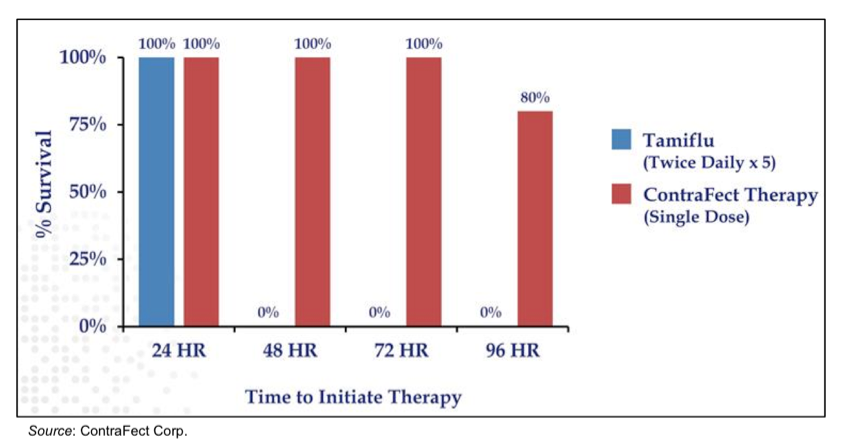
ContraFect will be positioning CF-404 as a therapeutic option for the approximately 200,000 individuals who are hospitalized each year due to influenza, although the total number of influenza-related hospitalizations for the 2014-2015 influenza season was over 970,000. Preclinical data shows that CF-404 is effective in a mouse model of the H1N1 virus even when dosed up to 96 hours post-infection. This is in stark contrast to Tamiflu® (oseltamivir), an antiviral medication that must be administered within 24 hours of infection in the same model, as shown in the following figure.
ContraFect has completed the cGMP manufacturing of CF-404 to support Investigational New Drug (IND)-enabling activities. The company is planning on filing an IND application in mid-2017, with initiation of Phase 1 clinical trials commencing shortly thereafter.
Expanded Research Collaboration with Rockefeller University
On November 14, 2016, ContraFect announced it entered into a three-year research collaboration with The Rockefeller University to identify new lysin therapeutic candidates targeting Gram-negative bacteria. The company currently has a research collaboration with Rockefeller and this agreement expands upon that collaboration and will focus on lysin therapeutic candidates that target Gram-negative pathogens. ContraFects lead lysin CF-301 targets S. aureus, which is a Gram-positive pathogen. Examples of Gram-negative pathogens include Escherichia coli, Pseudomonas aeroginosa, and Klebsiella. These bacteria can cause infections including pneumonia, bloodstream infections, wound infections, and meningitis, and many of them are becoming increasingly resistant to most available antibiotics.
ContraFect Designated a Small and Medium Enterprise by EMA
On August 4, 2016, ContraFect announced that it was granted Small and Medium Enterprise (SME) designation by the European Medicines Agency (EMA). SME designation was designed to assist companies with the development of innovative new medicinal products. The benefits available to SME companies include access to dedicated EMA personnel during clinical development, reductions in fess associated with regulatory procedures, and early application to the priority medicines (PRIME) scheme, which provides support for medicines that target unmet medical needs.
Valuation
We have constructed a probability adjusted discounted cash flow model that takes into account potential future revenues from CF-301 and the company’s influenza treatment CF-404. Importantly, the company now has sufficient capital to fund operations into the second half of 2018, which is beyond when we anticipate topline results for the upcoming Phase 2 clinical trial of CF-301 in the second quarter of 2018. Our valuation currently stands at $10 per share. We continue to be highly enthusiastic about the lysin technology and ContraFect’s prospects. The initiation of the upcoming Phase 2 clinical trial of CF-301 could be a positive catalyst for the shares and with the uncertainties surrounding the company’s finances removed, we believe now is the time for investors to take a serious look at ContraFect.
For a free copy of the full research report, please email scrinvestors@zacks.com with CFRX as the subject.
SUBSCRIBE TO ZACKS SMALL CAP RESEARCH to receive our articles and reports emailed directly to you each morning. Please visit our website for additional information on Zacks SCR and to view our disclaimer.