By Grant Zeng, CFA
TSX:COT.V
COTI-2 Also Targets the PI3K/AKT/mTOR Pathway and Cancer Stem Cells
The PI3K/AKT/mTOR pathway
COTI-2 is not a traditional kinase inhibitor, but it has been shown to negatively modulate the PI3K/AKT/mTOR pathway.
The PI3K/AKT/mTOR signaling pathway is involved in cell proliferation, survival, motility, and metabolism. Abnormalities or mutations in this pathway are typically found in many cancerous cells, which lead to tumor proliferation, survival, metastasis, and drug resistance. Frequent activation of the PI3K/AKT/mTOR pathway has been reported in a broad range of human cancers at frequencies of up to 50%.
COTI-2 negatively modulates the PI3K/AKT/mTOR pathway to target cell growth and proliferation.
- COTI-2 directly inhibits PI3K via the upregulation of PIK3IP1,
- Increased/restored p53 function stimulates PTEN activity,
- Increased PTEN activity leads to AKT protein degradation.
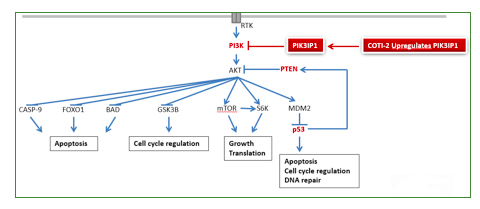
The end results are increased apoptosis, cell cycle regulation and DNA repair of the cancer cells.
Cancer Stem Cell Inhibition
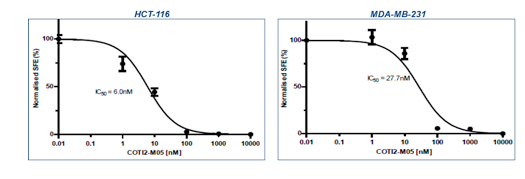
In a preclinical cell line experiment, COTI-2 inhibited both MDA-MB-231 (IC50 = 27.7 nM) and HCT-116 (IC50 = 6.0 nM) cancer stem cells as determined by a stem cell sphere assay. The positive control, DAPT, exhibited an IC50 = 50 mM.
The Phase I Study of COTI-2 for Gynecological Cancers
Based on the compelling data from the OVCAR-3 ovarian cancer tumor model, at the end of 2015, COTI together with its collaborator MD Anderson initiated a Phase I clinical trial to evaluate COTI-2 for the treatment of patients with gynecological cancers including ovarian cancer, fallopian tube cancer, endometrial cancer, cervical cancer, and peritoneal cancer (NCT02433626).
This Phase I trial is a single arm, single center, open-label study of COTI-2 in female patients with platinum-resistant, recurrent ovarian (including fallopian tube or primary peritoneal cancer), endometrial, or cervical cancer. COTI-2 will be self-administered as a single agent, orally, once daily for 5 days followed by 2 treatment-free days each week. 1 cycle will be defined as 4 weeks of treatment as described (5 days on, 2 days off per week). Participants will remain on treatment until they experience a lack of benefit.
The primary endpoints will be safety and tolerability. Secondary endpoints include clinical response and progression free survival (PFS). The trial will enroll up to 46 patients. We expect top line data to be available in 1H2017.
COTI is also planning clinical trials in Canada and the US for the treatment of patients with recurrent head and neck squamous cell cancer. The Company (TSX:COT.V) will file an Investigational New Drug application with the US FDA and is also completing a Clinical Trial Application for submission to Health Canada.
The next step with COTI-2 will be the initiation of a Phase II trial for ovarian cancer in 2017 following the conclusion of the Phase I trial. The logic of choosing ovarian cancer is because as many as 95% of ovarian cancer patients have a p53 gene mutation, and the market for ovarian cancer treatment in the US will well surpass $1 billion.
COTI-2 received an orphan-drug designation for ovarian cancer by the FDA in June 2014.
The Advantages of COTI-2
COTI-2 is being developed as an oral treatment for solid tumors; it is easy to synthesize (3 steps). COTI‐2’s specific protein target, low toxicity, combination effectiveness with standard agents, and potential for longer term outpatient therapy as an oral agent, supports a dramatic change in the treatment of susceptible cancers.
COTI-2 is a 3rd generation thiosemicarbazone that demonstrates both class and unique effects. The class effects include restoration of p53 function to a wide range of common p53 mutations and binding/chelation of 2+ metal ions (zinc, copper, and/or iron).
The unique effects include negative modulation of the PI3K/AKT/mTOR pathway and cancer stem cell (CSC) inhibition.
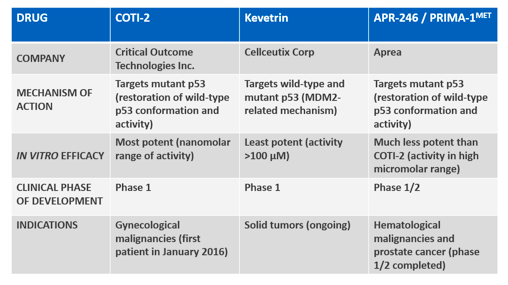
When compared to similar competitors currently under development, COTI-2 has a big advantage in efficacy. COTI-2 is the most potent activator of mutant p53 with IC50’s in the low nanomolar range in multiple human cancer cell lines. While Kevetrin is active at greater than 100 micromolar level, and APR-246 is active only at a high micromolar range.
Ovarian Cancer and the Market
Ovarian Cancer
According to the American Cancer Society, ovarian cancer accounts for about 3% of cancers among women. In 2015, it is estimated that about 21,290 women received a new diagnosis of ovarian cancer and about 14,180 women died from ovarian cancer in the US.
Ovarian cancer ranks fifth in cancer deaths among women, but accounts for more deaths than any other cancer of the female reproductive system. This cancer mainly develops in older women. About half of the women who are diagnosed with ovarian cancer are 63 years or older.
About 90 percent of ovarian cancers are epithelial tumors, derived from the epithelium, the thin layer of tissue that covers the ovaries. Other ovarian cancers include Germ cell carcinoma tumors, Stromal carcinoma tumors, and Small cell carcinoma of the ovary.
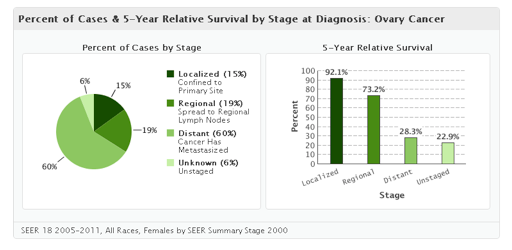
Survival rates differ for different stage of ovarian cancers. For all types of ovarian cancer, the 5-year relative survival is 45%. If ovarian cancer is found (and treated) before the cancer has spread outside the ovary (localized), the 5-year relative survival rate is 92%. However, only 15% of all ovarian cancers are found at this early stage. 5-year survival rate for metastasized cancer is only 28.3%.
Treatment of Ovarian Cancer
The main treatments for ovarian cancer include surgery, radiation, chemo, hormone and targeted therapy.
The standard chemo therapy is the combination of a platinum compound, such as cisplatin or carboplatin, and a taxane, such as paclitaxel (Taxol®) or docetaxel (Taxotere®).
Some of the other common chemo drugs that are helpful in treating ovarian cancer include Abraxane, Xeloda, Topotecan, Vinorelbine, and Melphalan.
There are two targeted therapies approved by the FDA for the treatment of ovarian cancer: Bevacizumab (Avastin®) and Olaparib (Lynparza™).
Avastin (marketed by Roche) belongs to a class of drugs known as angiogenesis inhibitors. In clinical studies, avastin has been shown to shrink or slow the growth of advanced epithelial ovarian cancers. Trials to see if bevacizumab works even better when given along with chemotherapy have shown good results in terms of shrinking tumors, but it doesn’t seem to help women live longer.
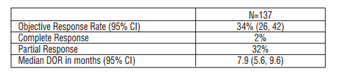
Olaparib (marketed by AstraZeneca) is the first oral prescription medicine used to treat patients with BRCA-mutated advanced ovarian cancer who have received three or more prior chemotherapy medicines. The efficacy of Olaparib was investigated in a single-arm study in patients with deleterious germline BRCA-mutated advanced ovarian cancer. Efficacy results are summarized in the following table.
Hormone therapy is rarely used to treat epithelial ovarian cancer, but is more often used to treat ovarian stromal tumors. Two common types of hormone therapy are Tamoxifen and aromatase inhibitors including letrozole (Femara®), anastrozole (Arimidex®), and exemestane (Aromasin®).
The Ovarian Cancer Drug Market and COTI-2 Opportunity
The world market for ovarian cancer treatments has been dominated by generic chemotherapies following patent expiries for leading drugs almost 15 years ago. However, the market has seen new approvals in recent years, such as Avastin, Lynparza, and Yondelis (approved in the EU, but not in the US) which are gradually capturing market share.
The industry is changing, and novel therapies are in development. However, the success of these agents will depend on how much of an improvement they provide over the current standard of care. This is particularly of importance for cost-effectiveness assessments, which are having a greater impact on the industry as healthcare budgets are tightened. With a growing incidence of ovarian cancer and high recurrence and mortality rates, the demand for better treatment will continue to bolster this drug market.
Multiple sources have projected that the market for ovarian cancer treatment will well surpass $1 billion in the next few years. According to a new report by visiongain the overall world market for drugs treating cancer of the ovaries will reach $1.71 billion in 2019. Decision Resources, one of the world’s leading research and advisory firms for pharmaceutical and healthcare issues, also projects that the ovarian cancer drug market will more than triple over the next decade, increasing from $460 million in 2011 to $1.4 billion in 2021 in the United States, France, Germany, Italy, Spain, the United Kingdom and Japan.
We think the market growth will be primarily driven by the penetration of newly approved therapies and new approvals in the following years. Market growth will also be driven by the growing patient population and rising costs of drug therapies.
COTI-2 is a new class of targeted anti-ovarian cancer agent, which has a different mechanism of action compared to Avastin and Lynparza, two targeted agents currently marketed in the US. COTI-2 targets both the p53 path way and the PI3K/AKT/mTOR pathway as well as cancer stem cell inhibition. COTI-2’s potent anti-cancer efficacy and favorable safety profile as well as its oral formulation may positon it as the choice of targeted therapy for ovarian cancer patients if it finally reaches the market.
Licensing Opportunities
One value driver for COTI is the potential for licensing opportunities. The Company is actively pursuing licensing opportunities during the development of COTI-2 consistent with its strategy to be a pipeline provider to major pharmaceutical companies and has been approached by potential partners for its lead candidate COTI-2. Our guess is that after a positive readout of the Phase I trial, licensing opportunities could materialize.
More importantly, positive data from COTI-2 will validate the CHEMSAS® technology, which could lead to more licensing opportunities for COTI-2 and for the technology.
Licensing deals are important to COTI. First, these deals will provide revenue and hence non-dilutive funding for the Company’s operations. Secondly, any licensing deal is a validation of the Company’s technology and clinical programs. Thirdly, these licensing deals will accelerate the development of COTI’s other preclinical and clinical programs.
Other Technologies
In addition to CHEMSAS®, COTI has also developed ROSALIND. ROSALIND is a computer platform for realizing the promise of personalized medicine for cancer patients. The goal of ROSALIND is to provide better personalized treatment options based on the genetic profile of the patient’s cancer.
ROSALIND is a dynamic, programmable computer simulation of how cell signaling pathways are altered by specific gene mutations that are associated with specific types of cancers. The technology produces a comprehensive mathematical model of cell signaling and identifies optimal personalized cancer treatment options.
While access to high-quality cancer gene mutation profiling continues to evolve, personalized cancer therapy is really a big data problem. For example, the number of unique single, double, and triple drug combinations from just 150 cancer drugs would be in excess of 540,000. This is simply too many potential therapies for any physician or group of physicians to evaluate. ROSALIND addresses this big data problem.
The technology uses a gene expression and mutation profile of a patient’s tumor to evaluate a full range of available therapies. ROSALIND V2.0 can analyze more than 1000 gene mutations simultaneously.
ROSALIND targets the multi-billion dollar personalized cancer gene profiling market. The Company is seeking commercial and validation development partners.
READ THE FULL INITIATION REPORT HERE
SUBSCRIBE TO ZACKS SMALL CAP RESEARCH to receive our articles and reports emailed directly to you each morning. Please visit our website for additional information on Zacks SCR and to view our disclaimer.