By Grant Zeng, CFA
NASDAQ:CPXX
On Feb. 16, 2016, Celator Pharmaceuticals (NASDAQ:CPXX) announced that its Phase III clinical trial of VYXEOS™ (CPX-351) in patients with untreated high-risk (secondary) acute myeloid leukemia (AML) has reached its pre-specified number of events required for the analysis of overall survival.
The company expects to announce overall survival results later this quarter.
Background of the Phase III Trial
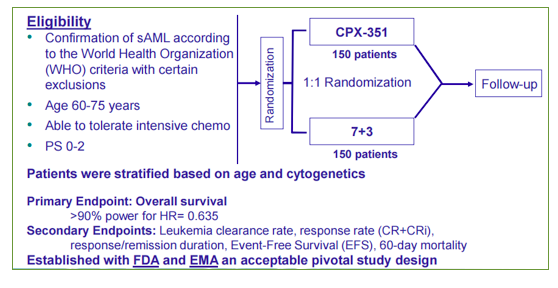
The randomized, controlled, Phase III study (NCT01696084), conducted at 39 centers in the United States and Canada, compared VYXEOS to the conventional cytarabine and daunorubicin treatment regimen (commonly referred to as 7+3) as first-line therapy.
The study enrolled 309 patients between the ages of 60 and 75 who had pathologically confirmed diagnosis of high-risk AML by WHO criteria including: therapy-related AML, AML with a history of myelodysplasia (MDS), AML with a history of chronic myelomonocytic leukemia (CMMoL), and de novo AML with karyotypic abnormalities characteristic of MDS.
Patients were randomized 1:1 to receive either VYXEOS (100u/m2; days 1, 3, and 5 by 90-minute infusion) or 7+3 (cytarabine 100mg/m2/day by continuous infusion for 7 days and daunorubicin 60mg/m2 on days 1, 2, and 3).
The study was conducted in partnership with The Leukemia & Lymphoma Society® (LLS) through its Therapy Acceleration Program (TAP), which has supported the clinical development of VYXEOS beginning in Phase II.
Update on the Phase III Trial
Celator recently updated final induction response rate (complete remission plus complete remission with incomplete hematologic recovery, or CR+CRi) in the Phase III study comparing CPX-351 to the standard of care regimen 7+3.
The induction response rate for CPX-351 is 47.7% vs. 33.3% for the 7+3 regimen, representing a relative improvement of 43.2%.
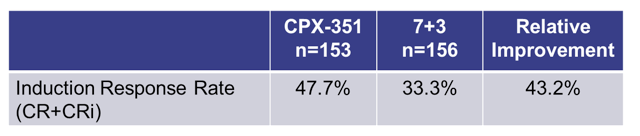
Induction response rate is a key secondary endpoint in the Phase III study and has been an important surrogate of overall survival and clinical benefit in this patient population. These data validate the induction response rates observed in the Phase II study, which was associated with a marked improvement in overall survival.
In addition to induction response and overall survival, other important information, such as rate of morphologic leukemia-free state, best overall response, response duration, event-free survival, and early mortality, as well as pharmacoeconomic comparisons, will be assessed and available at the conclusion of the study.
We are pleased with the positive data from the Phase III trial. The 43% improvement in induction response rate for CPX-351 is promising since response rate in induction therapy for AML has historically served as a surrogate for overall survival. Based on the encouraging induction response rate, we believe there will be a high probability that the overall survival will also be positive.
VYXEOS™ Shows No QT/QTc Interval Prolongation in an Intensive QT/QTc Study
On Dec. 8, 2015, Celator announced positive data from a Phase II PK/PD study of VYXEOS™ (CPX-351) at the ASH meeting.
This open-label, single arm, Phase II PK/PD study measured the effects of VYXEOS on cardiac repolarization during the first induction cycle and correlated electrophysiologic changes, as measured by the QT/QTc interval, with a detailed pharmacokinetic assessment of cytarabine and daunorubicin and their metabolites using exposure response modeling methodology.
This study, in adult patients with acute hematologic malignancies, was conducted to support the NDA filing in the US.
The study completed enrollment in June 2015. Each patient received a first induction of VYXEOS on days 1, 3 and 5 and, if necessary, a second induction for patients with reduced leukemia burden not yet achieving a disease-free state. Responding patients were eligible for up to four consolidation courses.
Twenty-six patients with acute myeloid leukemia (AML) or acute lymphoblastic leukemia (ALL) were enrolled and 21 were evaluable for QT interval change from baseline. VYXEOS did not prolong the QT/QTc interval, a positive safety outcome. The largest absolute and mean change from time-matched baseline was 12.56 and 8.03 ms, respectively (Day 1, hour 4). Mean QTcF change on Day 5 was unchanged from baseline. QTcF intervals >480 ms were never observed and no consistent QTcF intervals >450 ms were noted. Absolute QTcF increases between 30 and 60 ms were present in 4 of 25 patients and no changes >60 ms were observed. CPX-351 plasma concentration vs. time curves for day 1 and 5 exhibited a volume of distribution approximately equal to the plasma volume with prolonged single-exponential elimination half-lives for cytarabine and daunorubicin of ≥24 hours.
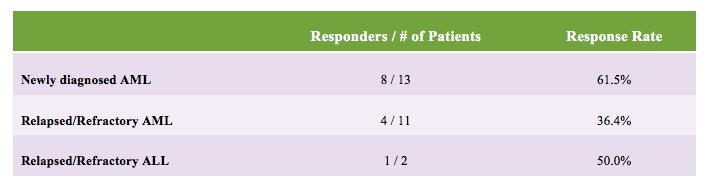
The study included patients with newly diagnosed AML, relapsed/refractory AML and relapsed/refractory ALL. Thirteen of the 26 patients responded. Responses were seen in each of the three acute leukemia patient populations. The high response rates corroborate the high level of efficacy observed in earlier studies with CPX-351.
In addition, CPX-351 exposure was independent of renal function, indicating no need for dose adjustment when renal function is impaired.
Adverse events were similar in frequency and severity to those described in earlier studies.
Paving the Way to CPX-351 Commercialization
Based on the positive PKPD data and the availability of the primary endpoint of overall survival for the Phase III trial in 1Q16, we estimate CPXX will submit a NDA in the 3Q16 and that CPX-351 will be approved in mid-2017 by the FDA.
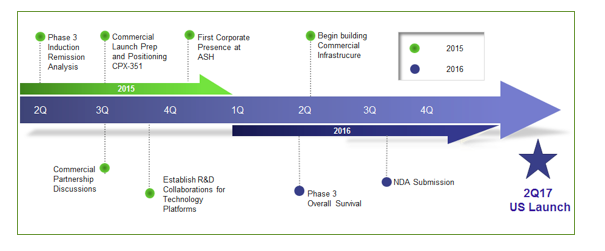
The FDA granted Fast Track designation for CPX-351for the treatment of elderly patients with secondary AML. If approved, CPX-351 may ultimately replace 7+3 on the basis of improved efficacy and acceptable safety.
CPXX also plans a MAA submission in 1Q17 and we expect the approval of CPX-351 by the EMA in 1H18.
CPXX plans to market CPX-351 in the US on its own and find a partner for ex-US markets. It’s also possible that the company co-markets CPX-351 in the US with its partner. CPXX plans to hire about 30 sales rep and managers in the US targeting 50 centers which performed more than 70% of all AML SCTs.
SUBSCRIBE TO ZACKS SMALL CAP RESEARCH to receive our articles and reports emailed directly to you each morning. Please visit our website for additional information on Zacks SCR and to view our disclaimer.