By Grant Zeng, CFA
NASDAQ:CPXX
On March 14, 2016, Celator (NASDAQ:CPXX) announced positive results from the Phase III trial of VYXEOS™ (cytarabine:daunorubicin) Liposome for Injection (CPX-351) in patients with high-risk (secondary) acute myeloid leukemia (AML) compared to the standard of care regimen of cytarabine and daunorubicin.
The Phase III Trial
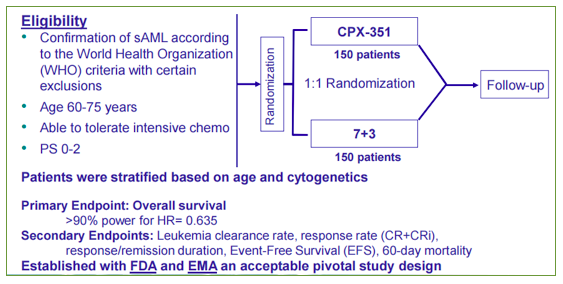
The randomized, controlled, Phase III study (NCT01696084), conducted at 39 centers in the United States and Canada, compared VYXEOS to the conventional cytarabine and daunorubicin treatment regimen (commonly referred to as 7+3) as first-line therapy.
The study enrolled 309 patients between the ages of 60 and 75 who had pathologically confirmed diagnosis of high-risk AML by WHO criteria including: therapy-related AML, AML with a history of myelodysplasia (MDS), AML with a history of chronic myelomonocytic leukemia (CMMoL), and de novo AML with karyotypic abnormalities characteristic of MDS.
Patients were randomized 1:1 to receive either VYXEOS (100u/m2; days 1, 3, and 5 by 90-minute infusion) or 7+3 (cytarabine 100mg/m2/day by continuous infusion for 7 days and daunorubicin 60mg/m2 on days 1, 2, and 3).
The study was conducted in partnership with The Leukemia & Lymphoma Society® (LLS) through its Therapy Acceleration Program (TAP), which has supported the clinical development of VYXEOS beginning in Phase II.
The Positive Data
The trial met its primary endpoint demonstrating a statistically significant improvement in overall survival.
- The median overall survival for patients treated with VYXEOS was 9.56 months compared to 5.95 months for patients receiving 7+3, representing a 3.61 month improvement in favor of VYXEOS.
- The hazard ratio (HR) was 0.69 (p=0.005) which represents a 31 percent reduction in the risk of death versus 7+3.
- The percentage of patients alive 12 months after randomization was 41.5% on the VYXEOS arm compared to 27.6% on the 7+3 arm.
- The percentage of patients alive 24 months after randomization was 31.1% on the VYXEOS arm compared to 12.3% on the 7+3 arm.
- VYXEOS also demonstrated a statistically significant improvement in induction response rate (CR+CRi of 47.7% versus 33.3%; p=0.016) and this significance was maintained for the analysis of CR alone (CR of 37.3% versus 25.6%, p=0.040).
- Sixty-day all-cause mortality was 13.7% versus 21.2%, in favor of patients treated with VYXEOS.
No substantial difference in Grade 3 or higher adverse events was observed between VYXEOS and 7+3. In the intent-to-treat population, Grade 3 or higher, hematologic adverse events were similar for overall infections, febrile neutropenia, and bleeding events. In the intent-to-treat population, Grade 3 or higher, non-hematologic adverse events were similar across all organ systems, including cardiac, gastrointestinal, general systems, metabolic disorders, musculoskeletal, nervous system, respiratory, skin and renal.
Data will be submitted for presentation at the American Society of Clinical Oncology (ASCO) 2016 Annual Meeting.
Based on these results the company expects to submit a New Drug Application (NDA) for VYXEOS with the US FDA at the end of 3Q16 and submit a Marketing Authorization Application (MAA) with the European Medicines Agency (EMA) in 1Q17.
Paving the Way to VYXEOS Commercialization
Based on the positive Phase III data and the PKPD data, we estimate CPXX will submit a NDA in the 3Q16 and that CPX-351 will be approved in mid-2017 by the FDA. Therefore, VYXEOS could be launched in the beginning of 3Q17.
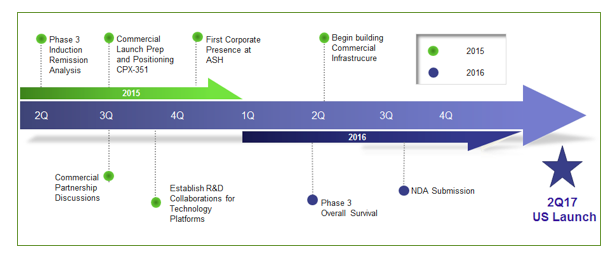
The FDA granted Fast Track designation for CPX-351for the treatment of elderly patients with secondary AML. If approved, CPX-351 may ultimately replace 7+3 on the basis of improved efficacy and acceptable safety.
CPXX also plans a MAA submission in 1Q17 and we expect the approval of CPX-351 by the EMA in 1H18.
CPXX plans to market CPX-351 in the US on its own and find a partner for ex-US markets. It’s also possible that the company co-markets CPX-351 in the US with its partner. CPXX plans to hire about 30 sales rep and managers in the US targeting 50 centers which performed more than 70% of all AML SCTs.
Market Potential for CPX-351
Current Treatment Regimens for AML
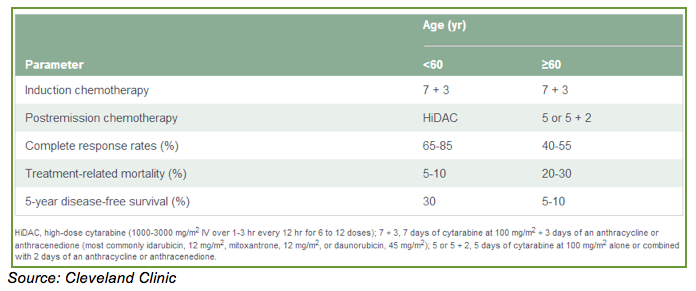
Treatments for AML patients usually include induction therapy followed by post-remission chemotherapy (consolidation) for most patients. For some patients, this will be followed by hematopoietic stem cell transplantation. Treatment options for AML patients vary depending on the patient’s age, cytogenetics, and prognostic factors. Currently, the treatment options are often divided into two groups: one for patients younger than 60 and one for patients 60 years and older.
The goal of induction chemotherapy is to reduce the number of leukemic cells as well as return proper function to the bone marrow. The 7+3 regimen of cytarabine (100 mg/m2 for 7 days) plus daunorubicin (45 to 60 mg/m2 for 3 days) is the most common induction regimen for both age groups. Induction is successful in about 65% of all AML patients who get standard induction chemotherapy with daunorubicin and cytarabine. The actual chance of remission depends to a large part on a person’s specific prognostic factors, such as age or the presence of certain gene or chromosome changes.
Post-remission consolidation therapy then aims to eradicate any residual disease in an attempt at cure. Post-remission chemotherapy includes high-dose cytarabine (ara-c; HiDAC) for patients younger than 60 years, whereas a 5 or 5 + 2 regimen of cytarabine plus an anthracycline or anthracenedione is preferred for patients older than 60 years. HiDAC has proven to be efficacious for young patients with good or intermediate prognosis. In patients younger than 60 years, HiDAC yields a 4-year disease-free survival rate of 44%, with relatively few relapses, but carries with it a 5% treatment-related mortality. In contrast, HiDAC failed to improve the outcome of patients older than 60 years. HiDAC has shown particular efficacy for patients with CBF DNA subunit abnormalities.
Older patients generally don’t do as well as those younger than 60. They have trouble tolerating intensive treatment and often have chromosome changes in their leukemia cells that are linked to a poorer outlook.
Allogeneic or autologous bone marrow transplantation is an additional option for post-remission therapy in adults with AML. For some patients younger than 60 years and for whom an HLA-matched sibling or matched unrelated donor is available, allogeneic stem cell transplantation should follow induction chemotherapy. However, this procedure has an associated 20% to 25% treatment-related mortality rate. For patients without a compatible donor or for whom age precludes such treatment, additional chemotherapy or autologous stem cell transplantation are options.
CPX-351 Advantage and Opportunity
The 7+3 regimen has been the standard first-line treatment for AML for over 40 years. Better therapies are urgently needed in view of the relatively poor prognosis for most patients with AML. Efforts to improve these outcomes, including intensification of treatment via modification of dose levels and schedules and/or addition of new cytotoxic and targeted therapies to existing regimens, have had limited success.
Despite the widespread use of the 7+3 regimen for AML, there has been little research focused on understanding how these two drugs interact on a cellular level. The different treatment schedules used for cytarabine and daunorubicin in the 7+3 regimen result in leukemia cells being exposed to constantly changing ratios, which may limit the effectiveness of this chemotherapy combination when some of those ratios are antagonistic. In fact, drug ratio dependency was observed and superiority of the 5:1 molar ratio was identified by Celator in pre-clinical studies, both in vitro and in vivo. Consequently, the CombiPlex technology platform was applied to this combination and nano-scale liposomes were engineered that co-encapsulated cytarabine and daunorubicin, to maintain the optimal synergistic drug ratio for extended periods of time after intravenous injection, with the aim of improving anti-leukemia activity.
From the existing clinical data, we believe CPX-351 has the potential to replace 7+3 as the current standard of care for AML. CPX-351 contains the same 2 active ingredients, cytarabine and daunorubicin, but at a pre-determined synergistic 5:1 molar ratio. This synergistic ratio is preserved and maintained in human serum via co-encapsulation within a nanoparticle-size liposomal formulation. CPX-351 is administered as a 90-minute infusion on days 1, 3, and 5. Data from the pivotal study, along with data from the completed Phase II studies and the ongoing and proposed clinical studies (investigator-initiated or possibly cooperative group studies) are critical to establish the benefit of CPX-351 in patients with AML and other hematologic malignancies.
Key advantages of CPX-531 include:
-Prolonged overall survival
-Significant reduction in 60-day early mortality
-Higher remission rates could result in more transplant candidates
-More convenient and less resource-intensive dosing schedule
- 3 x 90 minute infusions vs 7-day continuous infusion coupled with an IV push on days 1-3 during induction
- Fixed, co-formulation of 2 drugs eliminates need to mix or identify optimal ratio
-Alopecia rarely observed
-Potential for outpatient treatment in consolidation phase
Celator selected sAML as the “get-to-market” strategy because this represents the fastest path to market for a Phase III study and a higher probability for success because a statistically significant survival advantage has already been demonstrated in the completed Phase II study. CPX-351 may provide potential benefit in other AML populations as well as other hematologic malignancies.
We estimate peak sales of CPX-351 will be in the range of $300 to $500 million for the first indication globally. The overall global market opportunity for all indications will well be over $1 billion.
READ THE FULL RESEARCH REPORT HERE
SUBSCRIBE TO ZACKS SMALL CAP RESEARCH to receive our articles and reports emailed directly to you each morning. Please visit our website for additional information on Zacks SCR and to view our disclaimer.