By Brian Marckx, CFA
NASDAQ:CTSO
Q1 Financials / Operating Update: Clinical Outcomes Data Continues To Drive Strong Revenue Growth..
CytoSorbents (NASDAQ:CTSO) reported financial results for the first quarter ending March 31st. While product sales came in moderately lower than our $1.7M estimate, Q1 results were solid with total revenue growing 150% yoy to $1.8M, including a 127% increase in product sales to $1.6M – with both total revenue and product sales setting new records. Product margin remained strong at 62% and should continue its upward trajectory with further sales growth and greater economies of scale. Operating expenses (as well as cash burn) were relatively low. The net result was a $189k and one-half cent beat on operating income and EPS as compared to our estimates.
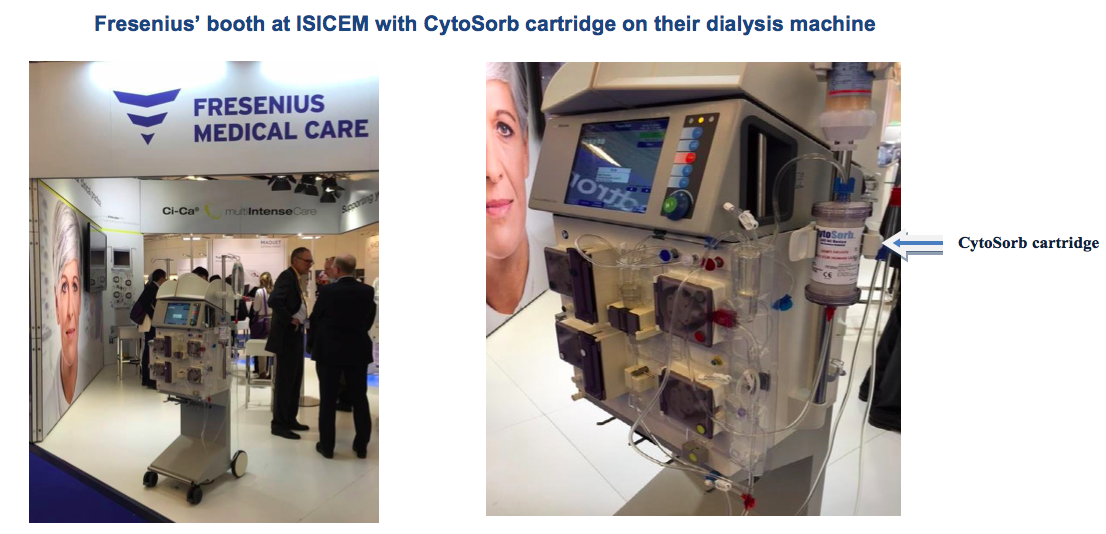
Revenue posted approximately 7% sequential growth (from Q4 2015) – we were looking for 15% q-o-q growth as we had anticipated at least some stocking contribution from Fresenius (FMS). While Fresenius kicked off their CytoSorb introduction at the ISICEM conference in mid-March, Q2 will mark the first detailing of the product by the dialysis heavyweight. Fresenius had a significant CytoSorb-related presence at ISICEM and CTSO’s annual user’s meeting where they had 18 people representing each of their six sales territories.
Importantly, on the call management again noted that product sales growth continues to be driven by reordering from existing customers as well as expansion of the customer base as a whole. They continue to guide for sequential product sales growth. And other catalysts should come online in the near-term. In addition to the formal Fresenius launch (France, Poland, Denmark, Finland, Norway and Sweden), product registration in other territories should make a positive contribution. CTSO also recently further beefed-up their direct sales force which increased from nine (plus another nine support staff) as of March 1st to 11 (plus 12 support staff) as of May 1st.
CTSO recently noted that they are seeing a greater shift from hospitals employing CytoSorb in somewhat of a one-off use to more regularly reliance on the device for certain diseases and conditions including some hospitals where CytoSorb “has been used almost as a standard of care.” This is being driven by positive patient outcomes and clinical evidence which has been and continues to be the basis for increasing demand. And more and more of the clinical evidence is starting to be published – which should be a catalyst to broadening both awareness of the technology as well as providing greater validation of its effectiveness. Currently ongoing are 55 investigator-initiated studies, 12 of which are in later stages and enrolling patients. These will provide the basis for additional publications.
The clinical database continues to grow as does evidence of CytoSorb’s efficacy in treating various conditions and diseases. Management noted that while much of the early validation was in the form of small case studies involving one or only a few patients that that has more recently migrated towards case series and small clinical trials – providing a much more robust efficacy assessment. Earlier this year CTSO announced highly positive outcomes from a recent investigator-initiated sepsis study (detailed below) where CytoSorb was introduced with very ill patients after standard of care had failed. More outcomes data from case studies and investigator initiated studies have been released since with use of CytoSorb in sepsis, cardiac surgery, liver failure and other applications. Presentations at the third annual international user’s meeting (link http://bit.ly/1TPL4jg) and ISICEM conference, including five poster presentations, further supported efficacy of the device in areas such as sepsis, cardiac surgery and liver failure. This included an evaluation in cardiac surgery with a 10-patient population similar to those enrolling in CTSO’s REFRESH I study which showed CytoSorb helped to stabilize two patients and reduced the need for vasopressors and extracorporeal life support.
CytoSorb’s ability to remove toxic levels of bilirubin in patients with severely compromised liver function is an application which CTSO has not talked about much in the past but was another of the poster presentations at ISICEM. This may be an area where the device sees more use and something which CTSO may be reporting more on the future.
Cardiac surgery (as well as sepsis) is the application with perhaps the bulk of the clinical history and evidence continues to support CytoSorb’s utility in this area. In addition to the aforementioned positive 10-patient data, an ongoing three-arm randomized open heart surgery study being conducted in Cologne, France continues to show positive results. Late last year CTSO announced data from 142 patients, more recently data from 165 (of an expected 300) was presented showing a statistically significant reduction in sternal wound infections. Sternal wounds are potentially lethal complications following cardiac surgery and associated with high morbidity and mortality.
As use in cardiac surgery applications is expected to form the basis for the initial indication in the U.S., ongoing positive data in this area is obviously encouraging. Relative to REFRESH I, management noted on the Q1 call that it is currently 63% enrolled (was 35% enrolled as of March 9th) and they continue to expect it to be fully enrolled by about mid-year and have top-line data in Q3 of this year. And, assuming positive results, CTSO will look to move into the larger REFRESH II study – which management believes could commence (following discussions with FDA on trial design) early next year.
Q1 Results
Q1 total revenue was $1.810M, up 150% yoy and +3% on a sequential basis. Product sales grew 127% yoy to $1.597M, representing 7% sequential growth. While Fx had been a headwind for much of 2015, that was mostly a non-factor in the most recent quarter. The growth catalysts that we outlined above should bode well for continued sequential revenue growth throughout the remainder of 2016.
Grant revenue was $213k – with contributions from DARPA (sepsis) of $77k, Phase II NHLBI HemoDefend of $87k and the new Phase I SBIR Mycotoxin contract of $50k. We model meaningful grant revenue through the remainder of 2016 as $100k remains under the Mycotoxin contract, $224k under DARPA and $1.4M remains under the HemoDefend grant.
As noted, product margins remain very healthy - which was approximately 62% in Q1. We model very incremental improvement in product margin going forward. Operating expenses, at just under $3.1M ($2.2M SG&A, $856k R&D) were well below our $3.4M ($2.2M SG&A, $1.1M R&D) estimate as grant activity absorbed a meaningful amount of R&D expense. We continue to expect R&D to tick upwards with additional clinical activities including REFRESH I.
Excluding non-cash items (Fx translation and change in warrant liability), EPS was ($0.085), slightly ahead of our ($0.090) estimate. Cash balance, including liquid investments, was $6.0M at quarter-end. Cash used in operating and investing activities was $1.3M and $107k, respectively. Excluding change in working capital, cash used in operating activities was $1.9M. Management expects the current cash balance to be sufficient to fund operations into Q4 of this year. CFO, Kathy Bloch, noted on the call that they have been exploring funding options and, based on the current state of the equity markets, are leaning towards some form of debt financing – also noting that they have several competitive debt proposals that they are evaluating. As a placeholder, our model continues to incorporate the assumption that future financings come in the form of secondary equity offerings but will be updated when a financing is completed.
Further Support for Sepsis Pursuit
CytoSorbents presented initial results from an investigator initiated septic shock study (n=22) conducted in Germany at the Symposium for Intensive Medicine + Intensive Care in Bremen, Germany. The single-arm study included 22 very ill patients with refractory late-stage septic shock and multiple organ failure. All standard intervention (i.e. vasopressors, artificial ventilation, dialysis, etc) had failed prior to initiating CytoSorb therapy for twelve-hours over “several days”.
Initial results showed;
- 28-day survival of 41% of the patients. 28-day all-cause mortality is FDA’s accepted primary endpoint in sepsis therapy studies to-date. This 41%, as CytoSorbents notes in today’s PR, compares favorably to the 0% survival (100% mortality) observed in the Conrad, et al study (published in Journal of Critical Care, Aug 2015) among the group of patients (n=16) that failed to respond to standard intervention (i.e. vasopressors, artificial ventilation, dialysis, etc).
- Shock was reversed in 68% of patients
- IL-6 (high levels of which have been associated with septic shock and mortality) fell from an average mean of 87,000 pg/mL, to below 10,000 pg/mL after 24 hours of treatment. As a reminder, CytoSorbents’ European sepsis study also demonstrated the ability of CytoSorb to significantly reduce IL-6 as well as a statistically significant reduction in 28-day mortality in a subgroup of patients which had very high cytokine levels (IL-6 1,000 pg/mL and/or IL-1ra 16,000 pg/mL)
While we believe the study is too small to draw any concrete conclusions, particularly as sepsis is a complex condition affecting heterogeneous populations making homogenous enrollment difficult, we characterize the results as positive in that it provides additional credence to the idea that CytoSorb may be effective in reducing sepsis mortality. CTSO expects to complete the full analysis and submit additional data for publication in the future. And we expect CTSO and clinicians will be conducting more sepsis-related studies which may provide more insight into the effectiveness of CytoSorb for this disease – these studies may also help narrow enrollment criteria for a pivotal U.S. study in a sepsis indication.
Management noted on the Q4 2015 call that they are very encouraged by the results. Also noting that this is an example of a patient population (i.e. refractory septic shock) that could potentially represent one which a formal, and potentially relatively small, sepsis study could be designed around.
Relative to potential plans of a U.S. pivotal sepsis study – management indicated that they are approaching this idea very systematically. Indicating that they will continue to conduct OUS sepsis-related studies to help flesh out potential patient populations in which CytoSorb appears to be most effective and which may afford a relatively small (potentially) pivotal sepsis study. We fully support that strategy given the potential black hole that a large, long and drawn out and expensive pivotal sepsis study could create given the difficulty in enrolling from a relatively heterogeneous population.
Outlook and Model Update
We view 2015 as somewhat of a re-grouping year on the income statement - although “regrouping” should be put into context given that product sales grew 29% – and which would have been almost 50% if not for an Fx headwind. And if not for the sales force disruption earlier in the year, product sales growth would likely have been even significantly stronger.
We expect to see accelerating product sales growth as well as more strides on the operational front in 2016. In addition to Fresenius coming online, expansion into other geographic territories (in addition to those detailed by Fresenius), an expected continued regular flow of clinical data (including that from the patient registry as well as REFRESH I), potential additional production gains from the direct sales force, sales through Biocon could also accelerate further. And the cardiac-surgery channel also holds significantly promise. Consummation of a partnering agreement could further this opportunity.
Based on our 10-year DCF model, which uses a 13% discount rate to account for certain risks and uncertainties that CytoSorbents faces, and a 2% terminal growth rate, the shares are valued at approximately $12.50.
READ THE FULL RESEARCH REPORT HERE
SUBSCRIBE TO ZACKS SMALL CAP RESEARCH to receive our articles and reports emailed directly to you each morning. Please visit our website for additional information on Zacks SCR and to view our disclaimer.