By
Brian Marckx, CFA
NASDAQ:CTSO
Q3 Financials / Operating Update: Product Sales Continue Charging. Terumo Should Be Key In Cardiac Channel..
CytoSorbents (NASDAQ:CTSO) reported financial results for the third quarter ending September 30th and provided a business update. Financial results continue to come in very strong with Q3 product revenue up 100% yoy, setting a new record and marking the sixth straight quarter of sequential growth. Product sales continue to be fueled in large part to reorders from existing accounts but also from new customer wins as CTSO enters new geographic territories through both its own direct sales force and expansion of its third-party distribution network. As we have stressed in the past, we are encouraged by the high quality product revenue growth – that is, mostly reorders, no channel stuffing or lumpy distributor stocking – which we believe offers a certain level of validation of burgeoning demand and by extension, clinical utility of CytoSorb. And further expansion of the commercial and distribution footprint, which recently included (territorial expansion into) Chile, additional direct reps in the Benelux region and Terumo Cardiovascular Group (distribution for cardiac surgery) should layer on additional growth.
And while more feet on the ground, additional distribution and geographic expansion have clearly been a key part of the company’s growth strategy, there is little doubt that the marketing message of CytoSorb’s clinical effectiveness has been at least as important in driving initial adoption and maintaining accounts. CTSO continues to build on a virtual database of clinical evidence of CytoSorb’s effectiveness in a variety of conditions. Much of this evidence has been submitted for publication – management noted on the Q3 call that more than two dozen manuscripts have been submitted or are being prepared for publication covering a host of different conditions.
We expect there will be a regular flow of publications for some time, particularly given the number of ongoing and planned investigator-initiated studies as well as larger studies. CTSO has approximately 55 investigator-initiated studies, either ongoing or planned to initiate, in a variety of indications. In addition, data from the company’s Germany-based, multi-site single arm dosing study in which patients were treated with CytoSorb for 24 hours per day for seven days (using a new device each day) has completed.
We attribute much of the customer stickiness, product reordering and relative lack of ‘one-and-done’ accounts to CytoSorbents’ marketing strategy focused on leading with clinical evidence and then layering in appropriate sales and marketing resources. This pull-through demand should also offer potentially significant opportunity to exploit operating leverage once the customer base is further scaled as sales strategies shift away from less efficient customer-win focused activities to less resource-intensive and more profitable account maintenance activities.
Validation of the utility and effectiveness of CytoSorb is also not just borne out of the various clinical and case studies but certainly also supported by the fact that hospitals and KOL’s continue to use the device. The device has now been used in more than 17k treatments – up from 14k just three months ago – which clearly suggest the pace of utilization is also increasing. Management has noted over the recent past, including again on the Q3 call, that CytoSorb is being used as a de facto standard of care in certain conditions at some major hospitals. And while expanding this to other conditions and a significantly greater number of hospitals and KOL’s may require more in the way of clinical experience and evidence, we think it is difficult to dismiss regular reordering and use as standard of care (at least in some instances and at some hospitals) as only casual belief in the effectiveness of CytoSorb in improving patient outcomes.
But positive data from formal clinical studies is critical and requisite for a pathway to eventually reach the U.S. market. Data from REFRESH I, the 40-patient randomized cardiac surgery study, could provide even greater insight into the utility of CytoSorb. In October CTSO announced positive safety-related information and the company expects to release results on ‘efficacy’-related data at an upcoming U.S. cardiothoracic surgery meeting (possibly either at STS in January or AATS in April). Change in plasma free hemoglobin, which has been implicated as an independent predictor of mortality and becomes elevated during cardiopulmonary bypass, is the outcome that is being measured in REFRESH I.
The data is currently undergoing analysis. Management indicated on the Q3 call that they are confident the data will show that CytoSorb was effective in lowering free hemoglobin. As such, this data will not only be important as support for regulatory approval to initiate a larger REFRESH II study but, in our opinion, also as further validation of CytoSorb and a potential catalyst to further adoption and use in cardiac surgery. The upcoming data presentation looks like it could be timely given that Terumo, recently announced as CTSO’s major cardiac surgery-related distribution partner for six European countries, is gearing up for their CytoSorb launch.
Financials…
Product revenue again came in just about dead-on with our number but we were a bit high on grant income, the latter related to estimating too high and too early recognition of some of the outstanding contracts – our “miss” will benefit future periods, however. In addition to record total revenue and product sales, other highlights in the Q3 financial results included continuation of the relatively very strong product margin and a sequential 18% drop in SG&A expense.
Q3 total revenue of $2.41M ($2.61M E) was a new record and up 80% yoy and 9% sequentially. Product sales were $2.14M ($2.20M E), an increase of 100% from $1.07M in Q3 2016, up 16% from Q2 2016 and also a new record. This marks the sixth consecutive quarter of sequential product revenue growth. Also noteworthy is that while the restructuring of the sales force in 2015 caused significant disruption in product sales, this had largely been ironed out by the third quarter – as such, the yoy doubling of product sales in Q3 is not a result of a favorable prior-year comp. Meanwhile, grant income was $269k ($415k E).
Q3 product margin was approximately 68% - this is the second straight quarter at that relatively elevated level. Management noted on the call that they believe gross margin has further room to widen over the near term and pointed to implementation of product efficiency measures as most of the impetus. Additionally, CTSO indicated that there may be some opportunistic pricing power as reimbursement is established in additional territories which could also benefit margins. However, we continue to have what may be a slightly more conservative outlook and model roughly flattish gross margins with the assumption that third-party distributor sales increase as a percentage of total product revenue and offset some of these benefits. This, like all of our assumptions are subject to updating.
Operating expenses, at $3.6M were down by more than $400k compared to Q2 of this year. Cash used for operating activities was $2.5M ($2.1M ex-changes in working capital) and $5.7M ($6.2M ex-changes in working capital) in the three and nine months ending September 30, 2016. Cash balance at quarter end stood at $6.4M. While the $5M “B” tranche from the June 2016 debt facility remains untapped, access is conditional on meeting certain financial (cash and revenue) metrics. Management noted on the Q3 call that they are exploring a variety of other potential funding sources as well. We have little concern that CTSO will be able to raise additional capital on reasonable terms. We also think that additional positive clinical data as well continued strong financial results should help to facilitate those efforts.
Operational update…
Along with the announcement in early October that the DSMB overseeing REFRESH I found no safety concerns, which was a major milestone as it moved CTSO one step closer towards REFERESH II, there were other recent operational highlights.
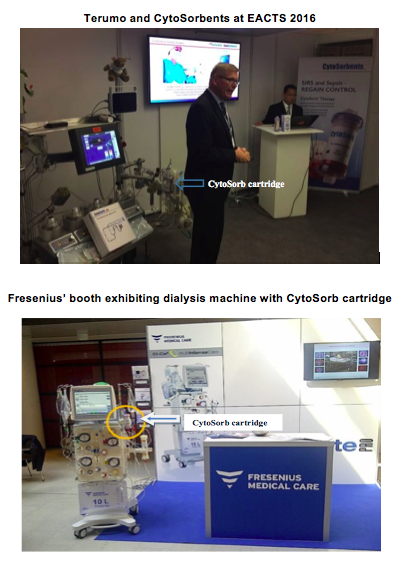
Relative to distribution, the addition of Terumo Cardiovascular, which has exclusive rights to distribute CytoSorb in France, Sweden, Denmark, Norway, Finland and Iceland for cardiac surgery applications, is particularly significant in our opinion in that it provides immediate and direct access to Terumo’s vast and established cardiovascular channel. While cardiac surgery has been a targeted “indication” for CTSO for the better part of two years now, much of the distribution relationships (save for Fresenius’ dialysis channel) to-date, while providing experience, depth, reach and contacts, have been more indication-neutral. Terumo Cardiovascular, which is a division of Terumo Corp., a major Japan-based medical device company with $5B+ in annual revenue, will provide CTSO the access, depth and breadth to the cardiac space that few other partners could. And the writing may be on the wall that if and when CytoSorb enters the Japanese market, that Terumo will be a key ally there as well.
CytoSorbents is also now entering the South American market with the addition of Foxx Medical as their exclusive distributor, for all indications, for the country of Chile.
Contribution from new territories, distributors will begin to make more significant impact…
Management noted that reorders from existing customers has fueled 80% - 90% of recent revenue growth. With several new territories having either recently come online or expected to do so in the very near future, this strong reorder growth should be complemented with steepening third party distributor sales.
There are now 42 countries where CytoSorb is approved for sale and distribution is in place, 32 of which are now contributing to revenue - this is up from just 15 at the beginning of 2016. The most recent major addition to the distribution network, as noted above, was Terumo Cardiovascular. While Terumo’s symbolic marketing launch occurred at EACTS in early October, preparations continue for the physical launch.
While we don’t expect to see any meaningful contribution from Terumo until early next year, we do believe that the Terumo channel could represent not only an eventual significant source of revenue, but also greatly facilitate CytoSorb experience in cardiac surgery – which by extension could have a potentially important and positive effect in driving adoption and utilization for this indication even outside of Terumo’s footprint. And the other potential benefit of having a company of Terumo’s caliber is validation – similar to Fresenius, there is an implied level of due diligence that these ‘majors’ will undertake before committing to supporting a third-party product or company and CytoSorb and CytoSorbents apparently passed that test.
Relative to Fresenius, they commenced roll-out in May with 30 reps detailing CytoSorb at the ICU level in Poland, France, Sweden, Denmark, Finland and Norway. Fresenius is also actively involved in promoting CytoSorb at critical care conferences where feedback has been positive. Russia, where CytoSorb received product registration in May and is being actively promoted by INTENSIVEMED (including exhibiting at clinical conferences), could also be meaningful territory for CTSO.
And the list of countries where CytoSorb is being sold should grow following gaining requisite marketing clearance. The Middle East could present a new opportunity for CTSO given the unique flu strains in that part of the world. As a reminder, management had previously talked about the potential utility of CytoSorb for the treatment of Middle East Respiratory Syndrome Coronavirus, or MERS, which is an aggressive and often deadly virus thought to be linked to camels and/or bats. Malaria and other mosquito-transmitted tropical diseases is another potential indication-expansion opportunity – CytoSorb was recently successfully used to treat a patient with malaria – details of which are expected to be included in the CytoSorb registry. With CTSO’s recent entry into S. America via Foxx Medical, malaria and other tropical diseases – including potentially Zika, could possibly be in the future pipeline.
Clinical Data, Positive Outcomes Driving Awareness, Interest and Demand…
CytoSorb has now been used in more than 17k human treatments. CTSO recently noted that they are seeing a greater shift from hospitals employing CytoSorb in somewhat of a one-off use to more regularly reliance on the device for certain diseases and conditions including some hospitals where CytoSorb “has been used almost as a standard of care.” This is being driven by positive patient outcomes and clinical evidence which has been and continues to be the basis for increasing demand. And more and more of the clinical evidence is starting to be published – which should be a catalyst to broadening both awareness of the technology as well as providing greater validation of its effectiveness.
The clinical database continues to grow as does evidence of CytoSorb’s efficacy in treating various conditions and diseases. Management noted that while much of the early validation was in the form of small case studies involving one or only a few patients that that has more recently migrated towards case series and small clinical trials – providing a much more robust efficacy assessment. Earlier this year CTSO announced highly positive outcomes from a recent investigator-initiated sepsis study (detailed below) where CytoSorb was introduced with very ill patients after standard of care had failed. More outcomes data from case studies and investigator initiated studies have been released since with use of CytoSorb in sepsis, cardiac surgery, liver failure and other applications. Presentations at the third annual international user’s meeting (link http://bit.ly/1TPL4jg) and ISICEM conference, including five poster presentations, further supported efficacy of the device in areas such as sepsis, cardiac surgery and liver failure. This included an evaluation in cardiac surgery with a 10-patient population similar to those treated in CTSO’s REFRESH I study which showed CytoSorb helped to stabilize two patients and reduced the need for vasopressors and extracorporeal life support.
CytoSorb’s ability to remove toxic levels of bilirubin in patients with severely compromised liver function is an application which CTSO has not talked about much in the past but was another of the poster presentations at ISICEM. This may be an area where the device sees more use and something which CTSO may be reporting more on the future.
And case reports also continue to provide growing evidence of CtyoSorb's life-saving efficacy. On the Q2 call management highlighted two cases where their device was introduced in critically ill individuals after their condition continued to deteriorate when standard care failed to stabilize the patients. While these case studies do not provide the breadth of scientific data of randomized clinical studies, we think as the number of case reports similar to these (i.e. critically ill patients make full recovery after CytoSorb is introduced when standard care failed) grows it will be increasingly difficult to ignore the association between CytoSorb and its utility in saving lives.
REFRESH I: No Safety Concerns, Efficacy Results Expected at Upcoming Conference…
As use in cardiac surgery applications is expected to form the basis for the initial indication in the U.S., ongoing positive data in this area is obviously encouraging. Relative to REFRESH I, in early October CytoSorbents announced that the DSMB found “no safety concerns” related to CytoSorb after reviewing all reported adverse events of the 46 enrolled patients in REFRESH I. The therapy was considered feasible, well tolerated and a seamless fit into the cardiopulmonary bypass workflow and equipment incorporated during cardiac surgery. We view as obviously a positive development as it gets CTSO closer to the next step of moving into the larger REFRESH II study.
With the primary safety endpoint now satisfied, the focus will be on biomarker data, including plasma-free hemoglobin, filtered from blood by the CytoSorb cartridge. CTSO’s Chief Medical Officer noted in the October press release announcing the safety findings that “the data on plasma free hemoglobin are promising and are pending review by the cardiac surgery advisory board and trial investigators.” Management echoed this message on the Q3 call and indicated that they believe the data will meet the criteria that FDA needs to approve an eventual IDE filing for a larger REFRESH II study. CytoSorbents expects to release the plasma free hemoglobin results at an upcoming U.S. cardiothoracic surgery meeting (possibly either at STS in January or AATS in April).
Specifics of the U.S. regulatory pathway will not be known until after release of the free hemoglobin data and subsequent discussions with FDA. As it is now, management has talked about two potential paths which were borne from earlier discussions with FDA.
The PMA pathway is what CTSO expects to be the default route – which would seek a clinical outcomes indication – management noted examples such as reduction in progression in kidney injury, reduction in need of ventilator support, reduction in need for vasopressors and others as potential possibilities. Given that the pivotal study would need to be powered to demonstrate improvement in patient outcomes, it is expected that enrollment would be relatively large – perhaps 300 to 500 patients and study duration could be ~ two years.
The other potential route is not clinical outcomes-based and, as such, could potentially follow the de novo 510(k) route. Instead of a clinical outcome, endpoint might be similar to REFRESH I, that is reduction in free hemoglobin. While a pivotal study would still need to demonstrate significance on the endpoint, CTSO believes that this may only require a relatively small (n=100 – 150) and short-duration (~1 year) study. However, there are potential drawbacks of a non-clinical outcomes endpoint including slow adoption and reimbursement challenges. But, on the positive side, it could afford CTSO a quicker and less costly route to the U.S. market. And by then there would almost certainly be significantly more user experience and clinical evidence that could help to drive interest in the U.S. despite lack of a clinical outcomes label.
Sepsis
CytoSorbents presented initial results from an investigator initiated septic shock study (n=22) conducted in Germany at the Symposium for Intensive Medicine + Intensive Care in Bremen, Germany. The single-arm study included 22 very ill patients with refractory late-stage septic shock and multiple organ failure. All standard intervention (i.e. vasopressors, artificial ventilation, dialysis, etc) had failed prior to initiating CytoSorb therapy for twelve-hours over “several days”.
Initial results showed;
- 28-day survival of 41% of the patients. 28-day all-cause mortality is FDA’s accepted primary endpoint in sepsis therapy studies to-date. This 41%, as CytoSorbents notes in today’s PR, compares favorably to the 0% survival (100% mortality) observed in the Conrad, et al study (published in Journal of Critical Care, Aug 2015) among the group of patients (n=16) that failed to respond to standard intervention (i.e. vasopressors, artificial ventilation, dialysis, etc).
- Shock was reversed in 68% of patients
- IL-6 (high levels of which have been associated with septic shock and mortality) fell from an average mean of 87,000 pg/mL, to below 10,000 pg/mL after 24 hours of treatment. As a reminder, CytoSorbents’ European sepsis study also demonstrated the ability of CytoSorb to significantly reduce IL-6 as well as a statistically significant reduction in 28-day mortality in a subgroup of patients which had very high cytokine levels (IL-6 1,000 pg/mL and/or IL-1ra 16,000 pg/mL)
While we believe the study is too small to draw any concrete conclusions, particularly as sepsis is a complex condition affecting heterogeneous populations making homogenous enrollment difficult, we characterize the results as positive in that it provides additional credence to the idea that CytoSorb may be effective in reducing sepsis mortality. CTSO expects to complete the full analysis and submit additional data for publication in the future. And we expect CTSO and clinicians will be conducting more sepsis-related studies which may provide more insight into the effectiveness of CytoSorb for this disease.
Relative to potential plans of a U.S. pivotal sepsis study – management has previously indicated that they are approaching this idea very systematically. Indicating that they will continue to conduct OUS sepsis-related studies to help flesh out potential patient populations in which CytoSorb appears to be most effective and which may afford a relatively small (potentially) pivotal sepsis study. We fully support that strategy given the potential black hole that a large, long and drawn out and expensive pivotal sepsis study could create given the difficulty in enrolling from a relatively heterogeneous population. And with the recent revelation that CTSO is developing a next-gen product that may be more suited to sepsis but not available for several years, we think this may mean a U.S.-based sepsis study may not be a near-term event.
In September CTSO announced that it is developing a next-gen CytoSorb device dubbed CytoSorb-XL. “XL” incorporates bead technology that in addition to capturing cytokines and other inflammatory mediators, also removes endotoxins which is believed to be the most potent initiator of septic response. CTSO noted on the Q3 call that they believe XL will succeed CytoSorb within the next five years.
CTSO notes that in an in vitro study which used plasma in a recirculation system that XL matched the level of endotoxin removal of Toraymyxin, an extracorporeal endotoxin filter which is commercialized in Japan. Spectral Medical owns U.S. rights to Toraymyxin. While Spectral announced in October that Toramyxin failed to meet the primary endpoint in its U.S. pivotal study for the treatment of sepsis, XL may prove to be more efficacious given that it is being designed to remove a much broader array of toxins that have been implicated in contributing to sepsis.
We cover CTSO with a $12.50/share price target. See below for access to our updated report on the company.
For a free copy of the full research report, please email scrinvestors@zacks.com with CTSO as the subject.
SUBSCRIBE TO ZACKS SMALL CAP RESEARCH to receive our articles and reports emailed directly to you each morning. Please visit our website for additional information on Zacks SCR and to view our disclaimer.