By Anita Dushyanth, PhD
NASDAQ:CYNA
As a reminder, management plans on submitting the New Drug Application (NDA) for APL- 130277 to the FDA in the beginning of 2017 for a potential approval in 2018. It is reassuring to note that CYNA’s (NASDAQ:CYNA) trial progress is on track and we should be hearing some exciting news in the second half of this year. At this time the application for regulatory approval and launch timelines would show more clarity.
CTH-300 Phase 3 Efficacy Study: This double-blind, placebo-controlled, parallel-design trial across 35 sites commenced during Q2 2015 (June 2015) to evaluate the efficacy and safety of APL-130277 versus placebo in an estimated 126 Parkinson’s Disease (PD) patient population. The enrollment at thirty eight U.S. centers was completed on June 30, 2016 with 102 PD patients.
Patients experiencing at least one OFF episode and a total OFF time of at least two hours per day were enrolled into the study. Patients were pretreated with antiemetic and dosed at home as well as in the clinic. Based on the response of the patient after the first treatment, escalating doses were administered in the morning OFF state starting at 10mg up to 35mg in 5mg increments with a minimum period of three hours between doses. The patients were observed for twelve weeks and evaluated every four weeks. The twelve week observation period offers sufficient time to give insight and elucidate the safety issues of the drug.
The primary endpoint is the mean change in the Movement Disorder Society’s Unified Parkinson’s Disease Rating Scale Part III (MDS-UPDRS Part III) score at thirty minutes after dosing and was measured during week twelve. The results of the dose titration phase from the first 92 patients were released on July 19, 2016. The company anticipates releasing top-line data by end of Q3 2016.
The following points highlight the results from the dose titration phase. As a reminder, the primary endpoint is the mean change in MDS-UPDRS Part III score (changes/improvement in motor function) before and after treatment and the secondary endpoint is the percentage of patients that go from OFF to complete ON state in thirty minutes at week twelve after taking APL-130277.
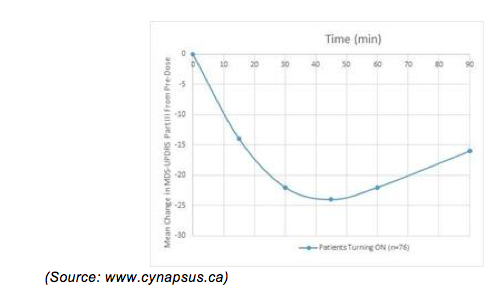
- The median dose of APL-130277 that helped patients to turn to complete ON state was 20mg.
- 83% of patients turned from OFF to fully ON state.
- 78% of patients turned fully ON within 30 minutes; about 38% were fully ON at 15 minutes.
- The mean change in MDS-UPDRS Part III score was 22 points from baseline to 30 minutes and 24 points from baseline to 45 minutes. A low rating indicates an improvement after treatment
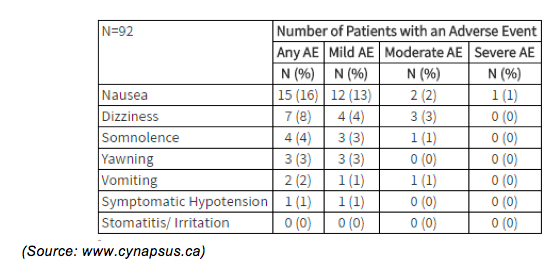
- Between five to twelve minutes after dosing about 60% of patients showed improvement in motor function.
- Patients demonstrated improvement in motor function lasted more than ninety minutes. The mean improvement of the MDS UPDRS Part III score was sixteen points.
- APL-130277 was well tolerated. About 34% of patients reported adverse events such as mild nausea (16%), dizziness (8%), somnolence (4%), vomiting (2%) and symptomatic hypotension (1%).
- No one reported having local irritation during the study.
- A total of sixteen patients were dosed and did not complete the dose titration study. Five patients discontinued due to an adverse event, nine patients discontinued as the highest dose in this study (35mg) was not sufficient to turn them from OFF to ON state within the 45-minute duration and two patients discontinued for administrative reasons.
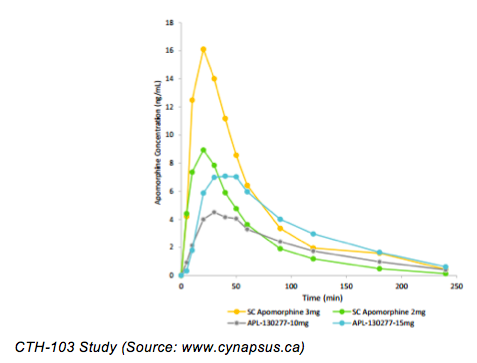
The Phase 1 clinical trial (CTH-103) demonstrated that APL-130277 had a pharmacokinetic (PK) profile that was comparable to SC apomorphine. APL-130277 demonstrated muted adverse events (AEs) including nausea, vomiting, hypotension and skin irritation profile. The rounded curve on the graph showing plasma concentration and longer duration of effect compared to SC apomorphine (blue) shows extended efficiency of APL-130277. The findings from CTH-300 dose titration phase were comparable to those from CTH-103 study.
Management thinks that the trial is adequately powered (90%) with a sample size of 92 patients and is sufficient to show statistical and clinical significance. Further, the Phase 3 study has almost five times more patients from various centers distributed widely with a broad range of investigators as compared to Phase 1/2 studies. This helps prove the efficacy of the drug across a wider population that may help in highlighting the superiority of the drug relative to the active comparator.
The CTH-301 Phase 3 Safety Study (CTH-301) is a long-term open-label, single arm safety study in PD patients who have at least one OFF episode per day, with total OFF time of at least two hours per day. The objective is to evaluate the safety and tolerability of APL-130277 in up to 200 patients with PD over a six-month period. Patients completing CTH-300 are eligible to enter CTH-301. In addition, new patients from approximately 65 sites in the U.S. and Europe will be enrolled in CTH-301.
European Clinical Trial Update: As planned the company consulted with the European Medicines Agency (EMA) regarding the design, duration and size of the clinical trial for obtaining regulatory approval in Europe. The EMA requires that the trial is able to establish significant functional endpoint (activities of daily living) as compared to SC apomorphine. Based on the guidance received from the EMA, Cynapsus plans to initiate a pivotal clinical program evaluating the safety and efficacy of APL-130277 in up to eighty PD patients in Europe in 2H 2016. Patients are expected to be randomized in a 4-week open label, active comparator crossover study with sub-cutaneous apomorphine. The functional endpoints include the duration of ON state, preference and ease-of-use of APL-130277, the use of patient diaries, and tolerability of APL-130277. The study expects using limited use of an anti-emetic (domperidone). Although domperidone (upper gastrointestinal motility agent) has been used previously in Europe to reduce occurrence of peripheral adverse events such as nausea and vomiting, its use was restricted to a low dose of 10mg for three times a day up to one week duration. CYNA has been advised to restrict the use of antiemetic in this study as it may cause sedation or drowsiness and/or reduce the effectiveness of APL-130277. Based on the current timing of events, the European clinical trial is expected to commence in the fourth quarter of 2016.
Market Potential and Pricing: Approximately one million of the U.S. adult population and an estimated six million people worldwide suffer from PD. Management’s survey conducted in 2012 provided insight into the market potential of this product. About 40% of these patients experience at least one OFF episode or two hours of cumulative OFF episodes per day. This equates to a target patient population of around 400,000. As per management’s survey of neurologists and movement disorder specialists, the target audience can be categorized into three segments: ~20% are considered mild (experiencing one OFF episode per day), ~55% are considered moderate (experiencing two OFF episodes per day) and ~25% are considered advanced (experiencing three or more OFF episodes per day).
Cynapsus is attempting to address the wide range of severity of PD patients (mild, moderate and severe) with APL-130277. Since every PD patient’s range of symptoms is unique they require different treatment regimens. While patients with mild symptoms may administer one strip per day, a patient experiencing severe symptoms may require three to five strips per day. Further, PD is known to worsen over time, which implies that increased doses need to be taken to manage symptoms as they progress. Additionally, high insurance premium are imposed on patients taking expensive drugs.
In order to address this broad spectrum of patient audience and bring financial relief them, CYNA is planning to price APL-130277 attractively to make it accessible and affordable. While apomorphine has been the holy grail in treating advanced PD patients, the high cost of the drug, the necessity of co-therapies for prevention of side effects and the subcutaneous administration has restricted its use. Besides attracting new patients to the sublingual formation, APL-130277 could widen the use per patient as it is definitely user friendly and less painful as compared to the injectable drug.
Back in 2010-2011, management surveyed neurologists, movement disorder specialists as well as large insurance payors to determine pricing structure for the drug. The result of the survey showed a potential favorable pricing environment and high acceptance (~90%) for reimbursement. Roughly 75% of the responders were willing to reimburse at an average wholesale price equal to the apomorphine injection, if clinical trials demonstrated substantial benefit over the injectable apomorphine.
It is a known fact that apomorphine is a morphine derivative but is a non-narcotic. It acts as a potent dopaminergic agonist. Since hepatic metabolism prevents its effectiveness when dosed orally, subcutaneous (SC) injection has been set as the gold standard for maximum effectiveness. SC injections are used either intermittently or continuously to help in managing sudden and/or unexpected OFF episodes. Since the use of injections can be difficult for some patients experiencing severe tremor or dyskinesias during OFF periods CYNA has developed APL-130277 that is dosed sublingually.
Cash Position: As of May 31, 2016, CYNA reported cash and cash equivalents of approximately $68 million. Quarterly operating burn is ~$8 million. There are currently 16.5 million shares on a fully diluted basis. CYNA also has some warrants that are subject to a forced exercise provision if the firm’s closing share price meets or exceeds the strike price. We believe there is a potential for this to happen when the firm releases top line data from CTH-300 study as well as if interim results are revealed from the European trial by end of 2016/beginning 2017. If all of the warrants are exercised, CYNA will receive proceeds of about $30 million (non-dilutive to investors) which will bring the cash balance to around $70 million in the beginning of 2017. The additional funds will be used for launching APL-130277 and for general working capital. We have forecasted NDA approval around the beginning of 2018. Based on our financial model, we believe this is achievable with ~$25 million in cash on hand at that time.
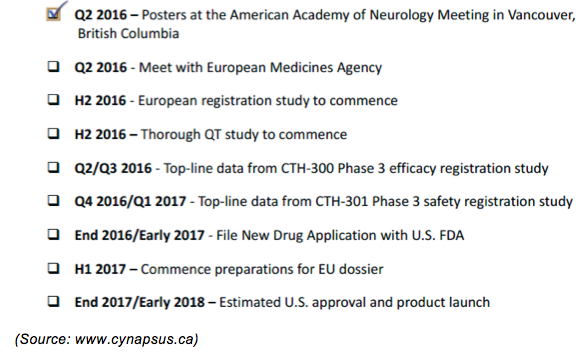
Anticipated Timeline: CYNA’s goal is to report data from the CTH-300 study in the third/fourth quarter 2016. If the data are positive, which we think is highly likely, we believe the company will move quickly to secure a commercialization partnership for the drug. This could be a potential game-changer for Cynapsus, which will allow management to initiate additional M&A or licensing transactions to expand their commercial business beyond 2018.
READ THE FULL RESEARCH REPORT HERE
SUBSCRIBE TO ZACKS SMALL CAP RESEARCH to receive our articles and reports emailed directly to you each morning. Please visit our website for additional information on Zacks SCR and to view our disclaimer.