By Nisha Hirani, M.D.
TSX:CZO.V
On March 1, 2016, Ceapro Inc. (TSX:CZO.V) announced a research partnership with McMaster University for its Pressurized Gas eXpanded (PGX) Technology. McMaster University researchers (Professor Todd Hoare and Professor David Latulippe from the Department of Chemical Engineering) have been awarded a $370,300 research grant from The Natural Sciences and Engineering Research Council of Canada (NSERC) to advance Ceapro's application of its PGX technology. This research program will aim to develop novel chemistries for stabilizing Ceapro's PGX-derived products. There is a three-year agreement in place, and through this strategic research project collaboration, Ceapro will host and train three graduate students as well as two undergraduate students per year in its Edmonton-based laboratories. Ceapro will provide in-kind financial support to match the NSERC award received by McMaster University.
The study will focus on the development and application of highly tunable porous biopolymers and smart polymer scaffolds using Ceapro's PGX technology that change properties in response to an environmental stimulus, which is temperature in this case. The study should commence at some point during the first half of 2016 and aims to expand the use of renewable biopolymers such as starch, pectin, chitosan and crystalline nanocellulose as scaffolding materials. According to Ceapro, the goal is for these novel chemistries to be leveraged “to apply these stabilized porous constructs to improve delivery of drugs and agricultural chemicals, generate 3D cell scaffolds maintaining high cell viability, generate low-cost alternatives for purification of antibodies and viruses, improve methods of removing heavy metal ions from industrial waste water, and enhance the capture of carbon dioxide from polluted air.”
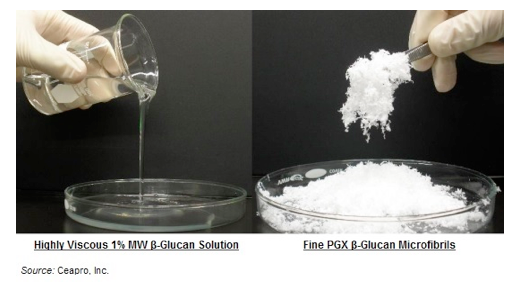
As a reminder, PGX technology was co-invented by Dr. Bernhard Seifried, Senior Researcher at Ceapro, and Dr. Feral Temelli from the Department of Agricultural, Food & Nutritional Science of the University of Alberta. PGX technology is a novel, heat-free, drying technique that utilizes properties of pressurized gas expanded liquids to produce a wide variety of highly porous, preservative free, sterile morphologies of water-soluble biopolymers that have large specific surface areas and tunable surface properties (below). These morphologies include granular powders, fine fibers, granules, aerogels, purified bioactives and exfoliated bio-nanocomposites and, according to management, are similar to those obtained by freeze-drying but at a fraction of the required time and cost.
Management hopes to be able to expand the applications for its PGX technology and generate more exports of Ceapro’s products through this partnership with McMaster University. We believe there is potential to develop and expand PGX technology. We also find the ability of PGX technology to crossover into other industries to be very appealing and, in our opinion, could provide significant upside potential in the near future. The U.S. patent for PGX technology that was issued on February 3, 2016 further strengthens Ceapro’s patent portfolio, and we see this as great news for the company. In the future, we think that Ceapro may have the opportunity to sub-license PGX technology to third parties and/or serve as a contract manufacturer. As per management, several multinational organizations in a variety of different industries have already executed confidentially agreements with Ceapro to assess their material with the proprietary PGX technology. We look forward to watching the PGX story unfold for Ceapro.
Follow Nisha On Twitter @HiraniMD
SUBSCRIBE TO ZACKS SMALL CAP RESEARCH to receive our articles and reports emailed directly to you each morning. Please visit our website for additional information on Zacks SCR and to view our disclaimer.