By John Vandermosten, CFA
TSX:CZO.V
On May 18, 2016, Ceapro Inc. (TSX:CZO.V) announced first quarter 2016 revenues and earnings. Sales increased by 137% in the first quarter, achieving a company record of $4.1 million (note that all currency herein is denominated in Canadian dollars). This handily surpassed our estimates which called for revenues of $2.8 million. Better than expected growth continued to come from strong sales of beta glucan in Asia and more specifically China, and a stronger dollar which helped CAD based revenues. Sales to Germany increased by $1.4 million from sales to partner Symrise. Ceapro’s distribution partner, Symrise, conducts sales not only in Europe but also beyond Europe’s borders. A material but undisclosed proportion of sales classified in the Germany segment are passed on to Asia, and more specifically China, as demand for anti-aging cosmeceuticals is increasing considerably, driving the tremendous growth observed in the quarter.
Gross margins continued to impress in 1Q:16, increasing 24 percentage points over the prior year as the benefit from higher quality feedstock and process efficiencies persists. Volume growth also helped leverage fixed costs over a greater level of revenues, as did input costs sourced in Canadian dollars compared to sales in the stronger US Dollar.
General and administrative expense declined dramatically compared to the prior year from $0.8 million to $0.5 million. The 38% contraction was mainly attributable to two items, lower legal expenses related to the AVAC trial and lower salaries and benefits due to lower non-cash compensation expenses. Lower board compensation expenses, also related to non-cash compensation, was a factor and partially offset by higher public company expenses. Amounts were lower than our estimate of $0.7 million
Research and development expenses increased from $0.1 million in 1Q:15 to $0.3 million in 1Q:16 or by approximately 200% over the prior year, which matches our estimate. Additional R&D staff and patent costs were the main drivers behind the increase.
The balance sheet continues to improve as cash increases from $1.7 million in the prior quarter to $2.0 million in 1Q:16. Positive operating cash flows of $2.3 million were reduced by investing activities of $1.7 million and repayment of $0.2 million of debt. Total debt carried on the balance sheet fell sequentially from $4.4 million to $4.2 million.
Cash flow improved dramatically in the first quarter of 2016, with operations generating $2.3 million compared to a deficit of ($0.2) million in the same period last year. Capital investments and leasehold improvements were $1.6 million in the quarter vs. $0.5 million in 1Q:15. 1Q:16 free cash flow was $0.7 million, well ahead of the ($0.6) million draw in the first quarter of 2015.
2016 Estimates
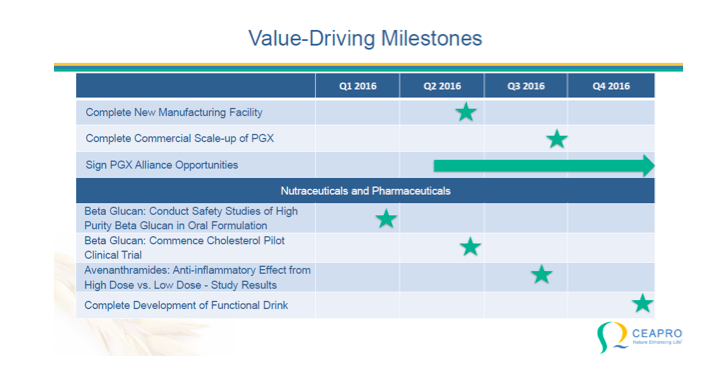
Our forecasts for 2016 reflect a slight reduction from first quarter sales trends on the revenue line as we anticipate a slightly slower rate of sales as the channel is filled. During 2016, Ceapro anticipates bringing new production facilities on-line with initial validation trials in the June to August timeframe and eventual production by 4Q:16. The company is required by its agreements with customers to run both the old and new facilities simultaneously for the first six months; however, management will attempt to shorten this period to leverage the higher level of efficiency anticipated with the new manufacturing plant. We forecast the currency related drivers of gross margin to subside as 2016 progresses and forecast a level in the mid to high 60% range. However, we anticipate higher efficiencies, automation and throughput from the new facilities to support gross margin levels over the longer term.
Research and development costs are anticipated to rise in 2016 as clinical trials are launched for beta glucan (cholesterol reduction) and safety and bioavailability studies are conducted. We have conservatively forecasted $1.2 million of expenses here. General and administrative costs should remain relatively constant with 2015 levels despite the anticipated continued growth of the company due to lower expected options expenses and the absence of other one-time expenses that were carried in this line item in previous years. Sales and marketing expenses are considered to be close to zero in 2016 as the company exclusively uses distributors for selling its product.
Ceapro believes that operating cash flows combined with cash from financing will be sufficient to fund operating expenses, ongoing capital investment and current debt repayment. The company estimates it will need to generate $3 million from operations and other sources to complete the new facility and we anticipate that the majority of this cash requirement will be able to be generated internally through operating activities.
Recent Material Events
In early May, Ceapro’s senior research scientist Bernard Seifried, Ph.D. presented the PGX Technology at the 15th European Meeting on Supercritical Fluids. His presentation, entitled “PGX Technology: An Enabling Technology for Generating Biopolymer Fibrils, Particles Aerogels and Nano-Composites,” discussed the detail behind the Pressurized Gas eXpanded Liquid Technology describing the key advantages over conventional drying and purification technologies that can be used to process biopolymers into high-value, nano-sized polymer structures and novel bio-nanocomposites.
Ceapro announced a continuation of its relationship with the German-based Symrise on April 6, which, along with Ross Organic in California, comprise near 90% of corporate sales. This is an agreement for the distribution and commercialization of Ceapro’s active ingredients in the cosmetic markets. Additionally, the company has an outstanding loan agreement with Symrise for Euro 1 million.
On February 3, 2016, Ceapro announced that it received issuance from the U.S. Patent and Trademark Office (USPTO) for U.S. Patent No. 13/638,254 titled, “Supercritical Fluid Treatment of High Molecular Weight Biopolymers.” The patent covers proprietary methods related to the production, impregnation and micro-encapsulation of micro- and nano-particles, agglomerates and fibers from high molecular weight water-soluble biopolymers generated by applying Pressurized Gas eXpanded (PGX) supercritical fluid technology. Not only does this strengthen Ceapro’s intellectual property portfolio, but also helps expand the company’s reach into the pharmaceutical and nutraceutical arenas in addition to advancing strategic alliance collaborations in various industrial applications.
Below, we share some of the key milestones expected in 2016 with regard to the manufacturing facility and some of the research the company is conducting on the health benefits from its key products.
Summary
Ceapro utilizes a proprietary plant extraction based manufacturing process to supply ingredients that are currently used in multiple household products in the personal care and cosmetics industries. We can find Ceapro ingredients inside well-known branded products like Aveeno, Burts Bees, and Nexxus. Ceapro’s active ingredients are manufactured from proprietary oat varieties and various natural sources grown in many regions around the globe, with additional emphasis on Canadian crops. The company’s flagship product, avenanthramides (AVA), in addition to its value driver, beta glucan, are two oat-derived compounds that make up the core of Ceapro’s product base. Ceapro is the only worldwide commercial manufacturer of natural AVA.
Over the last ten years, the main priority of the company has been to provide novel, natural, environmentally friendly ingredients to cosmetic and personal care product manufacturers and developers of human and animal therapeutics. Ceapro extracts are currently used in the cosmeceutical (cosmetics that have medicinal or drug-like effects) market, with the hope for entry into the pharmaceutical and nutraceutical (derived from food sources that purport health benefits such as vitamins, minerals, herbals, and functional foods and beverages) sectors in the relative near term. The company has plans to involve a steady pipeline of innovative products for both the human and animal healthcare industries.
We continue to view the Ceapro strategy as promising, and believe there is potential to expand into the functional food/nutraceutical, and possibly the pharmaceutical markets. The PGX technology may be able to crossover into other industries and provide upside potential from licensing revenues. The U.S. patent for PGX technology that was issued on February 3, 2016 further strengthens Ceapro’s patent portfolio. We think that Ceapro may have the opportunity to sub-license PGX technology to third parties and/or serve as a contract manufacturer. As per management, several multinational organizations in a variety of different industries have already executed confidentially agreements with Ceapro to assess their material with the proprietary PGX technology.
In fiscal year 2015, Ceapro reported very strong revenue and earnings growth due to strong international demand for their products and improvements in feedstock yields that improved gross margins and leveraged fixed costs. The balance sheet is very strong due to debt and convertible issuances during the year and strong cash generation from operating activities. While the company may need to raise additional capital to complete the new manufacturing facility, it is also possible that internally generated funds alone may support the project. Although the company does have significant customer concentration, we believe its partnership with Symrise in particular, will assist them in selling the additional manufacturing capacity once the project is completed. We have not assumed any new sales in our model from the completion of the additional manufacturing capacity, and so this represents potential upside to the model.
Neither does our valuation model account for the commercialization of Ceapro’s avenanthramides and/or beta glucan as pharmaceutical products. In the near future, we expect to see results from the studies and trials that are being conducted that support efficacy for treating high cholesterol and inflammation. If these potential candidates are eventually approved, we anticipate material upside to our Ceapro valuation.
Our target price is derived using a multiple of earnings ratio of 15x applied to 2017 earnings per share. Based on our revisions to the model, we increase our target price from $0.85 to $1.24 per share.
READ THE FULL RESEARCH REPORT HERE
SUBSCRIBE TO ZACKS SMALL CAP RESEARCH to receive our articles and reports emailed directly to you each morning. Please visit our website for additional information on Zacks SCR and to view our disclaimer.