By Grant Zeng, CFA
OTC:DMPI
On April 19, 2016, DelMar (OTC:DMPI) presented updated data from its ongoing Phase I/II clinical trial in refractory glioblastoma multiforme (GBM) with its lead anti-cancer product candidate, VAL-083 (dianhydrogalactitol) at the American Association of Cancer Research (AACR) Annual Meeting in New Orleans.
Background of the Phase I/II clinical trial
DelMar initiated the Phase I/II clinical trial of VAL-083 for the treatment of refractory glioblastoma multiforme (GBM) or progressive secondary brain tumor in October 2011. The Phase I/II study is an open-label, single arm dose-escalation study designed to evaluate the safety, tolerability, pharmacokinetics and anti-tumor activity of VAL-083 in patients with histologically confirmed initial diagnosis of primary WHO Grade IV malignant glioma (GBM), now recurrent. Patients with prior low-grade glioma or anaplastic glioma are eligible if histologic assessment demonstrates transformation to GBM. Patients must have been previously treated for GBM with surgery, and/or radiation, if appropriate, and must have failed both Bevacizumab (Avastin) and temozolomide (Temodar), unless either or both are contra-indicated. Patients with brain tumors that have developed due to CNS metastases were eligible for the DelMar clinical trial at early doses.
The primary outcome measures in the dose-modernization portion of the clinical trial will be the determination of maximum tolerated dose (MTD). Secondary outcome measures include tumor response in patients and pharmacokinetics.
An initial phase of the Phase I/II study will involve dose escalation cohorts until a maximum tolerated dose (MTD) is established in the context of modern care. Once the modernized dosing regimen has been established, additional patients will be enrolled at the MTD in a registration directed Phase II clinical trial.
The study was designed for patients to receive VAL-083 on days 1, 2, and 3 of a 21-day cycle. Tumor response is assessed according to RANO criteria prior to every other 21-day treatment cycle and patients exhibiting stable disease or tumor regression remained on VAL-083. Determination of MTD is based on 3+3 design.
The Phase II Expansion Study
In the Phase I dose-escalation portion of the study, VAL-083 was well tolerated at doses up to 40mg/m2 using a regimen of daily x 3 every 21 days. The 40 mg/m2/d dose exhibited a favorable safety profile, with a trend toward improved survival versus lower doses. Following determination of the maximum tolerated dose (MTD) at 40 mg/m2/d, a 14-patient Phase II expansion cohort was rapidly enrolled at a dose of 40 mg/m2/d on day 1, 2, 3 of a 21-day cycle.
DelMar commenced enrollment in the 14-patient expansion cohort for the trial in GBM near the end of the second quarter of 2015. The purpose of the expansion cohort is to gain additional information about the safety and efficacy of VAL-083 at a 40mg/m2 dose prior to advancement into registration-directed Phase II/III clinical trials.
On October 21, 2015, DelMar announced the full enrollment of the Phase II expansion cohort.
To further explore the therapeutic window of VAL-083, DelMar also enrolled three (3) patients an interim dose of 45mg/m2. Patients enrolled in this clinical trial have failed both front-line therapy with temozolomide and second-line Avastin and, in most cases, one or more salvage therapies.
Updated data were presented at the 20th Annual Scientific Meeting and Education Day of the Society for Neuro-Oncology being held November 19 - 22, 2015, in San Antonio, Texas. Here are the summary of the updated data:
- The 14th and final patient to be enrolled in the Phase II expansion cohort initiated treatment on October 14, 2015, and all patients enrolled in the Phase II expansion cohort have received at least one cycle of treatment to date.
- Safety observations in the Phase II expansion cohort to date are consistent with the Phase I dose-escalation cohort. Generally, observed myelosuppression is mild (Grade 1), with the exception of one patient.
-One subject previously treated with CCNU developed Grade 4 thrombocytopenia suggesting patients with prior nitrosourea treatment who may exhibit higher susceptibility to thrombocytopenia. The inclusion criteria were modified to account for this observation.
- To date, 20 GBM patients failing standard front-line therapy and bevacizumab have been treated with an assumed well-tolerated therapeutic dose of VAL-083 (30mg/m2 /d & 40mg/m2 /d). A Kaplan Meyer survival estimate based on interim analysis of patients enrolled in the Phase II expansion cohort is consistent with observations made in the Phase I dose-escalation portion of the study. Preliminary analysis suggests a potentially meaningful survival benefit in this population following treatment with VAL-083 at doses ≥30 mg/m2 /d in comparison to published reports for the same population.
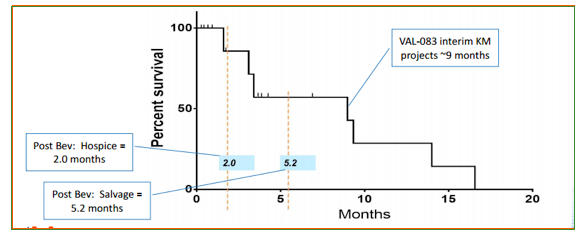
In 2009, Iwamoto reported a median overall survival of 2.0 months after failing bevacizumab for patients receiving only hospice care, and 5.2 months after failing bevacizumab for patients receiving further salvage therapy. The observed median survival to date following treatment with VAL-083 is 9.2 months.
Multiple historical NCI-sponsored clinical studies of VAL-083 demonstrated that, in general, tumor regression in brain cancer was achieved following therapy in greater than 40% of patients treated and stabilization was achieved in an additional 20% to 30%. In published clinical studies VAL-083 has previously been shown to have a statistically significant impact on median survival in high grade glioma brain tumors when combined with radiation versus radiation alone with results similar or superior to other chemotherapies approved for use in GBM.
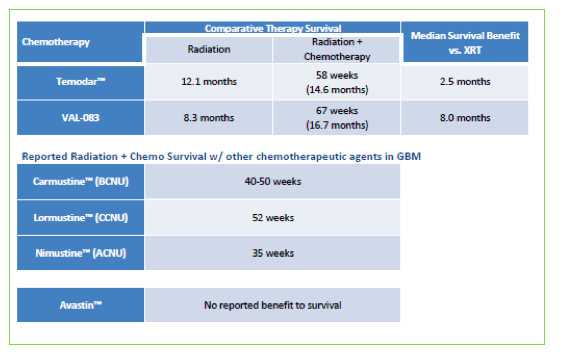
We think the interim survival data from the Phase II expansion cohort is highly promising. We are especially impressed with the safety profile of VAL-083 at the dose of 40 mg/m2/d and the projected greater than 9-month median survival. Taken together with historical and recently demonstrated clinical activity, these results suggest that VAL-083's distinct anti-cancer mechanism has the potential to overcome chemo-resistance and surpass the standard of care in the treatment of GBM.
Updated Data Presented at AACR 2016
DelMar presented updated data at 2016 AACR. In summary, DelMar presented that:
- A well-tolerated VAL-083 dosing regimen of 40 mg/m2/daily every 3 days in a 21 day cycle has been selected for advancement into a Phase III refractory GBM study;
- The Phase III study design and initiation shall be determined in consultation with the USDFA during a meeting planned for the first half of 2016;
- The majority of GBM patients enrolled in DelMar's Phase I/II clinical trial have tumors exhibiting features correlated with resistance to currently available therapies, aggressive disease and poor patient outcomes; and
- This clinical trial is ongoing with expected median survival of eight to nine months following bevacizumab failure. Results to date support the potential of VAL-083 to offer a clinically meaningful survival benefit and a promising new treatment option for GBM patients who have failed or are unlikely to respond to currently available chemotherapeutic regimens.
Tumor Response and Outcomes
Consistent with un-resected refractory GBM, median progression free survival (PFS) was short at 1.2 months (range: 0.2 – 20.1 months). Five GBM patients treated with VAL-083 were reported to have stable disease as their best response following treatment; the remainder reported progressive disease.
Ad-hoc subgroup analysis of the Phase I dose-escalation data indicated a dose response trend. Increase survival was observed at 6, 9 and 12 months following initiation of treatment in a high dose (30 and 40mg/m2) sub-group vs. a low dose (≤5mg/m2) sub-group.
GBM patients failing bevacizumab have a poor prognosis with expected survival under five months. To date, more than half of patients receiving an assumed therapeutic dose of VAL-083 (≥20mg/m2) have survived more than six months following bevacizumab failure; more than 40% have survived for nine months or are currently alive and more than 20% have survived for twelve months or are currently alive with median survival expected to be determined at between eight and nine months following bevacizumab failure.
The study is ongoing and analysis of patient outcomes is continuing.
Data also indicate that the majority of patients enrolled in DelMar's clinical trial have GBM tumors that exhibit features correlated with resistance to currently available therapies, aggressive disease and poor patient outcomes.
Pharmacokinetics
Pharmacokinetic (PK) analyses showed dose-dependent linear systemic exposure with a short (1-2h) plasma terminal half-life; average Cmax at 40 mg/m2/day was 781 ng/mL (5.3µM). The observed PK profile is comparable to published literature. Prior NCI-sponsored studies demonstrated that VAL-083 readily crosses the blood brain barrier and has a long (>20 hour) half-life in the central nervous system.
Based on observed and previously published pharmacokinetics, DelMar believes that therapeutic doses equal to or above 20 mg/m2 daily on days 1, 2 and 3 of a 21 day cycle should deliver sufficient levels of VAL-083 to brain tumors to achieve a therapeutic benefit.
Safety & Tolerability
In the Phase I dose escalation regimen, no serious adverse events (SAEs) related to VAL-083 were encountered at doses up to 40 mg/m2/day.
Increasing frequency of and higher grade hematologic toxicities were observed at doses above 40 mg/m2/day. Consistent with the published literature, the observed dose limiting toxicity for VAL-083 is primarily thrombocytopenia. Observed platelet nadir occurred at approximately day 18, and recovery was rapid and spontaneous following treatment.
Based on Phase I observations, fourteen additional patients were enrolled in a Phase II expansion cohort at 40mg/m2.
Consistent with Phase I, the dose of VAL-083 40 mg/m2 on days 1, 2 and 3 of a 21 day cycle was generally well tolerated in Phase II.
A Registration Directed Phase III Trial to Begin in 2016
Based on the positive interim data, DelMar will request a meeting with the FDA in 2016. The company plans to initiate a registration directed Phase II/III trial in refractory GBM in 2016. This could be a single arm or controlled trial after the feedback from the FDA.
Based on historical development of other products in GBM, it’s possible that DelMar may be able to obtain FDA approval to commercialize VAL-083 to treat patients who have failed other therapies from a Phase II registration-directed clinical trial, which will save significant costs of a large Phase III clinical trial. It’s also possible that the FDA may grant fast-track, accelerated approval and/or priority review status to VAL-083, which will enable DelMar to begin filing for commercial approval during the clinical trial process.
Based on historical precedent with the FDA, the Phase III registration directed trial are expected to mirror the Avastin approval study in that indication. Primary endpoints are overall survival and radiographic response. Secondary endpoints include quality of life, safety and tolerability. The trial will enroll approximately 100 patients. Patients with recurrent GBM who have failed or are ineligible for both Temodar® and Avastin® will be enrolled (the same population as in the current trial).
The recent failure of Avastin in the front line treatment of GBM has highlighted the need for new therapies in newly diagnosed patients, particularly those with unmethylated MGMT promoter regions who do not respond to standard of care with temozolomide.
The registration directed Phase II/III trial for the refractory GBM will take about 9 to 12 months. We estimate data from this will be available in 2H17 and an NDA will be filed in 2H17 or early 2018. The FDA approval will occur in late 2018 or early 2019.
In addition to the proposed Phase III clinical trial, DelMar plans to conduct two additional Phase II studies in separate GBM populations:
- In collaboration with the University of Texas MD Anderson Cancer Center, DelMar plans to conduct a randomized Phase II clinical trial of VAL-083 versus CCNU in bevacizumab-naïve MGMT-unmethylated GBM patients at first recurrence/progression to confirm the tolerability of DelMar's dosing regimen and assess outcomes in recurrent bevacizumab-naïve GBM patients whose tumors are known to express high levels of MGMT (NCT02717962); and
- In collaboration with Sun Yat-Sen University and Guangxi Wuzhou Pharmaceutical (Group) Co., Ltd, DelMar plans to conduct a single arm Phase II clinical trial to confirm the tolerability of DelMar's dosing regimen in combination with radiotherapy (XRT) and to explore the activity of VAL-083 in newly diagnosed MGMT-unmethylated GBM patients whose tumors are known to express high levels of MGMT.
SUBSCRIBE TO ZACKS SMALL CAP RESEARCH to receive our articles and reports emailed directly to you each morning. Please visit our website for additional information on Zacks SCR and to view our disclaimer.