By
Grant Zeng, CFA
NASDAQ:DMPI
On July 11, DelMar (NASDAQ:DMPI) announced the approval from the Nasdaq Stock Market LLC for the listing of its common stock on the NASDAQ Capital Market. The company’s common stock began trading on the NASDAQ Capital Market at the opening of trading on July 12, 2016 under the ticker symbol DMPI.
In preparation for the uplisting, the company did a 1-for-4 reverse stock split of its authorized, issued and outstanding common stock in May 2016.
The NASDAQ uplisting marks a major corporate milestone for the Company. The uplisting will position the company to broaden its shareholder base, increase appeal to institutional investors, provide improved liquidity and ultimately contribute to increasing shareholder value.
As a result of the uplisting and the reverse split, we adjusted our valuation to $16.00 per share from previous $4.00 per share.
We continue to be bullish on the DelMar story based on recent clinical progress the company has made and attractive valuation of the company shares.
DMPI is a clinical and commercial stage biopharmaceutical company focused on the development and commercialization of oncology drugs. The Company’s lead drug candidate VAL-083 is currently in a Phase I/II trial for the treatment of recurring GBM.
Previous multiple clinical studies conducted by NCI have demonstrated that VAL-083 is safe and efficacious for the treatment of GBM. Interim data from the Company’s Phase I/II trial confirmed the efficacy and safety profile of VAL-083 in GBM patients. Based on the data currently available, DMPI intends to initiate a registration directed Phase III trial of VAL-083 for recurring GBM as quickly as possible, and possibly in late 2016. This will be a significant milestone for DelMar which will position the Company as a late stage development company.
DelMar also plans to expand its pipeline by initiating clinical trials of VAL-083 for lung cancer and ovarian cancer.
VAL-083 has been approved in China for leukemia and lung cancer and DMPI has acquired its commercial rights in China market. Delmar is seeking to enter into a marketing partnership that could generate upfront fees, milestones and royalty revenue for DMPI, which is a de-risking event for the Company.
VAL-083 is a first-in-class alkylating agent with a different mechanism of action from that of Temodar, current market leader for GBM. The unique MOA of VAL-083 overcomes the resistance problem for Temodar.
Currently, DMPI shares are trading at around $7.5 per share, which values the Company at about $75 million in market cap based on 10 million outstanding shares. This is a deep discount compared to its peers. We noticed that most small biotech companies of development stage are valued from $50 million to $1 billion depending on how advanced the pipeline is and which indications the company is targeting. DMPI’s lead drug candidate VAL-083 is in a Phase I/II clinical trial and will enter a registration directed Phase III trial in 2016.
We estimate VAL-083 could be approved by the FDA in late 2018 or early 2019 for recurring GBM. The broad application of VAL-083, including first line, second line and third line treatment of GBM, and other cancers, means a great market potential for VAL-083, which could be a blockbuster for DelMar. We estimate DMPI will be profitable in fiscal 2019 with an EPS of $0.24 based on product sales of $35 million. EPS will grow to $1.27 in fiscal 2020 based on total product sales of $70 million.
Based on our financial model and the Company’s fundamentals, we have a valuation at $16.00 per share for DMPI. We think a P/E ratio of 30x is appropriate for DMPI considering its growth in the next few years. Based on this P/E multiple, we come up with our valuation of $16.00 per share using 25% discount for 4 years. Our price target values DMPI at $160 million in market cap, which we think is still conservative compared to its peers.
But risk is still high at this point for DMPI. Although VAL-083 has been approved in China for marketing, its indications are leukemia and lung cancer, different from the current indication of GBM under development in the US. The bars on both clinical and regulatory hurdle in the US are higher. We remind investors that risks associated with drug development are high. But generally speaking, DMPI is a name with a favorable risk/reward profile for investors with a high risk tolerance and longtime investment horizon.
A Registration Directed Phase III Trial to Begin in 2016
In late May, DelMar announced the successful completion of an End of Phase II meeting with the FDA.
DelMar's advanced development program for VAL-083 will feature a single randomized Phase III study measuring survival outcomes compared to a "physicians' choice" control, which, if successful, would serve as the basis for a New Drug Application (NDA) submission for VAL-083. The control arm will consist of a limited number of salvage chemotherapies currently utilized in the treatment of Avastin-failed GBM. The final pivotal trial design will be confirmed with the FDA following further discussions with the Company's clinical advisors.
The FDA confirmed that it will consider the totality of data available, including data obtained from DelMar's other planned clinical trials in related GBM populations, when assessing the NDA. The FDA also noted that DelMar can rely on prior US National Cancer Institutes (NCI) studies and historical literature to support non-clinical data required for an NDA filing and that DelMar will have the option to file under a 505(b)(2) strategy, which allows a sponsor to rely on already established safety and efficacy data in support an NDA.
The company plans to initiate the study as quickly as possible. We estimate it could happen in late 2016.
The registration directed Phase II/III trial for the refractory GBM will take about 9 to 12 months. We estimate data from this will be available in 2H17 and an NDA will be filed in 2H17 or early 2018. The FDA approval will occur in late 2018 or early 2019.
In addition to the proposed Phase III clinical trial, DelMar plans to conduct two additional Phase II studies in separate GBM populations:
- In collaboration with the University of Texas MD Anderson Cancer Center, DelMar plans to conduct a randomized Phase II clinical trial of VAL-083 versus CCNU in bevacizumab-naïve MGMT-unmethylated GBM patients at first recurrence/progression to confirm the tolerability of DelMar's dosing regimen and assess outcomes in recurrent bevacizumab-naïve GBM patients whose tumors are known to express high levels of MGMT (NCT02717962); and
- In collaboration with Sun Yat-Sen University and Guangxi Wuzhou Pharmaceutical (Group) Co., Ltd, DelMar plans to conduct a single arm Phase II clinical trial to confirm the tolerability of DelMar's dosing regimen in combination with radiotherapy (XRT) and to explore the activity of VAL-083 in newly diagnosed MGMT-unmethylated GBM patients whose tumors are known to express high levels of MGMT.
Update on Ongoing Phase I/II Refractory GBM Clinical Trial with VAL-083
On June 4, 2016, DelMar presented updated data from its ongoing Phase I/II clinical trial in refractory glioblastoma multiforme (GBM) with its lead anti-cancer product candidate, VAL-083 (dianhydrogalactitol) at the American Society of Clinical Oncology's (ASCO) Annual Meeting.
DelMar presented updated data at 2016 AACR. In summary, DelMar presented that:
·VAL-083 attacks cancer cells via a unique mechanism of action which is distinct from other chemotherapies used in the treatment of GBM. Specifically, VAL-083 is active independent of MGMT, a DNA repair enzyme which is highly expressed in approximately 2/3 of GBM patients and correlated with resistance to temozolomide, the current front-line chemotherapy in the treatment of GBM. Of patients tested in the DelMar trial, 84% exhibited high MGMT.
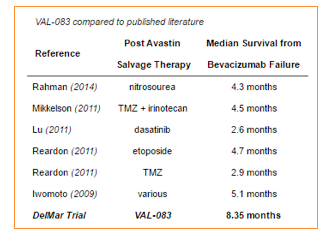
· Median survival of 22 patients receiving an assumed therapeutic dose of VAL-083 (≥20mg/m2) was 8.35 months, suggesting that VAL-083 may offer improved survival for GBM patients following bevacizumab (Avastin) failure in comparison to currently available salvage therapy. Median survival for VAL-083 treated patients following bevacizumab failure compared with published literature demonstrating survival of approximately three to five months with common salvage therapy regimens.
· A dose of 40 mg/m2/day VAL-083 administered on the first three days of every three week cycle is well tolerated in refractory GBM patients and has been selected for study in subsequent clinical trials.
READ THE FULL RESEARCH REPORT HERE
SUBSCRIBE TO ZACKS SMALL CAP RESEARCH to receive our articles and reports emailed directly to you each morning. Please visit our website for additional information on Zacks SCR and to view our disclaimer.