By Grant Zeng, CFA
NASDAQ:DRRX
On Feb. 29, 2016, DURECT Corporation (NASDAQ:DRRX) reported its financial results for the three months ended December 31, 2015.
Total revenues for the 4Q15 were $5.2 million, compared to $4.3 million for the three months ended December 31, 2014, an increase of 21%.
Total revenues for 4Q15 included product sales of $2.9 million and collaborative revenue of $2.3 million, which compared to product sales of $3.0 million and collaborative revenue of $1.3 million for 4Q14.
R&D expenses for 4Q15 were $6.7 million, compared to $5.4 million for 4Q14.
SG&A expenses for 4Q15 were $2.8 million, compared to $3.0 million for 4Q14.
Net loss was $5.8 million ($0.05 per share) for the three months ended December 31, 2015, compared to a net loss of $5.9 million ($0.05 per share) for the same period in 2014.
At December 31, 2015, the company had cash and investments of $29.3 million, compared to cash and investments of $34.9 million at December 31, 2014. At December 31, 2015, the company had $19.7 million in long term debt. Current cash balance can last into the end of 2016 according to our financial model.
As we discussed in our previous reports, earnings report is a non-event for Durect at this stage. Investors should be focused on the advancement the company has made for its pipeline. In this regard, we think Durect has made great progress.
Phase Ib Oral Study of DUR-928 for NASH Initiated
On Jan. 11, 2016, DURECT announced it has initiated a single-ascending-dose Phase Ib clinical trial with oral DUR-928 in patients with nonalcoholic steatohepatitis (NASH).
This Phase Ib trial of DUR-928 is a dose ranging, single-ascending-dose safety and pharmacokinetic study of DUR-928 of subjects with NASH and matched control subjects. This study will be conducted in three successive cohorts evaluating three single-dose levels of oral DUR-928. After a PK/safety review at each dose, the study can proceed to a successively higher dose. Assuming all three cohorts are dosed, the study will comprise approximately 48 subjects, of which approximately 30 will have received DUR-928.
The study is being conducted in Australia and the company anticipates that it will be completed in the first half of 2016. If positive, the Phase Ib data will enable and inform multi-dose POC study in NASH patients in 2016.
The Phase Ib NASH patient trial is based on the positive Phase I safety data the company recently completed with the oral formulation of DUR-928.
The initial Phase I trial of DUR-928 was a single-site, randomized, double-blinded, placebo-controlled, single-ascending-dose study that evaluated the safety, tolerability and pharmacokinetics of DUR-928 when orally administered in 30 subjects. After the completion of the initial single-dose trial, the company subsequently conducted a Phase I multiple-ascending-dose, oral administration trial in 20 healthy subjects, evaluating DUR-928 in two consecutive 10-subject cohorts, the first receiving DUR-928 at a lower dose and the second at a higher dose.
In both Phase I clinical trials, DUR-928 was well-tolerated at all dose levels, with no clinically significant changes in vital signs, laboratory values or ECG parameters, no severe or serious drug-related adverse events reported and no subjects withdrawing from the study. Peak plasma concentrations achieved were at least 100-fold higher than endogenous levels, no accumulation in plasma concentrations were observed with repeat dosing, and dose related increases in plasma concentrations were observed with peak plasma concentration at approximately 2 – 6 hours after dosing.
DURECT Announces Positive Phase I Data for Injectable DUR-928
On Jan 6, 2016, DURECT announced the successful completion of a Phase I clinical trial with an injectable formulation of DUR-928 intended for acute use indications.
The Phase I trial of injectable DUR-928 was a single-site, randomized, double-blinded, placebo-controlled, single-ascending-dose study that evaluated the safety, tolerability and pharmacokinetics of 4 doses of DUR-928 when administered through an intramuscular injection. Total of 24 healthy volunteers in four cohorts were enrolled in the study with 16 receiving DUR-928 and 8 receiving placebo.
Peak plasma concentrations were over 100 fold higher than endogenous levels. DUR-928 was well-tolerated at all dose levels, with no treatment-related adverse events reported and plasma levels were dose proportional.
Before the highest dose was added to the single-ascending-dose study, the company proceeded to a multi-dose cohort including 10 healthy volunteers, in which study participants received DUR-928 for 5 consecutive days (n = 8 on drug, 2 on placebo) with what at the time was the highest dose in the prior study. No treatment related adverse events were reported, no subjects withdrew from the study, no accumulation in plasma concentrations were observed with repeat dosing, and the pain scores and injection site reactions were minimal.
The completion of the Phase I trial of injectable DUR-928 is on track with the company’s development plan and is an important milestone in the development of DUR-928.
What’s next for DUR-928?
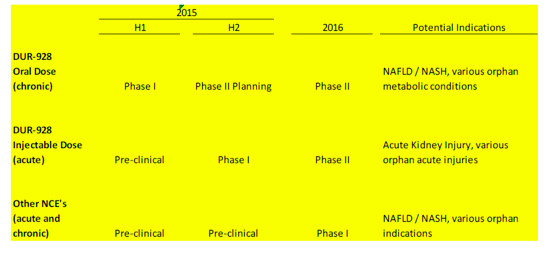
Durect plans to move into Phase II trial in 2016 for both oral DUR-928 and injectable DUR-928, which will be conducted in Australia.
For oral DUR-928, the company plans to conduct Phase IIa multi-dose POC study in NASH patients in 2016 if the Phase Ib data prove to be positive.
For injectable DUR-928, the company is planning to conduct a Phase Ib clinical trial in kidney injury patients shortly based on the positive Phase I data discussed above. This Phase Ib will also be conducted in Australia.
This Phase Ib trial of DUR-928 will be a single-ascending-dose safety and pharmacokinetic study of DUR-928 in patients with impaired kidney function and matched control subjects. This study will be conducted in three successive cohorts evaluating three single-dose levels of DUR-928 administered by injection. After a PK/safety review at each dose, the study can proceed to the next higher dose. Assuming all three cohorts are dosed, the study will comprise approximately 45 subjects, of which approximately 30 will have received DUR-928. The company anticipates that this study will be completed in 2016, and that this study will enable and inform subsequent trials for patients with either acute kidney injury or other kidney function impairment.
If data from the Phase Ib trial of injectable DUR-928 are positive, the company will conduct Phase IIa POC study in acute kidney injury and/or chronic kidney injury patients in 2016.
Long term opportunities fall into four broad categories:
- orphan acute indications;
- broader acute indications;
- orphan chronic indications, and
- broader chronic indications.
DURECT’s initial Phase II studies will be designed to show an efficacy signal in patients suffering from one orphan acute condition such as acute kidney injury and one broad chronic indication such as NAFLD/NASH. We will provide update when the company provides more detail on the Phase II studies in the future.
Large Market Opportunity for DUR-928
Although DUR-928 may have broad applications in many indications, we believe the initial focus will be in NAFLD/NASH and acute kidney injury.
Non-alcoholic fatty liver disease (NAFLD) is the build-up of extra fat in liver cells that is not caused by alcohol. It is normal for the liver to contain some fat. However, if more than 5% - 10% percent of the liver’s weight is fat, then it is called a fatty liver (steatosis). The more severe form of NAFLD is called non-alcoholic steatohepatitis (NASH). NASH causes the liver to swell and become damaged.
NAFLD affects about 30% of adults and 10% of children in the US, among which 10-30% will develop NASH. 25-40% NASH patients will develop progressive liver fibrosis, while 20-30% NASH patients with advanced fibrosis will develop cirrhosis, which could lead to liver cancer.
Currently there are no FDA approved medicines for the treatment of NAFLD/NASH.
Acute kidney injury (AKI) is defined as an abrupt or rapid decline in renal filtration function. This condition is usually marked by a rise in serum creatinine concentration or by azotemia (a rise in blood urea nitrogen [BUN] concentration).
According to Medscape, in the United States, approximately 1% of patients admitted to hospitals have AKI at the time of admission. The estimated incidence rate of AKI during hospitalization is 2-5%. AKI develops within 30 days postoperatively in approximately 1% of general surgery cases and arises in up to 67% of intensive care unit (ICU) patients. Approximately 95% of consultations with nephrologists are related to AKI. The appropriate nephrologist referral rate is approximately 70 cases per million populations.
The current treatment for AKI is mainly supportive in nature. No therapeutic modalities to date have shown efficacy in treating the condition. Therapeutic agents (eg, dopamine, nesiritide, fenoldopam, mannitol) are not indicated in the management of AKI and may be harmful for the patient.
Certainly there are highly unmet medical needs in the NAFLD/NASH and acute kidney injury fields. The unique mechanism of action and the compelling animal and human data so far make DUR-928 a highly promising candidate for the management of NAFLD/NASH and kidney injury.
Update on Posimir (SABER®-Bupivacaine) Post-Operative Pain Relief Depot
In November 2015, Durect began enrolling patients for PERSIST, the POSIMIR pivotal Phase III clinical trial. PERSIST is planned to involve slightly over 300 patients undergoing laparoscopic cholecystectomy (gallbladder removal) surgery. These patients will be randomized on a one-to-one basis to receive either POSIMIR or placebo as a one-time intra-incisional instillation at the time of surgery. In a previous clinical trial of 50 patients undergoing laparoscopic cholecystectomy, POSIMIR was compared with the active control bupivacaine hydrochloride, against which POSIMIR demonstrated an approximately 25% reduction in pain intensity on movement for the first 3 days after surgery (p=0.024), using the same statistical methodology specified for the current trial. PERSIST represents the first pivotal efficacy trial in this category in a laparoscopic procedure. This trial will take approximately one year to complete patient enrollment. This clinical trial is designed to generate additional data necessary to support an NDA resubmission.
POSIMIR is the company’s investigational post-operative pain relief depot that utilizes the company’s patented SABER technology and is intended to deliver bupivacaine to provide 3 days of pain relief after surgery. The company is in discussions with potential partners regarding licensing development and commercialization rights to POSIMIR, for which Durect holds worldwide rights. The company is also continuing to evaluate the requirements for commercializing POSIMIR on its own in the U.S., in the event that the company determines that to be the preferred route of commercialization.
READ THE FULL RESEARCH REPORT HERE
SUBSCRIBE TO ZACKS SMALL CAP RESEARCH to receive our articles and reports emailed directly to you each morning. Please visit our website for additional information on Zacks SCR and to view our disclaimer.