By
Grant Zeng, CFA
NASDAQ:DRRX
Durect Exited Third Quarter with Strong Balance SheetOn October 31, Durect (NASDAQ:DRRX) announced its financial results for the third quarter of 2016 ended September 30.
Total revenue for 3Q16 was $3.7 million, compared to $4.7 million for the same period of last year, a decrease of 21%.
Product sales were $3.4 million for 3Q16, compared to $2.7 million for 3Q15, an increase of 26%. Removing the one-time charge of $0.9 million, gross margin for product sales remained at 61%.
Collaborative R&D revenue was $0.4 million for 3Q16, compared to $2.1 million for 3Q15.
R&D expenses for 3Q16 were $6.8 million, compared to $6.7 million for 3Q15.
SG&A expenses for 3Q16 were $3.0 million, compared to $3.2 million for 3Q15.
Net loss for the third quarter of 2016 was $8.8 million, as compared a net loss of $6.5 million for the three months ended September 30, 2015.
As of September 30, 2016, Durect had cash and investments of $27.8 million. At September 30, 2016, the company had $19.8 million in long term debt.
In July 2016, Durect refinanced its existing $20 million term loan with Oxford Finance into a new term loan that results in an extended maturity (to four years) and an extended interest only period (to 18 months).
Current cash balance can last into the end of 2017 according to our financial model.
Update on Remoxy
In September 2016, Durect’s licensee, Pain Therapeutics, received a Complete Response Letter (CRL) from the FDA for REMOXY ER. Based on its review, the FDA has determined that the NDA cannot be approved in its present form and specifies additional actions and data that are needed for final approval.
According to Pain Therapeutics, the CRL focused on the abuse-deterrent properties of REMOXY ER and proposed drug labeling. The CRL made no mention of clinical safety, drug efficacy, manufacturing, stability, bioequivalence or any other issues from a prior Complete Response Letter.
The CRL specified additional actions that are needed in order to obtain approval of REMOXY ER with label claims against three routes of abuse (i.e., injection, inhalation and snorting).
Specifically, Pain Therapeutics need to conduct the following studies, comparing REMOXY ER vs. one or more commercially available oxycodone ER drug product:
- To support a potential drug label claim against abuse by injection: Repeat an injectability/syringeability study using thin films of drug, smaller volumes of solvents, additional mixed solvents and alternative extraction methods and syringe filter.
- To support a potential drug label claim against abuse by inhalation: Repeat a volatilization study using the same thickness for each drug to increase surface area.
- To support a potential drug label claim against abuse by snorting: Conduct an intranasal abuse potential study in human volunteers (i.e., not the animal data we had submitted) with drug applied directly inside the human nasal cavity.
These actions may take approximately a year to conduct and may cost approximately $5 million.
Pain Therapeutics is evaluating the comments raised by the FDA and is consulting with outside experts.
Based on DURECT's ORADUR®technology, REMOXY (oxycodone extended-release capsules) is a unique oral, long-acting formulation of oxycodone designed to discourage common methods of tampering associated with opioid misuse and abuse. REMOXY is designed to manage pain severe enough to require daily, around-the-clock, long-term opioid treatment and for which alternative treatment options are inadequate.
Chronic pain affects as many as 100 million Americans annually. When chronic pain is severe enough, patients are frequently prescribed long-acting opioid analgesics. Opioids (also called narcotics) include oxycodone, hydrocodone, hydromorphone, oxymorphone, morphine, fentanyl, methadone, and other members of this class.
While opioids are effective at treating pain, they are also widely misused and abused. The FDA has recently described this situation as the opioid abuse epidemic, and called for a far-reaching action plan to reassess the agency's approach to opioid medications. One element of this action plan includes expanding access to, and encouraging the development of, abuse-deterrent formulations of opioid products.
The extended release oxycodone market is ~$2.4 billion in the U.S. alone. We believe that REMOXY represents a $500-750 million drug, of which Durect is entitled to 6-11.5% royalties on commercial sales once launched.
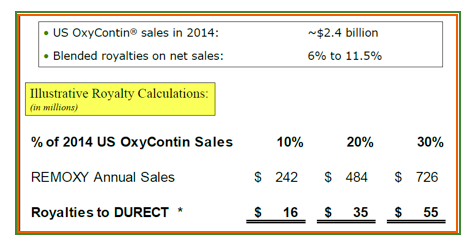
If approved, Remoxy would be the first pharmaceutical product in Durect’s pipeline authorized for commercialization.
Update on DUR-928 Programs
As Durect’s Epigenetic Regulator Program's lead product candidate, DUR-928 is an endogenous, small molecule, new chemical entity (NCE), which may have broad applicability in several metabolic diseases such as nonalcoholic steatohepatitis (NASH), and in acute organ injuries such as acute kidney injury. As we stated in our previous reports, we think DUR-928 is the most important program for Durect and the key value driver for the company in the long run.
Phase Ib Oral Study of DUR-928 for NASH
In January, 2016, Durect initiated a single-ascending-dose Phase Ib clinical trial with oral DUR-928 in patients with nonalcoholic steatohepatitis (NASH) in Australia.
This Phase Ib trial of DUR-928 is a dose ranging, single-ascending-dose safety and pharmacokinetic study of oral DUR-928 in subjects with NASH and matched control subjects. This study will be conducted in three successive cohorts evaluating three single-dose levels of oral DUR-928. After a PK/safety review at each dose, the study can proceed to a successively higher dose. Assuming all three cohorts are dosed, the study will comprise approximately 48 subjects, of which approximately 30 will have received DUR-928.
The company has completed the first, low dose, cohort, consisted of 10 subjects with NASH (of which 4 were cirrhotic and 6 were not cirrhotic) and 6 matched control subjects. After a PK/safety review of this cohort, the study has proceeded to the higher dose cohort utilizing a dose four times larger than the low dose cohort. Major findings from the first cohort:
- Data from the first cohort showed the PK parameters between the NASH patients and the matched control subjects were comparable.
- While this study was not designed to assess the efficacy of DUR-928, certain clinical chemistry biomarkers for liver function and liver injury were reduced 12 hours after dosing with DUR-928 as compared to before dosing.
- Furthermore, high sensitivity C-Reactive Protein (hsCRP), a marker of inflammation, was reduced after dosing with DUR-928. IL-18, an inflammatory mediator implicated in both liver and kidney diseases, decreased in the NASH patients as soon as a few hours after dosing, with the effect more pronounced in cirrhotic subjects at 12 hours after dosing; there was little or no change of IL-18 levels in matched control subjects.
- In addition, both full length CK18 (a generalized cell death marker) and cleaved CK18 (a cell apoptosis marker) were reduced after DUR-928 treatment in the NASH patients, with the effect more pronounced in cirrhotic subjects, and little or no change in matched control subjects.
These preliminary results from the low dose cohort are especially encouraging in our view. Collectively, the reduction of these biomarkers plus results from the company’s animal and cell culture studies suggest potential therapeutic activity of DUR-928 for patients with liver disease.
The trial is currently enrolling and dosing patients in the higher dose cohort, which is expected to complete in 2016. This single-ascending-dose Phase Ib trial will enable and inform future studies in patients with liver diseases. Durect has requested a pre-IND meeting with the FDA with respect to a future liver disease clinical trial in the United States.
Phase Ib Injectable DUR-928 for Kidney Disease
This ongoing trial is also conducted in Australia.
This Phase Ib trial of DUR-928 is an open-label single-ascending-dose safety and pharmacokinetic study in patients with impaired kidney function (stage 3 and 4 chronic kidney disease) and matched control subjects. This study will be conducted in successive cohorts evaluating single-dose levels of DUR-928 administered by injection.
After a PK/safety review of the low dose, the study can proceed to a higher dose. Assuming both cohorts are dosed, the study will comprise approximately 16-18 subjects, of which approximately 10-12 will have received DUR-928. The company anticipates that this study will be completed in 2016, and that this study will enable and inform subsequent trials for patients with either acute kidney injury or other kidney function impairment.
The company recently held a pre-IND meeting with the Cardiovascular and Renal Products Division of the FDA and plans to file an IND which is required to enable a future kidney disease clinical trial in the United States.
Results from additional animal studies
During the third quarter earnings conference call, management of Durect also discussed two additional animal disease models.
In a mouse model of advanced NASH conducted by a Contract Research Organization (CRO) in Japan, the treatment was initiated after fibrosis had formed and stopped after nodules had developed. Daily oral administration of DUR-928 for 4 weeks resulted in statistically significant reduction of fibrosis and hepatocyte ballooning as compared to placebo control. The fibrosis seen at the end of the study in DUR-928 treated animals was less than that seen at the beginning of the treatment. The hepatocyte ballooning seen at the end of the study in the DUR-928 group was significantly lower than at the beginning of the treatment.
In a bile duct ligation rat model (a model for cholestatic liver diseases such as Primary Sclerosing Cholangitis or PSC) conducted by a CRO in Canada, the bile duct was surgically ligated, resulting in cholestatic inflammatory liver injury. Daily oral administration for nine days of DUR-928 showed significant improvement in body temperature and body weight, as well as a statistically significant reduction of total bilirubin (including both direct and indirect bilirubin).
For a free copy of the full research report, please email scrinvestors@zacks.com with DRRX as the subject.
SUBSCRIBE TO ZACKS SMALL CAP RESEARCH to receive our articles and reports emailed directly to you each morning. Please visit our website for additional information on Zacks SCR and to view our disclaimer.