By M. Marin
OTC:EPSC
Founded in 2010, Phoenix-based Epic Stores (OTC:EPSC) is an emerging company launched to leverage growing consumer interest in thrift store shopping. The company has an ambitious store expansion strategy. Epic opened its first unit in Phoenix, Arizona in 2011 and now operates ten used merchandise shops. In addition to Arizona, Epic has locations in Nevada, Colorado, and Texas and plans further expansion throughout the southern and western U.S. Epic believes it offers quality, fashionable second-hand products at steep discounts to their original retail prices.
Store Expansion Continues in 2016
Epic opened two new stores in 2015 and plans to launch another six to eight in 2016, if financing can be obtained. Management is analyzing potential venues in Houston, San Antonio and Austin, as well as Colorado and Arizona. In seeking locations for new stores, the company’s goal is to leverage retail traffic from nearby retailers that target similar consumer demographics.
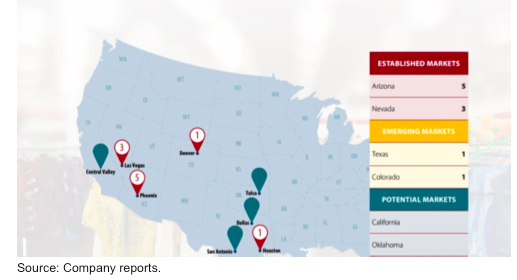
For example, two new Texas locations slated to launch in the first half of 2016 in Houston and San Antonio are each expected to benefit from retail traffic at nearby Walmart stores. In Houston, the company has broken ground on a 29,500 square foot property that is also near a mall, as well as a Walmart and a Sam's Club.
The company is also completing construction on a 23,800 square foot location in San Antonio, which will be its first store in that market. Similar to the planned Houston site, Epic expects to benefit from the traffic of a nearby Walmart, as well as a YMCA.
Management believes San Antonio offers substantial opportunities for further expansion, reflecting economic growth in the market. San Antonio registered 2014 job growth in excess of 3%, according to the San Antonio Economic Development Foundation. Trade publications report that the cybersecurity and overall IT industry are expanding there. Microsoft and Oracle each recently opened or expanded facilities and Dollar General, a major discount store operator, has a new distribution center.
Initiatives to Boost Efficiencies
In the third quarter of 2015, Epic’s retail revenue of $1.6 million was up 26% year-over-year. Although the company does not report same-store sales, given the store expansion, this metric would suggest that some units are experiencing flat to negative same-store sales. Moreover, Epic does not appear to be garnering the economies of scale we would anticipate; cost of goods during the quarter represented 18% of total revenue versus 12% in the comparable 2014 period.
To improve operating metrics, Epic is relocating two existing stores to the Houston and San Antonio locations discussed earlier. The company had two Phoenix sites that were smaller than the newer stores and did not perform at the same level, according to management.
The strategy to shutter these older stores and transfer their inventory is an initiative to raise the company’s overall financial performance. The new, larger locations in Texas are designed to process inventory on-site, similar to Epic’s other locations.
Overall, management’s recent initiatives to improve efficiency and profitability, including sourcing inventory from local charities and schools, appear to have had an impact. Yesterday, Epic announced that it recorded a 27% year-over-year advance in sell-through in 2016 to-date, as well as a 130% gain in on-site merchandise acquisition.
Thriving Thrift Industry
If the company can continue to improve logistics and operating metrics, the backdrop of a growing thrift industry could also enhance its store expansion strategy, management believes. The thrift industry expanded during the recent economic downturn and continues to grow. The National Association of Resale and Thrift Shops (NARTS) indicates that the domestic resale niche, including thrift shops and consignment stores, is among the fastest-growing genres within the overall retail sector.
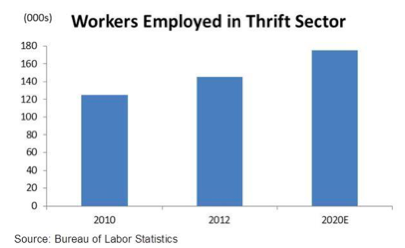
This is supported by data from the Bureau of Labor Statistics (BLS), as well, which indicates that there were 17,206 thrift stores in 2012, up from 16,238 in 2010. In 2012, resale stores employed more than 145,000 workers, up from 125,000+ in 2010 and BLS estimates that the industry will employ 175,000 people by 2020.
Market research firm First Research estimates that, including antique stores which account for an estimated 13% of total sales, the domestic resale industry generates annual revenues of roughly $16 billion. Goodwill Industries accounted for about $5.4 billion in retail sales in 2014, according to NARTS. Data from the Oregon Employment Department indicates that from December 2007 to December 2013, the rate of spending on resale items advanced by 19.5%.
Moreover, the demographics of thrift shoppers is also changing, according to trade publications, as the recent economic downturn, growing interest in DIY and in vintage are making it more mainstream. Consumer research firm America’s Research Group indicates that roughly 12% to 15% of U.S. shoppers purchase from a consignment or resale store annually. According to a December 2014 report published by the BLS, The changing face of retail trade, “Over the last 10 years, changes in the economy have influenced the growth of retail trade. When the economy worsens, consumers look for ways to save money — such as by shopping for products at reduced prices. This results in more workers being needed at discount stores.”
Growing Interest in the Sector
Reflecting this growth, interest in thrift and discount operators appears to be increasing. For example, in 2012 private equity firms TPG and Leonard Green acquired a stake in Savers, the largest for-profit thrift store operator, for over $1.6 billion. According to trade publications, this represented an estimated 10x EBITDA. In 2015, discount retailer Dollar Tree acquired Family Dollar Stores for $8.5 billion.
While the sector has a significant number of Mom & Pops, there are also several large operators. Dollar General is another large publically traded discount player, with a roughly $21 billion market capitalization. In the not-for-profit space, Goodwill Industries processes more than two billion pounds of clothing and household goods each year, “recovering the value in consumers’ donated goods.” About 15% of The Salvation Army’s $4.1 billion in 2014 revenue came from sales to the public.
Epic’s Wholesale Business
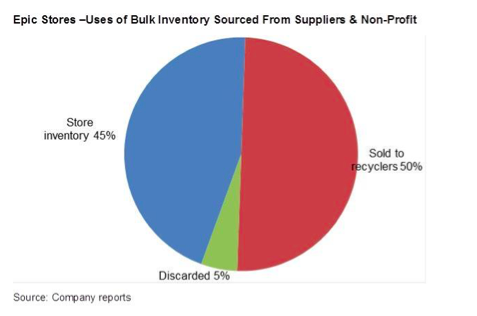
Epic obtains a significant portion of its retail inventory from non-profits organizations. For example, in 2015, the company formed a partnership with the Ronald McDonald House Charity of Greater Las Vegas and will pay for every home pick-up of used merchandise the charity refers. The company is generally able to resell roughly 45% of the inventory it purchases in bulk. Another roughly 50% is sold to recyclers. Epic operates a wholesale business to sell the merchandise that does not sell through its retail stores. Through a subsidiary, Atlas Global, the company supplies used merchandise to distributors. The company’s wholesale business has been under pressure recently. In the first nine months of 2015, revenue of $222,198 was down 70% year-over-year and accounted for only 4% of total revenue, down from 17% in the prior year period. Epic attributes this largely to constrained export demand reflecting the stronger dollar.
Balance Sheet and Financing
Similar to many emerging companies, Epic operates on a thin balance sheet, with cash of $57,977 at September 2015, and continues to seek financing. In June 2015, the company completed a private placement with warrant coverage and raised $2.3 million. Epic recently obtained financing of up to $500,000 from Old Main Capital.
Management
Senior management has extensive experience in the real estate industry. Prior to launching Epic, from 2000 through 2010, co-founder and CEO Brian Davidson was VP of Construction for privately held Riggs Contracting, a $100 million revenue commercial construction company. Co-founder and COO Bob Riggs spent 12 years at Riggs Contracting. Management has indicated that store managers and regional general managers have extensive retail experience, although we believe the company could probably benefit from having a high level executive with a strong retail background.
EPSC Trading Liquidity
The company’s shares became publically traded through a reverse merger in August of 2015. Recently, Epic filed a registration statement for the sale of up to 10.3 million EPSC shares by selling shareholders who obtained shares during the reverse merger. In the near-term, this transaction might constrain the share price, but it might also help the trading liquidity of a thinly traded stock.
SUBSCRIBE TO ZACKS SMALL CAP RESEARCH to receive our articles and reports emailed directly to you each morning. Please visit our website for additional information on Zacks SCR and to view our disclaimer.