Q1 Financial Results, Operating Update…
EyeGate (NASDAQ:EYEG) reported financial results for their first quarter ending March 31st and provided a business update. As expected, the company has yet to generate revenue. Operating expenses of $2.4M were mostly inline with our $2.5M estimate and up significantly (121%) compared to Q1 2015, but about 9% lower on a sequential basis. We expect the inclusion of Jade, the acquisition of which closed in March, along with ramping clinical trial activities to push operating expenses higher throughout the remainder of the year. Q1 EPS was ($0.31), inline with our ($0.32) estimate.
Cash used in operating activities was $1.4M in Q1 but excluding changes in working capital, which included $799k increase in deferred revenue and $570k collection of license fees, cash used in operating activities was $2.3M. EYEG exited the quarter with $7.2M in cash and equivalents which the company believes is sufficient to fund operations for the next 12 – 15 months.
On the operational front, the company continues to make progress with its EGP-437 clinical programs as well as with CMHA-S, Jade’s cross-linked hyaluronic acid compound. Near-term timelines for the three EGP-437 clinical trials remain unchanged, specifically that EYEG expects top-line data from the anterior uveitis phase III study in Q1 2017 and in Q2 of this year to have top-line data from both the second leg of the phase Ia/IIb macular edema trial as well as from the phase Ia/IIb post-cataract surgery study.
EYEG received $1.2M in milestones from Valeant during Q1 related to development progress of EGP-437 for the anterior uveitis indication. We also note that the deferred revenue balance increased by a net $752k through the end of Q1 – which may suggest that EYEG might book additional Valeant-related milestones in the near-term.
Relative to JDE-003, initial clinical trials could begin before current year-end. The compound has demonstrated superior efficacy in animal studies to non-crosslinked HA in corneal repair, which is expected to be the initial indication. In early May, EYEG had four posters related to CMHA-S presented at the Annual Meeting of the Association for Research in Vision and Ophthalmology (ARVO).
As a reminder, EYEG previously noted that they believe JDE-003 will be able to follow an FDA medical device pathway (as opposed to drug pathway) and expects to meet with the agency in Q3 of this year for confirmation. We note that AmbioDisk and Prokera, both amniotic membranes (i.e. disks placed on the eye by clinicians) indicated for use of non-healing epithelial defects also did not follow NDA pathways. Prokera followed 510(k) as a Class II device while AmbioDisk is regulated under Section 361 of the Public Health Service Act by FDA with no clearance required. These are more invasive and require much greater skill to administer than eye drops (i.e. JDE-003). This, combined with the strong safety data to-date, may play in EYEG’s favor. Assuming they get confirmation of the device pathway, EYEG expects to initiate clinical studies for corneal repair in Q4.
EYEG acquires ophthalmic therapy company, Jade Therapeutics…
In early March EyeGate announced the acquisition of Jade Therapeutics, a Utah-based, privately-held specialty pharma developing locally administered, polymer-based ophthalmic therapies. Their lead technology, CMHA-S, is a proprietary cross-linked, thiolated (with carboxymethyl groups) version of hyaluronic acid (HA). HA is a naturally occurring in the human body and is a primary contributor of cell proliferation with wound-healing, tissue repair and anti-inflammatory properties. BioTime Inc. granted Jade a worldwide exclusive license to CMHA-S for delivery of any and all therapeutic molecules related to the human eye. BioTime retains rights for non-ophthalmic indications.
Terms of the deal:
- EYEG paid up to $300k of Jade’s liabilities
- EYEG issued ~766k common shares to Jade, 90% which were issued at closing with the other 10% to be issued 18 months later
- An additional $2.2M in cash is payable upon receiving FDA approval of a Jade product candidate
EYEG assumes Jade’s Salt Lake City based R&D facility. Jade’s co-founders as well as its research team also migrated over to EyeGate. This includes their Chief Medical Officer (who assumed the same role at EYEG) and co-founder, a board certified ophthalmologist with a strong research background and who at a previous role as Pfizer’s Senior Medical Director led the successful European regulatory filing for pediatric Xalatan (eye drop for open-angle glaucoma). Also coming from Jade is their head of R&D who has extensive experience in hydrogels for wound healing and drug delivery as well as another of Jade’s co-founders.
EYEG pulled the trigger on Jade given the complementary product portfolios. We think this is about as good of a marriage in terms of fit for products and customer-channels that could be hoped for. And both companies’ products address the shortcomings of the way that ophthalmic medications are administrated – that is, a rigorous dosing regimen and ineffective penetration.
EYEG bolts on several potential ophthalmic indications at a reasonable purchase price. The pipeline is also re-risked to a degree in that the active ingredient (HA) is already widely used in human ophthalmic (as well as non-eye) applications, a similar cross-linked formulation is already 510(k)-cleared for dermal wound management (BioTime’s product), CMHA-S has been vigorously and successfully tested in animals and a version is marketed by BayerDVM (animal health) in the U.S. and Europe under the Remend brand for corneal wound repair which has sold over 600k units.
Jades Technology…
The average person has about 15 to 20 grams of hyaluronic acid in their body. It is a main component in synovial fluid, which reduces friction between joints, is found in connective tissue and is also a major component of skin where it is involved in tissue repair. It has been used since the 1970s during intraocular surgery to protect the corneal endothelium where it is still considered standard of care. Hyaluronic acid’s efficacy in protecting the corneal endothelium during cataract surgery has been well established.[if !supportFootnotes][1][endif] It is also used in Europe as a first-line treatment for dry eye disease. HA is also an active ingredient in many of the “artificial tears” products sold in the U.S. and internationally. HA is also used in other applications, including as an injectable to treat osteoarthritis. Safety of HA, therefore, has already been well-established (particularly in ophthalmic applications).
One issue that HA suffers from, however, is that it has short half-life with approximately one-third of it degraded (and replenished) in the body each day. But by cross-linking it, it stabilizes the molecule and forms into a hydrogel with a very high molecular weight and viscosity which resists degradation and allows it to adhere to the surface of the eye much longer. Unlike typical eye drops, which quickly run down the side of user’s face, a hydrogel will stay in place and provide the benefit of sustained release, thereby improving efficacy. It also means a much less rigorous dosing regimen. And it remains biocompatible, will thin with blinking and a user’s vision will not be compromised immediately following administration (despite its gel-like properties).
The compound starts with HA from Novosymes (bacterial fermentation). Carboxymethyl groups at then added to produce CMHA which are then thiolated using a proprietary method to produce CMHA-S. Depending on the intended application, it can be formulated into a relatively low viscosity liquid or higher viscosity gel or film.
Initial Indication…
The initial indication EYEG expects to seek is for corneal repair (currently dubbed JDE-003) for populations such as;
- Persistent corneal epithelial defects (PCED)
- Following photoreactive keratectomy (similar to LASIK)
- Moderate-to-severe dry eye
- Following diabetic vitrectomy (eye surgery to remove vitreous gel)
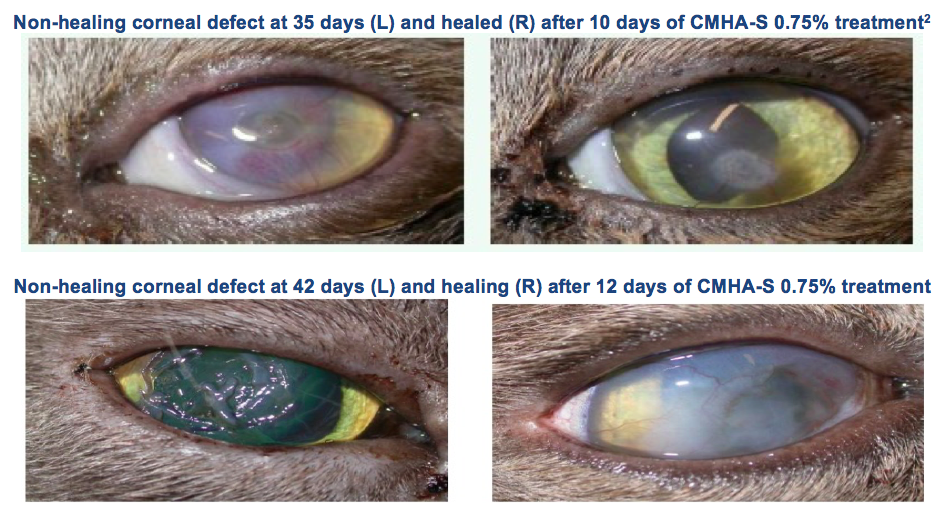
JDE-003 uses cross-linked 0.75% HA solution. A non-healing corneal defect is considered persistent, or non-healing, if it persists for more than two weeks. PCED’s can result in corneal ulcers, scarring, infection and, eventually, blindness if not effectively treated.
A masked, randomized study in 29 cats with superficial, mid-stromal and deep stromal (i.e. non-healing) corneal defects showed superior efficacy of CMHA-S (0.75% concentration) as compared to non-cross-linked 0.25% eye drops. Both arms received their respective eye drops 3x/day and were evaluated weekly. Primary endpoint was lack of staining with fluorescein (i.e. healed ulcer). Results showed eyes treated with CMHA-S 0.75% took an average of 21 days (+ 11 days) to heal while those treated with non-cross-linked 0.25% HA concentration took an average of 32 days (+ 10 days) to heal.
FDA Meeting Upcoming…
EYEG believes JDE-003 will be able to follow an FDA medical device pathway (as opposed to drug pathway) and expects to meet with the agency in Q3 of this year for confirmation. We note that AmbioDisk and Prokera, both amniotic membranes (i.e. disks placed on the eye by clinicians) indicated for use of non-healing epithelial defects also did not follow NDA pathways. Prokera followed 510(k) as a Class II device while AmbioDisk is regulated under Section 361 of the Public Health Service Act by FDA with no clearance required. These are more invasive and require much greater skill to administer than eye drops (i.e. JDE-003). This, combined with the strong safety data to-date, may play in EYEG’s favor. Assuming they get confirmation of the device pathway, EYEG expects to initiate clinical studies for corneal repair in Q4.
Pipeline Indications…
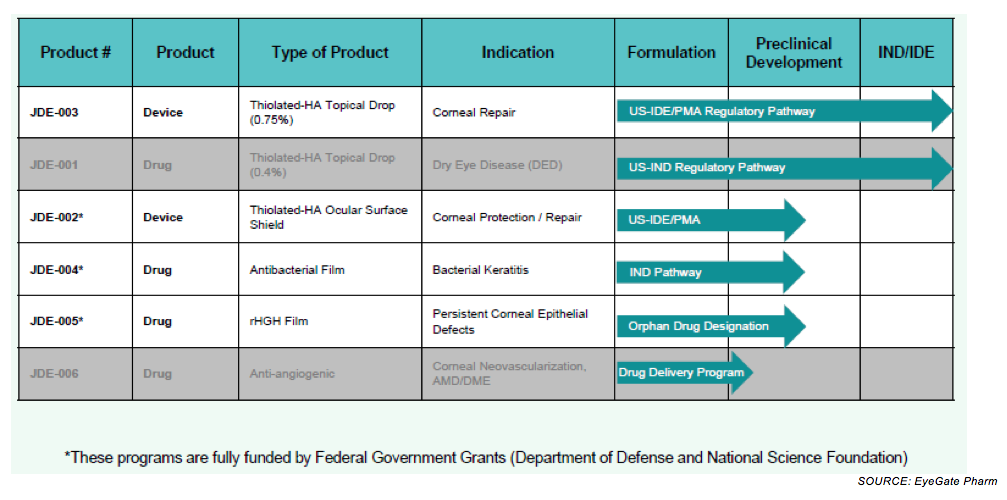
In addition to corneal repair, the pipeline includes JDE-002, an ocular surface shield and JDE-004, for treatment of bacterial keratitis. Both of these programs have been funded by federal government grants.
The ocular shield candidate consists of a thin film, shaped to surface of the eye which will remain in place up to 7 days to promote healing. Department of Defense funding has funded over $1M for Phase 1 and 2 (through August 2017).
JDE-004 utilizes the Jade technology to deliver antibiotics to the eye to treat bacterial keratitis (infectious corneal ulcers), which is most common due to wearing contact lenses overnight. Typical treatment is antibiotics delivered via drops such as Bausch+Lomb’s Besivance (besifloxacin 0.6%). JDE-004 would deliver a medication via a CHMA film with a 7 – 8 day release window, thereby eliminating the need of the rigorous 3x/day for 7 days dosing schedule recommended with Besivance. Jade has demonstrated safety and tolerability of the sustained release film in rabbit models.
Market Opportunity…
JDE-003 is considered the lead Jade candidate with PCED potentially being the most near-term opportunity. EYEG estimates PCED encompasses an annual U.S. market of approximately 125k people. Incorporating an estimated $300 per treatment cost and an average of two (i.e. one to three) treatments per patient, results in a U.S. market opportunity worth roughly $75M (i.e. - ~$40M - $115M). Other indications for JDE-003 could include post photoreactive keratectomy, moderate-to-severe dry eye and following diabetic vitrectomy which, in aggregate, could balloon the total market opportunity to over $1B – the vast majority of which would relate to dry eye, given the relatively high incidence (3 – 5 million Americans) of the condition.
Comments
Jade’s pipeline looks like it could be a seamless fit to that of EYEG’s – not only does it target similar customer channels but also addresses the drawbacks of current ophthalmic drug administration. JDE-003, the lead candidate, is already de-risked to an extent given the long history of HA being used in human eyes and its broad use and extensive successful testing for corneal repair in animals.
Standard of care for corneal repair, including liquid eye drops, bandage soft contact lenses, pressure patching and debridement sometimes fail or require onerous dosing/administration regimens. Newer therapies, including amniotic membranes, offer the potential for greater efficacy and more rapid healing but come with drawbacks – including that some of these must be sewn in place or glued and all require a skilled clinician. These are also relatively costly ($1k - $2k per treatment).
Jade also comes with an existing R&D facility, highly experience staff and existing government grants to help fund other of the pipeline candidates. The purchase price equates to approximately $3.2M (~$2.9M worth of stock plus $300k assumed liabilities) and EYEG will pay another $2.2M (cash) upon FDA approval/clearance of a Jade candidate. All in, this equates to approximately 4% of the annual estimated U.S. market of just the PCED indication. And this implies a no-cost option for all of the other potential indications ($1B plus market, ~$200M of which might be lower-hanging fruit) of JDE-003 as well as for the other pipeline candidates (i.e. corneal protection, bacterial keratitis) and the opportunity to expand into other areas.
We think the JDE-003 program could be fairly fast moving given the existing safety data and that the FDA regulatory pathway is expected to follow that of a device. While it may be a PMA pathway (as opposed to 510(k)), the FDA clinical program could potentially be a relatively small Phase 2 study, followed by a larger (n = 100 or 200) Phase 3 study. While this is just speculation on our part, we should know more following the anticipated FDA meeting in Q3.
We have incorporated JDE-003 into our model and using similar methodology of that for EYEG’s legacy product candidates. If all goes well we think JDE-003 could reach the market sometime in 2018. We use a 50% probability of successful launch in the U.S. and, similar to the deal with Valeant for EGP-437 for the anterior uveitis indication, assume EYEG out-licenses marketing rights. But, given that we are modeling that EYEG assumes all R&D risk, we assume a much higher royalty rate of 20% (versus “high single digits” with Valeant for EGP-437). We think there could be several interested licensors, which could include Valeant but also Allergan and Novartis. We are modeling single-digit penetration through 2022. These, however, are early assumptions and very likely to change as more information becomes available – with the most significant near-term information expected to relate to the FDA pathway and scope of requisite clinical studies.
We cover EYEG with a $6/share price target. See below for free access to our updated report on EYEG
READ THE FULL RESEARCH REPORT HERE
SUBSCRIBE TO ZACKS SMALL CAP RESEARCH to receive our articles and reports emailed directly to you each morning. Please visit our website for additional information on Zacks SCR and to view our disclaimer.