By
Brian Marckx, CFA
NASDAQ:EYEG
Additional Positive EGP-437 Cataract Surgery Data, 510(k) De Novo Pathway Confirmed for OBG…
EyeGate (NASDAQ:EYEG) announced back-to-back positive news over the last few weeks related to both their EGP-437 (iontophoretic delivery of reformulated dexamethasone phosphate) and CMHA-S development programs.
Relative to EyeGate’s Ocular Bandage Gel (OBG), the lead CMHA-S candidate which came from the Jade Therapeutics acquisition being developed for corneal repair indications, EYEG announced in mid-November that they received confirmation from FDA that De Novo 510(k) is an acceptable regulatory pathway. While it had been our expectation that a medical device pathway would be deemed appropriate given that a similar cross-linked formulation had already followed a 510(k) route towards FDA clearance (for dermal wound management), we still view this as positive news as it confirms that EYEG will avoid having to pursue PMA. It also speaks to the validated safety profile of CMHA-S.
De Novo 510(k) was created by FDA in an effort to help streamline approval of novel, low-to-moderate risk medical devices. Prior to De Novo the only route for new devices and for which there was not an acceptable predicate, regardless of their risk profile, was the relatively long, arduous and costly PMA process. The other benefit of De Novo is an expected shorter FDA review time following submission – FDA’s stated goal for De Novo submissions is to make a determination within 120 days while their goal with PMA is 180 days.
EYEG hopes to release top-line results of a clinical pilot study in the very near term. EYEG will compare their CMHA-S Ocular Bandage Gel to artificial tears (i.e. standard of care) in the rate of healing of subjects that have undergone photoreactive keratectomy (PRK). Included in their presentation in September at the Rodman & Renshaw conference was the anticipated design of the PRK pilot study, which we have copied below;
Ocular Bandage Gel photoreactive keratectomy pilot study
- Objective: evaluate safety and performance of OBG eye drop administered 4x/day for 14 days with or without a bandage contact lens (BCL) as compared to artificial tears and a bandage contact lens.
- Primary efficacy endpoint: time to re-epithelization (i.e. healing) of epithelial defect following PRK surgery
- Design: prospective, randomized, controlled study in up to 39 subjects undergoing bilateral PRK surgery. Subjects will be randomized 1:1:1 to one of three cohorts;
-Arm 1: EyeGate Ocular Bandage Gel 4x/day for 2 weeks after surgery in combination with a BCL
-Arm 2: EyeGate Ocular Bandage Gel 4x/day for 2 weeks after surgery without a BCL
-Artificial tears and BCL
As it relates to EGP-437, earlier this week (12/5) EYEG announced additional positive clinical data from their phase Ib/IIa post-cataract surgery dose-ranging clinical trial. As a reminder, the study was designed to enroll up to 80 patients which have undergone unilateral cataract extraction and implantation of a monofocal intraocular lens.
Patients are separated into cohorts of 10 patients each with each cohort treated at different doses and/or treatment regimens. Subjects are evaluated on days 1 (i.e. 1 day following cataract surgery), 14 and 28. Primary endpoint is the proportion of subjects with ACC count of zero on day 14. Secondary efficacy endpoint is the proportion of subjects with a pain score of zero on Day 7.
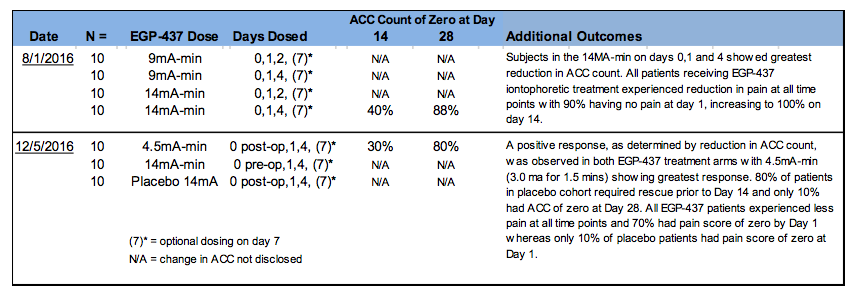
In early August EYEG announced top-line data from 40 patients (4 cohorts) which were administered iontophoretic EGP-437 at either 9.0 mA-min or 14.0 mA-min on day 0, day 1 and day 2 or day 0, day 1 and day 4, with potential for an additional treatment at day 7 in all cohorts. Results showed patients receiving the 14.0 mA-min dose on days 0, 1 and 4 had the most significant improvement in ACC - with 40% of patients in this group achieving an ACC count of 0 at day 14 (i.e. the primary endpoint) and this increased to 88% on day 28.
In addition, all patients receiving the iontophoretic treatment reported reduced pain at all time points with 90% having no pain as early as day 1 and increasing to 100% on day 14. In addition, there was no steroid-related increase in intraocular pressure reported.
Concurrent with the top-line data release in August, the company noted that they would enroll three additional cohorts at other doses and dosing regimens with the expectation of further improving on the efficacy data to-date.
In early December 2016, EYEG announced additional positive data. Dosing and treatment regimen were modified slightly from that of the cohorts represented in the August data and included 30 patients (3 cohorts) which were administered iontophoretic EGP-437 at either 4.5mA-min on day 0 (post-operative), day 1 and day 4 or at 14mA-min on day 0 (pre-operative), day 1 and day 4. The third cohort was dosed with placebo on day 0 (post-operative), day 1 and day 4. An optional treatment (at physician’s discretion) on day 7 was available for all three cohorts.
Results indicated that subjects in the lowest dose cohort (i.e. 4.5mA-min) exhibited the greatest response, with 30% of those patients reaching an ACC count of zero by day 14 and 80% by day 28. While there was limited other data released, EYEG’s press release does provide other indications of a positive EGP-437 treatment response including that; ACC count reduction was observed in both EGP-437 treatment arms, only 10% of placebo patients reached an ACC count of zero by day 28 and 80% of placebo patients required rescue prior to day 14.
In addition, and related to the pain outcome measure, it was noted that all EGP-437 patients experienced less pain at all time points and 70% had pain score of zero by day 1 whereas only 10% of placebo patients had pain score of zero at day 1.
See our table below summarizing the results disclosed in August (4 cohorts) and December (3 cohorts) and the respective dosing and treatment regimens. Perhaps interesting, and maybe arguably confounding, is that ACC count reduction was most profound in one of the two highest dose cohorts in the August data but the December data showed the opposite – that is, the lowest dose cohort had the greatest number of subjects reaching an ACC count of zero.
Although not mentioned in EYEG’s data announcement, one potential factor that could relate to this seeming counter-dose effect is that the higher dose cohort (i.e. 14mA-min) in the December data was treated on day 0 pre-operatively while the lower dose cohort (i.e. 4.5mA-min) was treated post-operatively on day 0. Treating pre-operatively was found to be problematic in EYEG’s earlier cataract surgery (completed in 2013) study as the surgical procedure washed out the drug, thereby eliminating any potential therapeutic benefit. This “wash-out” effect is what prompted the change in trial design to where EGP-437 is administered immediately following surgery.
We characterize this new data as highly promising given that it provides additional evidence of a positive treatment response to EGP-437. EYEG continues to expect to initiate a randomized, placebo-controlled clinical trial of EGP-437 in cataract surgery patients in Q1 2017.
For a free copy of the full research report, please email scrinvestors@zacks.com with EYEG as the subject.
SUBSCRIBE TO ZACKS SMALL CAP RESEARCH to receive our articles and reports emailed directly to you each morning. Please visit our website for additional information on Zacks SCR and to view our disclaimer.