By Brian Marckx, CFA
OTC:ILIU
Q4 2015: PerioPredict Adoption Still Slow, But Making Progress. Top-Notch Clinical Advisory Board Brought On
Interleukin Genetics (OTC:ILIU) reported financial results for the fourth quarter ending December 31st. The majority of revenue continues to come from the Weight Management test although genetic testing revenue continues to slide, including a 6% contraction from Q3 of this year. For the full year genetic testing revenue fell 30%, from $1.6M in 2014 to $1.2M in 2015. We continue to expect little to no growth in revenue of the Weight Management test from the Amway channel, where sales began to soften shortly following Amway’s decision to include the Weight Management test as a promotional bundle, which took effect in early 2013.
We also do not expect any material increase in total sales until there is traction from new products, with PerioPredict being the candidate that likely holds the most promise to significantly jump-start the growth curve. And while management has made substantive progress in laying the groundwork for eventually monetizing this product via their two-pronged (large employers and insurers) strategy, adoption of the test in benefit and insurance plans is clearly a process that will take more time. To facilitate both awareness and adoption of PerioPredict, last week ILIU announced the appointment of a clinical advisory board made up leading experts in the field of chronic inflammatory diseases. A particular focus for the advisory board will be generation and publication of additional clinical data supporting the use of PerdioPredict, including the benefit to lower health care costs and improved patient outcomes.
ILIU also has other irons in the fire besides PerioPredict including potential companion diagnostics for cardiovascular disease (CVD) and osteoarthritis. Management noted on the call that they are aware of 28 drug candidates that are in development by various companies that incorporate an interleukin-1 blocking mechanism and which potentially could be a fit for ILIU’s technology – either as an aid for clinical trial enrollment or as an eventual companion diagnostic for a commercialized drug. We continue to believe that there is substantive potential in this space and one we think may offer ancillary opportunities for ILIU – stay tuned.
PerioPredict:
As a reminder, Mark Carbeau, who was appointed CEO in April 2015, recently laid out a somewhat revised / enhanced strategy for the initial commercialization of PerioPredict aimed at increasing early adoption. Employee Benefit Consulting Group (EBCG), which works with employers and insurers to help align benefit packages with the needs of employer groups and their employees, was brought on to help with implementation.
The strategy is dual-pronged – focusing on large employers, which is expected to provide the initial revenue, and insurance companies, which are expected to require a longer sales cycle but also offer more scalability and upside.
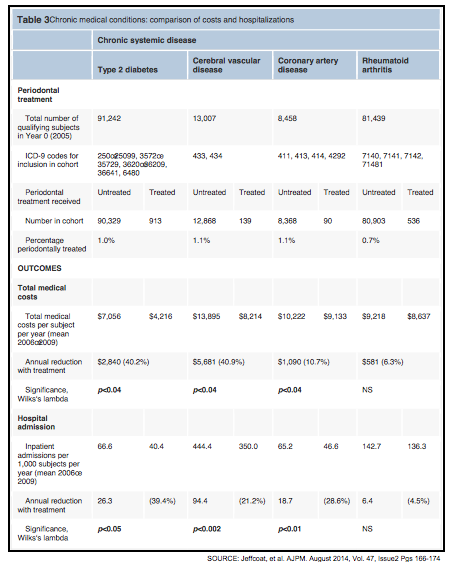
A major focus of the new strategy to help drive adoption of PerioPredict is to leverage evidence that shows that proper dental care can reduce medical expenses and communicate this message to stakeholders (employers, employer groups, insurance carriers, individuals). As support for pursuing this strategy ILIU cites a major study led by Dr. Marjorie Jeffcoat, Professor of Periodontology at the University of Pennsylvania School of Dentistry which evaluated the connection between periodontal disease treatment and medical costs.
The study looked at five years’ worth of medical and dental records data from almost 339k patients. It compared the medical treatment and related costs of individuals that completed treatment and maintenance of gum disease with those that did not. Subsets included a.) diagnosis of at least one specified medical condition and b.) evidence of periodontal disease. Chronic conditions included cerebral vascular disease (stroke), coronary artery disease and type-2 diabetes. Results, which were published in 2014 in the American Journal of Preventive Medicine in an article titled Impact of Periodontal Therapy on General Health and presented by Dr. Jeffcoat at the American Association of Dental Research meeting in Charlotte that same year, showed that for individuals that completed treatment and maintenance of gum disease as compared to those that didn’t had;
annual medical cost savings of
- almost $5,700 for those with stroke (41% reduction)
- almost $1,100 for those with coronary artery disease (11% reduction)
- over $2,800 for those with diabetes (40% reduction)
- over $2,400 for women who were pregnant (74% reduction)
annual hospital reductions of
- 21% for those with stroke
- 29% for those with heart disease
- 39% for those with diabetes
All differences were statistically significant at p<0.05. The study also looked at those with rheumatoid arthritis although this population did not show a statistically significant reduction in medical costs.
So to leverage this type of evidence that proper dental care can reduce medical expenses ILIU and EBCG are targeting both large employers who self-insure and insurance carriers. The initial focus, and likely the lower hanging fruit, is to encourage PerioPredict testing of individuals with chronic conditions such as CVD and type-2 diabetes as this is where the evidence shows more informed dental care can reduce medical costs.
ILIU and EBCG are dedicating most of their initial focus on employers as they believe the sales and adoption cycle may be quicker, given that there are less structural hurdles to overcome (as compared to insurance carriers which requires a modification to plans and have more red tape in general).
On the large-employer side, the value proposition is that PerioPredict can fit into wellness programs (similar to smoking cessation) – essentially that if employers sponsor (or perhaps co-sponsor with employees bearing some of the cost) PerioPredict testing that this cost will be more than recouped in lower medical costs and less employee downtime and missed worked days. The employer then may coordinate with their dental carrier to modify coverage, if appropriate. This is still expected to follow a “phased-in” approach whereby, for instance, wellness plans incorporating PerioPredict might initially target high-risk groups (such as those identified in the Jeffcoat study) and over time expand to a greater portion of the employee population.
In February of this year ILIU scored their first employer contract with Metagenics which will use PerioPredict in their employee benefit plans to help determine which individuals are most susceptible to developing periodontitis. This will not only provide additional guidance for most appropriate dental care but also, per ILIU’s press release, act “as an access point to reduce their systemic inflammatory burden”. Interleukin will provide the PerioPredict genetic testing as well as dental support to their dental providers. We think Metagenics should not only provide a good test-case for incorporating PerioPredict into a company’s benefit plan, but as the duo already have a long-standing relationship, this also has the potential to provide valuable feedback to Interleukin relative to how best to implement their test as well as “what-works and “what-doesn’t” type of feedback.
On the insurance carrier side, ILIU and EBCG have had and continue to have discussions with various carriers in incorporating coverage of PerioPredict in their plans. As noted the insurance-carrier sales cycle is anticipated to be longer – management noted that carriers want to see data-driven pilot and demonstration programs to assess the potential benefits. This, along with various decision-making layers at these large carriers as well as requisite time for new plan design, implementation and the fact that enrollment in new plans is typically a first-of-the-year event, means the insurance carrier channel is likely to be a more drawn out process.
On the Q4 2015 call management noted that the early focus, which may be the low-hanging fruit on the insurance carrier side, will be with those pursing “DMI” plans. These dental-medical integration plans provide employers with both dental and medical benefits. As it seems that integration of PerioPredict into employer benefit plans may be somewhat less than seamless – with one hurdle being how to coordinate between the different medical and dental benefits – these DMI plans may overcome some of these challenges. Of course these plans must first incorporate PerioPredict coverage in the plans first – pilot studies are expected to help facilitate that process.
Particularly positive, we believe is that while integration in both employer benefit plans and within insurance policies seems to be somewhat of a work-in-process with some wrinkles still need to be ironed out, that the potential benefits of PerioPredict do seem to be resonating. Management indicated as much on prior calls as well as the Q4 conference call. This, in our view, is a critically important first step – next is implementation. To aid on both the awareness/utility message and to help on the implementation side, ILIU brought on the advisory board and also expects to bring on additional sales personnel as well as potential increasing their benefits consulting capabilities.
Revenue
Q4 revenue of $366k was up 24% sequentially, up 14% yoy and about 18% better than our $310k estimate. Included in the revenue is $51k in “breakage” – related to an accounting change that ILIU began to recognize in Q4 2013 and allows for the recognition of years-earlier deferred revenue from test kits that have yet to be sent back to ILIU for processing (i.e- given that it’s unlikely these test kits will ever be returned for processing which is when ILIU typically recognizes revenue - ILIU can go ahead and recognize this as revenue).
GM / Operating Expenses / EPS
Q4 gross margin was negative 17%, down from 1% in the comparable year-earlier period and negative 9% in Q3 of this year. GM has contracted significantly with the recent slide in revenue due to less revenue to cover fixed manufacturing costs. Based on historical numbers as well as the most recent period, it appears ~$300k in revenue is the approximate level of break-even gross profit. OpEx was $1.6M, flat from Q3 2014 but down from $1.8M in Q3 2015 and better than our $1.9M estimate. The yoy increase is mostly related to bringing on the new CEO (and Dr. Kornman continuing to serve as Chief Scientific Officer). We expect OpEx to remain at higher levels than in the recent past with additions to the sales and support staff.
Net loss and EPS were $1.9M and ($0.01), which compares to $1.6M / ($0.01) in Q4 2014, $2.0M / ($0.01) in Q3 2015 and our estimate of $2.1M / ($0.01) – with the slight beat to our net loss number mostly coming from lower than anticipated operating expenses.
Cash
Cash used in operating activities was $1.5M in Q4 and $6.7 for the full year 2015. Ex-changes in working capital cash used was $6.5M in 2015. ILIU expects the current cash balance, which was $4.7M at 2015 year-end, to fund the company into the second half of 2016.
See below for access to our updated report in ILIU.
READ THE FULL RESEARCH REPORT HERE
SUBSCRIBE TO ZACKS SMALL CAP RESEARCH to receive our articles and reports emailed directly to you each morning. Please visit our website for additional information on Zacks SCR and to view our disclaimer.