2015 Financial and Operational Results
On March 10, 2016, Lipocine Inc. (NASDAQ:LPCN) reported fiscal year 2015 results which include a loss of $18.2 million, or ($1.11) per share compared with a loss of $20.4 million in 2014. The company did not report any revenues.
Total research and development expenses were $12.6 million, a decline from the previous year’s $15.5 million. Lower costs followed the conclusion of the Phase 3 clinical trial for LPCN 1021. Total R&D expense for LPCN 1021 was $8.3 million, including an NDA filing fee of $2.3 million. Expenses for LPCN 1111 and LPCN 1107 were both approximately $850,000. The balance of R&D costs were predominantly attributed to internal personnel expenses, which fell slightly from the prior year.
General and administrative expenditures of $5.8 million were higher than the prior year’s $5.0 million. The $800,000 increase was due to higher personnel and market research costs as well as pre-commercialization activities on behalf of LPCN 1107.
Total cash and marketable securities increased to $44.8 million, compared to year end 2014 levels of $27.7 million. Cash levels rose due to the April 2015 stock offering which generated $32 million and was offset by $15 million of cash used in operating activities. Lipocine’s balance sheet continues with no debt.
We anticipate first sales of LPCN 1021 to commence in early 2017 and for cash levels to support company operations until Lipocine is able to generate self-sustaining revenues without the need to access financial markets. Sales are anticipated to ramp up quickly, as management expects to develop a 50-person sales force to focus on specialists in endocrinology and urology.
Manufacturing Agreement
Lipocine entered into a manufacturing agreement with M.W. Encap (Encap), a UK-based global contract manufacturing and development organization, to supply bulk commercial quantities of LPCN 1021 on March 3rd of this year. For the five years following FDA approval, LPCN is subject to a minimum purchase agreement. The agreement may be terminated prior to production beginning for a cancellation fee. Encap had previously provided the capsules which were used in Lipocine’s Phase 3 study for LPCN 1021 and is now conducting an International Conference on Harmonization (ICH) Stability Study. This will examine how the compound will perform under the influence of variable temperature, humidity and light and to establish a shelf life for the product in support of Lipocine’s NDA filing for this product.
Pipeline Update for LPCN 1021, 1107 & 1111
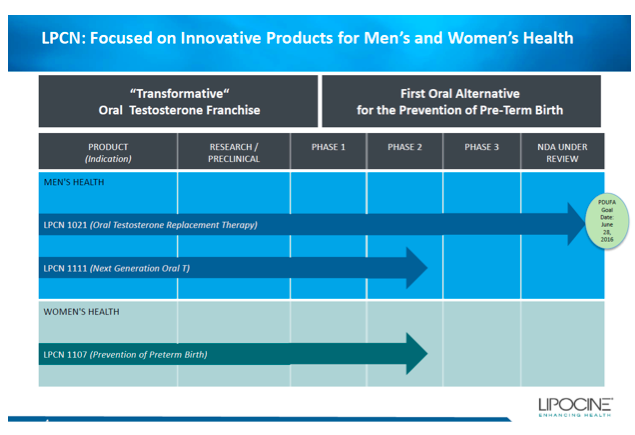
LPCN 1021 Status
On August 28, 2015, Lipocine Inc. submitted a 505(b)(2) New Drug Application (NDA) to the U.S. Food and Drug Administration (FDA) for Lipocine’s lead asset LPCN 1021. LPCN 1021 is a testosterone replacement therapy (TRT) designed for oral twice daily dosing in adult hypogonadal males with low testosterone. The FDA accepted the NDA on October 29, 2015, and subsequently on November 12, 2015, Lipocine announced that the FDA assigned a Prescription Drug User Fee Act (PDUFA) goal date of June 28, 2016 for completion of the review of the NDA, as we had expected according to the standard 10-month review period.
The FDA is not requiring an Advisory Committee prior to the PDUFA date. We view this as good news, and believe this means that the FDA does not need any independent expert advice regarding the LPCN 1021 data that Lipocine has submitted. We assume that the FDA did not identify any significant issues in its initial review to warrant an AdComm. We think there is always a small chance that the FDA could come back and ask for an AdComm, however we find this unlikely to occur at this point. Not having an AdComm will save Lipocine significant time and costs associated with hiring outside consultation for this activity. We believe that instead of preparing for an AdComm, Lipocine can instead focus on moving its pipeline forward and can continue to prepare for a potential commercial launch for LPCN 1021. We view all of this as good news for Lipocine, and continue to believe that LPCN 1021 is on track to receive approval.
Our previous updates discuss LPCN 1021 data from the Phase 3 SOAR trial, the food effect study, and 52-week safety extension arm study in depth. We continue to believe the oral formulation of LPCN 1021, if approved, may improve patient compliance as it appears to be a generally safe, effective, and a more convenient TRT option as compared to topical and injectable TRT products that are currently on the market. LPCN 1021 will have to adhere to all of the new regulations set forth by the FDA if approved. For instance, cautionary language will be required on the label for possible cardiovascular and stroke related risk with TRT, and the lack of benefit and safety of TRT in age-related hypogonadism. Additionally, if LPCN 1021 is approved, we are not sure what the post-approval obligations will be regarding a heart attack and stroke risk study. Lipocine may be have to contribute to an on-going industry-led heart attack and stroke risk study, or it may need to conduct a separate long-term study.
LPCN 1111 Status
On January 4, 2016, Lipocine announced that the first patient has been dosed in its Phase 2b clinical study for LPCN 1111, a once daily oral testosterone replacement therapy (TRT) product candidate. The primary objectives of the study will be to determine the optimal dose of LPCN 1111 along with the safety and tolerability of LPCN 1111 and its metabolites following oral administration of single and multiple doses of LPCN 1111 in hypogonadal males.
As a reminder, LPCN 1111 is the next-generation oral TRT version of LPCN 1021 that has the potential for once daily dosing through use of the company’s proprietary Lip’ral solubilization technology that improves systemic absorption to give effective testosterone levels upon daily dosing. We expect to see top-line data from the Phase 2b study at some point during the second quarter of 2016.
With positive Phase 2a data of LPCN 1111 in place, and the Phase 2b trial now initiated, we believe an end-of-Phase 2 meeting with the FDA should occur at some point during the second half of 2016. As per management guidance, LPCN 1111 is 24 to 36 months behind LPCN 1021. In our opinion, this candidate provides compelling solutions for the weaknesses of currently approved TRT therapies in terms of convenience and compliance. If the Phase 3 data are positive, and trial milestones progress according to the timeline, we could see potential approval as early as 2018.
LPCN 1107 Status
On February 16, 2016, the company reported top-line results of its multi-dose pharmacokinetic dose finding clinical study of LPCN 1107, its oral hydroxyprogesterone caproate (HPC) candidate for the prevention of preterm birth in pregnant women. LPCN 1107 was granted orphan drug designation by the U.S. Food and Drug Administration (FDA) in June 2015, and has also been evaluated in two Phase 1 proof-of-concept studies in both pregnant and non-pregnant women.
On September 28, 2015, Lipocine announced initiation of its Phase 2 multi-dose PK dose finding clinical study with the first subject dosed with LPCN 1107. The primary objective of the study was to study pharmacokinetics over an extended period of time in pregnant women at multiple dose strengths of oral administration of LPCN 1107. The clinical study was an open-label, four-period, four-treatment, randomized, single and multiple dose, PK study in pregnant women of three dose levels of LPCN 1107 and injectable HPC (Makena®). The study enrolled 12 healthy pregnant women (average age of 27 years) with a gestational age of approximately 16 to 19 weeks. Subjects received three dose levels of LPCN 1107 (400 mg twice-daily, 600 mg twice-daily, or 800 mg twice-daily) in a randomized, crossover manner during the first three treatment periods and then received five weekly injections of HPC during the fourth treatment period. During each of the LPCN 1107 treatment periods, subjects received a single dose of LPCN 1107 on Day 1 followed by twice daily administration from Day 2 to Day 8. Following completion of the three LPCN 1107 treatment periods and a washout period, all subjects received five weekly injections of HPC.
READ THE FULL RESEARCH REPORT HERE
SUBSCRIBE TO ZACKS SMALL CAP RESEARCH to receive our articles and reports emailed directly to you each morning. Please visit our website for additional information on Zacks SCR and to view our disclaimer.