By: Nisha Hirani, M.D.
NASDAQ:LPCN
We continue to believe that Lipocine Inc. (NASDAQ:LPCN) represents an attractive long-term investment opportunity. We spoke to management, and things appear to be progressing well with the company moving forward with LPCN 1021, LPCN 1111, and LPCN 1107 clinical programs. After re-visiting our model, we are raising our price target to $24, and continue to rate the stock a ‘Buy’. We believe the recent pullback in the biotech sector presents investors with an interesting long-term buying opportunity.
Update on LPCN 1107
On February 16, 2016, Lipocine Inc. (NASDAQ:LPCN) reported top-line results of its multi-dose pharmacokinetic dose finding clinical study of LPCN 1107, its oral hydroxyprogesterone caproate (HPC) candidate for the prevention of preterm birth in pregnant women. As a reminder, LPCN 1107 was granted orphan drug designation by the U.S. Food and Drug Administration (FDA) in June 2015, and has also been evaluated in two Phase 1 proof-of-concept studies in both pregnant and non-pregnant women.
On September 28, 2015, Lipocine announced initiation of its Phase 2 multi-dose PK dose finding clinical study with the first subject dosed with LPCN 1107. The primary objective of the study was to study pharmacokinetics over an extended period of time in pregnant women at multiple dose strengths of oral administration of LPCN 1107. The clinical study was an open-label, four-period, four-treatment, randomized, single and multiple dose, PK study in pregnant women of three dose levels of LPCN 1107 and injectable HPC (Makena®). The study enrolled 12 healthy pregnant women (average age of 27 years) with a gestational age of approximately 16 to 19 weeks. Subjects received three dose levels of LPCN 1107 (400 mg twice-daily, 600 mg twice-daily, or 800 mg twice-daily) in a randomized, crossover manner during the first three treatment periods and then received five weekly injections of HPC during the fourth treatment period. During each of the LPCN 1107 treatment periods, subjects received a single dose of LPCN 1107 on Day 1 followed by twice daily administration from Day 2 to Day 8. Following completion of the three LPCN 1107 treatment periods and a washout period, all subjects received five weekly injections of HPC.
The company reported that average steady state HPC levels (Cavg0-24) were comparable or higher for all three LPCN 1107 doses than for injectable HPC. HPC levels as a function of daily dose were linear for the three LPCN 1107 doses. Unlike the injectable HPC, steady state exposure was achieved for all three LPCN 1107 doses within seven days. Currently, the approved HPC injectable product is a single fixed dose product that does not allow for dose adjustments. Lipocine also referenced a previous literature study of 250 mg injectable HPC in pregnant women that reported that the lowest preterm birth rates were seen when median HPC concentrations exceeded 6.4 ng/mL and that the plasma concentrations of HPC ranged between 3.7 to 56 ng/mL with the injectable HPC (Caritis et al., 2013). With all three LPCN 1107 doses tested, HPC exposure (Cavg0-24) did not drop below 6.4 ng/ml in any of the study subjects.
We were expecting to see top-line results during the first quarter of 2016, so we are glad to see that things are progressing forward in a timely fashion. As per Lipocine, LPCN 1107 was well-tolerated at all three dose levels, with no adverse drug reactions, serious adverse events, or deaths reported during the study. Based on the released data, it sounds like relevant HPC levels were achieved following oral administration of the doses, and we think that the data reported is encouraging and could potentially allow for dose adjustments of LPCN 1107 during the course of therapy in order to obtain more favorable clinical outcomes. Overall, we view the top-line results as good news for Lipocine, and believe that the company will request an End-of-Phase 2 meeting with the FDA in regards to the Phase 3 development plan at some point during the second quarter of 2016. As a reminder, Lipocine announced its development plans for LPCN 1107 on June 8, 2015. Lipocine received a Type C written response from the FDA that outlined next steps in the development of LPCN 1107. Based on this FDA feedback, Lipocine has been working on formulation optimization of the candidate, and with the top-line results of the multiple-dose PK dose selection study in pregnant women now reported, we believe that LPCN 1107 should be Phase 3 ready by mid-late 2016.
We believe that an oral formulation of HPC would offer a number of advantages over the current injectable formulation of the drug, including elimination of pain and reaction at the injection site as well as eliminating weekly trips to the doctor’s office for administration of the compound. We continue to believe that the area of preterm birth, even in countries as developed as the United States, is an area of unmet need. At this point, we see a path forward for LPCN 1107, and look forward to watching the LPCN 1107 story unfold.
Conclusion
We continue to remain proponents of Lipocine Inc. as an investment in the specialty pharmaceutical sector, and we believe the recent pullback presents investors with an interesting buying opportunity. The company is currently developing three product candidates (LPCN 1021, LPCN 1111, and LPCN 1107) in conjunction with its patented Lip’ral™ oral drug delivery system which is designed to enhance the pharmacokinetic parameters of the drugs, facilitate lower dosing requirements, reduce side effects, and limit gastrointestinal interactions that would otherwise decrease the effectiveness of the compounds. We would like to bring attention to several near term value drivers, which are outlined below:
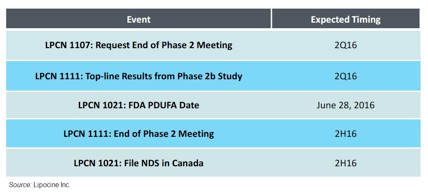
Lipocine has made considerable progress with LPCN 1021. With the NDA accepted and PDUFA date assigned for June 28, 2016, we see LPCN 1021 as having significant potential, and on track for mid-2016 approval. If all goes well, we are expecting LPCN 1021 will see U.S. approval around the middle of 2016, and model peak U.S. sales in the $400 million range. Additionally, we believe that Lipocine could file a New Drug Submission (NDS) in Canada during the second half of 2016. Although we do not currently factor Canadian sales of LPCN 1021 into our model, investors should know that this could offer additional upside to the story. We also believe that LPCN 1021 is much further ahead of any of its competitors, especially with news surrounding Repros Therapeutics Inc. ® (NASDAQ: RPRX) receiving a Complete Response Letter (CRL) from the FDA for its NDA for enclomiphene citrate (formerly known as Androxal®) for the treatment of secondary hypogonadism in overweight men wishing to restore normal testicular function.
Topical products that are associated with poor patient compliance dominate the current testosterone market. We view patient compliance as one of several of serious issues with testosterone replacement products. This issue is not limited to just testosterone products as numerous studies have shown that once-daily dosing regimens had the highest rates of patient adherence (Claxton et al., 2001). Thus, the strategy with LPCN 1111 is to formulate a once daily oral dose of testosterone through a proprietary formulation coupled with the Lip’ral™ technology. An oral dosage testosterone would differentiate itself from gels, patches, and injections due to the convenience, discreteness, and lack of transference. We remind investors that the second-generation version of the drug, LPCN 1111, currently being evaluated in a dose-finding Phase 2b trial, could expand the potential peak U.S. sales to over $600 million. We believe that LPCN 1111 is roughly 24 months behind LPCN 1021 in development. Additionally, it is important to point out that LPCN 1111 is intended to be a once-daily dosing product, as compared to the twice-daily dosing profile of LPCN 1021.
We believe that the positive top-line results from the Phase 2b study of LPCN 1107 for the prevention of preterm birth in pregnant women, and the candidate receiving U.S. orphan drug designation are significant positives for the company. Orphan designation not only protects the intellectual property of the drug, but also allows for aggressive pricing and reduced development and regulatory costs. We model peak U.S. sales of LPCN 1107 of approximately $275 million.
As of September 30, 2015, Lipocine had cash, cash equivalents, and marketable investment securities of $47.8 million. We continue to believe the current cash balance is sufficient to fund operations past the PDUFA date for LPCN 1021, and into the third quarter 2016. We believe that the April 2015 completion of the public offering is allowing Lipocine to step up increased development efforts of LPCN 1111 and LPCN 1107, in addition to focusing on the on-going pre-commercial LPCN 1021 activities. Assuming that LPCN 1021 is approved in 2016, we believe operating expenses will continue to rise in anticipation of the company hiring an adequate sized sales force to promote the drug, in addition to expenses related to maintaining, expanding, and protecting its IP portfolio, and other activities to prepare for the commercialization launch.
We would also like to point out that Lipocine adopted a poison pill on November 16, 2015. The plan was not adopted in response to any current takeover attempt, but is intended to ensure that if there is ever a party interested in acquiring Lipocine, that it will work through the board of directors as opposed to a hostile takeover.
Our NPV analysis on the three product candidates pegs fair value at close to $500 million. We continue to believe that the stock represents an attractive long-term investment opportunity. After re-visiting our model, we have raised the probability of success of LPCN 1107 to 40% as we believe the candidate will be Phase 3 by mid-late 2016. We are raising our price target to $24, and continue to rate the stock a ‘Buy’. We remain bullish on Lipocine shares as an investment in the specialty pharmaceutical sector because we think the company has a promising pipeline.
READ THE LATEST FULL RESEARCH REPORT HERE
Follow Nisha on Twitter @HiraniMD
SUBSCRIBE TO ZACKS SMALL CAP RESEARCH to receive our articles and reports emailed directly to you each morning. Please visit our website for additional information on Zacks SCR and to view our disclaimer.