By
John Vandermosten, CFA
NASDAQ:LPCN
3Q:16 Financial and Operational Report
On November 8, 2016, Lipocine Inc. (NASDAQ:LPCN) filed its third quarter 10-Q reporting a quarterly net loss of ($3.2) million for the three month period ending September 30, 2016. This compares to our estimate of a ($5.4) million loss. On a per share basis the loss was ($0.18) better than our estimate of ($0.29). No revenues were reported in the quarter as expected.
Research and development expense was $1.5 million in the quarter, decreasing from the prior year’s $4.7 million due almost exclusively to a $3.0 million reduction in spend related to LPCN 1021. The majority of the $3 million year over year difference was attributable to the $2.3 million filing fee for the 2015 drug application. Slight reductions in year over year spend for LPCN 1111 and 1107 also contributed to the decline. On a sequential basis, an over $700,000 reduction in LPCN 1111 R&D expenditure led to the majority of the drop off with lower allocations to the LPCN 1021 program also reducing the sequential trend.
General and administrative costs were $1.4 million, down both sequentially and on a year over year basis. Lower costs were attributable to the reduction in workforce which in turn were a response to the delay in approval of LPCN 1021. Other components of G&A also declined such as sales and pre-commercialization expenses as well as lower legal fees related to the Clarus litigation.
Due to the reduction in force, which impacted employees in all functional disciplines, Lipocine assumed a restructuring charge of $385 thousand.
Lipocine consumed $15.8 million in free cash flow for the first nine months of 2016 and $4.0 million for the quarter. The nine month use of free cash was up from the $12.5 million consumed in the same period in 2015. Net loss for the first nine months of the year was $16.0 million, and non-cash adjustment for stock-based compensation and other minor items reduced net cash used to the previously mentioned free cash flow of $15.8 million.
Cash balance declined sequentially from $32.9 million to $28.8 million in 3Q:16.
Key Events
The company announced several key events during the quarter.
-Restructuring charges of $385,000 were taken in the third quarter following a reduction in force of eight positions or one-third of the workforce. An additional two positions were eliminated in October 2016 following the post action meeting with the FDA. Of the total, $342,000 was cash expense for related severance costs.
-Patent 9,480,690 was issued to Lipocine by the US Patent Office on November 1, 2016, entitled "High-Strength Testosterone Undecanoate Compositions.”
-On October 17, 2016, the company announced that it had completed its post-action meeting with the FDA regarding the CRL issued for LPCN 1021, which we discuss further in a later section of this report.
-On October 7, the US District Court in Delaware dismissed a lawsuit by Clarus Therapeutics against Lipocine regarding infringement on Clarus’ patent 8,828,428. While good news, the rationale for the dismissal was based on the failure of the FDA to approve LPCN 1021 rather than the details of the patent. Clarus may refile the lawsuit if LPCN 1021 is later approved.
-Topline Phase 2b results for LPCN 1111 released on September 26, 2016.
Patent Dispute
As mentioned above, the US District Court in Delaware dismissed a lawsuit by Clarus regarding a patent applicable to LPCN 1021. Prior to the initial filing of the lawsuit by Clarus, Lipocine filed a separate, but related request with the US Patent Office regarding an interference related to the 8,828,428 patent. Following Lipocine’s request, the Patent Trial and Appeal Board (PTAB) recognized the interference and declared Lipocine to be the Senior Party. The Senior Party designation is important as it establishes Lipocine as the applicant or patentee who is entitled to rely on the earliest filing date and is therefore presumed, subject to contrary proof, to be the first inventor. At current, all of the proceedings have taken place in front of the patent judge and a decision could come at any time. We believe that the outcome of any future legal action by Claris regarding the ‘428 patent will depend on the outcome of the PTAB ruling, and given Lipocine’s designation as Senior Party, Lipocine is in a strong position to prevail. Additionally, we note that the intellectual property addressed in the ‘428 patent relates only to the LPCN 1021 formulation and not to the LPCN 1111 molecule.
Completion of FDA Post Action Meeting
On October 17, 2016, the company announced that it had held a Post Action meeting in the first half of October with the FDA following the receipt of a Complete Response Letter (CRL) on June 28 of this year. The meeting was held in order to clarify the deficiencies noted in the CRL and assist Lipocine in determining what is necessary to obtain approval of LPCN 1021 (Tlando).
The CRL had identified deficiencies in the dosing algorithm when comparing the protocol used in the trial with the data provided on the drug label. As a result, the FDA will require an additional trial that will validate the recommendations in the proposed label. In response, Lipocine has submitted a new dosing validation clinical study protocol to the FDA, and the agency has agreed to review the protocol through a Special Protocol Assessment (SPA). The SPA is an advance declaration from the FDA that the trial design is acceptable in terms of clinical endpoints and statistical analyses for eventual submission for approval.
Based on our discussion with management, we anticipate an approval of the SPA by the end of November, in line with the mandated 45-day turnaround for the FDA. Due to December holidays, we anticipate the trial to begin with the new year, and to last for up to three months, ending sometime around the end of the first quarter 2017. We forecast that the trial will require from 25 to 50 enrollees as to satisfy powering requirements and we anticipate additional costs of $1 to $5 million which will be incurred in 1Q:17.
The FDA will require new data from the validation trial which will be included in the resubmission and we anticipate that the new information will advocate for a Class 2 resubmission. A Class 2 resubmission provides a 6-month target for the FDA to provide a response, which should generate a 4Q:17 answer from the agency. If Tlando is approved, first sales may begin late 2017 or early 2018.
LPCN 1111 Phase 2b Topline
The goal of the Phase 2b trial was to determine the proper dose of LPCN 1111, and to generate further data supporting safety and tolerability. As disclosed in the press release:
The Phase 2b clinical trial was a randomized, open label, two-period, multi-dose PK study that enrolled hypogonadal males into five treatment groups. Each of the 12 subjects in a group received treatment for 14 days. Results of the Phase 2b study suggest that the primary objectives were met, including identifying the dose expected to be tested in a Phase 3 study. Good dose-response relationship was observed over the tested dose range in the Phase 2b study. The target Phase 3 dose met primary and secondary end points. LPCN 1111 was well tolerated with no drug-related severe or serious adverse events reported.
Lipocine will have a meeting with the FDA in 4Q:16 to determine the design for the Phase 3 trial for LPCN 1111. When the company developed the Phase 3 trial for LPCN 1111’s predecessor, the once per day TRT therapy, the FDA required a 52 week extension study as Tlando was the first oral product in the class. Management believes that a study that requires another extension study would run about $25 million. However, now that the oral administration route is better understood, LPCN 1111 trials may be able to rely on the Tlando research to determine safety. If this is the case, then only the efficacy study will be required and costs will fall dramatically to an estimated $5 million.
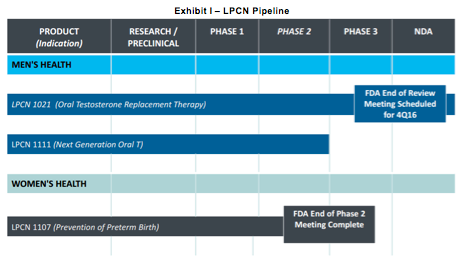
LPCN 1107 Milestones
The company also has a 4Q:16 milestone for LPCN 1107, which is the oral product for prevention of recurrent pre-term birth. Lipocine met with the FDA at the end of August for the end of Phase 2 meeting and received guidance on the clinical path forward. The next meeting in the current quarter will clarify study design, protocol and the number of subjects.
Tlando Background
On August 28, 2015, Lipocine Inc. submitted a 505(b)(2) New Drug Application (NDA) to the U.S. Food and Drug Administration (FDA) for Lipocine’s lead asset LPCN 1021. LPCN 1021 is a testosterone replacement therapy (TRT) designed for oral twice daily dosing in adult hypogonadal males with low testosterone. The FDA accepted the NDA on October 29, 2015, and subsequently on November 12, 2015, Lipocine announced that the FDA assigned a Prescription Drug User Fee Act (PDUFA) goal date of June 28, 2016 for completion of the review of the NDA. The FDA issued a CRL in June 2016, and met with Lipocine in October 2016 for a Post Action meeting that provided additional clarity on trial design and future steps required for resubmission to the FDA.
The CRL highlighted deficiencies related to dosing as provided in the label. The Phase 3 trial protocol had adjusted dosing based on 15 blood draws taken over a 24 hour period; however, the proposed label only relied on only one blood draw to determine the proper titration. The FDA felt that this inconsistency would lead to dosing errors and as a result will require evidence to support a single point window after administration of Tlando where the patient is evaluated and up-titrated or down-titrated to achieve the optimal dose. Prior to the letter, management felt that the trial design was sufficient as it was based on the Phase 3 trial for Axiron, an Eli Lilly topical testosterone product which was approved in 2010.
We continue to believe the oral formulation of LPCN 1021, if approved, may improve patient compliance as it appears to be a generally safe, effective, and a more convenient TRT option as compared to topical and injectable TRT products that are currently on the market. LPCN 1021 will have to adhere to all of the new regulations set forth by the FDA if approved. For instance, cautionary language will be required on the label for possible cardiovascular and stroke related risk with TRT, and the lack of benefit and safety of TRT in age-related hypogonadism.
Additionally, if LPCN 1021 is approved, there may be post-approval obligations regarding a heart attack and stroke risk study. Lipocine may be have to contribute to an on-going industry-led heart attack and stroke risk study, or it may need to conduct a separate long-term study.
Conclusion
The FDA’s responses with regard to the Post Action meeting suggest a pathway that will result in a 4Q:17 announcement date for Tlando with a subsequent launch of the product. We believe that the FDA’s emphasis on dosing protocols rather than on a fundamental flaw with the Lip’ral technology support eventual approval. While there is still some uncertainty regarding the duration of the trial, there is additional clarity due to the guidance provided at the Post Action meeting and we have taken a conservative approach regarding response times. Based on current information, we estimate that if approved, Tlando will achieve first sales in 2018. We will adjust our model accordingly as additional details become available.
Lipocine has reduced its workforce and other related expenditures in the third quarter and we lower general and administrative cost in the fourth quarter to reflect these changes. Currently, the company plans to begin the dosing validation study in 1Q:17, however, if approval for the SPA is received in a timely manner from the FDA, Lipocine could begin this work in December 2016. We maintain a positive view on Lipocine shares as an investment in the specialty pharmaceutical sector based on the company’s promising pipeline and Lip’ral technology. While the FDA’s issuance of a complete response letter will delay the launch of Tlando and potentially increase trial costs by several million dollars, we believe that Lipocine will obtain approval for the compound.
For a free copy of the full research report, please email scrinvestors@zacks.com with LPCN as the subject.
SUBSCRIBE TO ZACKS SMALL CAP RESEARCH to receive our articles and reports emailed directly to you each morning. Please visit our website for additional information on Zacks SCR and to view our disclaimer.