By: Nisha Hirani, MD & David Bautz, PhD
NASDAQ:LPCN
On January 4, 2016, Lipocine Inc. (NASDAQ:LPCN) announced that the first patient has been dosed in its Phase 2b clinical study for LPCN 1111, a once daily oral testosterone replacement therapy (TRT) product candidate. The primary objectives of the study will be to determine the optimal dose of LPCN 1111 along with the safety and tolerability of LPCN 1111 and its metabolites following oral administration of single and multiple doses of LPCN 1111 in hypogonadal males.
LPCN 1111 is the next-generation once daily oral product candidate for TRT
As a reminder, LPCN 1111 is the next-generation oral TRT version of LPCN 1021 that has the potential for once daily dosing through use of the company’s proprietary Lip’ral™ solubilization technology that improves systemic absorption to give effective testosterone levels upon daily dosing. As a side note, LPCN 1021, a twice-daily oral testosterone product candidate is currently under regulatory review with a FDA PDUFA goal date of June 28, 2016.
With positive Phase 2a data of LPCN 1111 in place, and the Phase 2b trial now initiated, we believe an End-of-Phase 2 meeting with the FDA should occur at some point during the second quarter 2016. We believe that LPCN 1111 should be Phase 3 ready by mid-2016. As per management, LPCN 1111 is about 24 months behind LPCN 1021. In our opinion, based on the Phase 2a data, this candidate looks like a potential game-changer for TRT, and if the Phase 3 data are positive, and all goes according to the timeline, we could see potential approval in 2018.
Positive Top-line Results in Phase 2a Study of LPCN 1111
LPCN 1111 is a next-generation, novel ester prodrug of testosterone. The drug has been studied in a Phase 1 single dose, randomized, open label, cross-over study in eight postmenopausal women. Data from the study established that LPCN 1111 has a strong safety profile and pharmacokinetics that should allow for once-daily dosing or provide high average testosterone levels while limiting the supraphysiological levels with a twice a day dosing regimen. This compound represents the first once-a-day, orally active TRT to enter clinical trials and would offer a clearly differentiated product compared to other oral testosterone products currently under development.
As a reminder, on October 13, 2014, Lipocine announced positive top-line results from its Phase 2a proof-of-concept study of LPCN 1111. This study was an open-label, dose-escalating single and multiple dose study. Subjects received a single dose of 330 mg, 550 mg, or 770 mg of LPCN 1111 followed by once daily dosing of 550 mg for 28 days in 10 subjects and once daily administration of 770 mg for 28 days in eight subjects.
Results showed that a single daily oral dose of LPCN 1111 provided testosterone levels in the eugonadal range, with good dose response and no subjects exceeding peak serum testosterone concentrations of 1500 ng/dl. In addition, LPCN 1111 was well-tolerated with no significant adverse events reported. The following table gives a summary of the CAVG and CMAX data.
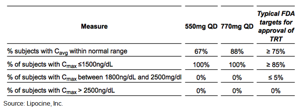
As shown in the table, the 770 mg dose QD (once daily) resulted in 88% of subjects within the normal range, which is above the FDA target of 75% of subjects. Secondary safety data on CMAX also looks outstanding. The fact that testosterone levels could be achieved in the normal range with no subjects developing abnormally high testosterone levels is quite encouraging as a once daily dosing TRT would be clearly differentiated in the marketplace.
Conclusion
Topical products that are associated with poor patient compliance dominate the current testosterone market. We view patient compliance as a serious issue with testosterone replacement products. This issue is not limited to just testosterone products as numerous studies have shown that once-daily dosing regimens had the highest rates of patient adherence (Claxton et al., 2001). Thus, the strategy with LPCN 1111 is to formulate a once daily oral dose of testosterone through a proprietary formulation coupled with the Lip’ral™ technology. An oral dosage testosterone would differentiate itself from gels, patches, and injections due to the convenience, discreteness, and lack of transference.
Lipocine has made considerable progress with its twice-daily oral TRT product candidate, LPCN 1021. With the PDUFA date assigned for June 28, 2016, we see twice-daily LPCN 1021 as having significant potential, and on track for approval. We believe that LPCN 1021 is much further ahead of its competitors. If all goes well, we are expecting LPCN 1021 will see U.S. approval around the middle of 2016, and model peak U.S. sales in the $400 million range. We remind investors that the second-generation version of the drug, LPCN 1111, currently being evaluated in a dose-finding Phase 2b trial, could expand the potential peak U.S. sales to over $600 million. We believe that LPCN 1111 is roughly 24 months behind LPCN 1021 in development. Additionally, it is important to point out that LPCN 1111 is intended to be a once daily dosing product, as compared to the twice-daily dosing profile of LPCN 1021.
We remain bullish on Lipocine shares as an investment in the specialty pharmaceutical sector because we think the company has a promising pipeline. We continue to believe that the stock represents an attractive long-term investment opportunity, and are maintaining our price target of $20, and continue to rate the stock a ‘Buy’.
Follow Nisha On Twitter @HiraniMD
SUBSCRIBE TO ZACKS SMALL CAP RESEARCH to receive our articles and reports emailed directly to you each morning. Please visit our website for additional information on Zacks SCR and to view our disclaimer.