By John Vandermosten, CFA
NASDAQ:LPCN
2Q:16 Financial and Operational Results
On August 9, 2016, Lipocine Inc. (NASDAQ:LPCN) reported second quarter 2016 results, posting an operating loss of $5.8 million. This was lower than the $6.6 million that we expected with the difference due to a slower ramp up in R&D expenditures related to LPCN 1111 and LPCN 1107. No revenues were reported in the quarter.
On a per share basis, LPCN lost ($0.32), better than our forecasted loss of ($0.35) per share. Shares outstanding were 18.3 million, essentially flat with 1Q:16 levels.
By line item, research & development expenditures were $2.6 million declining year over year due to lower contract research organization (CRO) and consultant costs. This compares to R&D of $3.2 million in 2Q:15. By product candidate, R&D expenses fell from $2.5 to $1.1 million for LPCN 1021, increased from $38,000 to $773,000 for LPCN 1111 and rose from $7,700 to $51,000 for LPCN 1107.
General and administrative expenses totaled $3.2 million, compared to our estimate of $2.8 million. On a year over year basis, expenses more than doubled due to pre-commercialization marketing and sales, higher personnel and stock compensation costs, and an increase in patent litigation costs.
Cash balance declined sequentially by $5.3 million to $32.9 million and the balance sheet continues with no debt.
Our Estimates
Following the issuance of the complete response letter (CRL) by the FDA, we have modified our forecasts to reflect first revenues for Tlando in late 2018. We estimate that Lipocine will be able to attract just under 1% of the TRT market with the product in FY:18 and generate revenues of approximately $58 million. Penetration is anticipated to nearly triple in the following year due to expanding salesforce productivity and increased awareness of the product. Due to the heightened level of uncertainty regarding timeline, costs and FDA requirements, we employ a discount rate of 20% and apply a probability of approval for Tlando of 50%.
In our previous update, we adjusted our forecasts to reflect a one year delay in the launch of Tlando based on the time it will take to address the deficiencies highlighted by the FDA and resubmit a new drug application (NDA). In terms of revenues, we estimate that Lipocine will be able to achieve a 4% share of the TRT market with Tlando by 2020 at which time once-a-day testosterone (LPCN 1111) will take the reins of LPCN’s testosterone franchise. Penetration of Lipocine’s once-a-day product is anticipated to hold 4.5% of the target market by 2024 due to expanding salesforce productivity and increased awareness of the product.
Despite additional costs from defending against shareholder lawsuits, addressing issues in the CRL and resubmitting its NDA, operating expenses are guided to be lower in the second half. Much of this decline is attributable to the workforce reduction that was announced on July 19th. The company has also increased its focus on controlling costs as it pursues another NDA. Based on these changes we are reducing second half expenses by approximately $4 million and maintaining our 2017 estimates. Assuming that LPCN 1021 is approved in 2017, we anticipate a ramp up in commercial and marketing costs as the company develops the necessary salesforce to market Tlando.
Following approval, management anticipates developing a 50-person sales force to focus on endocrinologists and urologists. The company is also contemplating working with a partner to focus on the primary care physician segment. Our expense forecasts for 2017 and 2018 reflect this effort. Refer to our model at the end of the report for additional detail.
Pipeline Update for LPCN 1021, 1107 & 1111
Tlando (LPCN 1021) Status
On June 29, 2016, Lipocine announced that the Food and Drug Administration (FDA) had issued a Complete Response Letter (CRL) for LPCN 1021 (Tlando).
The CRL highlighted deficiencies related to dosing as provided in the label. The Phase 3 trial had adjusting dosing based on 15 blood draws taken over a 24 hour period; however, the proposed label only relied on only one blood draw to determine the proper titration. The FDA felt that this inconsistency would lead to dosing errors and as a result will require evidence to support a single point window after administration of Tlando where the patient is evaluated and up-titrated or down-titrated to achieve the optimal dose. Prior to the letter, management felt that the trial design was sufficient as it was based on the Phase 3 trial for Axiron, an Eli Lilly topical testosterone product which was approved in 2010.
Lipocine noted that the CRL did not include any language that questioned LPCN 1021’s efficacy, safety, adverse events, side effects or the effectiveness of Lipocine’s proprietary Lip’ral drug delivery technology.
Lipocine will require additional clarity from the FDA before taking the next step and will request a Type A meeting. Over the last month, the company has been reviewing the CRL and employing experts and consultants to help develop an appropriate response to the document. Based on our conversations with management, we expect the request to meet with the FDA will be submitted within the next 30 days and the meeting will take place in the following month. Prior to the meeting there is a high degree of uncertainty as to what may be required to ultimately gain approval from the FDA. Based on our discussions with management, there may be several pathways of varying duration and expense required before a new application satisfies the regulatory agency.
In a best case scenario, a label bridging study using existing data may satisfy regulators. This approach tests the pharmacokinetics of a drug under different dosing titrations by extrapolating data that has already been collected. Under this scenario we anticipate only a minimal amount of additional expense and a delay of four to eight months. We estimate 30 days for the initial FDA meeting, a minimum of 30 days to conduct additional analysis and 60 days for a Class 1 resubmission response from the FDA.
If the FDA requires additional substantiation regarding an optimal titration point, then a 45-day safety and efficacy study may be required with costs ranging from $1 to $5 million depending upon the agency’s needs. Under this scenario, we anticipate it could take from 12 to 15 months to obtain approval. We estimate 30 days for the initial FDA meeting, 2 to 3 months to enroll and set up for the trial, 45 days to conduct the trial, 2 to 3 months to analyze data and 6 months for a Class 2 resubmission response from the FDA.
It is possible that a longer study may be required with additional expense in excess of $5 million and a duration on par with the 15-month SOAR trial. However, we think this is unlikely given the narrow focus of the CRL on titration and dosing requirements.
We do not believe that the FDA’s response threatens Lipocine’s Lip’ral technology or will have a materially negative impact on the other two programs in the pipeline. Lipocine anticipates consulting with the FDA regarding trial design following the end of the Phase 2 trials for LPCN 1111 (once-daily testosterone) and LPCN 1107 (pre-term birth) and expects to meet with the agency in later this year. We anticipate that Lipocine will make any and all adjustments necessary to ensure that dosing and titration protocols satisfy the FDA’s requirements for the other development programs.
Tlando Background
On August 28, 2015, Lipocine Inc. submitted a 505(b)(2) New Drug Application (NDA) to the U.S. Food and Drug Administration (FDA) for Lipocine’s lead asset LPCN 1021. LPCN 1021 is a testosterone replacement therapy (TRT) designed for oral twice daily dosing in adult hypogonadal males with low testosterone. The FDA accepted the NDA on October 29, 2015, and subsequently on November 12, 2015, Lipocine announced that the FDA assigned a Prescription Drug User Fee Act (PDUFA) goal date of June 28, 2016 for completion of the review of the NDA.
We continue to believe the oral formulation of LPCN 1021, if approved, may improve patient compliance as it appears to be a generally safe, effective, and a more convenient TRT option as compared to topical and injectable TRT products that are currently on the market. LPCN 1021 will have to adhere to all of the new regulations set forth by the FDA if approved. For instance, cautionary language will be required on the label for possible cardiovascular and stroke related risk with TRT, and the lack of benefit and safety of TRT in age-related hypogonadism. Additionally, if LPCN 1021 is approved, we are not sure what the post-approval obligations will be regarding a heart attack and stroke risk study. Lipocine may be have to contribute to an on-going industry-led heart attack and stroke risk study, or it may need to conduct a separate long-term study.
LPCN 1111 Status
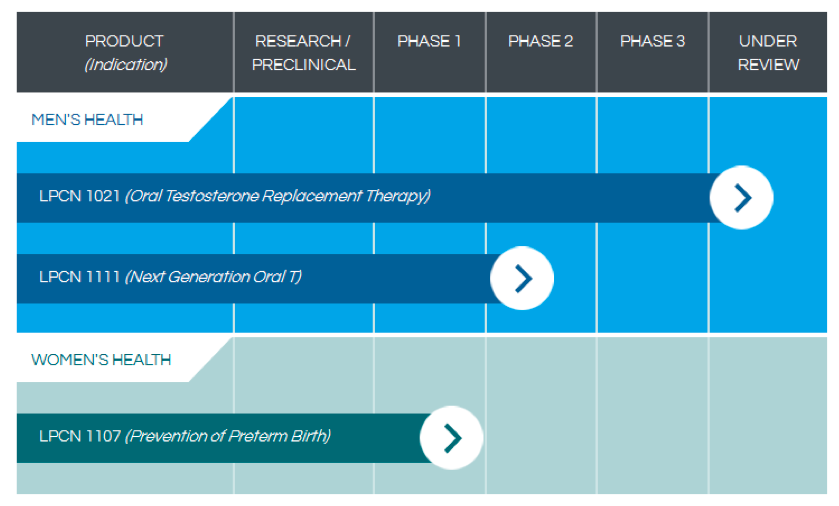
On January 4, 2016, Lipocine announced that the first patient has been dosed in its Phase 2b clinical study for LPCN 1111, a once daily oral testosterone replacement therapy (TRT) product candidate. The primary objectives of the study will be to determine the optimal dose of LPCN 1111 along with the safety and tolerability of LPCN 1111 and its metabolites following oral administration of single and multiple doses of LPCN 1111 in hypogonadal males.
As a reminder, LPCN 1111 is the next-generation oral TRT version of LPCN 1021 that has the potential for once daily dosing through use of the company’s proprietary Lip’ral solubilization technology that improves systemic absorption to give effective testosterone levels upon daily dosing. We expect to see top-line data from the Phase 2b study at some point during the second quarter of 2016.
With positive Phase 2a data of LPCN 1111 in place, and the Phase 2b trial now initiated, we believe an end-of-Phase 2 meeting with the FDA should occur at some point during the second half of 2016. As per management guidance, LPCN 1111 is 24 to 36 months behind LPCN 1021. In our opinion, this candidate provides compelling solutions for the weaknesses of currently approved TRT therapies in terms of convenience and compliance. If the Phase 3 data are positive, and trial milestones progress according to the timeline, we could see potential approval as early as 2018.
LPCN 1107 Status
On February 16, 2016, the company reported top-line results of its multi-dose pharmacokinetic dose finding clinical study of LPCN 1107, its oral hydroxyprogesterone caproate (HPC) candidate for the prevention of preterm birth in pregnant women. LPCN 1107 was granted orphan drug designation by the U.S. Food and Drug Administration (FDA) in June 2015, and has also been evaluated in two Phase 1 proof-of-concept studies in both pregnant and non-pregnant women.
On September 28, 2015, Lipocine announced initiation of its Phase 2 multi-dose PK dose finding clinical study with the first subject dosed with LPCN 1107. The primary objective of the study was to study pharmacokinetics over an extended period of time in pregnant women at multiple dose strengths of oral administration of LPCN 1107. The clinical study was an open-label, four-period, four-treatment, randomized, single and multiple dose, PK study in pregnant women of three dose levels of LPCN 1107 and injectable HPC (Makena). The study enrolled 12 healthy pregnant women (average age of 27 years) with a gestational age of approximately 16 to 19 weeks. Subjects received three dose levels of LPCN 1107 (400 mg twice-daily, 600 mg twice-daily, or 800 mg twice-daily) in a randomized, crossover manner during the first three treatment periods and then received five weekly injections of HPC during the fourth treatment period. During each of the LPCN 1107 treatment periods, subjects received a single dose of LPCN 1107 on Day 1 followed by twice daily administration from Day 2 to Day 8. Following completion of the three LPCN 1107 treatment periods and a washout period, all subjects received five weekly injections of HPC.
LPCN 1107 Receives Orphan Drug Designation
On June 2, 2015, Lipocine announced that the FDA granted orphan drug designation to LPCN 1107. In order to obtain orphan drug exclusivity upon approval, LPCN 1107 will need to demonstrate clinical superiority to the same drug already approved for the same orphan indication. This can be achieved, for instance, by demonstrating clinical superiority through establishing that the product offers a "major contribution to patient care."
Conclusion
Our NPV analysis on the three product candidates pegs fair value at almost $200 million with the reduction from the pre-CRL valuation due to delays in launch and a higher risk profile. We continue to believe that the stock represents an attractive long-term investment opportunity and are confident LPCN will be able to satisfy the requirements to gain FDA approval. Our price target is $9, based on a 20% discount rate, and probability of eventual sales for LPCN 1021, LPCN 1111 and LPCN 1107 of 50%, 15% and 10% respectively. We maintain a positive view on Lipocine shares as an investment in the specialty pharmaceutical sector based on the company’s promising pipeline and Lip’ral technology.
While the FDA’s issuance of a complete response letter will delay the launch of Tlando and potentially increase trial costs by several million dollars, we believe that the narrow focus of the FDA’s concerns and emphasis on dosing protocols rather than on a fundamental flaw with the Lip’ral technology support eventual approval. While the requirements to satisfy the FDA will only become clear after Lipocine meets with the agency, based on current information, we have conservatively estimated an additional twelve months will be required to launch Tlando placing first sales in 2018. We will adjust our model accordingly as additional details become available. We currently maintain a $9.00 per share target price.
READ THE FULL RESEARCH REPORT HERE
SUBSCRIBE TO ZACKS SMALL CAP RESEARCH to receive our articles and reports emailed directly to you each morning. Please visit our website for additional information on Zacks SCR and to view our disclaimer.