By David Bautz, PhD
OTC:MBVX
MabVax Therapeutic Holdings, Inc. (OTC:MBVX) presented three posters at the 2016 American Association of Cancer Research (AACR) Annual Meeting. In this report, we provide analysis for each of the posters and provide an update for the company’s development programs.
Poster #1: Phase 1 trial of HuMab-5B1 (MVT-5873), a novel monoclonal antibody targeting sLea, in patients with advanced pancreatic cancer and other CA19-9 positive malignancies.
MabVax’s lead antibody candidate, HuMab-5B1, targets the tumor associated carbohydrate antigen (TACA) sialyl Lewisa (sLea). A diagnostic assay using an antibody (CA19-9) raised to sLea is used worldwide to aid in the management of pancreatic cancer, as the antigen is typically shed into the bloodstream by tumors and thus can be monitored over time. sLea is over-expressed on a number of different epithelial tumor types including pancreatic, colon, stomach, ovarian, breast, and small-cell lung cancers. The following figure shows significant homogeneity and staining intensity of sLea on different types of cancer cells along with limited staining of normal tissue. The expression of sLea on normal breast, colon, and pancreatic tissue is restricted to cells of the secretory ducts and lumen, which are inaccessible to the immune effector mechanisms.
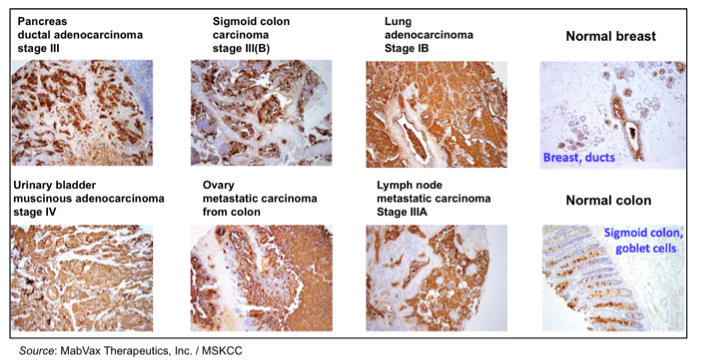
HuMab-5B1 was generated from the company’s novel antibody discovery platform, which allows for the generation of fully human antibodies. The antibodies are derived from B-cells extracted from patients immunized with proprietary cancer vaccines. This is the only example we know of where fully human monoclonal antibodies targeting cancer are generated from immunized patients. The following schematic shows the steps involved in identifying antibodies from the company’s platform.
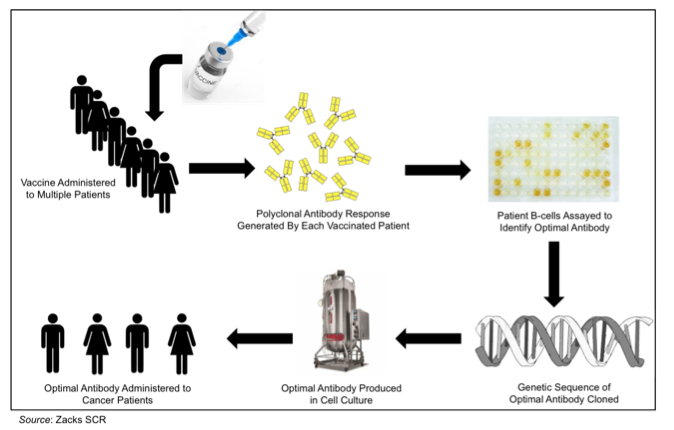
HuMab-5B1 was derived from a patient with Stage IV breast cancer who was originally vaccinated with a sLea vaccine at the end of 2008. A total of seven patients were vaccinated at that time with the sLea vaccine and six of them are still alive today. The patient from whom 5B1 was derived remains disease free to this day.
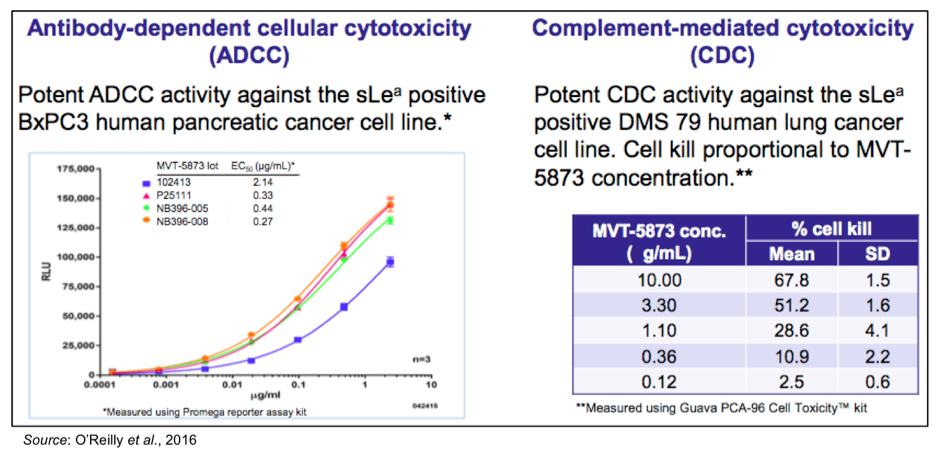
In vitro assays show that HuMab-5B1 exhibits potent antibody-dependent cellular cytotoxicity (ADCC), in which antibody coated cells are lysed by immune effector cells (typically natural killer cells), and by complement-mediated cytotoxicity (CDC), where antibodies coated on the surface of target cells activate the complement cascade and the formation of the membrane attack complex and cell lysis. The following graph and table show that both ADCC and CDC functions are dependent upon the concentration of HuMab-5B1 in each assay.
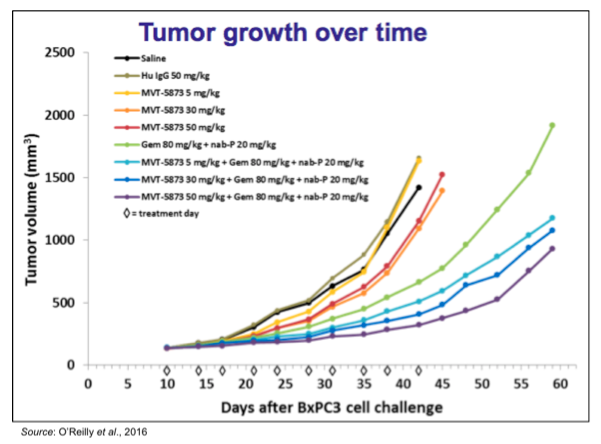
The antitumor efficacy of HuMab-5B1 is shown in the following graph, where different concentrations of the antibody were utilized both alone and in combination with gemcitabine and/or nab-paclitaxel (Abraxane), both of which are chemotherapeutic agents utilized as standard of care for pancreatic cancer patients, in mice injected with BxPC3 pancreatic cancer cells. HuMab-5B1 shows potent tumor growth inhibition when used in combination with chemotherapy.
HuMab-5B1 is currently being investigated in a Phase 1 clinical trial in patients with pancreatic cancer as both a single agent therapy and in combination with gemcitabine/nab-paclitaxel (NCT0267917). The following schematic gives an overview for each of those studies.
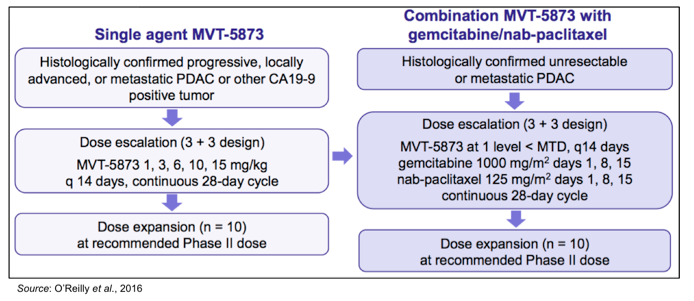
The primary objectives for the studies are to determine the safety, pharmacokinetics, and maximum tolerated dose of HuMab-5B1 as both a single agent and in combination with gemcitabine/nab-paclitaxel. Secondary objectives include evaluation of tumor response rate and the duration of any responses. Exploratory outcomes being evaluated include an assessment of anti-HuMab-5B1 antibodies, the relationship between circulating CA 19.9 levels and tumor response, and tumor sLea expression. Preliminary data from this study could be available by mid-2016, with the full data set likely to be reported in the first half of 2017.
Imaging Study of 89Zr-HuMab-5B1 to Start Soon
On January 6, 2016, MabVax announced the filing of an Investigational New Drug (IND) application with the FDA for 89Zr-HuMab-5B1, the company’s next generation PET imaging agent. The company received authorization from the FDA to proceed with a Phase 1 clinical trial on January 28, 2016. We anticipate the company beginning a Phase 1 clinical study of 89Zr-HuMab-5B1 very soon. The trial will likely include approximately 20 patients with pancreatic cancer. The goal of the Phase 1 study will be to determine the safety, pharmacokinetics, and biodistribution of 89Zr-HuMab-5B1. In addition, the trial will help determine the optimal amount of “cold”, or unlabeled antibody, to be administered before the radiolabeled antibody as well as the optimal time following injection of 89Zr-HuMab-5B1 to obtain the image. The target of HuMab-5B1, sLea, is shed by growing tumors into the bloodstream. Injecting non-labeled HuMab-5B1 binds this circulating sLea allowing for more radiolabeled antibody to reach the tumor, which helps to enhance tumor imaging as well as reduce the background. We anticipate the company could get initial results from the trial in the second half of 2016.
Poster #2: Improving the efficacy of pretargeted radioimmunotherapy in preclinical murine models by utilizing bioorthogonal click chemistry
This poster describes the work being done with MabVax’s radioimmunotherapy (RIT) program. RIT refers to the use of radionuclides to treat cancer. A radionuclide is an atom that contains excess nuclear energy, which results in it being unstable. The excess energy can be emitted in three forms: an alpha particle (a helium nuclei), a beta particle (an electron or positron), or gamma radiation. Most of the radionuclides used for therapeutic and imaging purposes emit beta particles.
Radioimmunotherapy is the use of a radionuclide attached to a monoclonal antibody to deliver cytotoxic radiation to a target cell. Thus far, there have been two radioimmunotherapy treatments approved by the FDA: Zevalin® (anti-CD20 monoclonal antibody attached to 90Y) and Bexxar® (anti-CD20 monoclonal antibody attached to 131I). Both 90Y and 131I emit beta particles, which have maximum ranges of 11.0 and 2.0 mm, respectively (Frost et al., 2015). Thus, beta particles can deliver radiation not just to the target cell but the surrounding cells as well. This could offer the advantage of affecting tumor cells that may have lost expression of the target antigen. MabVax is also testing 177Lu, another beta emitter that has similar properties to 131I and a maximum range 1.5 mm.
MabVax is utilizing a radionuclide attached to HuMab-5B1, which takes advantage of the precise targeting capabilities of the antibody, thus limiting radiation exposure throughout the rest of the body. The company is currently testing two different types of technology for the RIT program: 1) prelabeling HuMab-5B1 with a radionuclide and then injecting the radioactive antibody; and 2) labeling HuMab-5B1 with a ligand, injecting the antibody and allowing it to accumulate on the tumor cell surface, and then administering the radionuclide bound to a second ligand that chemically combines with the antibody/ligand at the site of the tumor, which is referred to as pretargeted RIT (PRIT).
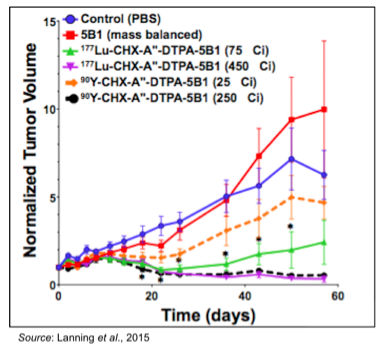
We have covered the company’s previous results with the RIT program, which showed the ability of 90Y- and 177Lu-labeled HuMab-5B1 to cause tumor regression in a xenograft model of pancreatic cancer. The results of that experiment are below, showing that at the higher doses of radionuclide (450 μCi 177Lu and 250 μCi 90Y) not only is tumor growth inhibited, but also there is regression of an established tumor.
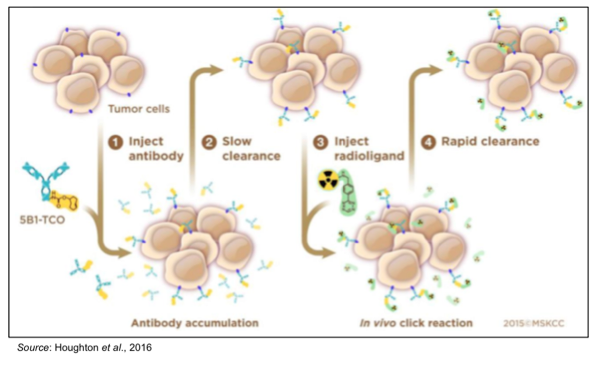
The latest data from the RIT program presented by MabVax at AACR 2016 concerns a method for using PRIT with HuMab-5B1. The following graphic shows the theory behind the technology, whereby HuMab-5B1 is labeled with a chemical linker and allowed to accumulate on the surface of the tumor. Then, a second linker with a radionuclide attached is injected and a chemical reaction takes place between the two linkers resulting in a radionuclide-labeled antibody on the tumor cell. Any radioligand that does not combined with the antibody is then rapidly cleared from the body, thus limiting off-target effects.
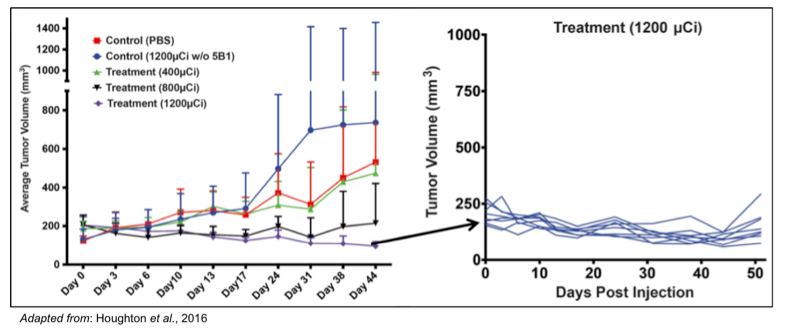
The results with the PRIT technology were very similar to what was seen with the radiolabeled HuMab-5B1 results shown above. Mice with BxPC3 xenografts were treated with the same amount of 5B1-TCO (linker-labeled HuMab5B1) and then with varying amounts of radioligand (one dose). There was a dose response to the radioligand, as higher amounts of radioactivity led to decreased tumor growth. This effect was dependent upon HuMab-5B1, as the administration of only radioligand did not have any effect on tumor growth. Tumor regression (close to 50% on average) was seen in almost all the mice treated with the highest dose. The graph on the right shows tumor growth for each animal in the treatment group that received the highest amount of radionuclide. Only one mouse exhibited minimal tumor growth toward the end of the experiment, and all the other mice showed tumor regression. This is important as the current standard of care (gemcitabine/nab-paclitaxel) is only able to cause tumor regression in a subset of animals treated in a similar model (Van Hoff et al., 2011).
The company is currently continuing preclinical work to determine which radionuclide to utilize in the clinic (90Y or 177Lu) and that should be completed by mid-2016. The company will initially put the fixed linker technology into the clinic while continuing to work with the PRIT technology, which is still not yet to GMP level (i.e., able to be used in clinical studies). The company is planning to initiate clinical studies with the RIT program in the fourth quarter of 2016.
Poster #3: Novel Fully Human Anti-GD2 Monoclonal Antibodies with Potent Therapeutic Activity against Neuroblastoma, Sarcoma, and Melanoma.
The third poster presented by MabVax at AACR 2016 concerned the company’s anti-GD2 monoclonal antibody program. Just as with HuMab-5B1, the company identified monoclonal antibodies from patients injected with a sarcoma vaccine that bound to GD2. GD2 is a sialic-acid containing glycosphingolipid expressed primarily on the cell surface. The function of GD2 is not completely understood, although it is thought to play a role in the attachment of tumor cells to extracellular matrix proteins (Cheresh et al., 1986). It is expressed on the surface of neuroblastomas, melanomas, and sarcomas (Mujoo et al., 1987; Chang et al., 1992; Tsuchida et al., 1987). Due to its relatively tumor-specific expression, GD2 is an attractive target for tumor-specific therapy. Treatment of children with neuroblastoma with a chimeric anti-GD2 antibody (ch14.18) resulted in a statistically significant improvement in time to progression of disease as well as overall survival (Yu et al., 2010). Based on these results, the FDA recently approved dinutuximab (Unituxin®) for the treatment of neuroblastoma, thus validating GD2 as an effective therapeutic target.
MabVax has identified two lead anti-GD2 candidates (HuMab-31F9V2, HuMab-1B7) by examining the immune response from more than 60 patients who participated in a sarcoma vaccine trial over the last three years. Preclinical studies performed with these antibodies showed them to be effective against Ewing’s sarcoma (TC71, below left) and osteosarcoma (SaOS2, below right) xenograft models.
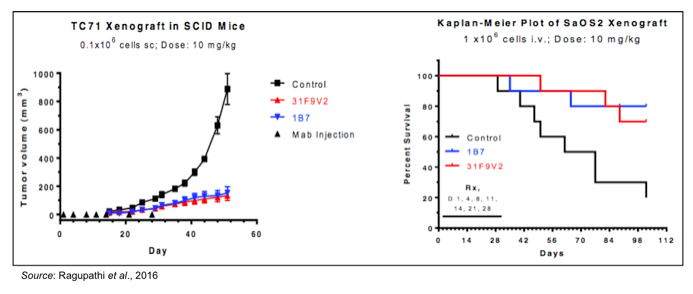
The data for the anti-GD2 antibodies is encouraging, and represents another opportunity from the company’s novel antibody discovery program.
Conclusion and Recommendation
The data presented at AACR 2016 was highly encouraging, particularly in regards to the company’s RIT program, which again was shown to induce tumor regression in a model of pancreatic cancer. We are looking forward to seeing the first data from the clinical trials of HuMab-5B1 as a therapeutic agent and an imaging agent later in 2016, both of which represent potential catalysts for the stock.
Our target price of $4 is derived from a probability adjusted discounted cash flow model that takes into account potential future revenues from the sale of HuMab-5B1 has both a therapeutic and an imaging agent. We also take into account the company’s two cancer vaccine programs that are currently in Phase 2 clinical trials for sarcoma and ovarian cancer. We continue to be very positive on the MabVax story and believe that the stock price will head higher as more investors become aware of the potential for HuMab-5B1 and the company’s pipeline of fully human antibodies.
READ THE FULL RESEARCH REPORT HERE
SUBSCRIBE TO ZACKS SMALL CAP RESEARCH to receive our articles and reports emailed directly to you each morning. Please visit our website for additional information on Zacks SCR and to view our disclaimer.