By
David Bautz, PhD
OTC:MBVX
Financial Update
On March 14, 2016, MabVax Therapeutics Holding, Inc. (OTC:MBVX) filed form 10-K with financial results for the fourth quarter and full year 2015. The company reported revenue of $0.8 million in the fourth quarter of 2015 and $1.3 million for the full year 2015. This income is derived from the $1.5 million Phase II Small Business Innovation Research contract with the National Cancer Institute for developing HuMab-5B1 as an imaging agent in pancreatic cancer. The company recognizes the revenue from grants received from the National Institutes of Health (NIH) as expenses that directly relate to the grant are incurred.
Net loss for the fourth quarter was $4.0 million, or $0.14 per share, which was comprised of $2.4 million in R&D expenses and $2.3 million in G&A expenses. Total cash burn for the quarter was $2.7 million. For the full year 2015, net loss was $36.1 million, or $1.82 per share, and was comprised of $9.6 million in R&D expenses and $9.8 million in G&A expenses. Cash burn for 2015 was approximately $10.6 million. The company exited 2015 with approximately $4.0 million in cash and cash equivalents. Subsequent to the end of the quarter, the company announced it closed on the first part of a financing agreement with Oxford Finance, LLC that will provide the company with up to $10 million in senior secured debt financing. The $10 million loan agreement consists of two parts: 1) an initial loan of $5 million that the company has already received, and 2) a second tranche of $5 million that may be requested by the company upon a) “positive interim data on the Phase 1a HuMab-5B1 antibody trial in pancreatic cancer”, and b) uplisting of the common stock to the NASDAQ stock market or New York Stock Exchange. In conjunction with the loan, the company issued to Oxford Finance, LLC five-year warrants to purchase an aggregate 1,666,668 shares of common stock at $0.75 per share. We believe the company has sufficient resources to fund operations through the third quarter of 2016.
HuMab-5B1 Update
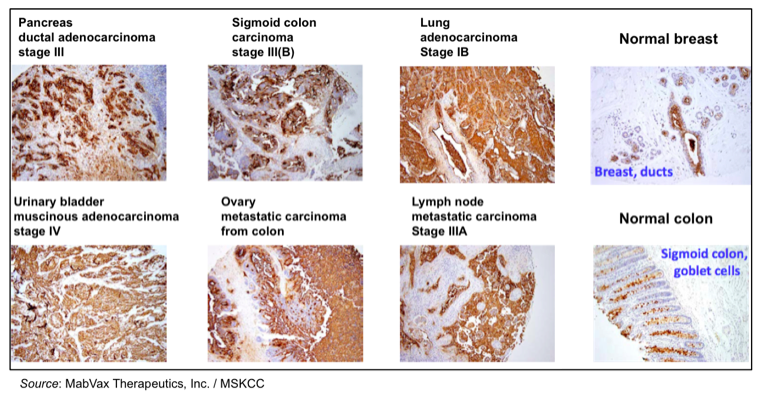
MabVax’s lead antibody candidate, HuMab-5B1, targets the tumor associated carbohydrate antigen (TACA) sialyl Lewisa (sLea). A diagnostic assay using an antibody (CA19-9) raised to sLea is used worldwide to aid in the management of pancreatic cancer, as the antigen is typically shed into the bloodstream by tumors and thus can be monitored over time. sLea is over-expressed on a number of different epithelial tumor types including pancreatic, colon, stomach, ovarian, breast, and small-cell lung cancers. The following figure shows significant homogeneity and staining intensity of sLea on different types of cancer cells along with limited staining of normal tissue. The expression of sLea on normal breast, colon, and pancreatic tissue is restricted to cells of the secretory ducts and lumen, which are inaccessible to the immune effector mechanisms.
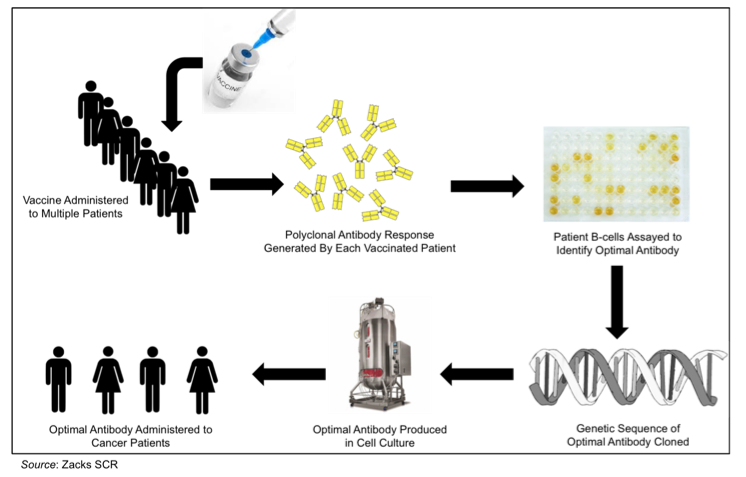
HuMab-5B1 was generated from the company’s novel antibody discovery platform, which allows for the generation of fully human antibodies. The antibodies are derived from B-cells extracted from patients immunized with proprietary cancer vaccines. This is the only example we know of where fully human monoclonal antibodies targeting cancer are generated from immunized patients. The following schematic shows the steps involved in identifying antibodies from the company’s platform.
HuMab-5B1 was derived from a patient with Stage IV breast cancer who was originally vaccinated with a sLea vaccine at the end of 2008. A total of seven patients were vaccinated at that time with the sLea vaccine and six of them are still alive today. The patient from whom 5B1 was derived remains disease free to this day.
MabVax is initially targeting HuMab-5B1 for the treatment of metastatic pancreatic cancer and as an imaging agent for the detection of pancreatic cancer. There are approximately 49,000 individuals diagnosed with pancreatic cancer each year, and close to 80% have metastatic disease at the time of diagnosis. The 5-year survival rates for patients with pancreatic cancer are dismal (<14%) and are particularly bad for those with metastatic disease (~1%).
The company is also developing HuMab-5B1 as a diagnostic imaging agent by linking the antibody to 89Zr, which is known to offer good quality imaging data based on previous pre-clinical and clinical data. For background on the use of HuMab-5B1 as an imaging agent along with preclinical data supporting its use, please see our previous report.
Phase 1 Clinical Trial of HuMab-5B1 Is Underway
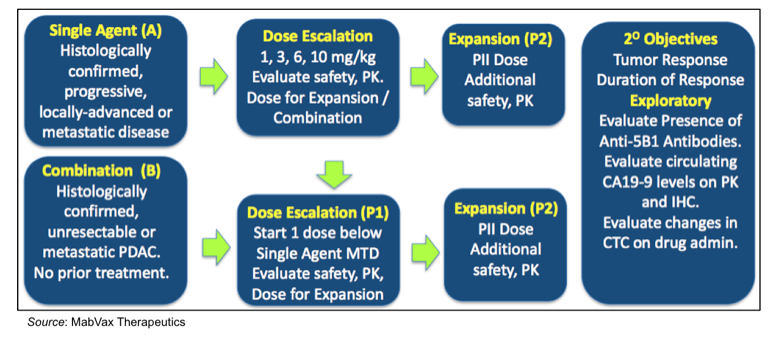
On March 21, 2016, MabVax announced the initiation of a Phase 1 clinical trial of HuMab-5B1 in patients with pancreatic cancer. This is an open label, multi-center, dose escalation clinical trial that is designed to determine the safety, maximum tolerated dose (MTD), and pharmacokinetics (PK) of HuMab-5B1. An evaluation of tumor response rate based on RECIST 1.1 and the duration of response of HuMab-5B1 as a single agent or in combination with the standard of care chemotherapy agent gemcitabine will also be evaluated.
The initial cohort of patients will be treated with 1, 3, 6 or 10 mg/kg of HuMab-5B1 to determine the MTD. This dose will then be utilized in an expansion cohort of approximately 10 subjects to examine additional safety and PK parameters. For the combination study, the first cohort will be treated with one dose below the MTD with escalation up to the MTD. This dose will then be utilized in an expansion study where HuMab-5B1 will be administered alongside the standard of care chemotherapeutic agent gemcitabine. An overview of the Phase 1 protocol is given in the following figure. We anticipate preliminary data from the study being reported in the third quarter of 2016, with the full data set likely to be reported in the first half of 2017.
Imaging Study of 89Zr-HuMab-5B1 to Start Soon
On January 6, 2016, MabVax announced the filing of an Investigational New Drug (IND) application with the FDA for 89Zr-HuMab-5B1, the company’s next generation PET imaging agent. The company received authorization from the FDA to proceed with a Phase 1 clinical trial on January 28, 2016. We anticipate the company beginning a Phase 1 clinical study of 89Zr-HuMab-5B1 very soon. The trial will likely include approximately 20 patients with pancreatic cancer. The goal of the Phase 1 study will be to determine the safety, pharmacokinetics, and biodistribution of 89Zr-HuMab-5B1. In addition, the trial will help determine the optimal amount of “cold”, or unlabeled antibody, to be administered before the radiolabeled antibody as well as the optimal time following injection of 89Zr-HuMab-5B1 to obtain the image. The target of HuMab-5B1, sLea, is shed by growing tumors into the bloodstream. Injecting non-labeled HuMab-5B1 binds this circulating sLea allowing for more radiolabeled antibody to reach the tumor, which helps to enhance tumor imaging as well as reduce the background. We anticipate the company could get initial results from the trial by mid-2016.
HuMab-5B1 Radioimmunotherapy IND to be Filed in 2H16
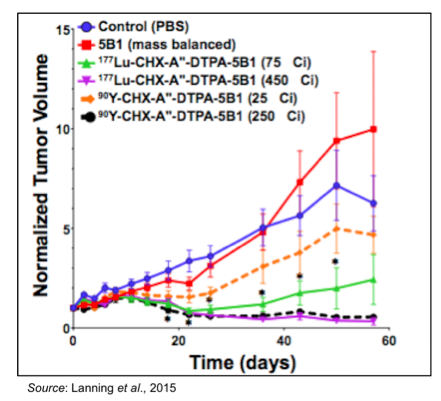
Since HuMab-5B1 has shown such promising results as a PET agent through uptake of the antibody by tumor cells, MabVax has constructed HuMab-5B1 as a radioimmunotherapy by attaching the antibody to both 90Y and 177Lu. The following figure shows the results of treating mice with BxPC3 xenografts after tumors had reached approximately 100 mm3 with either 90Y-5B1 or 177Lu-5B1. At the higher radiation dose, both 90Y-5B1 and 177Lu-5B1 showed tumor regression, not just inhibition or slowing of tumor growth. It should be noted that 5B1 without a radionuclide was added in an equivalent mass dosage and was not optimized as a single agent for this study, hence the reason that there is no activity of the antibody with no radionuclide attached.
Additionally, the 5B1 radioimmunotherapies appear to be equally effective in an orthotopic pancreatic cancer model. As opposed to a xenograft, in which the cancer cells are injected subcutaneously, in an orthotopic model the cancer cells are injected into the tissue from which the tumor cells were derived. This has the advantage of being a more clinically relevant model. The following graph shows how both the tumor volume and bioluminescence of the tumors decreases following administration of 300 μCi of 177Lu-5B1.
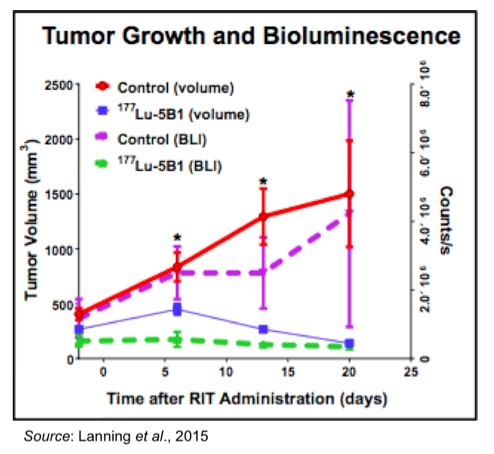
The preclinical results showing 5B1 as a radioimmunotherapy are very encouraging, particularly since the agents were successful against both a xenograft and an orthotopic model. The small error bars for mice showing regression of tumor means that all the mice showed tumor regression and it was not just a subset of those treated. This is important, as the combination of gemcitabine and nab-paclitaxel (Abraxane®) is only able to cause tumor regression in a subset of mice with human pancreatic cancer xenografts (Van Hoff et al., 2011). MabVax is hoping to quickly follow up on these successful preclinical results by filing an Investigational New Drug (IND) application with the FDA for a radioimmunotherapy product by the end of 2016 and initiating a Phase 1 clinical study in the first half of 2017.
Presentations Coming Up at AACR 2016
MabVax will have three poster presentations at the 2016 Annual Meeting of the American Association of Cancer Research, which is being held in New Orleans, LA from Apr. 16-20.
- Presentation 1 (Abstract #CT026): Phase I trial of HuMab-5B1 (MVT-5873), a novel monoclonal antibody targeting sLea, in patients with advanced pancreatic cancer and other CA19-9 positive malignancies.
- Presentation 2 (Abstract #3051): Improving the efficacy of pretargeted radioimmunotherapy in preclinical murine models by utilizing bioorthogonal click chemistry. The abstract describes the use of a novel linker to attach a radionuclide to HuMab-5B1, with results showing a 177Lu-labeled HuMab-5B1 leading to tumor regression and complete elimination of tumor cells in vivo.
- Presentation 3 (Abstract #4993): Novel fully human anti-GD2 monoclonal antibodies with potent therapeutic activity against neuroblastoma, sarcoma and melanoma. This poster describes the identification and characterization of fully human antibodies that bind to GD2, which were shown to be very active in functional assays.
We look forward to examining the posters after they are presented and providing further commentary on the results in future updates.
Vaccine Program Update
Dr. Philip Livingston, who is the company’s Chief Scientific Officer and former Head of the Laboratory of Tumor Vaccinology at Memorial Sloan-Kettering Cancer Center (MSKCC), has been developing a series of monovalent (targeting a single tumor antigen) cancer vaccines for the last 30 years that target carbohydrate antigens on neuroectodermal and epithelial cancers. MabVax has licensed exclusive rights to vaccines that cover 11 validated target antigens from MSKCC. The license agreement calls for MSKCC to complete all preclinical and Phase 1 clinical trial work at MSKCC’s expense at which point the IND would be transferred to MabVax for continued development. Importantly, the vaccine program offers significant upside with little additional investment necessary by MabVax. We believe each of the vaccine programs is a potential $200 million opportunity.
Sarcoma Vaccine
Sarcomas comprise a diverse group of malignant tumors that develop from fat, muscles, nerves, joints, blood vessels, and bone. They are relative rare, with approximately 13,000 people diagnosed with sarcoma each year in the U.S. Eighty percent of those cases are due to soft-tissue sarcoma and the rest arise from bone (National Cancer Institute). Five-year survival rates for localized, regional (spread to nearby lymph nodes only), and distant (metastasized) sarcomas are 83%, 54%, and 16%, respectively.
Like other cancers, recurrence and metastasis are common with sarcoma. Approximately 20% of patients with extremity sarcoma will have lung metastases at some point during the disease course. For patients who are diagnosed with metastatic disease, approximately 30% will recur following initial therapy. When sarcomas do recur the prognosis is poor and gets worse with each subsequent recurrence.
The standard of care for sarcoma is surgery, which may or may not be coupled with radiation or chemotherapy. Multi-agent chemotherapy with doxorubicin, cyclophosphamide, and methotrexate following surgery improved disease-free survival rates for patients with high-grade extremity sarcomas; however, the toxicity associated with treatment was substantial (Chang et al., 1988). Following successful treatment where the patient is diagnosed as being free of disease the current standard of care is watchful waiting, where the patient is closely monitored to determine if recurrence occurs, however no treatment is given during this time.
MabVax has designed its cancer vaccines to be utilized during the watchful waiting portion of treatment to determine the effect on time to recurrence and overall survival. A randomized, multi-center, double blind Phase 2 clinical trial was initiated in July 2010 with 136 patients who had Stage IV metastatic sarcoma but were cleared by surgery (NCT01141491). The patients received 10 vaccinations over an 84-week period. The study was powered to show a statistical improvement in both progression free survival (measured at the mid-point of the study) and overall survival. In October of 2013, MabVax presented the mid-point results to the independent Drug Safety Monitoring Board (DSMB). The DSMB concluded that there were no unanticipated or clinically worrisome safety concerns and that investigators and patients should remain blinded as to treatment assignment and the patients should continue to be followed to assess overall survival.
The company reported that the sarcoma vaccine elicited an antibody response intended to kill circulating tumor cells and micrometastases in all but one of the vaccinated patients. However, the DSMB concluded that the study did not reach statistical significance for its primary efficacy endpoint of a 50% improvement in progression free survival. The study has not yet accumulated a sufficient number of events to evaluate the secondary endpoint of overall survival. Prior to initiating the study, the FDA indicated that the overall survival endpoint would be considered the primary endpoint for the measurement of efficacy. Thus, patients will be followed until sufficient numbers of events (deaths) have occurred to allow analysis of the overall survival endpoint. We anticipate results from this study to be reported in late 2016 or early 2017.
Ovarian Cancer Vaccine
Ovarian tumors are the most common cause of death from gynecological cancers in the U.S. Approximately 21,000 women will be diagnosed while approximately 14,000 will die with the disease in 2015 (American Cancer Society). Almost half of the women diagnosed will be over the age of 63. As with all other cancers, five-year survival rates are dependent on when the disease is diagnosed and range from >90% for Stage I disease to 17% for Stage IV disease.
Most ovarian cancers are diagnosed at later stages due to the fact that patients with early disease have very few symptoms, which are often vague and nonspecific. Symptoms associated with later-stage disease include gastrointestinal symptoms such as nausea and vomiting, constipation, and diarrhea. Approximately 20%, 5%, 58%, and 17% of women present with stage I, II, III, and IV, respectively (Medscape). A large percentage of patients (70%) will have recurrence of disease, with prognosis worsening for each successive recurrence.
Surgery is the initial treatment option provided patients are in a good enough condition and includes aggressive cytoreduction where as much of the cancer is removed as possible. Following surgery, patients are given taxane- or platinum-based chemotherapy. Patients with recurrent ovarian cancer that is resistant to platinum-based chemotherapy may be treated with bevacizumab (Avastin®) and another chemotherapeutic agent.
Just as with the sarcoma vaccine, the ovarian cancer vaccine was administered to patients who have been cleared of the disease in the hopes it can prevent recurrence. A randomized, multi-center, double blind Phase 2 clinical trial was initiated in July of 2010. Importantly, a NIH grant award co-authored by Dr. Philip Livingston is fully funding the trial, which is being managed by the Gynecologic Oncology Group (GOG). MabVax has contributed to the development of the IND and provided financial support for the manufacture of the clinical material.
A total of 164 patients with Stage IV ovarian cancer were enrolled. They had been treated with cytoreductive surgery and chemotherapy and were in complete clinical remission as defined by CA-125 levels in the normal range, negative physical examination, and no evidence of disease by CT scan. Patients were vaccinated 10 times over 84 weeks and monitored throughout the study period. The study is powered to show a statistical improvement in both progression free survival (measured at the mid-point of the study) and overall survival. The study has not achieved a sufficient number of events to trigger the mid-point analysis. We anticipate results from the overall survival endpoint will be announced in late 2016 or early 2017.
Conclusion and Recommendation
We are glad to see that MabVax has initiated the Phase 1 study of HuMab-5B1 in patients with pancreatic cancer as all the pre-clinical data generated thus far for the antibody has been quite encouraging. The company should also be initiating the Phase 1 study of the 5B1 imaging agent very soon. The release of positive preliminary data from these two studies in mid-2016 represents a potential catalyst for the stock, and we believe that investors would be wise to build a position now ahead of the data release later in the year.
The pre-clinical data for the radioimmunotherapy using HuMab-5B1 is also highly encouraging, and that program should be entering the clinic in the first half of 2017. In the second half of 2017, we anticipate the company filing an IND for an additional HuMab-5B1 product as an antibody-drug conjugate. Thus, the company could potentially have four products in the clinic based on one antibody by the end of 2017! Besides HuMab-5B1, the company has a library of over 100 other fully human antibodies that could be developed in a similar fashion to HuMab-5B1.
Lastly, additional upside for the company is possible from the ongoing cancer vaccine studies. We believe that topline overall survival data for both the sarcoma and ovarian cancer vaccines will be reported in either late 2016 or early 2017. We continue to be very positive on the MabVax story and believe that the stock price will head higher as more investors become aware of the potential for HuMab-5B1 and the company’s pipeline of fully human antibodies. We are maintaining a ‘Buy’ rating on the stock and a $4 price target.
READ THE FULL RESEARCH REPORT HERE
SUBSCRIBE TO ZACKS SMALL CAP RESEARCH to receive our articles and reports emailed directly to you each morning. Please visit our website for additional information on Zacks SCR and to view our disclaimer.