By
David Bautz, PhD
NASDAQ:MBVX
Business Update
MabVax Therapeutics Holdings, Inc. (NASDAQ:MBVX) is a biopharmaceutical company that is developing proprietary human monoclonal antibody products for the diagnosis and treatment of a variety of cancers. The company utilizes a novel antibody discovery platform that identifies potent antibodies targeted to unique cancer-specific antigens. These antibodies are identified from patients immunized with proprietary cancer vaccines that result in robust anti-cancer immune responses. The company’s lead antibody asset is HuMab-5B1, which is currently in clinical trials as a potential therapeutic (MVT-5873) and imaging agent (MVT-2163).
MVT-5873 Interim Phase 1 Data
On November 14, 2016, MabVax announced interim safety data from the Phase 1 clinical trial of MVT-5873. This is an open label, multi-center, dose escalation clinical trial that is designed to determine the safety, maximum tolerated dose (MTD), and pharmacokinetics (PK) of MVT-5873 (NCT02672917). An evaluation of tumor response rate based on RECIST 1.1 and the duration of response of MVT-5873 as a single agent (Part 1) or in combination with standard of care chemotherapy (Part 2) will also be evaluated.
The company reported that the safety of MVT-5873 was established by treating 16 patients at three incremental dose levels. The MTD has not yet been reached, thus additional patients will continue to be recruited for Part 1 of the study such that a recommended Phase 2 dose can be established.
Thus far, 28 subjects have been consented into the trial: three are in screening, nine failed screening (due to being too sick to enter the trial), and 16 subjects were treated. Of the 16 treated patients, stable disease was noted for seven of them lasting from three to eight months. Six of the 16 continue to receive treatment. Patients are allowed to continue to receive treatment based on dose tolerability and continued benefit, which includes assessment of disease using RECIST 1.1 criteria to evaluate tumor response. While these data are still early, and its difficult to take too much away from them, it is still very encouraging that patients are experiencing a benefit from MVT-5873 in a dose escalation Phase 1 safety study.
MVT-5873 + Standard of Care Chemotherapy
MabVax has initiated Part 2 of the Phase 1 study, which is the addition of MVT-5873 to standard of care chemotherapy (gemcitabine and nab-paclitaxel) in newly diagnosed patients with unresectable or metastatic pancreatic cancer. We anticipate initial results from Part 2 of the study to be reported in 2017.
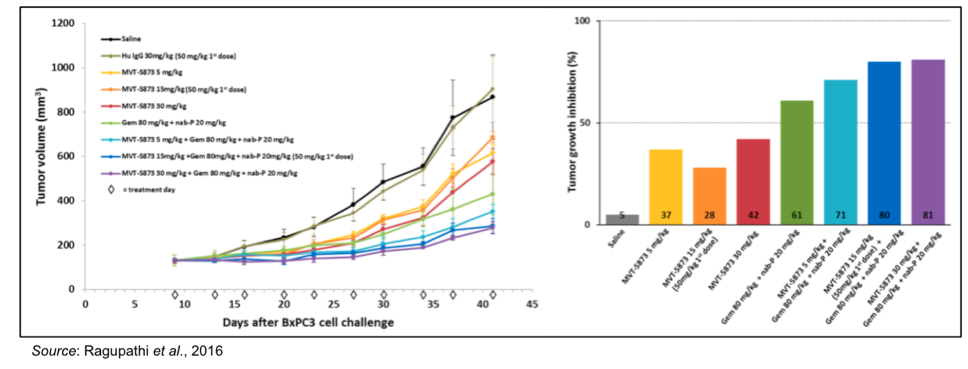
Previous preclinical results showed a synergistic effect between MVT-5873 and standard of care chemotherapy in a mouse model that utilized BxPC3 human pancreatic cancer cells. The following graph shows MVT-5873 as a monotherapy had moderate tumor growth inhibition, however this effect was potentiated when it was combined with gemcitabine and nab-paclitaxel. This data strongly supports the rationale for combining MVT-5873 with standard of care chemotherapy.
MVT-2163 Interim Phase 1 Data
The company also provided an update on the Phase 1 trial of MVT-2163, the company’s next-generation diagnostic PET imaging agent that combines HuMab-5B1 with the radionuclide 89Zr using a clinically validated linking agent (DFO). The trial is designed to establish the safety, pharmacokinetics, biodistribution, and the amount of MVT-5873 to be used as a “blocking agent” to optimize the PET scan images. Two cohorts of patients have been dosed thus far: the first cohort received MVT-2163 alone while the second cohort received MVT-2163 following administration of MVT-5873. The use of MVT-5873 as a blocking agent is intended to neutralize any circulating CA19.9 antigen, thus allowing for increased binding of MVT-2163 on tumor cells.
The initial PET images that have been obtained thus far demonstrate that the antibody is binding specifically to tumors, as the images correlate with those obtained by conventional CT scans. Administration of MVT-5873 improves the biodistribution of MVT-2163, which is similar to what is seen with the use of a blocking agent with other antibody-based PET agents. The company will continue to dose patients to establish the optimal blocking dose of MVT-5873 as well as to establish the optimal time after administration of MVT-2163 for obtaining the PET image.
MVT-1075 IND to be Filed in 4Q16
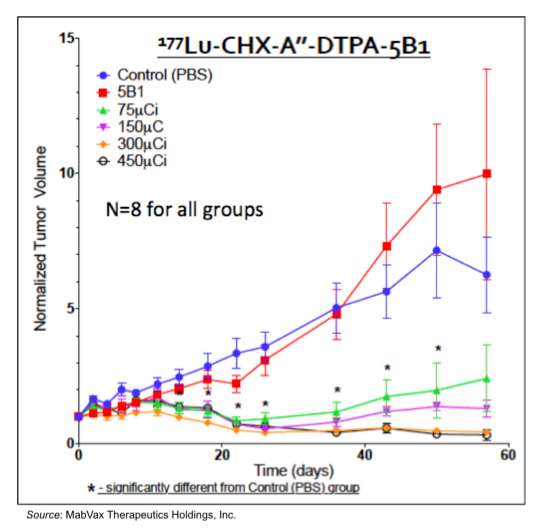
Since HuMab-5B1 has shown such promising results as a PET agent through uptake of the antibody by tumor cells, MabVax has constructed HuMab-5B1 as a radioimmunotherapy (MVT-1075) by attaching the antibody to the radionuclide 177Lu. The following figure shows the results of treating mice with BxPC3 xenografts (after tumors had reached approximately 100 mm3) with one dose of differing amounts of MVT-1075 (based on radioactivity). At the higher radiation doses, MVT-1075 showed tumor regression, not just inhibition or slowing of tumor growth. It should be noted that 5B1 without a radionuclide was added in an equivalent mass dosage and was not optimized as a single agent for this study, hence the reason that there was no anti-tumor activity of the antibody with no radionuclide attached.
MVT-1075 also appears to be equally effective in an orthotopic pancreatic cancer model. As opposed to a xenograft, in which the cancer cells are injected subcutaneously, in an orthotopic model the cancer cells are injected into the tissue from which the tumor cells were derived (i.e., BxPC3 pancreatic cancer cells are injected into the mouse pancreas and allowed to grow). This has the advantage of being a more clinically relevant model. The following images again show tumor regression, not just growth inhibition, following administration of 300 μCi of MVT-1075.
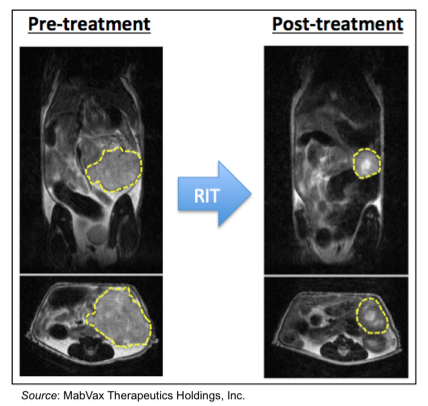
The preclinical results with MVT-1075 are very encouraging, particularly since it was successful using both a xenograft and an orthotopic model. The small error bars for mice showing regression of tumor means that all the mice showed tumor regression and it was not just a subset of those treated. This is important, as the combination of gemcitabine and nab-paclitaxel is only able to cause tumor regression in a subset of mice with human pancreatic cancer xenografts (Van Hoff et al., 2011). MabVax is hoping to quickly follow up on these successful preclinical results by filing an Investigational New Drug (IND) application with the FDA for MVT-1075 by the end of 2016 and initiating a Phase 1 clinical study in the first half of 2017.
Financial Update
On November 7, 2016, MabVax filed form 10-Q with financial results for the third quarter of 2016. The company did not report any revenues in the quarter, compared to $0.1 million in the same period last year. The decrease in revenue was due to the completion of the NIH imaging contract during the first quarter of 2016. Net loss for the third quarter was $4.4 million, or $0.86 per share, and consisted of $1.7 million in R&D expenses and $2.4 million in G&A expenses. Total cash burn for the second quarter was approximately $4.5 million. The company exited the third quarter with approximately $6.9 million in cash and cash equivalents. We anticipate this will be sufficient to fund the operations through the first quarter of 2017.
The company currently has approximately 6.3 million shares of common stock outstanding, 1.8 million shares upon conversion of the Series D Preferred shares, 0.5 million shares upon conversion of the Series E Preferred shares, 0.7 million shares upon conversion of the Series F Preferred shares, 0.8 million stock options, 0.2 million restricted stock grants, and 5.1 million warrants for a fully diluted share count of 15.6 million.
Conclusion
We are very encouraged by the interim data that has been released thus far for both MVT-5873 and MVT-2163. The most important questions to be answered during these Phase 1 studies have to do with the safety and specificity of HuMab-5B1, and we believe that the results obtained thus far show that both MVT-5873 and MVT-2163 are safe and that they are binding specifically to tumor cells.
One of the most important aspects of the data could be the read through that is available for MVT-1075. As discussed above, preclinical results showed that treatment with MVT-1075 resulted in tumor regression, thus alluding to the potential for increased activity compared to MVT-5873. Now that we know HuMab-5B1 can effectively bind to tumors in patients, it stands to reason that MVT-1075 will also be able to effectively saturate tumor cells and may lead to tumor cell killing, which is a very exciting possibility.
With so few options available, a successful treatment for pancreatic cancer could easily become a blockbuster drug. The current standard of care for patients with metastatic pancreatic cancer includes gemcitabine combined with either erlotinib or nab-paclitaxel (Abraxane®). Gemzar® (gemcitabine) is now available as a generic, however prior to losing patent protection the drug generated peak revenues of approximately $700 million in the U.S. for Eli Lilly (EvaluatePharma). Tarceva® (erlotinib), which is approved for the treatment of metastatic non-small cell lung cancer and metastatic pancreatic cancer, is marketed by Roche and Astellas and sales of the drug generated $1.2 billion in revenue in 2015 (EvaluatePharma). Abraxane® (nab-paclitaxel), which was approved for the treatment of breast cancer in 2005 and non-small cell lung cancer in 2012, was approved by the FDA in 2013 for the treatment of metastatic pancreatic cancer. Sales of Abraxane® totaled $1.1 billion in 2015 for all indications (EvalatePharma). Our model estimates peak revenues for MVT-5873 of $1 billion in the U.S.
MabVax continues to successfully execute on its business plan, and we continue to be very positive about the company and the prospects for its development pipeline. Our probability adjusted discounted cash flow model leads to a valuation for MabVax of $15, and we believe that as more investors begin to see the potential for the company’s pipeline the share price should align much closer with our valuation.
For a free copy of the full research report, please email scrinvestors@zacks.com with MBVX as the subject.
SUBSCRIBE TO ZACKS SMALL CAP RESEARCH to receive our articles and reports emailed directly to you each morning. Please visit our website for additional information on Zacks SCR and to view our disclaimer.