By David Bautz, PhD
OTC:MBVX
Financial Update
On May 9, 2014, MabVax Therapeutics Holdings, Inc. (OTC:MBVX) filed form 10-Q with financial results for the first quarter of 2016. The company reported revenue of $0.1 million, which was derived from the $1.5 million Phase II Small Business Innovation Research contract with the National Cancer Institute for developing HuMab-5B1 as an imaging agent in pancreatic cancer. The company recognizes the revenue from grants received from the National Institutes of Health (NIH) as expenses that directly relate to the grant are incurred.
Net loss for the first quarter of 2016 was $4.4 million, or $0.15 per share, and was comprised of $1.7 million in R&D expenses and $2.7 million in G&A expenses. Total cash burn for the first quarter of 2016 was approximately $3.1 million. The company exited the first quarter with approximately $5.6 million, due in part to a financing agreement with Oxford Finance, LLC that will provide the company with up to $10 million in senior secured debt financing. MabVax has received an initial loan of $5 million from this agreement, and we anticipate the company’s current cash position as sufficient to fund operations through the third quarter of 2016, at which point the other $5 million from the loan agreement could be available.
HuMab-5B1 Update
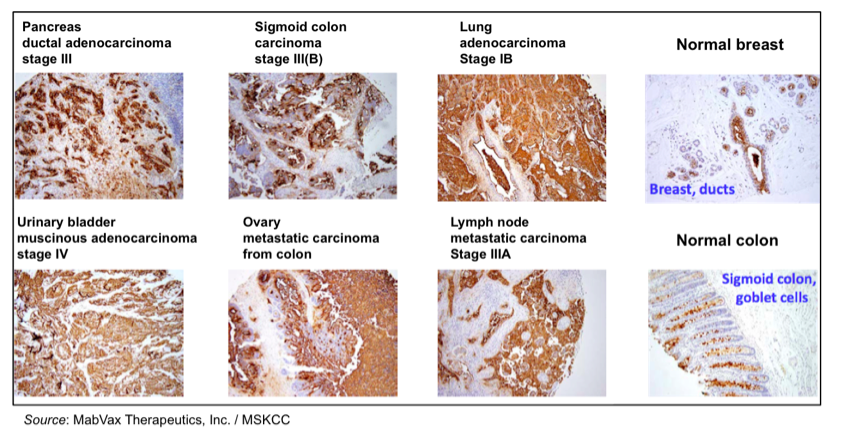
MabVax’s lead antibody candidate, HuMab-5B1, targets the tumor associated carbohydrate antigen (TACA) sialyl Lewisa (sLea). A diagnostic assay using an antibody (CA19-9) raised to sLea is used worldwide to aid in the management of pancreatic cancer, as the antigen is typically shed into the bloodstream by tumors and thus can be monitored over time. sLea is over-expressed on a number of different epithelial tumor types including pancreatic, colon, stomach, ovarian, breast, and small-cell lung cancers. The following figure shows significant homogeneity and staining intensity of sLea on different types of cancer cells along with limited staining of normal tissue. The expression of sLea on normal breast, colon, and pancreatic tissue is restricted to cells of the secretory ducts and lumen, which are inaccessible to the immune effector mechanisms.
HuMab-5B1 was generated from the company’s novel antibody discovery platform, which allows for the generation of fully human antibodies. The antibodies are derived from B-cells extracted from patients immunized with proprietary cancer vaccines. This is the only example we know of where fully human monoclonal antibodies targeting cancer are generated from immunized patients. HuMab-5B1 was derived from a patient with Stage IV breast cancer who was originally vaccinated with a sLea vaccine at the end of 2008. A total of seven patients were vaccinated at that time with the sLea vaccine and six of them are still alive today. The patient from whom 5B1 was derived remains disease free to this day.
MabVax is initially targeting HuMab-5B1 for the treatment of metastatic pancreatic cancer and as an imaging agent for the detection of pancreatic cancer. There are approximately 49,000 individuals diagnosed with pancreatic cancer each year, and close to 80% have metastatic disease at the time of diagnosis. The 5-year survival rates for patients with pancreatic cancer are dismal (<14%) and are particularly bad for those with metastatic disease (~1%).
The company is also developing HuMab-5B1 as a diagnostic imaging agent by linking the antibody to 89Zr, which is known to offer good quality imaging data based on previous pre-clinical and clinical data. For background on the use of HuMab-5B1 as an imaging agent along with preclinical data supporting its use, please see our previous report.
Phase 1 Clinical Trial of HuMab-5B1
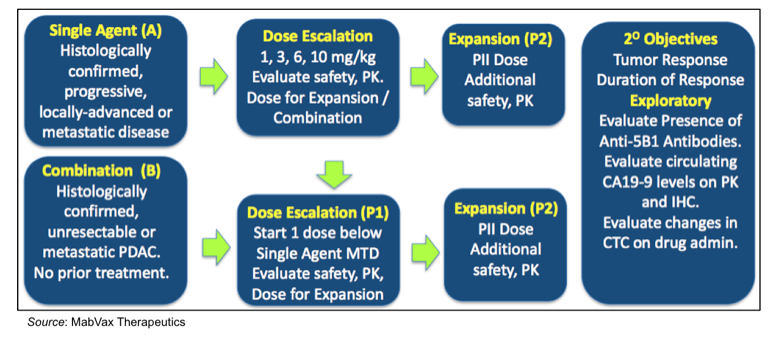
On March 21, 2016, MabVax announced the initiation of a Phase 1 clinical trial of HuMab-5B1 in patients with pancreatic cancer. This is an open label, multi-center, dose escalation clinical trial that is designed to determine the safety, maximum tolerated dose (MTD), and pharmacokinetics (PK) of HuMab-5B1. An evaluation of tumor response rate based on RECIST 1.1 and the duration of response of HuMab-5B1 as a single agent or in combination with the standard of care chemotherapy agent gemcitabine will also be evaluated.
The initial cohort of patients will be treated with 1, 3, 6 or 10 mg/kg of HuMab-5B1 to determine the MTD. This dose will then be utilized in an expansion cohort of approximately 10 subjects to examine additional safety and PK parameters. For the combination study, the first cohort will be treated with one dose below the MTD with escalation up to the MTD. This dose will then be utilized in an expansion study where HuMab-5B1 will be administered alongside the standard of care chemotherapeutic agent gemcitabine. An overview of the Phase 1 protocol is given in the following figure. We anticipate preliminary data from the study being reported in the third quarter of 2016, with the full data set likely to be reported in the first half of 2017.
Imaging Study of 89Zr-HuMab-5B1 to Start Soon
On January 6, 2016, MabVax announced the filing of an Investigational New Drug (IND) application with the FDA for 89Zr-HuMab-5B1, the company’s next generation PET imaging agent. The company received authorization from the FDA to proceed with a Phase 1 clinical trial on January 28, 2016. We anticipate the company beginning a Phase 1 clinical study of 89Zr-HuMab-5B1 very soon. The trial will likely include approximately 20 patients with pancreatic cancer. The goal of the Phase 1 study will be to determine the safety, pharmacokinetics, and biodistribution of 89Zr-HuMab-5B1. In addition, the trial will help determine the optimal amount of “cold”, or unlabeled antibody, to be administered before the radiolabeled antibody as well as the optimal time following injection of 89Zr-HuMab-5B1 to obtain the image. The target of HuMab-5B1, sLea, is shed by growing tumors into the bloodstream. Injecting non-labeled HuMab-5B1 binds this circulating sLea allowing for more radiolabeled antibody to reach the tumor, which helps to enhance tumor imaging as well as reduce the background. We anticipate the company could get initial results from the trial by the third quarter of 2016, with full results available in 2017.
HuMab-5B1 Radioimmunotherapy IND to be Filed in 2H16
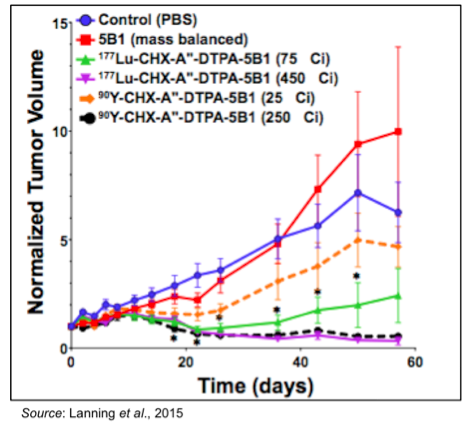
Since HuMab-5B1 has shown such promising results as a PET agent through uptake of the antibody by tumor cells, MabVax has constructed HuMab-5B1 as a radioimmunotherapy by attaching the antibody to both 90Y and 177Lu. The following figure shows the results of treating mice with BxPC3 xenografts after tumors had reached approximately 100 mm3 with either 90Y-5B1 or 177Lu-5B1. At the higher radiation dose, both 90Y-5B1 and 177Lu-5B1 showed tumor regression, not just inhibition or slowing of tumor growth. It should be noted that 5B1 without a radionuclide was added in an equivalent mass dosage and was not optimized as a single agent for this study, hence the reason that there is no activity of the antibody with no radionuclide attached.
Additionally, the 5B1 radioimmunotherapies appear to be equally effective in an orthotopic pancreatic cancer model. As opposed to a xenograft, in which the cancer cells are injected subcutaneously, in an orthotopic model the cancer cells are injected into the tissue from which the tumor cells were derived (i.e., BxPC3 pancreatic cancer cells are injected into the mouse pancreas and allowed to grow). This has the advantage of being a more clinically relevant model. The following graph shows how both the tumor volume and bioluminescence of the tumors decreases following administration of 300 μCi of 177Lu-5B1.
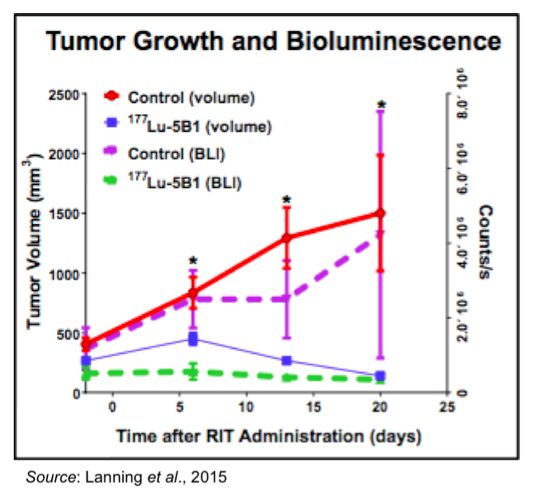
The preclinical results showing 5B1 as a radioimmunotherapy are very encouraging, particularly since the agents were successful against both a xenograft and an orthotopic model. The small error bars for mice showing regression of tumor means that all the mice showed tumor regression and it was not just a subset of those treated. This is important, as the combination of gemcitabine and nab-paclitaxel (Abraxane®) is only able to cause tumor regression in a subset of mice with human pancreatic cancer xenografts (Van Hoff et al., 2011). MabVax is hoping to quickly follow up on these successful preclinical results by filing an Investigational New Drug (IND) application with the FDA for a radioimmunotherapy product by the end of 2016 and initiating a Phase 1 clinical study in the first half of 2017.
Conclusion and Recommendation
We are looking forward to seeing preliminary data from the two Phase 1 studies of HuMab-5B1 in the third quarter of 2016. The release of positive data at that point is a potential catalyst for the stock, and investors could use the current downturn in the stock to accumulate shares ahead of the data release.
The pre-clinical data for the radioimmunotherapy using HuMab-5B1 is very encouraging, and that program should be entering the clinic in the first half of 2017. In the second half of 2017, we anticipate the company filing an IND for an additional HuMab-5B1 product as an antibody-drug conjugate. Thus, the company could potentially have four products in the clinic based on one antibody by the end of 2017! Besides HuMab-5B1, the company has a library of over 100 other fully human antibodies that could be developed in a similar fashion to HuMab-5B1, including anti-GD2 antibodies that were discussed in the last report.
Lastly, additional upside for the company is possible from the ongoing cancer vaccine studies. We believe that topline overall survival data for both the sarcoma and ovarian cancer vaccines will be reported in either late 2016 or early 2017. We continue to be very positive on the MabVax story and believe that the stock price will head higher as more investors become aware of the potential for HuMab-5B1 and the company’s pipeline of fully human antibodies. Our probability adjusted discounted cash flow model leads to a valuation for MabVax of $4 per share.
READ THE FULL RESEARCH REPORT HERE
SUBSCRIBE TO ZACKS SMALL CAP RESEARCH to receive our articles and reports emailed directly to you each morning. Please visit our website for additional information on Zacks SCR and to view our disclaimer.