By Brian Marckx, CFA
NYSE:MDGN
Initiating Severe Pediatric Onset Inflammatory Bowel Disease Program. Second CHOP Collaboration
Yesterday (6/7) Medgenics (NYSE:MDGN) announced that, in collaboration with Japanese biopharmaceutical company Kyowa Hakko Kirin, they are initiating a development program with an anti-LIGHT monoclonal antibody for the ultra-orphan disease Severe Pediatric Onset Inflammatory Bowel Disease. This is the second program coming out of the company’s research collaboration with CHOP.
Key points include;
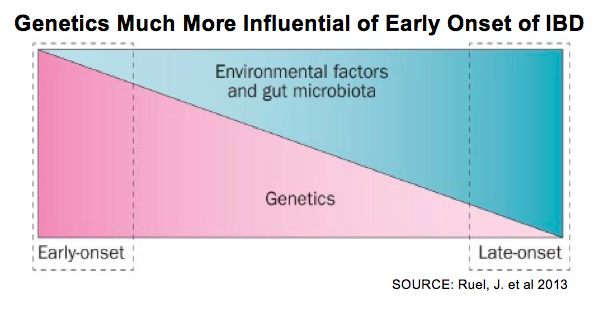
- Unlike adult-onset, pediatric IBD highly influenced by genetic factors
- High unmet need for effective therapy, particularly in chronic pediatric IBD which is associated with high morbidity
- Severe Pediatric Onset Inflammatory Bowel Disease could be ~$300M+ ultra-orphan market opportunity with follow-on indications offering potential additional upside
- Phase 2-ready first-in-class biologic with available clinical supply
- MDGN will initiate signal finding study with Dr. Robert Baldassono, CHOP’s Director for the Center of Pediatric IBD
- Kyowa Hakko Kirin has ~$3B in annual sales with focus on discovering antibody related drugs. Existing collaborations with large pharma include mogamulizumab (anti-CCR4) and benralizumab (anti-IL-5R alpha). Other collaborations include anti-FGF23a and anti-CD40 monoclonal antibodies
- Upon successful completion of signal finding study, MDGN will have option to license development rights At that point
- MDGN will make upfront payment to Kirin in the “low single digit millions”
- Kirin will choose of one two collaboration options
- co-development/co-commercialization partnership. Under this scenario
- MDGN will have U.S. and Canadian commercialization rights
- Kirin will have European and ROW (ex-U.S., ex-Canadian) commercialization rights
- Sales and costs will be equally shared in the U.S. and Canada. MDGN receives double-digit royalty on sales outside of North America
- licensing arrangement. Under this scenario
- MDGN will have U.S., Canadian and European commercialization rights
- Kirin will have ROW commercialization rights
- MDGN funds development and retains 75% of profits in
- Development could be fast-moving. POC study results expected 1H 2017. If positive expect to move directly to phase III pivotal study
Severe Pediatric Onset Inflammatory Bowel Disease
IBD is comprised of ulcerative colitis and Crohn’s disease. U.S. prevalence of pediatric IBD is approximately 50k. Approximately 20% of IBD cases are initially diagnosed by adolescence. While similar in many respects, pediatric IBD has some unique characteristics as compared to the adult form. This includes a relationship between pediatric IBD and impaired growth and skeletal development. Genetics is also believed to play a much more significant role in the pediatric form of IBD. It is also typically more difficult to treat, less responsive to first-line treatments and often more severe than adult onset of the disease.
Ruel at el. found that genetics play a much more prominent role in pediatric, as compared to adult-onset, IBD. In addition, over time pediatric Crohn’s disease is much more likely to develop into more severe state and result in higher morbidity and mortality.
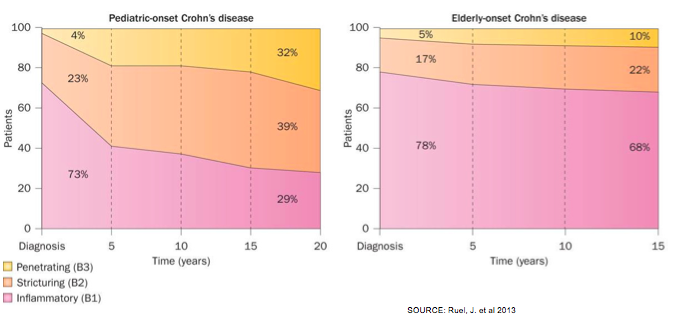
Severe Pediatric Onset IBD is a chronic form of the disease, characterized by recurrent relapse of inflammation of the GI tract. Relapse can have serious consequences including chronic malnutrition, stunted growth and bowel resection surgery. Given the serious morbidity of pediatric IBD, relatively aggressive approaches to treating the disease have been employed.
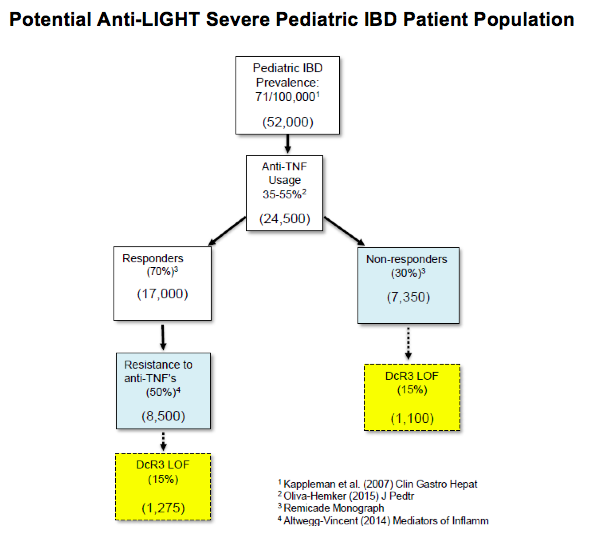
While anti-TNFalpha therapy (infliximab) has been shown to induce and prolong IBD remission in children, it is ineffective in as many as 16k (~30%). And in those patients who do respond to anti-TNFalpha therapy, as many has one-half will develop resistance to it within 3 years. MDGN believes ~2k-3k of these individuals would be eligible for treatment with their anti-LIGHT monoclonal antibody.
Anti-LIGHT monoclonal antibody
Research by Dr. Hakon Hakonarson, of CHOP’s Center for Applied Genomics, and colleagues have identified decoy receptor 3 (DcR3), an immune regulatory protein as playing a role in Severe Pediatric Onset IBD. In healthy individuals DcR3 binds to inflammatory proteins such as LIGHT (ligand for herpesvirus entry mediator). But in some individuals with IBD LIGHT are upregulated in the intestines, resulting in inflammation. Developing a direct substitute for DcR3 was found to not be feasible given its short half-life and toxicity.
The anti-LIGHT candidate, which is believed to mimic DcR3 regulation (i.e. downregulating inflammation) by binding to LIGHT, was discovered at La Jolla Institute for Allergy and Immunology and then licensed to Kirin which created a human version of the antibody. Sanofi then licensed it and, via a U.S. IND, brought it through phase I which showed that LIGHT is overexpressed in IBD. In 2015 Kirin regained rights.
The candidate ‘fits’ within the parameters of MDGN’s collaboration with CHOP. It targets orphan populations, has been validated in phase I and has potential to rapidly move through development, has a moat of IP with 12 years of exclusivity in the U.S. and may have platform utility with possible follow-on orphan indications.
A single-center non-interventional study done by Sanofi demonstrated significantly higher levels of LIGHT in IBD patients versus healthy subjects, supporting the hypothesis that LIGHT plays a role in IBD.
Development Path
MDGN’s development strategy will focus on patients with Severe Pediatric Onset IBD with DcR3 loss-of-function mutations and which have failed anti-TNF alpha therapy. The study will also enroll patients which do not have DcR3 loss-of-function mutations as controls.
MDGN expects to complete a proof-of-concept study under the existing IND in the U.S. The company believes given the existing clinical trial supplies from Sanofi’s study along with resources at CHOP that the POC study can be fairly fast-moving. MDGN hopes to meet with FDA in the near term to discuss the program and believes they can initiate enrollment this year.
If initial results are successful, MDGN believes there may be an opportunity to further expand to program to include all pediatric IBD anti-TNF alpha failures as well as move into other pediatric autoimmune diseases where DcR3 plays a role.
MDGN’s proposed POC trial is a s single-site (at CHOP), 12-patient study over 8 to 12 weeks using ascending doses. Clinical endpoints will be endoscopic evaluation (i.e. healing) and the Pediatric Crohn’s Disease Index. The company estimates cost at approximately $2M. MDGN expects to have data from the proof-of-concept study in 1H 2017.
Based on the high unmet need and assuming positive results, MDGN would then hope to move directly to a single phase III pivotal trial (with orphan status). A long-term safety study will also be conducted.
Market Opportunity
Based on the 2k – 3k of Severe Pediatric Onset IBD patients that could be candidates for their anti-LIGHT therapy, including 1k+ non-responders to anti-TNF alpha therapy and 1k+ which initially respond but eventually build resistance to anti-TNF alpha therapy, and biologic pricing for ultra-orphan diseases, MDGN estimates this initial indication (i.e. Severe Pediatric Onset IBD) could be worth $300M - $400M. Any follow-on indications would offer additional upside.
READ THE FULL RESEARCH REPORT HERE
SUBSCRIBE TO ZACKS SMALL CAP RESEARCH to receive our articles and reports emailed directly to you each morning. Please visit our website for additional information on Zacks SCR and to view our disclaimer.