By Brian Marckx, CFA
NYSE:MDGN
Q1 Results 2015, Operational Update: Setting Up For Exciting 2H 2016….
Medgenics (NYSE:MDGN) reported first quarter 2016 financial results and provided a comprehensive operational update on the conference call, including a detailed review of their NFC-1 program.
As a reminder, in September 2015 MDGN acquired neuroFix Therapeutics, LLC and its lead candidate NFC-1, a compound targeting CNS disorders associated with mutations of the metabotropic glutamate receptors (mGluRs). Initial investigated indications are ADHD and 22q11.2 Deletion Syndrome, although other CNS diseases may also be pursued (see refresher below for info on the deal and NFC-1 including clinical data to-date). Highly positive results of a phenotyping/genotyping study which MDGN announced with their Q1 earnings release sets of the second half of this year to be potentially exciting as initial read-outs from both the NFC-1 ADHD and 22q11.2 Deletion Syndrome studies are slated to happen before current year-end.
Relative to the financials, the most notable item was a meaningful jump in R&D as compared to both the comparable year-earlier period as well as to Q4 2015. The increase was mostly attributable to additional costs related to the NFC-1 clinical program and the CHOP collaboration. As management noted on the call, the NFC-1 ADHD program has been moving faster than earlier anticipated due to a much more rapid enrollment rate than expected in the phenotype/genotype study.
Net loss and EPS were $11.1M and ($0.34), slightly higher than our $10.0M and ($0.31) estimates - the difference mostly due to the accelerated pace of the mGluR+ADHD program. Cash used in operating activities was $9.1M in Q1. Cash balance was ~$44M at quarter-end – which management believes will be sufficient to fund operations into early Q4 2017.
NFC-1: Confirmed mGluR+ Mutation Rates, Phase II/III Initiating. Could Be Fast-Moving Through Ph III…
Results of the non-interventional phenotype/genotype study were exactly what management was hoping for. Approximately 700 of an expected 1,000 subjects have already been genotyped and of that population, about 25% tested positive for genetic mutations that affect the mGluR network. This is actually slightly higher (i.e. better) than earlier research by Dr. Hakonarson which indicated ~20% of ADHD patients have an underlying mGluR network mutation.
The study also had a somewhat unexpected outcome as well – that being the very rapid pace of enrollment. Prior to the start of the pheno/geno study management had expected it would likely run through approximately the end of 2016. Instead the initial 700 patients ran through in just 10 weeks and full enrollment is expected to be complete in June (final analysis will include phenotypic data). Management attributes the rapid pace to the current lack of safe and effective ADHD treatments which has created a thirst from ADHD sufferers, their parents and clinicians for a better alternative. This is indicative of the 95%+ of subjects in the geno/pheno study which agreed to be on a call-back list for inclusion in future studies, including MDGN’s Phase II/III ADHD study.
MDGN met with FDA in early May and noted on the Q1 call that the meeting was constructive in terms of the path forward for both the ADHD and 22q indications. They have clearance to move forward with both the ADHD phase II/III adolescent study and 22q proof-of-concept study.
The phase II/III mGluR+ADHD randomized, placebo-controlled study in adolescents (ages 12 – 17);
- enrollment (n=90) expected to begin in June
- will use same 25 trial sites as geno/pheno study
- randomize 1:1; NFC-1/placebo
- following wash-out period patients will
- receive placebo or
- receive NFC-1
- in weekly escalating doses from 100mg (twice/day) to 400mg based on tolerability
- after the 4th week patients will stay on the optimized dose for 2-week maintenance phase
- followed by 1 week off-drug for safety observation
-Response endpoints will be ADHD RS (parent assessment) and Clinical Global Impressions (CGI-I)
- as typical stimulant-based ADHD drugs are associated with significant side effects including anxiety and difficulty sleeping, this study will also assess sleep using adolescents sleep hygiene scale (ASHS) and anxiety with the screen for childhood anxiety related disorders (SCARED)
Management believes this study can also enroll rapidly, facilitated by the 95% of subjects in the pheno/geno study that indicated interest in continuing in future studies. MDGN expects top-line results to be available in the second half of this year.
Phase III
Assuming positive results, they would then move to phase III studies – currently the expectation is to conduct both a pediatric and adolescent phase III study. Specifics on size and design will be determined following conclusion (and results of) the phase II/III study.
MDGN will also be developing a companion diagnostic which will determine whether an individual is positive for the genetic mutations of interest and, therefore, appropriate for treatment with NFC-1. Management noted on the call that while specifics are still in the planning stage, that this is expected to follow an FDA-clearance pathway (i.e. – will not be an LDT).
22q11.2 Deletion Syndrome
While initiation of the 22q phase I/II study has been delayed, management noted on the call that this is now nearing kick-off. The randomized, placebo-controlled, proof-of-concept, dose-finding study will be a single-site study at CHOP;
- enroll (n=30) adolescents (ages 12 – 17) expected to begin June
- protocol;
- open label, dose-finding phase for first 5 weeks
- non-responders will exit the study. Responders will be randomized ~1:3; NFC-1/placebo
- will remain on optimal dose for up to 7 weeks
- assessments will be made on three neuropsychiatric disorders; ADHD, anxiety and autism spectrum disorders
- endpoints will be CGI-I, ADHD-RS, Pediatric Anxiety Rating Scale (PARS) and Childhood Autism Rating Scale (CARS-2)
MDGN noted that they do not expect much in the way of a placebo response given the typical relatively low (~65 – 75) IQ of 22q subjects. As such, we think that there’s potential for a marked signal despite the small size of this study. Management expects to have the open-label data in 2H 2016.
TARGT CNS
MDGN did not address their TARGT CNS program (as a reminder the TARGT EPO program was recently shelved - at least for the time being) on the Q1 call other than noting that preclinical activity continues in Israel and hope to report on that prior to current year-end.
REFRESHER: NFC-1 Acquisition, Clinical Data
In September 2015 MDGN acquired neuroFix Therapeutics, LLC and its lead candidate NFC-1, a compound targeting CNS disorders associated with mutations of the metabotropic glutamate receptors (mGluRs). Initial focus is on Attention Deficit Hyperactivity Disorder (ADHD) and 22q11.2 Deletion Syndrome, a rare condition also associated with mGluR mutations and one which may offer orphan status opportunities (both specifically for 22q11.2 Deletion Syndrome as well as associated indications).
This is the first opportunity to come from MDGN's relationship with CHOP
neuroFix was founded by Dr. Hakon Hakonarson, Director of the Center for Applied Genomics at CHOP, in order further develop NFC-1. Prior to MDGN's acquisition, neuroFix licensed certain technology related to ADHD and other neurological and neuropsychological indications from CHOP.
Terms of the deal;
- $8M in cash and common stock
- additional payments of up to $450M upon achievement of certain milestones (development, regulatory and sales) related to an oral formulation of NFC-1 and any new chemical entity (NCE) developed covering the same indication (specifics in terms of exactly what this relates to and what the triggers are were not disclosed)
- sales royalties based on tiered rates ranging from mid-to-high single digits depending on the product or NCE
- $25M for each FDA approved indication beyond the initial indication
Terms of License Agreement between neuroFix and CHOP;
- up to $1.5M in regulatory and sales milestones for each FDA approved indication using IP covering the agreement
- sales royalties based on a fluctuating rate in the low single digits - which adjust downward based on the extent of third party royalties
- $100k or less in annual maintenance fees
- a percentage (ranging from mid-single digits to mid-teens) of any sublicense income (ex-sublicensed sales by a certain party in Japan)
- this license agreement terminates upon the later of the expiration of certain CHOP patent rights and January 1, 2025, at which time neuroFix owns the covered licensed rights
Metabotropic Glutamate Receptors (mGluRs)
The amino acid glutamate is the most prominent excitatory neurotransmitter in the brain. It binds to mGluRs which are involved in the modulation of synaptic transmission and neuronal excitability in the central and peripheral nervous system. Genetic mutations of genes within the mGluR network have been associated with certain conditions including ADHD, anxiety disorders, schizophrenia and other neuropsychiatric disorders.
Research conducted by Dr. Hakonarson and colleagues indicated that mutations in the mGluR gene network are associated with a 10x higher rate of ADHD. They found that disruptions specifically to GRM1 (glutamate receptor, metabotropic 5), GRM3, GRM 7 and GRM8 were associated with ADHD.
NFC-1 GREAT Study
neuroFix, in collaboration with CHOP, conducted a Phase 1, 30-patient, single arm study at Thomas Jefferson University (Philadelphia) assessing NFC-1 in adolescents with ADHD. Inclusion criteria included professionally diagnosed with ADHD and genotyped as having disruptions to the mGluR network. The background of the enrolled population had certain symptoms which could be considered particularly challenging to effectively treat including;
- 73% had severe ADHD (CGI-S>5, on a scale of 1=normal to 7=extremely ill)
- 67% had co-morbid psychiatric conditions such as anxiety, ODD and insomnia
- 30% were on antipsychotics and/or antidepressants
- 70% had been previously treated with ADHD drugs (with presumably little benefit)
One-week run-in on placebo was followed by four weeks of active treatment. Treatment was dose-escalating from 50mg (x2/day) to a maximum of 400mg (x2/day). Dose was escalated weekly. Patients were blinded, clinicians were not. Primary endpoint was safety, secondary endpoint efficacy measures were standard ADHD assessments including Vanderbilt and Clinical Global Impressions (CGI) scores.
Results showed;
- dose and time-dependent response on both the CGI-I and Vanderbilt measures
- over 80% of patients responded to NFC-1 treatment on Vanderbilt measure at week 5
- just under 80% of patients responded NFC-1 treatment on CGI-I measure at week 5
- repeated measure analysis showed statistically significant response on both measures over time and at higher doses
- Mutations to "tier 1" genes (i.e those in the mGluR receptors) and "tier 2" genes (i.e. those that encode proteins that influence mGluR but are not in the receptors) showed much higher response rates compared to "tier 3" genes (more distant from the receptors and therefore likely to show lower response)
- Excellent safety with no treatment related serious adverse events
- 20 of the 30 patients chose to continue to receive NFC-1 therapy in an ongoing long-term safety trial. As management noted in their presentation, this is clearly a positive vote of confidence in the efficacy of NFC-1 given that there's a significant hassle involved in coming to the clinic on a regular basis to receive treatment (i.e. - it's unlikely patients/parents would continue if they experienced no positive effect)
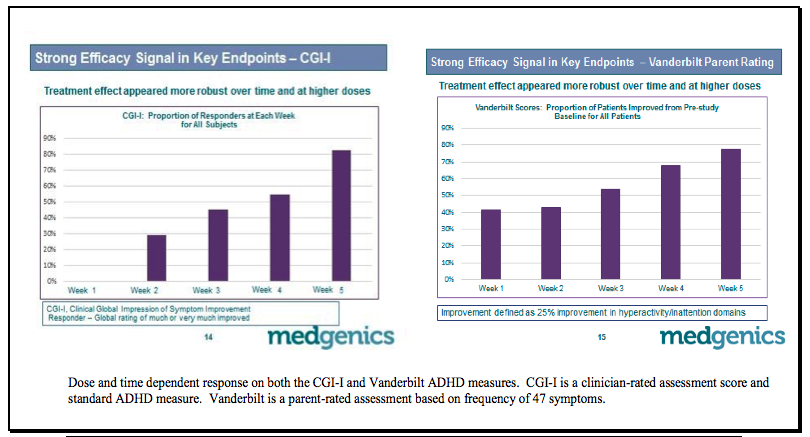
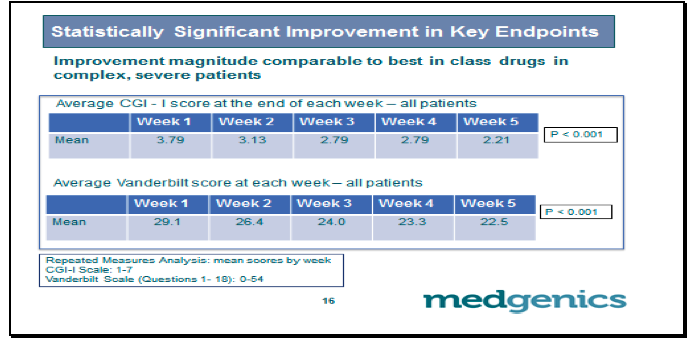
We note that there is the risk of unintended bias in the CGI-I score given that the clinician was not blinded in this study (management noted that the clinician is highly qualified in ADHD assessment, which we acknowledge is likely a mitigating factor). Risk of bias, however, is not relevant with Vanderbilt which is a parent-rated assessment as the parents were blinded in the study - and both CGI-I and Vanderbilt demonstrated dose and time dependent response, indicating that NFC-1 is effective in ADHD treatment. The planned upcoming Phase 2/3 will be double-blinded and therefore will not be at risk of bias.
Phase 2/3 Study
Given the more pronounced response in tier 1 and tier 2 gene mutations, which are believed to account for 20% or more (MDGN’s genotyping/phenotyping study showed prevalence of ~25%) of the ADHD population, this will be an inclusion criteria in the Phase 2/3 trial. The phase 2/3 mGluR+ADHD randomized, placebo-controlled study in adolescents (ages 12 – 17);
- enrollment (n=90) expected to begin in June 2016
- will use same 25 trial sites as geno/pheno study
- randomize 1:1; NFC-1/placebo
- following wash-out period patients will
- receive placebo or
- receive NFC-1
- in weekly escalating doses from 100mg (twice/day) to 400mg based on tolerability
- after the 4th week patients will stay on the optimized dose for 2-week maintenance phase
- followed by 1 week off-drug for safety observation
- Response endpoints will be ADHD RS (parent assessment) and Clinical Global Impressions (CGI-I)
- as typical stimulant-based ADHD drugs are associated with significant side effects including anxiety and difficulty sleeping, this study will also assess sleep using adolescents sleep hygiene scale (ASHS) and anxiety with the screen for childhood anxiety related disorders (SCARED)
ADHD Market Is Attractive: Positive Phase 2/3 Data Could Be a Needle-Mover to Share Price
ADHD could be a hugely attractive market for MDGN and a genetic-based therapy including the significant size of the market, ambiguity of diagnosis and unmet need for therapies which are more effective and have less problematic side effect profiles.
- ~6M children are diagnosed with ADHD in the U.S.
- ~25% of ADHD population, or 1.5M, is mGluR+
- based on pricing, dosing regimen and compliance of current ADHD drugs (~$12/day), this equates to a potential market opportunity for NFC-1 in ADHD of ~$3B – which could be conservative given that this assumes only 180 days/year of compliance and does not include the adult market
- ADHD is the most common neurobehavioral disorder diagnosed in the U.S.
- No definitive test exists to diagnose ADHD - all ADHD diagnoses are arbitrary based on subjective assessment
- Stimulants such as Adderrall (amphetamine and dextroamphetamine), Vyvanse (lisdexamfetamine) and ritalin (methylphenidate) account for over 90% of ADHD prescriptions. These drugs are associated with significant side effects including risk of addiction, irritability and difficulty sleeping, among others. They are highly regulated due to their risk of addiction. These stimulants do not always address all of the underlying symptoms which often can include anxiety and psychotic disorders - mGluR mutations have been associated with other psychiatric conditions which means NFC-1 may be able to address not only ADHD but other of these conditions as well.
Unlike stimulants NFC-1 does address the underlying cause of ADHD. In addition, diagnosis (of mGluR mutations) is genetically-based, not arbitrary. It also (in clinical trials to-date, which includes a 1,000+ patient study in vascular dementia), has shown an excellent side-effect profile. And 20% - 25% of the entire U.S. ADHD market is very significant for a company of MDGN's size, particularly given that the benefits of NFC-1 over stimulants should offer the opportunity for premium pricing. We think it is conceivable that mGluR+ADHD could easily represent a multi-billion dollar market opportunity. As such, if the planned Phase 2/3 study confirms what was demonstrated in Phase 1, we think this could be a needle-mover to the share price.
22q11.2 Deletion Syndrome: Orphan Opportunity for NFC-1 to Address Related Psychological Disorders
22q11.2 Deletion Syndrome is a relatively rare disease with incidence (per The International 22q11.2 Foundation Inc.) estimated at one in every 1,000 live births - which equates to about 4,000 new cases every year in the U.S (~130k worldwide). We have not been able to find an estimate of prevalence rates, although management noted on the call that U.S. prevalence is believed to be approximately 75k - 100k.
22q11.2 Deletion Syndrome is characterized by the deletion on the long arm of one pair of chromosome 22 (region 1, band 1, sub-band 1). The disorder can affect most systems in the body and is associated with serious physical and neuropsychological problems including cardiovascular issues, cleft palate, abnormal facial features, immune disorders and behavioral, psychotic and anxiety disorders (including ADHD). And while many of the physical problems such as heart defects and cleft palate can be addressed by traditional medical intervention such as surgery, there are no current therapies available to address the psychological disorders. It is estimated that about 30% - 40% of individuals with 22q11.2 Deletion Syndrome will eventually progress to schizophrenia.
And mGluR mutations appear to play a roll in 22q11.2 Deletion Syndrome with over 90% of 22q11.2 Deletion Syndrome patients having at least one mGluR network related deletion. In fact two patients in the Phase 1 ADHD study had 22q11.2 mutations (one deletion and one duplication), both of which, per the company's presentation, reported "significant symptom improvement in both CGI-I and Vanderbilt" and both patients continue in the long-term safety trial.
So MDGN will look to capitalize on the potential effect of NFC-1 in 22q11.2 Deletion Syndrome and expects to initiate a Phase 1/2 indication and dose finding study in the near term with data expected around the end of this year. Received IND in January 2016 to begin this study. The initial study is expected to parse out the first (of potentially other follow-on) indication - which MDGN noted could be related to ADHD, anxiety or mood disorders.
READ THE FULL RESEARCH REPORT HERE
SUBSCRIBE TO ZACKS SMALL CAP RESEARCH to receive our articles and reports emailed directly to you each morning. Please visit our website for additional information on Zacks SCR and to view our disclaimer.