By
Brian Marckx, CFA
NYSE:MDGN
NYSE:SNY
Q2 Results, Operational Update: Several Significant Upcoming Clinical Milestones, Restocked Cash Balance..
Medgenics (NYSE:MDGN) reported financial results for the second quarter ending June 30th and provided and operational update including status reports on their NFC-1 programs in ADHD and 22q Deletion Syndrome as well as their anti-LIGHT candidate targeting severe pediatric onset IBD.
Relative to the financials, results were largely inline with our estimates. Operating expenses, while relatively flat from Q1 were up by approximately 69% from the comparable prior year period. About 30% of the difference relates to $1.4M offset to R&D in Q2 2015 related to Office of Chief Scientist grant compared to no offset in the most recent quarter. The remaining 70% relates to higher gross R&D spend related to the additional programs that were onboarded over the last several quarters.
Q2 net loss and EPS were $11.7M and ($0.35), compared to our $11.4M and ($0.35) estimates. Cash used in operating activities was $9.8M and $18.9M in the first three and six months of 2016. Cash balance, bolstered by the June equity raise (3.8M shares @ $5.50/share) which netted ~$19.7M, was $53.7M at quarter end. The sizeable raise and beefed-up cash balance allows development programs to remain on track and at their accelerated pace. Management expects current cash to fund operations through Q1 2018. By that time NFC-1 should have significant data points in both mGlurR+ ADHD and 22q and initial responder data should be available from the anti-LIGHT program.
Several clinical milestones in the NFC-1 and anti-LIGHT programs are anticipated over the next several months. NFC-1 mGluR+ ADHD development continues at a fast rate. The genotype/phenotype study ran through 1k+ patients in less than four months and the phase II/III interventional study initiated enrollment in June. And while initiation of the 22q signal finding study has been delayed awaiting sign-off from CHOP, that hurdle was recently cleared and the study will begin imminently. Assuming timely meeting with FDA and agreement on study design, MDGN could also have initial data from the anti-LIGHT program in the near term. Expected upcoming milestones include;
NFC-1:
- mGluR+ ADHD phase II/III top-line data in 2H 2016
- 22q
- phase I/II signal finding study initiate Q3 2016
- data from open label portion (through first 5 weeks) in 2H 2016
anti-LIGHT:
-meeting with FDA late Q3/early Q4
-signal finding study commences Q4 2016
- initial open label responder data in 1H 2017
NFC-1: Confirmed mGluR+ Mutation Rates, Phase II/III Initiated. Could Be Fast-Moving Through Ph III…
Results of the non-interventional phenotype/genotype study were exactly what management was hoping for. Over 1,000 subjects were genotyped and about 25% tested positive for genetic mutations that affect the mGluR network. This is actually slightly higher (i.e. better) than earlier research by Dr. Hakonarson which indicated ~20% of ADHD patients have an underlying mGluR network mutation.
The study also had a somewhat unexpected outcome as well – that being the very rapid pace of enrollment. Prior to the start of the pheno/geno study management had expected it would likely run through approximately the end of 2016. Instead it took less than four months for the 1,000+ patients to run through. Management attributes the rapid pace to the current lack of safe and effective ADHD treatments which has created a thirst from ADHD sufferers, their parents and clinicians for a better alternative. This is indicative of the 95%+ of subjects in the geno/pheno study which agreed to be on a call-back list for inclusion in future studies, including MDGN’s Phase II/III ADHD study. Enrollment in the phase II/III interventional study began in June with top-line data expected later this year.
The phase II/III mGluR+ADHD randomized, placebo-controlled study in adolescents (ages 12 – 17) dubbed the SAGA (Study of Adolescent Glutamate Receptor Network Copy Number Variant ADHD) trial ;
- enrollment (n=90), first patient enrolled in June
- will use same 25 trial sites as geno/pheno study
- randomize 1:1; NFC-1/placebo
- following wash-out period patients will
- receive placebo or
- receive NFC-1
- in weekly escalating doses from 100mg (twice/day) to 400mg based on tolerability
- after the 4th week patients will stay on the optimized dose for 2-week maintenance phase
- followed by 1 week off-drug for safety observation
- Response endpoints will be ADHD RS (parent assessment) and Clinical Global Impressions (CGI-I)
- as typical stimulant-based ADHD drugs are associated with significant side effects including anxiety and difficulty sleeping, this study will also assess sleep using adolescents sleep hygiene scale (ASHS) and anxiety with the screen for childhood anxiety related disorders (SCARED)
Management believes this study can also enroll rapidly, facilitated by the 95% of subjects in the pheno/geno study that indicated interest in continuing in future studies. MDGN expects top-line results to be available later this year.
Phase III
Assuming positive results, they would then move to phase III studies – currently the expectation is to conduct both a pediatric and adolescent phase III study. Specifics on size and design will be determined following conclusion (and results of) the phase II/III study.
MDGN will also be developing a companion diagnostic which will determine whether an individual is positive for the genetic mutations of interest and, therefore, appropriate for treatment with NFC-1. While specifics are still in the planning stage, that this is expected to follow an FDA-clearance pathway (i.e. – will not be an LDT).
22q11.2 Deletion Syndrome
While initiation of the 22q phase I/II study has been delayed, management noted on the call that this is now nearing kick-off as administrative issues with CHOP have been resolved. The randomized, placebo-controlled, proof-of-concept, dose-finding study will be a single-site study at CHOP;
- enroll (n=30) adolescents (ages 12 – 17) expected to begin Q3 2016
- protocol;
- open label, dose-finding phase for first 5 weeks
- non-responders will exit the study. Responders will be randomized ~1:3; NFC-1/placebo
- will remain on optimal dose for up to 7 weeks
- assessments will be made on three neuropsychiatric disorders; ADHD, anxiety and autism spectrum disorders
- endpoints will be CGI-I, ADHD-RS, Pediatric Anxiety Rating Scale (PARS) and Childhood Autism Rating Scale (CARS-2)
- data from open label portion (through first 5 weeks) in 2H 2016
MDGN noted that they do not expect much in the way of a placebo response given the typical relatively low (~65 – 75) IQ of 22q subjects. As such, we think that there’s potential for a marked signal despite the small size of this study. Management expects to have the open-label data in 2H 2016.
Severe Pediatric Onset Inflammatory Bowel Disease Program. Second CHOP Collaboration
In June MDGN announced that, in collaboration with Japanese biopharmaceutical company Kyowa Hakko Kirin, they initiated a development program with an anti-LIGHT monoclonal antibody for the ultra-orphan disease Severe Pediatric Onset Inflammatory Bowel Disease. This is the second program from the company’s research collaboration with CHOP. It will leverage CHOP's Center for Applied Genomics (CAG), one of the world's largest repositories of pediatric genetic data.
Key points include;
- Phase 2-ready first-in-class biologic with available clinical supply
- MDGN will initiate signal finding study with Dr. Robert Baldassono, CHOP’s Director for the Center of Pediatric IBD
- Kyowa Hakko Kirin has ~$3B in annual sales with focus on discovering antibody related drugs. Existing collaborations with large pharma include mogamulizumab (anti-CCR4) and benralizumab (anti-IL-5R alpha). Other collaborations include anti-FGF23a and anti-CD40 monoclonal antibodies
- Upon successful completion of signal finding study, MDGN will have option to license development rights At that point
- MDGN will make upfront payment to Kirin in the “low single digit millions”
- Kirin will choose of one two collaboration options
- co-development/co-commercialization partnership. Under this scenario
- MDGN will have U.S. and Canadian commercialization rights
- Kirin will have European and ROW (ex-U.S., ex-Canadian) commercialization rights
- Sales and costs will be equally shared in the U.S. and Canada. MDGN receives double-digit royalty on sales outside of North America
- licensing arrangement. Under this scenario
- MDGN will have U.S., Canadian and European commercialization rights
- Kirin will have ROW commercialization rights
- MDGN funds development and retains 75% of profits in
- Specific terms of each of the two structures was not disclosed although MDGN notes that they “include a combination of royalties and profit sharing.
Severe Pediatric Onset Inflammatory Bowel Disease
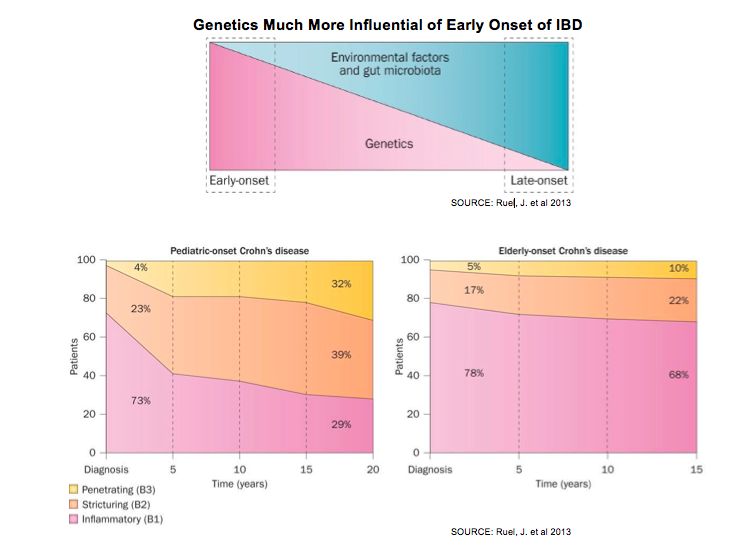
IBD is comprised of ulcerative colitis and Crohn’s disease. U.S. prevalence of pediatric IBD is approximately 50k - 100k. Approximately 20% of IBD cases are initially diagnosed by adolescence. While similar in many respects, pediatric IBD has some unique characteristics as compared to the adult form. This includes a relationship between pediatric IBD and impaired growth and skeletal development. Genetics is also believed to play a much more significant role in the pediatric form of IBD. It is also typically more difficult to treat, less responsive to first-line treatments and often more severe than adult onset of the disease.
Ruel at el. found that genetics play a much more prominent role in pediatric, as opposed to adult-onset, IBD. In addition, over time pediatric Crohn’s disease is much more likely to develop into more severe state and result in higher morbidity and mortality.
Severe Pediatric Onset IBD is a chronic form of the disease, characterized by recurrent relapse of inflammation of the GI tract. Relapse can have serious consequences including chronic malnutrition, stunted growth and bowel resection surgery. Given the serious morbidity of pediatric IBD, relatively aggressive approaches to treating the disease have been employed.
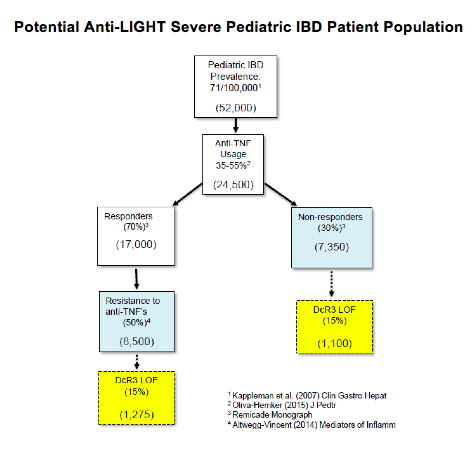
While anti-TNFalpha therapy (infliximab) has been shown to induce and prolong IBD remission in children, it is ineffective in as many as 16k (~30%). And in those patients who do respond to anti-TNFalpha therapy, as many has one-half will develop resistance to it within 3 years. MDGN believes ~2k-3k of these individuals would be eligible for treatment with their anti-LIGHT monoclonal antibody.
Anti-LIGHT monoclonal antibody
Research by Dr. Hakon Hakonarson, of CHOP’s Center for Applied Genomics, and colleagues have identified decoy receptor 3 (DcR3), an immune regulatory protein as playing a role in Severe Pediatric Onset IBD. In healthy individuals DcR3 binds to inflammatory proteins such as LIGHT (ligand for herpesvirus entry mediator). But in some individuals with IBD LIGHT are upregulated in the intestines, resulting in inflammation. Developing a direct substitute for DcR3 was found to not be feasible given its short half-life and toxicity.
The anti-LIGHT candidate, which is believed to mimic DcR3 regulation (i.e. downregulating inflammation) by binding to LIGHT, was discovered at La Jolla Institute for Allergy and Immunology and then licensed to Kirin which created a human version of the antibody. Sanofi (NYSE:SNY) then licensed it and, via a U.S. IND, brought it through phase I which showed that LIGHT is overexpressed in IBD. In 2015 Kirin regained rights.
The candidate ‘fits’ within the parameters of MDGN’s collaboration with CHOP. It targets orphan populations, has been validated in phase I and has potential to rapidly move through development, has a moat of IP with 12 years of exclusivity in the U.S. and may have platform utility with possible follow-on orphan indications.
A single-center non-interventional study done by Sanofi demonstrated significantly higher levels of LIGHT in IBD patients versus healthy subjects, supporting the hypothesis that LIGHT plays a role in IBD.
MDGN development strategy will focus on patients with Severe Pediatric Onset IBD with DcR3 loss-of-function mutations and which have failed anti-TNF alpha therapy. The study will also enroll patients which do not have DcR3 loss-of-function mutations as controls.
MDGN expects to complete a proof-of-concept study under the existing IND in the U.S. The company believes given the existing clinical trial supplies from Sanofi’s study along with resources at CHOP that the POC study can be fairly fast-moving. Initial preparations towards initiating the study have been made including transfer of the clinical trial supplies and scheduled meetings with the joint development team (MDGN, Kirin, CAG). MDGN hopes to meet with FDA sometime this Fall to discuss the program and believes they can initiate enrollment this year. If all goes well initial open label responder data could be available in 1H 2017.
If initial results are successful, MDGN believes there may be an opportunity to further expand to program to include all pediatric IBD anti-TNF alpha failures as well as move into other pediatric autoimmune diseases where DcR3 plays a role.
Development Path
MDGN’s proposed POC trial is a s single-site (at CHOP), up to 12 patients study over 8 to 12 weeks using ascending doses. Clinical endpoints will be endoscopic evaluation (i.e. healing) and the Pediatric Crohn’s Disease Index. The company estimates cost at approximately $2M. MDGN expects to have data from the proof-of-concept study in 1H 2017.
Based on the high unmet need and assuming positive results, MDGN would then hope to move directly to a single phase III pivotal trial (with orphan status). A long-term safety study will also be conducted.
Market Opportunity
Based on the 2k – 3k of Severe Pediatric Onset IBD patients that could be candidates for their anti-LIGHT therapy, including 1k+ non-responders to anti-TNF alpha therapy and 1k+ which initially respond but eventually build resistance to anti-TNF alpha therapy, and biologic pricing for ultra-orphan diseases, MDGN estimates this initial indication (i.e. Severe Pediatric Onset IBD) could be worth $300M - $400M. Any follow-on indications would offer additional upside
TARGT CNS
As a reminder the TARGT EPO program was recently shelved - at least for the time being. TARGT CNS program could have preclinical proof-of-concept data later in 2016
We cover MDGN with a $11/share price target. See below for free access to our updated report on the company.
READ THE FULL RESEARCH REPORT HERESUBSCRIBE TO ZACKS SMALL CAP RESEARCH to receive our articles and reports emailed directly to you each morning. Please visit our website for additional information on Zacks SCR and to view our disclaimer.