By David Bautz, PhD
NASDAQ:MNOV
MN-166 Update
MediciNova (NASDAQ:MNOV) is developing MN-166 (ibudilast) for the treatment of primary and secondary progressive multiple sclerosis (PPMS and SPMS), amyotrophic lateral sclerosis (ALS), methamphetamine (MA) addiction, opioid dependence, and alcohol dependence. The drug is currently being tested in four separate clinical trials in the aforementioned indications with two trials recently completed in alcohol dependence and opioid dependence.
MN-166 is an anti-inflammatory drug that has been used for over 20 years in Japan to treat asthma (Rolan et al., 2009) and post-stroke dizziness. It acts as a phophodiesterase (PDE) inhibitor (Suzumura et al., 1999) and preferentially inhibits PDE-4 (Huang et al., 2006). The drug has shown anti-inflammatory activity in both the peripheral immune system and in the CNS via attenuation of glial cells, which play a role in certain neurological conditions. In addition, delivery of a PDE-4 inhibitor led to enhanced differentiation of oligodendrocyte progenitor cells within areas of demyelination and a consequent acceleration of remyelination (Syed et al., 2013).
Preclinical work performed with MN-166 showed that the compound can suppress neuronal cell death induced by activated microglia (Mizuno et al., 2004). MN-166 was shown to suppress the production of TNF-α and IL-6 by microglia as well as enhance the production of the anti-inflammatory cytokine IL-10 and neurotrophic factors such as NGF, GDNF, and NT-4. These data are in agreement with an earlier study of MN-166 in a chronic cerebral hypoperfusion model that showed it could inhibit the activation of microglia cells and prevent the formation of white matter lesions (Wakita et al., 2003). This inhibitory effect was shown to be dose dependent and involve the suppression of TNF-α production.
MN-166 for the Treatment of Progressive Multiple Sclerosis
Multiple sclerosis (MS) is a chronic autoimmune, inflammatory disease that affects axons in the central nervous system (CNS). There is no single diagnostic test for MS, with diagnosis based on the following criteria: 1) at least two different lesions in the white matter of the CNS, 2) at least two different episodes in the disease course, and 3) chronic inflammation of the CNS as determined by analysis of the cerebrospinal fluid (CSF). Having one or more of these criteria allows a general diagnosis of MS.
The pattern and course of the disease is characterized by the following patterns:
- Primary progressive (PPMS): Characterized by disease progression from the onset with occasional plateaus and temporary minor improvements. It makes up approximately 10 percent of cases at onset. Patients typically experience a steady decline in function from the beginning and never have acute attacks. There are no currently approved medications for treating primary progressive MS.
- Relapsing remitting (RRMS): Characterized by clearly defined relapses with recovery. This type of MS accounts for approximately 85 to 90 percent of MS cases at onset. However, most patients will then progress into the secondary progressive phase.
- Secondary progressive (SPMS): Characterized by progression with or without occasional relapses, minor remissions, and plateaus. Studies suggest that approximately 50% of patients with relapsing-remitting MS will go on to develop secondary progressive MS.
- Progressive relapsing (PRMS): Characterized by progressive disease from the onset, with clear acute relapses, with or without full recovery. Disease progression continues to occur during the periods between disease relapses.
MN-166 was previously tested in a randomized, double blind, placebo controlled Phase 2a clinical trial to evaluate its safety and effectiveness in relapsing MS patients. The primary outcome of the study was the cumulative number of newly active lesions seen on bimonthly MRI scans over the first 12 months of treatment. Secondary outcomes included the time to first exacerbation, number of relapses, and annualized relapse rate over 12 months, and the cumulative volume of Gd-enhancing lesions over 12 months. The results showed that there was no difference in the number of newly active lesions or in the cumulative volume of Gd-enhancing lesions between treatment arms. Thus, MN-166 did not appear to have an effect on overt inflammation leading to a suppression of disease activity. However, MN-166 may exert a neuroprotective effect. A preplanned evaluation of brain atrophy showed a statistically significant dose-dependent decrease in atrophy progression in the 60-mg MN-166 group (mean -0.79) compared to placebo (mean -1.20, P = 0.04) after only one year of treatment.
Based on the results of the Phase 2a study, investigators from NeuroNEXT, an NIH funded clinical trial network that conducts studies of treatments for neurological diseases, initiated the SPRINT-MS trial, which is a Phase 2b trial evaluating MN-166 in PPMS and SPMS patients titled “A Randomized, Double-Blind, Placebo-Controlled Study to Evaluate the Safety, Tolerability and Activity of Ibudilast (MN-166) in Subjects with Progressive Multiple Sclerosis” (NCT01982942).
In June 2015, the company announced the ongoing clinical trial of MN-166 in progressive MS had completed randomization of 255 patients. Participants are receiving either MN-166 (100 mg/day) or placebo twice a day (e.g., MN-166 50 mg or placebo taken once in the morning and once at night) for a total of 96 weeks of treatment with a follow up visit one month after the week 96 visit. There is a planned interim efficacy analysis after half the subjects complete the 96-week treatment period. On July 13, 2016, the company announced that 50% of patients had completed the 96-week treatment period and that the trial’s Data Safety Monitoring Board (DSMB) will review the results of an interim analysis in the fourth quarter of 2016. Based upon this analysis, the DSMB will make one of three potential recommendations to the investigators of the trial: 1) continue the trial to completion as planned; 2) stop the trial for overwhelming efficacy; or 3) stop the trial for futility. As a reminder, the primary outcome of the study is the rate of change in brain atrophy over 96 weeks as measured by brain parenchymal fraction (BPF) using MRI.
Roche’s Ocrelizumab Shows Efficacy in Primary Progressive MS
Currently, there are no approved medications for treating PPMS, however in September 2015, Roche announced positive clinical trial results for ocrelizumab (an anti-CD20 monoclonal antibody) in a Phase 3 study of patients with PPMS. The ORATORIO study (NCT01194570) enrolled 732 patients who had an elevated cerebrospinal fluid IgG index or one or more oligoclonal bands. The mean duration since PPMS diagnosis was 2.8 years. The patients were randomly assigned in a 2:1 fashion to receive either ocrelizumab (600 mg intravenous infusion every 24 weeks) or placebo. The primary endpoint of progression of clinical disability (on the Expanded Disability Status Scale) sustained for at least 12 weeks was reduced by 24% in the ocrelizumab group (P=0.0321). In addition, the rate of brain volume loss was significantly less in the ocrelizumab group (0.9%) compared to the placebo group (1.1%) (P=0.02). In February 2016, Roche announced that ocrelizumab was granted Breakthrough Therapy Designation by the FDA for the treatment of PPMS. The company has applied for approval of the drug in both RRMS and PPMS in the U.S. and E.U. The FDA has granted priority review designation with a targeted action date of Dec. 28, 2016. However, we are uncertain as to the ultimate safety profile of ocrelizumab given its history including FDA clinical holds for Roche’s prior clinical studies of ocrelizumab in lupus and rheumatoid arthritis. There were serious and opportunistic infections including fatalities in these studies that led to the clinical holds and Roche’s termination of these programs.
Market Opportunity in MS
MS affects approximately 400,000 people in the U.S. (Tullman, 2013) and 700,000 people in the EU (European MS Platform). Approximately 10% of MS patients have the primary progressive form while approximately 85-90% are initially diagnosed with the relapse-remitting form (RRMS). Approximately 50% of those diagnosed with RRMS will go on to develop SPMS, although some may still suffer from relapses.
Although they are not approved for SPMS (except for mitoxantrone), all of the medications approved to treat RRMS may be used off label in patients who have progressed to SPMS. For example, if a RRMS patient is taking a beta interferon they are likely to stay on treatment even after they have progressed to SPMS. At that time, the patient may transition to Merck-KGa’s Novantrone® (mitoxantrone), the only FDA approved medication specifically for the treatment of SPMS. However, as per the label, the cumulative lifetime dose is limited to 2-3 years of treatment. In practice, very few patients actually take this medication due to its potential for cardiotoxicity.
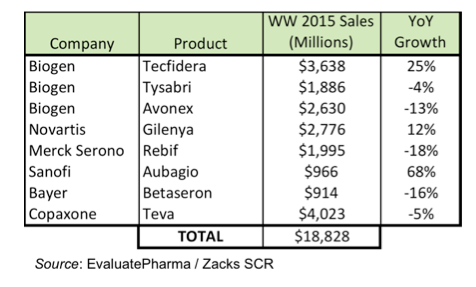
In the following figure we have compiled a list of the top selling MS medications and their total sales for 2015. Each of these medications is approved only for treating RRMS, and given the fact that half of RRMS patients go on to develop SPMS, there is an enormous market opportunity for an effective SPMS drug to become a blockbuster medication. Not included in the list is ocrelizumab, which is forecasted to generate revenues of $4.4 billion by 2022 (EvaluatePharma).
MN-166 for the Treatment of ALS
On April 20, 2016, Dr. Benjamin Brooks presented interim data from the Phase 2 clinical trial of MN-166 in patients with amyotrophic lateral sclerosis (ALS) at the American Academy of Neurology (AAN) 2016 Annual Meeting. The preliminary data analysis was conducted on 25 patients (20 on MN-166 + riluzole, 5 on placebo + riluzole) that had completed the six-month double blind portion of the study.
In September 2014, MediciNova initiated a Phase 2 study of MN-166 in patients with ALS (NCT02238626). This is a single center, randomized, double blind, placebo controlled six-month study to evaluate the safety, tolerability, and clinical responsiveness of MN-166 (60 mg/day) when administered as an adjunct to riluzole (100 mg/day) in 60 subjects with ALS. Patients in the study will be randomized 2:1 to receive either MN-166 or placebo. The study will consist of a three-month screening phase, a six-month double blind treatment phase, and a six-month open label extension phase and is taking place at Carolinas HealthCare System’s Neuromuscular/ALS-MDA Center in Charlotte, NC. The primary endpoint of the study is the safety and tolerability of MN-166 when administered with riluzole in ALS patients. A number of secondary endpoints are being evaluated including the change in ALS Functional Rating Scale Revised (ALSFRS-R), respiratory function, muscle strength, and non-invasive ventilation.
On April 21, 2015, MediciNova announced positive interim safety data from the study that showed no difference in safety or tolerability between MN-166 + riluzole and placebo + riluzole in the first 21 subjects enrolled in the study following three months of treatment. Importantly, the independent safety medical monitor recommended that the study continue as planned.
On September 2, 2015, MediciNova announced that the first ALS patient using non-invasive ventilation (NIV) was enrolled in the ongoing Phase 2 clinical trial. As ALS progresses, the muscles that control breathing become weaker, which leads to impairment of breathing function and an increased susceptibility for lung infections. In addition, patients may experience shortness of breath, fatigue, sleep apnea, and weakened cough. NIV is administered through a removable face mask that is placed around the nose and mouth and is utilized by ALS patients that can still breathe on their own but are beginning to experience the aforementioned effects of decreased breathing capabilities. The use of NIV typically signifies that a patient is more advanced in the course of the disease than a patient not using NIV.
MediciNova amended the clinical protocol to allow for the recruitment of 60 patients with advanced ALS using NIV in addition to the already planned recruitment of 60 patients with ALS that are not using NIV. Since the trial is now enrolling both NIV and non-NIV patients, we are unsure of when enrollment will be completed. We do anticipate that the two sets of patients (non-NIV and NIV) will be evaluated separately. The AAN poster shows the rate of enrollment thus far in the trial, with 46/60 non-NIV patients and 11/60 NIV patients enrolled thus far.
Interim Analysis Shows Positive Trends for MN-166 Treatment of ALS Patients
It’s important to remember that the Phase 2 study was not powered to show statistical significance since there was no prior clinical data from which to make powering assumptions. However, there are positive trends in the data which support continuing into a pivotal Phase 3 program.
The rate at which ALS progresses varies from patient to patient and is measured utilizing a scoring system called the “ALS Functional Rating Scale Revised” (ALSFRS-R) (Cedarbaum et al., 1999). This scoring system consists of a series of 12 questions on basic tasks (speech, salivation, swallowing, handwriting, cutting food, dressing and hygiene, turning in bed, walking, climbing stairs, dyspnea, orthopnea, and respiratory insufficiency) that are rated on a five-point scale where 0 = can’t do and 4 = normal ability. The individual items are summed to produce a score of between 0 = death and 48 = best.
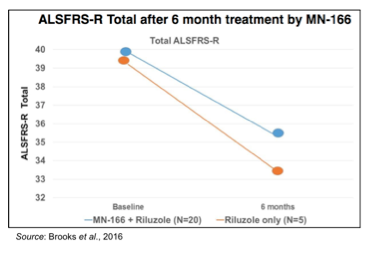
The following figure shows the ALSFRS-R score for patients treated with MN-166 + riluzole (n=20) or placebo + riluzole (n=5) both before and after six months of treatment. The average decline in ALSFRS-R score from baseline to month six was 4.55 (0.76 per month) in the MN-166 + riluzole group compared to 5.80 (0.97 per month) in the placebo + riluzole group.
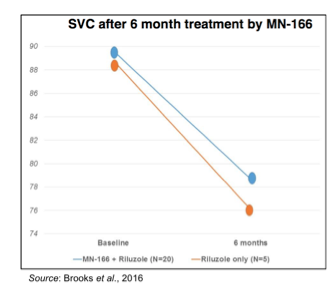
The effect on respiratory function was also evaluated by measuring the change in slow vital capacity (SVC), which measures the maximum volume of air that can be slowly exhaled following a maximum inhalation. The mean decline in SVC from baseline to month six was 10.93% (1.82% per month) in the MN-166 + riluzole group compared to 12.71% (2.12% per month) in the placebo + riluzole group. Since loss of respiratory function leads to significant morbidity in ALS patients, the ability to slow its decline would be quite beneficial.
ALS Biomarker Study Underway
MediciNova had previously announced a biomarker study in ALS patients would take place in collaboration with Massachusetts General Hospital. The trial is now ongoing and is expected to enroll at least 15 ALS patients and will investigate the effects of MN-166 on reducing brain microglial activation (NCT02714036). In this open-label trial, patients will be administered 100 mg of MN-166 daily (50 mg in the morning and 50 mg at night) for 36 weeks and the primary outcome will be the impact on microglial cell activation as measured through the uptake of [11C]-PBR28 in motor cortices and brain stem. [11C]-PBR28 is a ligand that is preferentially taken up by peripheral benzodiazepine receptors (PBRs) and can be tracked by positron emission tomography (PET) imaging. PBRs are known to be upregulated on activated microglia (Imalzumi et al., 2007). The study will also evaluate the impact of MN-166 on markers of neuro-inflammation measured by blood biomarkers. Secondary outcome measurements include safety and tolerability and changes in ALSFRS-R, SVC, and muscle strength from baseline. This study will provide important safety and efficacy data in regards to an increased daily dose of MN-166 as the company begins preparations for planning future studies in ALS.
MN-166 for the Treatment of Alcohol Dependence
The SAMHSA 2014 National Survey on Drug Use and Health reported approximately 17.0 million people in the U.S. with alcohol dependence or abuse. There are four FDA approved medicines to treat alcohol dependence: Antabuse®, Vivitrol®, Revia®, and Campral®. In 2015, sales of Vivitrol® totaled $114 million (EvaluatePharma), while sales of Antabuse®, Revia® and Campral® were not disclosed. Only 20% of eligible patients receive medications to help combat their addiction, thus there is still a pressing need for safe and effective treatments for alcohol addiction as the FDA approved compounds have limited efficacy (Witkiewitz et al., 2012).
A preclinical study of MN-166 was performed in alcohol-preferring P rats, high-alcohol drinking HAD1 rats, and mice made alcohol dependent through cycles of alcohol vapor exposure (Bell et al., 2015). The results showed that MN-166 administered twice-daily reduced alcohol drinking in rats by approximately 50% and reduced drinking in mice that were alcohol-dependent in doses that did not affect non-dependent mice.
In August 2013, MediciNova announced that the National Institute on Alcohol Abuse and Alcoholism (NIAAA) would fund a randomized, double blind, placebo controlled Phase 2 clinical trial of MN-166 in 24 non-treatment seeking individuals with either alcohol abuse or dependence (NCT02025998). The trial randomly assigned participants to seven days of MN-166 or placebo treatment during which time the participants took the study medication, completed an IV alcohol challenge, and took part in laboratory tests of alcohol craving as well as mood surveys and standard safety tests. Following a 7-10 day study break, trial participants re-enrolled for another 7-day period wherein they crossed over to the other treatment condition. The primary outcomes for the study included safety, tolerability, and preliminary efficacy as indicated by whether MN-166 reduced alcohol craving under controlled conditions.
The company had previously announced initial findings from the trial that showed MN-166 significantly decreased basal, daily alcohol craving over the course of the study (P<0.05) and increased positive mood during both the cue reactivity and stress procedures (P<0.05). On June 29, 2016, additional data from the trial was presented for patients that reported higher levels of depressive symptomology showing that MN-166: 1) significantly weakened the alcohol-induced stimulatory effect (P<0.05); 2) significantly decreased alcohol-induced positive mood (P<0.05); 3) significantly decreased ‘wanting’ of alcohol (P<0.05); 4) showed a trend to decreased ‘liking’ of alcohol (P=0.061).
Financial Update
On July 26, 2016, MediciNova released form 10-Q with financial results for the second quarter of 2016. As expected, the company did not report any revenues. Net loss for the quarter was $3.2 million, or $0.10 per share, and was comprised of $1.0 million in R&D expenses and $2.2 million in G&A expenses. This compared to $0.8 million in R&D expenses and $1.5 million in G&A expenses for the same time period in 2015. The increase in G&A expenses was mainly due to higher stock based compensation as a result of an increase in the company’s stock price over the past year. Total operating cash burn for the quarter was $1.5 million. As of June 30, 2016, the company had cash and cash equivalents of $26.6 million, which we estimate will be enough to fund operations through the end of 2018.
Conclusion
The most important catalyst for MediciNova in the second half of 2016 will be the interim analysis for the ongoing Phase 2b study of MN-166 in progressive MS. This represents an enormous potential opportunity for the company as there are no drugs currently approved for long-term treatment of progressive MS. While ocrelizumab could be approved for the treatment of PPMS, we question its safety and we believe there is plenty of room in the market for additional therapies, particularly for a compound like MN-166 that has a completely different mechanism of action. The MS market is enormous (currently $19 billion), and as shown by the chart earlier for treatments of RRMS, there is room for multiple blockbuster therapies for the treatment of progressive MS. A positive recommendation by the DSMB to halt the study for overwhelming efficacy would likely cause a significant revaluation of the company’s shares. While we do not think there is a great likelihood of that occurring, it is something that investors should be aware of going into the fourth quarter of 2016.
The treatment of ALS is another potential blockbuster opportunity. As there has only ever been one drug approved for treating ALS, which is not very effective, there is a huge unmet medical need for better treatment options for these patients. The FDA has granted MN-166 three separate Fast Track designations for the treatment of ALS, progressive MS, and methamphetamine addiction. Fast Track designation includes a number of incentives for the company including increased interactions with the FDA to discuss the drug’s development plan and the opportunity for priority review and accelerated approval.
Based on our probability adjusted discounted cash flow model we believe MediciNova is worth $10 per share.
READ THE FULL RESEARCH REPORT HERE
SUBSCRIBE TO ZACKS SMALL CAP RESEARCH to receive our articles and reports emailed directly to you each morning. Please visit our website for additional information on Zacks SCR and to view our disclaimer.