By
David Bautz, PhD
NASDAQ:MNOV
MN-166 Clinical Development for Multiple Sclerosis
MediciNova (NASDAQ:MNOV) is developing MN-166 (ibudilast) for the treatment of primary and secondary progressive multiple sclerosis (PPMS and SPMS), amyotrophic lateral sclerosis (ALS), methamphetamine (MA) addiction, opioid dependence, and alcohol dependence. The drug is currently being tested in four separate clinical trials in the aforementioned indications with two trials recently completed in alcohol dependence and opioid dependence.
MN-166 was previously tested in a randomized, double blind, placebo controlled Phase 2a clinical trial to evaluate its safety and effectiveness in relapsing MS patients. The primary efficacy outcome of the study was the cumulative number of active lesions seen on bimonthly MRI scans over the first 12 months of treatment. Secondary outcomes included the time to first exacerbation, annualized relapse rate over 12 months, and the cumulative volume of Gd-enhancing lesions over 12 months. The results showed that there was no difference in the number of active lesions or in the cumulative volume of Gd-enhancing lesions between treatment arms. Thus, MN-166 did not appear to have an effect on overt inflammation leading to a suppression of disease activity. However, MN-166 may exert a neuroprotective effect. A preplanned evaluation of brain atrophy showed a statistically significant dose-dependent decrease in percent brain volume loss in the 60-mg MN-166 group (mean -0.79) compared to placebo (mean -1.20, P=0.04) after only one year of treatment.
Based on the results of the Phase 2a study, investigators from NeuroNEXT, an NIH funded clinical trial network that conducts studies of treatments for neurological diseases, have initiated the SPRINT-MS trial; a Phase 2b trial evaluating MN-166 in PPMS and SPMS patients titled “A Phase 2 Randomized, Double-Blind, Placebo-Controlled Study to Evaluate the Safety, Tolerability and Activity of Ibudilast (MN-166) in Subjects with Progressive Multiple Sclerosis” (NCT01982942).
In June 2015, the company announced the ongoing Phase 2 clinical trial of MN-166 in progressive MS had completed randomization of 255 patients. Participants are receiving either MN-166 (100 mg/day) or placebo twice a day (e.g., MN-166 50 mg or placebo taken once in the morning and once at night) for a total of 96 weeks of treatment with a follow up visit one month after the week 96 visit. There is a planned interim efficacy analysis after half the subjects complete the 96-week treatment period. On July 13, 2016, the company announced that 50% of patients had completed the 96-week treatment period and that the trial’s Data Safety Monitoring Board (DSMB) will review the results of an interim analysis in the fourth quarter of 2016. Based upon this analysis, the DSMB will make one of three potential recommendations to the investigators of the trial: 1) continue the trial to completion as planned; 2) stop the trial for overwhelming efficacy; or 3) stop the trial for futility. As a reminder, the primary outcome of the study is the rate of change in brain atrophy over 96 weeks as measured by brain parenchymal fraction (BPF) using MRI.
MN-166 Granted Orphan Drug Designation for Treatment of ALS
On October 11, 2016, MediciNova, Inc. (MNOV) announced that the Food and Drug Administration (FDA) has granted MN-166 (ibudilast) Orphan Drug Designation (ODD) for the treatment of amyotrophic lateral sclerosis (ALS). ALS is a rapidly progressing neurodegenerative disease whereby the nerve cells in the brain and spinal cord that control muscle movement degenerate. This rapid degeneration of the motor neurons eventually leads to death, typically in three to five years after patients are first diagnosed. In the U.S., approximately 30,000 people are currently living with ALS.
MN-166 is currently being investigated in two Phase 2 clinical trials for ALS: 1) a safety and efficacy study in up to 60 ALS patients not currently requiring non-invasive ventilation (NIV) along with up to 60 patients with advanced ALS requiring the use of NIV; 2) a biomarker study in ALS patients that will examine the effect of MN-166 on reducing brain microglial activation.
Orphan drug designation carries a number of incentives for the company including seven years of market exclusivity following approval for the treatment of ALS, tax credits, and a waiver of PDUFA fees.
Phase 2 Clinical Trial of MN-166 in ALS
In September 2014, MediciNova initiated a Phase 2 study of MN-166 in patients with ALS (NCT02238626). This is a single center, randomized, double blind, placebo controlled six-month study to evaluate the safety, tolerability, and clinical responsiveness of MN-166 (60 mg/day) when administered as an adjunct to riluzole (100 mg/day) in up to 60 subjects with ALS. Patients in the study will be randomized 2:1 to receive either MN-166 or placebo. The study will consist of a three month screening phase, a six-month double blind treatment phase, and a six-month open-label extension phase and is taking place at the Carolinas Healthcare System’s Neuromuscular/ALS-MDA Center in Charlotte, NC. The primary endpoint of the study is the safety and tolerability of MN-166 when administered with riluzole in ALS patients. A number of secondary endpoints are being evaluated including the change in ALS Functional Rating Scale Revised (ALSFRS-R), respiratory function, muscle strength, and non-invasive ventilation.
On April 21, 2015, MediciNova announced positive interim safety data from the study that showed no difference in safety or tolerability between MN-166 and placebo in the first 21 subjects enrolled in the study following three months of treatment. Importantly, the independent safety medical monitor recommended that the study continue as planned.
On September 2, 2015, MediciNova announced that the first ALS patient using non-invasive ventilation (NIV) was enrolled in the ongoing Phase 2 clinical trial. As ALS progresses, the muscles that control breathing become weaker, which leads to impairment of breathing function and an increased susceptibility for lung infections. In addition, patients may experience shortness of breath, fatigue, sleep apnea, and weakened cough. NIV is administered through a removable face mask that is placed around the nose and mouth and is used by ALS patients that can still breathe on their own but are beginning to experience the aforementioned effects of decreased breathing capabilities. The use of NIV typically signifies that a patient is more advanced in the course of the disease than a patient not using NIV.
MediciNova amended the clinical protocol to allow for the recruitment of up to 60 patients with advanced ALS using NIV in addition to the already planned recruitment of up to 60 patients with ALS that are not using NIV. We anticipate that the two sets of patients (non-NIV and NIV) will be evaluated separately.
Interim Analysis Shows Positive Trends for MN-166 Treatment of ALS Patients
On April 20, 2016, Dr. Benjamin Brooks presented interim data at the American Academy of Neurology (AAN) 2016 Annual Meeting. The preliminary data analysis was conducted on 25 patients (20 on MN-166, 5 on placebo) that had completed the six-month double blind portion of the study. It’s important to remember that the Phase 2 study was not powered to show statistical significance since there was no prior data from which to make powering assumptions. However, there are positive trends in the data which support continuing into a pivotal Phase 3 program.
The rate at which ALS progresses varies from patient to patient and is measured utilizing a scoring system called the “ALS Functional Rating Scale Revised” (ALSFRS-R) (Cedarbaum et al., 1999). This scoring system consists of a series of 12 questions on basic tasks (speech, salivation, swallowing, handwriting, cutting food, dressing and hygiene, turning in bed, walking, climbing stairs, dyspnea, orthopnea, and respiratory insufficiency) that are rated on a five-point scale where 0 = can’t do and 4 = normal ability. The individual items are summed to produce a score of between 0 = death and 48 = best.
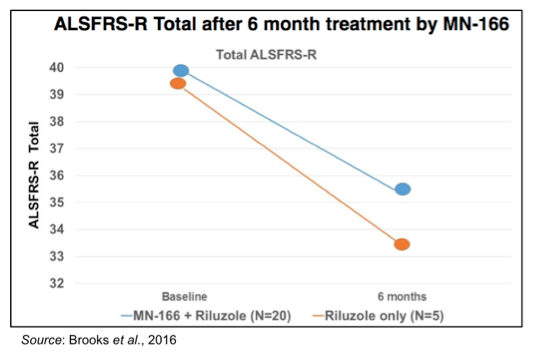
The following figure shows the ALSFRS-R score for patients treated with MN-166 (n=20) or placebo (n=5) both before and after six months of treatment. The average decline in ALSFRS-R score from baseline to month six was 4.55 (0.76 per month) in the MN-166 group compared to 5.80 (0.97 per month) in the placebo group.
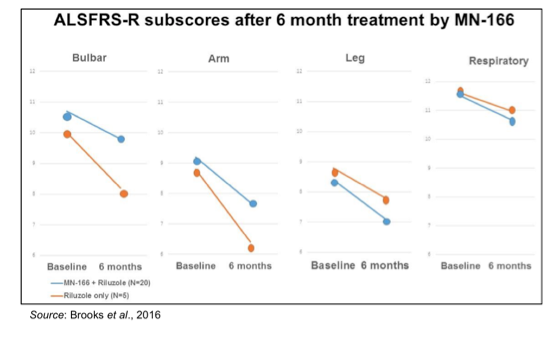
Additional data was presented regarding some of the subscores of the ALSFRS-R. Two of the subscores, for bulbar function (which measures speech, salivation, and swallowing) and arm function, showed positive trends in slowing decline in the MN-166 treated group. The mean decline in the bulbar score from baseline to month six was 0.90 (0.15 per month) in the MN-166 group compared to 1.80 (0.30 per month) in the placebo group. The mean decline in the arm score from baseline to month six was 1.50 (0.25 per month) in the MN-166 group compared to 2.40 (0.40 per month) in the placebo group.
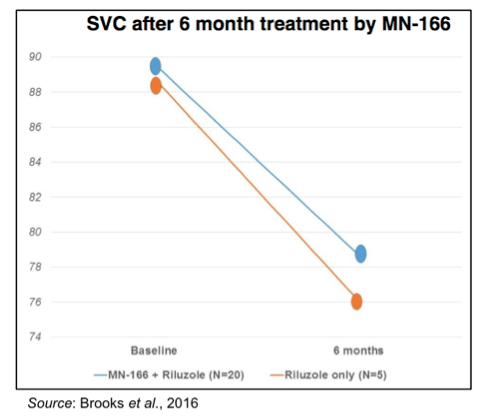
The effect on respiratory function was also evaluated by measuring the change in slow vital capacity (SVC), which measures the maximum volume of air that can be exhaled following a slow maximum inhalation. The mean decline in SVC from baseline to month six was 10.93% (1.82% per month) in the MN-166 group compared to 12.71% (2.12% per month) in the placebo group. Since loss of respiratory function leads to significant morbidity in ALS patients, the ability to slow its decline would be quite beneficial.
ALS Biomarker Study Underway
MediciNova had previously announced a biomarker study in ALS patients would take place in collaboration with Massachusetts General Hospital. The trial is now enrolling and is expected to enroll 15 ALS patients and will investigate the effects of MN-166 on reducing brain microglial activation (NCT02714036). In this open-label trial, ALS patients will be administered 100 mg MN-166 daily (50 mg in the morning and 50 mg at night) for 36 weeks and the primary outcome is to measure the effects of MN-166 on brain microglial activation as measured through the uptake of [11C]-PBR28, which is a ligand that is preferentially taken up by peripheral benzodiazepine receptors (PBRs) and can be tracked by positron emission tomography (PET) imaging. PBRs are known to be upregulated on activated microglia (Imalzumi et al., 2007). Secondary outcome measurements include changes in ALSFRS-R, SVC, and muscle strength from baseline. This study will provide important safety and efficacy data in regards to an increased daily dose of MN-166 as the company begins preparations for planning future studies in ALS. Importantly, this biomarker could potentially be used as a screening tool for recruitment in future studies.
Financial Update
On October 25, 2016, MediciNova filed form 10-Q with financial results for the third quarter of 2016. As expected, the company did not report any revenues. Net loss for the quarter was $2.8 million, or $0.08 per share, and was comprised of $0.9 million in R&D expenses and $2.0 million in G&A expenses. This compared to $0.6 million in R&D expenses and $1.0 million in G&A expenses for the same time period in 2015. The increase in R&D and G&A expenses between 2015 and 2016 was primarily due to higher stock compensation expense for performance-based stock options due in part to an increase in the stock price. Total operating cash burn for the third quarter of 2016 was $1.6 million and the Company’s operating cash burn was only $5.5 million for the nine months ending September 30, 2016. As of September 30, 2016, the company had cash and cash equivalents of approximately $25.0 million, which we estimate will be enough to fund operations at least through the end of 2018.
Conclusion
Having MN-166 be designated an orphan drug by the FDA for the treatment of ALS is an important step for the company, as it ensures at least 7 years of marketing exclusivity as well as allowing for certain tax breaks and a waiver of PDUFA fees if it is filed for approval. MN-166 had previously been granted Fast Track designation for the treatment of ALS, as well as for the treatment of progressive MS and methamphetamine addiction.
We believe that the treatment of ALS is a potential blockbuster opportunity. As there has only ever been one drug approved for treating ALS, Sanofi’s Rilutek® (riluzole) (which is not very effective), there is a huge unmet medical need for better treatment options for these patients. If effective, MN-166 would likely generate peak revenues for treating ALS of $1 billion, although we only assign a 33% chance of approval at this point based on the fact that only one drug has ever been approved for treating ALS.
The most important catalyst for MediciNova before the end of 2016 will be the interim analysis for the ongoing Phase 2b study of MN-166 in progressive MS. A positive recommendation by the DSMB to halt the study for overwhelming efficacy would likely cause a significant revaluation of the company’s shares, and while we do not think there is a great likelihood of that occurring it is something that investors should be aware of in the fourth quarter of 2016.
Based on our probability adjusted discounted cash flow model we believe MediciNova is currently worth $10 per share.
For a free copy of the full research report, please email scrinvestors@zacks.com with MNOV as the subject.
SUBSCRIBE TO ZACKS SMALL CAP RESEARCH to receive our articles and reports emailed directly to you each morning. Please visit our website for additional information on Zacks SCR and to view our disclaimer.