By David Bautz, PhD
NASDAQ:MNOV
Interim Data on MN-166 in ALS Presented at 2016 AAN Annual Meeting
On April 20, 2016, Dr. Benjamin Brooks presented interim data from the Phase 2 clinical trial of MN-166 in patients with amyotrophic lateral sclerosis (ALS) at the American Academy of Neurology (AAN) 2016 Annual Meeting. The preliminary data analysis was conducted on 25 patients (20 on MN-166 + riluzole, 5 on placebo + riluzole) that had completed the six-month double blind portion of the study. Below we provide an overview of MN-166, the Phase 2 trial in ALS, and the interim data that showed positive trends for MN-166 and will help to guide the design of a Phase 3 program.
Background on MN-166
MN-166 is an anti-inflammatory drug that has been used for more than 20 years in Japan to treat asthma (Rolan et al., 2009) and post-stroke dizziness. It acts as a phophodiesterase (PDE) inhibitor (Suzumura et al., 1999) and preferentially inhibits PDE-4 (Huang et al., 2006). The drug has shown anti-inflammatory activity in both the peripheral immune system and in the CNS via attenuation of glial cells, which play a role in certain neurological conditions. In addition, delivery of a PDE-4 inhibitor was shown to lead to enhanced differentiation of oligodendrocyte progenitor cells within areas of demyelination and a consequent acceleration of remyelination (Syed et al., 2013).
Preclinical work performed with MN-166 showed that the compound can suppress neuronal cell death induced by activated microglia (Mizuno et al., 2004). MN-166 was shown to suppress the production of TNF-α and IL-6 by microglia as well as enhance the production of the anti-inflammatory cytokine IL-10 and neurotrophic factors such as NGF, GDNF, and NT-4. These data are in agreement with an earlier study of MN-166 in a chronic cerebral hypoperfusion model that showed it could inhibit the activation of microglia cells and prevent the formation of white matter lesions (Wakita et al., 2003). This inhibitory effect was shown to be dose dependent and involve the suppression of TNF-α production.
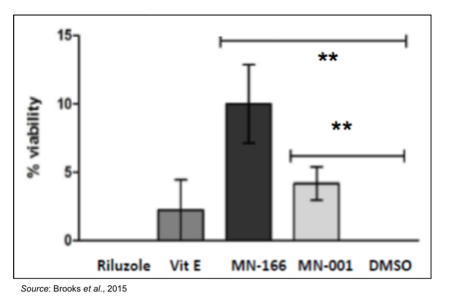
MN-166 has previously been studied in preclinical models of ALS with the use of the fruit fly (Drosophila melanogaster). One such model uses the transgenic overexpression of a mutated VAMP-associated protein (VAP P58S) that results in reduced viability of fly larvae. Mutations of VAP in humans are known to cause a number of motor neuron diseases, including ALS8, which is an inherited form of ALS. The addition of MN-166, and to a lesser extent MN-001 and Vitamin E, resulted in an increase in fly viability in the VAP P58S model, while dimethylsulfoxide (DMSO) and Rilutek® (riluzole; the only drug to ever be approved for the treatment of ALS), had no effect on viability, thus supporting the study of MN-166 in ALS patients.
Phase 2 Clinical Trial of MN-166 in ALS
In September 2014, MediciNova (NASDAQ:MNOV) initiated a Phase 2 study of MN-166 in patients with ALS (NCT02238626). This is a single center, randomized, double blind, placebo controlled six-month study to evaluate the safety, tolerability, and clinical responsiveness of MN-166 (60 mg/day) when administered as an adjunct to riluzole (100 mg/day) in 60 subjects with ALS. Patients in the study will be randomized 2:1 to receive either MN-166 or placebo. The study will consist of a three month screening phase, a six-month double blind treatment phase, and a six-month open label extension phase and is taking place at Carolinas HealthCare System’s Neuromuscular/ALS-MDA Center in Charlotte, NC. The primary endpoint of the study is the safety and tolerability of MN-166 when administered with riluzole in ALS patients. A number of secondary endpoints are being evaluated including the change in ALS Functional Rating Scale Revised (ALSFRS-R), respiratory function, muscle strength, and non-invasive ventilation.
On April 21, 2015, MediciNova announced positive interim safety data from the study that showed no difference in safety or tolerability between MN-166 + riluzole and placebo + riluzole in the first 21 subjects enrolled in the study following three months of treatment. Importantly, the independent safety medical monitor recommended that the study continue as planned.
On September 2, 2015, MediciNova announced that the first ALS patient using non-invasive ventilation (NIV) was enrolled in the ongoing Phase 2 clinical trial. As ALS progresses, the muscles that control breathing become weaker, which leads to impairment of breathing function and an increased susceptibility for lung infections. In addition, patients may experience shortness of breath, fatigue, sleep apnea, and weakened cough. NIV is administered through a removable face mask that is placed around the nose and mouth and is utilized by ALS patients that can still breathe on their own but are beginning to experience the aforementioned effects of decreased breathing capabilities. The use of NIV typically signifies that a patient is more advanced in the course of the disease than a patient not using NIV.
MediciNova amended the clinical protocol to allow for the recruitment of 60 patients with advanced ALS using NIV in addition to the already planned recruitment of 60 patients with ALS that are not using NIV. Since the trial is now enrolling both NIV and non-NIV patients, we are unsure of when enrollment will be completed. We do anticipate that the two sets of patients (non-NIV and NIV) will be evaluated separately. The AAN poster shows the rate of enrollment thus far in the trial, with 46/60 non-NIV patients and 11/60 NIV patients enrolled thus far.
Interim Analysis Shows Positive Trends for MN-166 Treatment of ALS Patients
It’s important to remember that the Phase 2 study was not powered to show statistical significance since there was no prior clinical data from which to make powering assumptions. However, there are positive trends in the data which support continuing into a pivotal Phase 3 program.
The rate at which ALS progresses varies from patient to patient and is measured utilizing a scoring system called the “ALS Functional Rating Scale Revised” (ALSFRS-R) (Cedarbaum et al., 1999). This scoring system consists of a series of 12 questions on basic tasks (speech, salivation, swallowing, handwriting, cutting food, dressing and hygiene, turning in bed, walking, climbing stairs, dyspnea, orthopnea, and respiratory insufficiency) that are rated on a five-point scale where 0 = can’t do and 4 = normal ability. The individual items are summed to produce a score of between 0 = death and 48 = best.
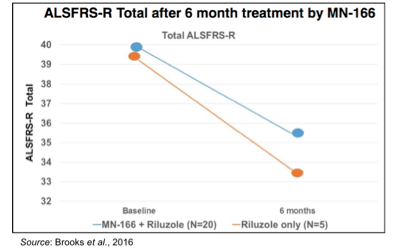
The following figure shows the ALSFRS-R score for patients treated with MN-166 + riluzole (n=20) or placebo + riluzole (n=5) both before and after six months of treatment. The average decline in ALSFRS-R score from baseline to month six was 4.55 (0.76 per month) in the MN-166 + riluzole group compared to 5.80 (0.97 per month) in the placebo + riluzole group.
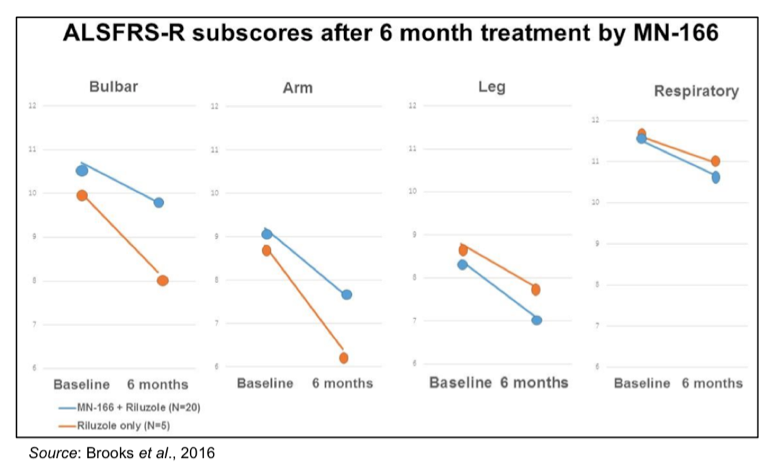
Additional data was presented regarding the subscores of the ALSFRS-R. Two of the subscores, for bulbar function (which measures speech, salivation, and swallowing) and arm function, showed positive trends in slowing decline in the MN-166 + riluzole treated group. The mean decline in the bulbar score from baseline to month six was 0.90 (0.15 per month) in the MN-166 + riluzole group compared to 1.80 (0.30 per month) in the placebo + riluzole group. The mean decline in the arm score from baseline to month six was 1.50 (0.25 per month) in the MN-166 + riluzole group compared to 2.40 (0.40 per month) in the placebo + riluzole group.
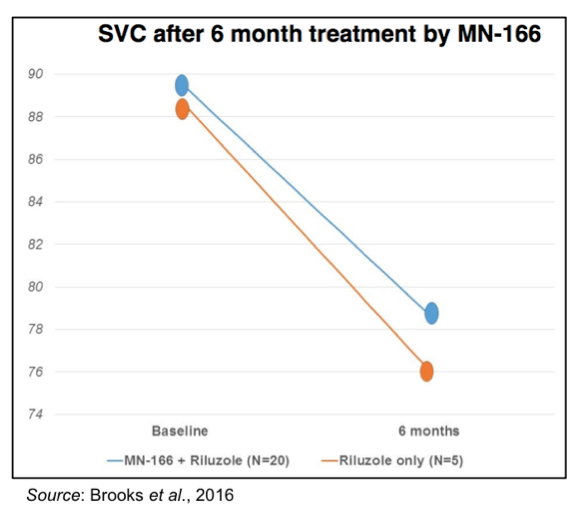
The effect on respiratory function was also evaluated by measuring the change in slow vital capacity (SVC), which measures the maximum volume of air that can be slowly exhaled following a maximum inhalation. The mean decline in SVC from baseline to month six was 10.93% (1.82% per month) in the MN-166 + riluzole group compared to 12.71% (2.12% per month) in the placebo + riluzole group. Since loss of respiratory function leads to significant morbidity in ALS patients, the ability to slow its decline would be quite beneficial.
Enrollment in ALS Biomarker Study To Commence Soon
MediciNova had previously announced a biomarker study in ALS patients would take place in collaboration with Massachusetts General Hospital. The trial is expected to enroll at least 15 ALS patients and will investigate the effects of MN-166 on reducing brain microglial activation (NCT02714036). In this open-label trial, patients will be administered 100 mg of MN-166 daily (50 mg in the morning and 50 mg at night) for 36 weeks and the primary outcome will be the impact on microglial cell activation as measured through the uptake of [11C]-PBR28 in motor cortices and brain stem. [11C]-PBR28 is a ligand that is preferentially taken up by peripheral benzodiazepine receptors (PBRs) and can be tracked by positron emission tomography (PET) imaging. PBRs are known to be upregulated on activated microglia (Imalzumi et al., 2007). The study will also evaluate the impact of MN-166 on markers of neuro-inflammation measured by blood biomarkers. Secondary outcome measurements include safety and tolerability and changes in ALSFRS-R, SVC, and muscle strength from baseline. This study will provide important safety and efficacy data in regards to an increased daily dose of MN-166 as the company begins preparations for planning future studies in ALS.
Financial Update
On April 27, 2016, MediciNova released form 10-Q with financial results for the first quarter of 2016. As expected, the company did not report any revenues. Net loss for the quarter was $3.4 million, or $0.11 per share, and was comprised of $1.1 million in R&D expenses and $2.3 million in G&A expenses. This compared to $0.7 million in R&D expenses and $1.5 million in G&A expenses for the same time period in 2015. The increase in both R&D and G&A expense from 2015 to 2016 was due primarily to higher stock based compensation due in part to an increase in the stock price. Total operating cash burn for the quarter was $2.4 million. During the quarter, 2,131,700 warrants were exercised for gross proceeds of $7.6 million. These warrants had a strike price of $3.56 and expired on March 29, 2016. As of March 31, 2016, the company had cash and cash equivalents of $27.6 million, which we estimate will be sufficient to fund operations beyond 2017.
Conclusion
The data presented on MN-166 in ALS patients is encouraging, as it appears a number of different attributes of the disease are being positively impacted by the addition of MN-166 to standard of care treatment with riluzole. Investors should not be concerned about the lack of statistical significance at this point, but should instead focus on the positive trends that appear to be forming from an early look at the data. As data from the entire patient population is evaluated these positive trends may become even more evident.
In addition, the dosage of MN-166 used in the ALS trial was most likely not optimized at 60 mg/day, which is below the maximum tolerated dose. Thus, there is potential to use a higher dose in future clinical trials. The 60 mg/day dose was chosen for this ongoing study as it was not known if there would be any type of drug-drug interaction with riluzole. The safety profile for treatment with MN-166 combined with riluzole appears quite good so far, with no cluster of adverse events present in MN-166 and placebo-treated groups, so it is possible that a higher dose of MN-166 could be tested in future clinical trials.
A lack of efficacy at lower doses and a statistically significant effect at higher doses has been seen previously with MN-166 in a Phase 2a study in multiple sclerosis patients, so there is precedent for moving to a higher dose and then seeing a statistically significant treatment effect. We believe the company will likely treat with 100 mg/day of MN-166 in future ALS trials, as that is the dose that will be used in the ALS biomarker study as well.
The treatment of ALS is a potential blockbuster opportunity. As there has only ever been one drug approved for treating ALS, which is not very effective, there is a huge unmet medical need for better treatment options for these patients. The FDA has granted MN-166 Fast Track designation for the treatment of ALS, which includes a number of incentives for the company including increased interactions with the FDA to discuss the drug’s development plan and the opportunity for priority review and accelerated approval.
Based on our probability adjusted discounted cash flow model, which takes into account potential future revenues for MN-166 and MN-001, we believe MediciNova is worth $10 per share.
READ THE FULL RESEARCH REPORT HERE
SUBSCRIBE TO ZACKS SMALL CAP RESEARCH to receive our articles and reports emailed directly to you each morning. Please visit our website for additional information on Zacks SCR and to view our disclaimer.