By David Bautz, PhD
OTC:MTNB
On February 1, 2016, Matinas BioPharma Holdings, Inc. (OTC:MTNB) announced that the Investigational New Drug (IND) application for MAT2501 is now open and the company is authorized to initiate a Phase 1 clinical trial. The company is targeting MAT2501 for the treatment of non-tuberculous mycobacterium (NTM) infections. MAT2501 is a lipid-crystal nano-particle formulation of amikacin that utilizes the company’s proprietary drug delivery technology.
Background on Nano-particle Drug Delivery
Matinas is developing a novel drug delivery technology that was acquired from Aquarius Biotechnologies in January 2015. The purpose of the technology is to allow the safe oral administration of drugs that are seldom used due to their toxic side effect profiles. The drug delivery platform is centered on the use of cochleates, which are stable, crystalline phospholipid-cation delivery vehicles that are composed of soybean phosphatidylserine (PS) and calcium. The compounds have a unique multilayered structure and no internal aqueous space. “Encochleated” molecules within the interior of the cochleate structure remain intact resulting in an increase of oral bioavailability, lower toxicity, and the opportunity for intracellular targeting. As the following figure shows, cochleates are produced from a large, continuous, solid, lipid bilayer sheet rolled up in a spiral or as stacked sheets, with no internal aqueous space.
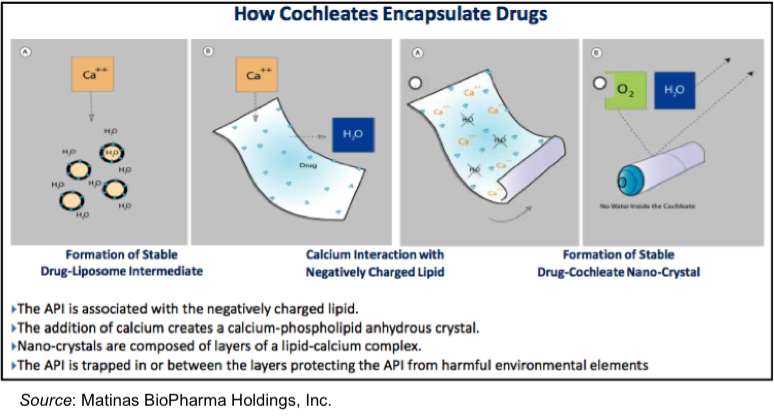
The technology has a number of unique attributes, including:
- The unique structure of the cochleate means that the compounds inside are protected even though the outer layers of a cochleate may be exposed to harsh environmental conditions or enzymes (i.e., the digestive tract)
- The technology allows for targeted delivery to the site of infection, as the cochleates are taken up by macrophages, which then travel to the site of infection and release the drug cargo
- Toxic drugs are sequestered until transported to the site of infection, thus decreasing their side effects
- Cochleates themselves appear to have a nontoxic profile
Theoretically, the technology could be utilized to develop an orally bioavailable formulation of any number of different types of compounds, however Matinas is initially focusing on using the technology to improve the safety and oral bioavailability of antimicrobial compounds that are seldom utilized due to their toxic side effect profiles.
Background on MAT2501
MAT2501 is a lipid-crystal nano-particle formulation of amikacin, an aminoglycoside antibiotic most commonly used to treat severe, hospital-acquired infections, including Gram-negative infections. It is typically used as a last resort medication against multi-drug resistant bacteria. The drug is administered either IV, intramuscularly, or through a nebulizer. All aminoglycosides carry the potential risk of nephrotoxicity, with the risk being greatest in those with impaired renal function. A reduction in dosage is usually necessary if evidence of renal dysfunction occurs. In addition, treatment with aminoglycosides can cause neurotoxicity in the form of hearing loss, numbness, skin tingling, muscle twitching, and convulsions. For these reason, an aminoglycoside formulation that would reduce the potential for this toxicity and allow for oral dosing is clearly warranted.
Encochleated Amakacin Demonstrated In Vitro and In Vivo Activity Against Mycobacterium Avium
Mycobacterium avium causes disease in immunocompromised patients as well as lung infections in patients with chronic lung disease. The lung infections are particularly resistant to standard antibiotic treatment due to the formation of biofilms. Amikacin is an effective treatment for M. avium infections, however its use is limited due to the requirement for intravenous administration as well as the potential for severe nephrotoxicity. Matinas tested whether an encochleated formulation of amikacin (MAT2501) would be effective against an in vitro biofilm model and in vivo models of M. avium infection.
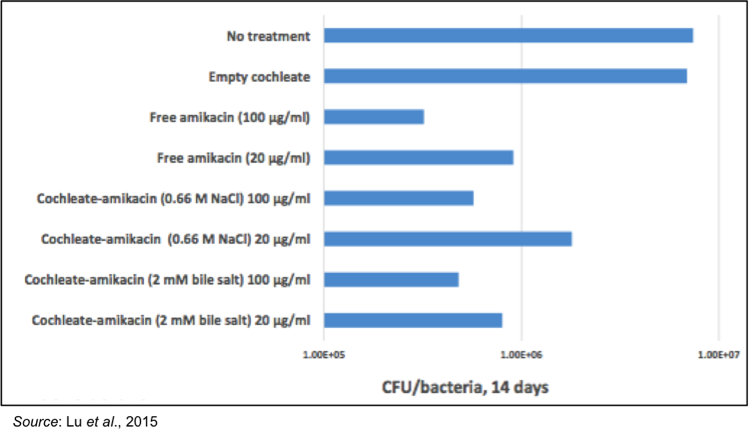
For the biofilm studies, A549 alveolar epithelial cells were seeded with M. avium bacteria and seven days was allowed for biofilm formation. Following treatment, the biofilm and epithelial cells were lysed and plated onto growth media to allow for bacterial cell counts. The results show that empty cochleate had no activity against M. avium infection, however both preparations of cochleate-amikacin (sodium and bile salt) were as effective as free amikacin.
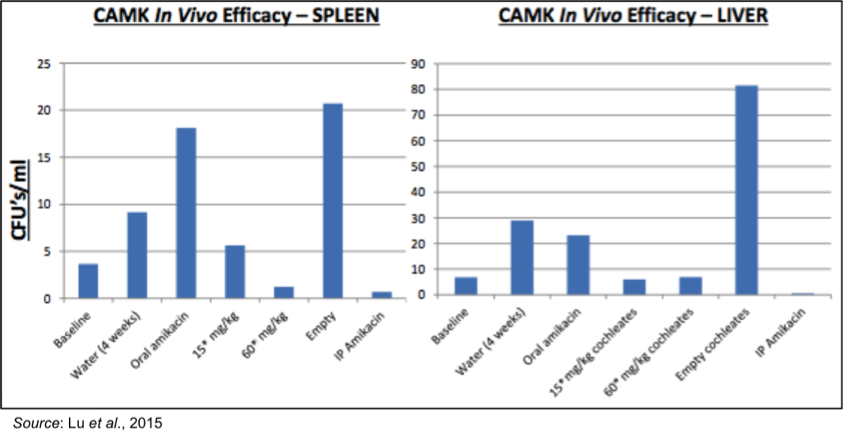
To test the ability of cochleate-amikacin (cAK) to treat a disseminated M. avium infection, mice were infected with M. avium intravenously one week prior to initiation of treatment with cAK, oral amikacin, empty cochleate, and amikacin delivered intraperitoneally (IP). A small number of mice were harvested one week after being infected to determine a baseline bacterial load. Following four weeks of daily treatment, livers and spleens from the mice were harvested and the bacterial load was quantified. Results showed that the higher dosage of cAK returned the bacterial loads to below baseline and was nearly as effective as IP amikacin, while orally administered amikacin showed little to no efficacy.
Very similar results were seen with mice in a lung infection model with M. avium subsp hominissuis. Following infection, baseline bacterial loads were determined after seven days in a group of mice and then once daily treatment was initiated for four weeks. Results showed that cAK was just as effective as IP amikacin at reducing bacterial loads with no toxicity observed for the cAK treated mice.
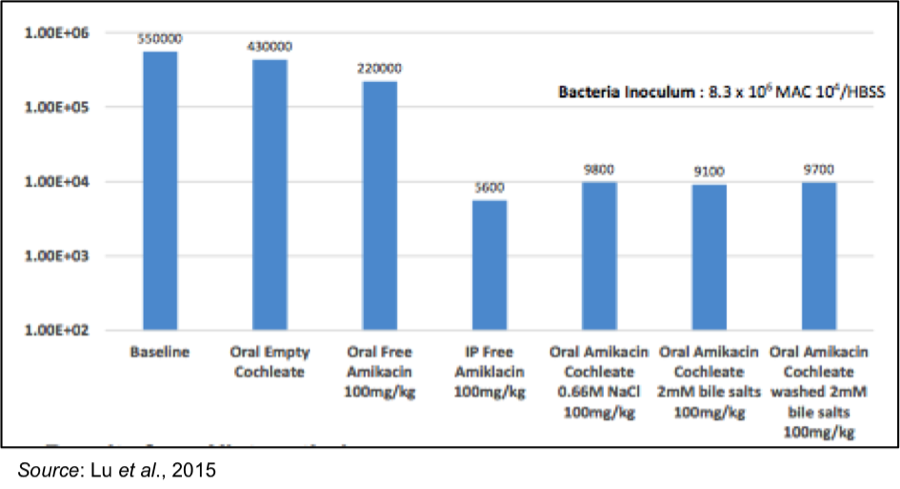
The conclusions from the studies with encochleated amikacin show the drug has similar antimicrobial activity to the non-encochleated formulations of the drug while minimizing toxicity and allowing for oral dosing. These properties would prove to be very valuable should these results hold up in clinical trials.
Clinical Development Plan for MAT2501
The company is expected to commence a Phase 1 study of MAT2501 during the first half of 2016 that will be a placebo controlled, single ascending dose study designed to evaluate the safety and pharmacokinetics of the drug in healthy volunteers. Following successful completion of that study, the company would then perform a placebo controlled, multiple ascending dose study to evaluate the safety and pharmacokinetics of the drug in healthy volunteers. Those two studies will help to establish a complete pharmacokinetic profile of MAT2501, particularly in regards to peak and trough concentrations of the drug following a multiple dose regimen.
Conclusion
The company previously announced that MAT2501 has been designated a Qualified Infectious Disease Product (QIDP) for the treatment of NTM. QIDP designation was first introduced by the Generating Antibiotics Incentives Now (GAIN) Act of 2012, and any QIDP designated products receive an additional five years of market exclusivity upon approval by the FDA. The five-year exclusivity for QIDP products is added to already available five-year market exclusivity for new chemical entities (NCE) and seven-year exclusivity for orphan drug designation (ODD).
We believe the lipid-crystal nano-particle technology that Matinas is developing could be a game-changer in the development of new antimicrobial therapeutics, as it allows for the safe, oral delivery of effective antibiotics that until now have had limited use due to their toxicity and necessity for non-oral dosing. In addition to MAT2501, Matinas’ other lead product is MAT2203, which is an encochleated formulation of Amphotericin B, an effective antifungal drug that currently has no oral formulations available. The company was recently approved to begin a Phase 2a clinical trial of MAT2203 in hereditary immuno-deficiency patients with recurrent candidiasis infections that are refractory to standard therapies. Results from that study should be available later in 2016.
This year is set to be transformative for Matinas, as a key inflection point for the company will be the Phase 2a results for MAT2203, as successful completion of the study would validate the opportunity that Matinas has with the cochleate technology. At this point, we believe that MAT2203 could be a $600-700 million drug, with the potential for significant upside should it prove to be highly safe and efficacious in clinical testing. We believe that MAT2501 could be a $500 million drug, as there are very limited treatment options for patients who suffer from antibiotic resistant Gram-negative infections. All told, our model currently values Matinas at approximately $2.50 per share, and we continue to rate the stock a ‘Buy’.
READ THE LATEST FULL RESEARCH REPORT HERE
SUBSCRIBE TO ZACKS SMALL CAP RESEARCH to receive our articles and reports emailed directly to you each morning. Please visit our website for additional information on Zacks SCR and to view our disclaimer.