By
David Bautz, PhD
NASDAQ:NBIX
NYSE:ABBV
AbbVie Presents Positive Data For Elagoiix in Endometriosis
On October 19, 2016, AbbVie (NYSE:ABBV) announced in cooperation with Neurocrine Biosciences, Inc. (NASDAQ:NBIX) the presentation of results from two pivotal Phase 3 clinical trials evaluating the efficacy and safety of elagolix in premenopausal women who suffer from endometriosis at the 72nd American Society for Reproductive Medicine Scientific Conference & Expo (ASRM). The data show that patients treated with elagolix had a statistically significant reduction in scores for both menstrual pain (dysmenorrhea, DYS) and non-menstrual pelvic pain (NMPP). AbbVie is planning to submit a New Drug Application (NDA) to the U.S. Food and Drug Administration (FDA) in 2017.
Phase 3 Trial Design
The first pivotal Phase 3 trial (NCT01620528) was a 24-week, multinational, randomized, double-blind, placebo-controlled study designed to evaluate the safety and efficacy of elagolix in 872 women, age 18 to 49, with moderate-to-severe endometriosis-associated pain. The trial was conducted at 175 sites in the United States, Puerto Rico and Canada. An extension study allowed for some patients to continue treatment for an additional six months.
The primary endpoint was a dual-endpoint in reduction in DYS and NMPP for women on two doses of elagolix (150 mg QD & 200 mg BID) vs. placebo in a 1-1-2 randomization over six months. Efficacy was assessed by a responder analysis for statistical evaluation. The inclusion of a higher dose allows for a potential full label with dose titration and prescribing options post approval.
The second Phase 3 trial (NCT01931670) was similar in design to the first trial and included 815 women age 18-49 with moderate to severe endometriosis-associated pain. The study was conducted across 226 sites in 13 countries, with equal representation of enrollment between U.S. and ex-U.S. countries.
Trial Results
AbbVie had previously announced positive top-line data for the two Phase 3 trials in Jan. 2015 and Feb. 2016. Detailed results from the trials were presented through five poster presentations and three oral presentations. The data show that both doses of elagolix resulted in a statistically significant improvement in DYS and NMPP (P<0.001).
In the first study, 46% and 76% of patients taking 150 mg once daily and 200 mg twice daily, respectively, were classified as DYS responders after three months of treatment. This compares to 20% of patients taking placebo. In addition, 50% and 55% of patients taking 150 mg once daily and 200 mg twice daily, respectively, were classified as NMPP responders, compared to 36% taking placebo.
Results from the second study were similar to the first study. After three months, 43% and 72% of patients taking 150 mg once daily and 200 mg twice daily, respectively, were classified as DYS responders, compared to 23% of those taking placebo. Fifty percent and 58% of patients taking 150 mg once daily and 200 mg twice daily, respectively, were classified as NMPP responders, compared to 37% taking placebo.
The safety profile of elagolix was consistent across both Phase 3 studies and was similar to what had been seen in prior studies of elagolix. The most common adverse events following six months were hot flush, headache, and nausea. Discontinuation rates due to adverse events in study 1 and study 2 occurred in 5.9% and 6.1% for placebo, 6.4% and 4.4% for 150 mg once daily, and 9% and 10% for 200 mg twice daily, respectively.
Based upon its mechanism of action, a loss in bone mineral density (BMD) is a potential side effect of elagolix treatment. AbbVie presented the following results regarding BMD in a poster presentation title “The Effect of Elagolix On Bone Mineral Density: Safety Results From Two Randomized, Placebo-Controlled Studies in Women With Endometriosis-Associated Pain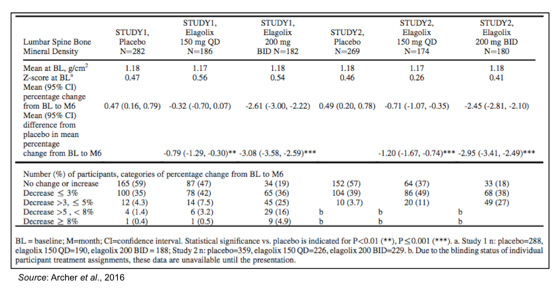
The results show that there is a minimal average decrease in BMD in the 150 mg once daily group, however there is a more sizeable decrease in the 200 mg twice daily cohort, which is similar to what was reported for Lupron (average loss in BMD of 3.2%, Lupron prescribing information). We do not believe that the 150 mg once daily dose will have any type of restrictive labeling based on loss in BMD. However, the 200 mg twice daily dose is likely to be restricted to shorter term use, at least initially until Abbvie submits additional data on the use of add-back hormonal therapy. Results from the use of elagolix in women suffering from uterine fibroids showed that the use of add-back therapy attenuated the reduction in BMD.
Conclusion
The data presented by AbbVie confirm our belief that elagolix is likely to be a blockbuster treatment for endometriosis, as we model for peak sales of elagolix in endometriosis of $1.5 billion worldwide. Using a composite 20% royalty rate, we estimate peak royalties to Neurocrine of approximately $300 million from sales in endometriosis.
For elagolix in uterine fibroids, we estimate an NDA filing would most likely not occur until the end of 2018, putting approval for elagolix in UF in 2019. We estimate that peak sales of elagolix in uterine fibroids could top $2.6 billion worldwide. Using a composite 20% royalty rate, we estimate peak royalties to Neurocrine of over $500 million from sales in UF.
As a reminder, Neurocrine recently filed the NDA for valbenazine (INGREZZA®) for the treatment of tardive dyskinesia (TD) and was assigned a PDUFA date of April 11, 2017. For valuation purposes, we assume U.S. approval of valbenazine in TD will target roughly 150,000 of the total patients in the U.S. that are moderate-to-severe in disease state. For modeling purposes, we estimate the yearly cost of valbenazine will be $20,000. If Neurocrine can capture 33% market share, which we believe is reasonable given the superior characteristics of valbenazine vs. generic tetrabenazine, then peak sales estimates are approximately $1.6 billion in this indication in the U.S. alone.
Lastly, we anticipate results from two Phase 2 studies of valbenazine in adults and children with Tourette Syndrome (TS) late in the fourth quarter of 2016 or in the first quarter of 2017. With an estimated 200,000 patients (both children and adults) with TS severe enough to require treatment in the U.S., a 15% peak market share represents another billion-dollar opportunity for valbenazine.
We continue to believe the future is bright for Neurocrine and that the stock would make a solid core holding in the portfolio of any investor interested in the biotechnology sector. We have built a probability adjusted discounted cash flow model that yields a current valuation for Neurocrine’s shares of $75.
For a free copy of the full research report, please email scrinvestors@zacks.com with NBIX as the subject.
SUBSCRIBE TO ZACKS SMALL CAP RESEARCH to receive our articles and reports emailed directly to you each morning. Please visit our website for additional information on Zacks SCR and to view our disclaimer.