By
David Bautz, PhD
NASDAQ:NBIX
Financial Update
On November 2, 2016, Neurocrine Biosciences, Inc. (NASDAQ:NBIX)
announced financial results for the third quarter of 2016 and provided a business update. As expected, the company did not report any revenues during the quarter. Operating expenses totaled $38.4 million and consisted of $17.5 million in R&D and $20.9 million in G&A expenses. This compares with R&D and G&A expenses of $24.4 million and $11.5 million, respectively, for the same time period in 2015. The $3.5 million decrease in R&D expenses was driven in part by a $2.5 million decrease in external development costs and a $2.8 million decrease in R&D personnel expense, offset by a $1.7 million increase in other R&D spending. The $6.0 million increase in G&A expenses was primarily due to external costs related to market research, commercial launch preparation, and other professional services.
Net loss for the quarter totaled $36.9 million, or $0.43 per share, compared with $34.4 million, or $0.40 per share, for the third quarter of 2015. The company exited the third quarter of 2016 with approximately $383.2 million in cash, cash equivalents, and investments. Management has updated financial guidance for 2016, and now expects to end the year with approximately $340 million in cash, cash equivalents, and investments, while previous guidance had been $320 million. Total operating expenses for 2016 are now expected to be approximately $160-$170 million, while previous guidance had ranged from $185-$195 million. The change in guidance is due to lower than anticipated costs for preclinical and clinical development as well as a lower headcount.
Valbenazine Update
Valbenazine (INGREZZA™) is a prodrug of the (+)-α-isomer of tetrabenazine that was specifically developed for slow metabolism (once a day dosing) and potent and highly selective VMAT-2 inhibition. VMAT-2 is a protein expressed in the brain that is primarily responsible for re-packaging and transporting monoamines (dopamine, norepinephrine, serotonin, and histamine) among nerve cells. Inhibition of VMAT-2 modulates presynaptic dopamine release during nerve communication, while at the same time having minimal impact on the other monoamines thereby reducing the likelihood of "off target" side effects. Neurocrine is currently developing valbenazine as a treatment in both tardive dyskinesia (TD) and Tourette syndrome (TS).
In the fourth quarter of 2015, Neurocrine
announced positive results from the six-week placebo controlled portion of the Phase 3 Kinect-3 clinical trial of valbenazine in TD (
NCT02274558). The Kinect-3 study was a randomized, parallel group, double blind, placebo controlled Phase 3 clinical trial testing valbenazine in moderate to severe TD patients with underlying schizophrenia, schizoaffective disorder, or mood disorder. A total of 234 patients were randomized to receive placebo, 40 mg of valbenazine, or 80 mg of valbenazine once daily for six weeks. The results showed a highly significant change from baseline in the Abnormal Involuntary Movement Scale (AIMS) at Week 6 (p<0.0001).
The topline data that was released for Kinect-3 shows that the trial was very successful, as shown in the following table.
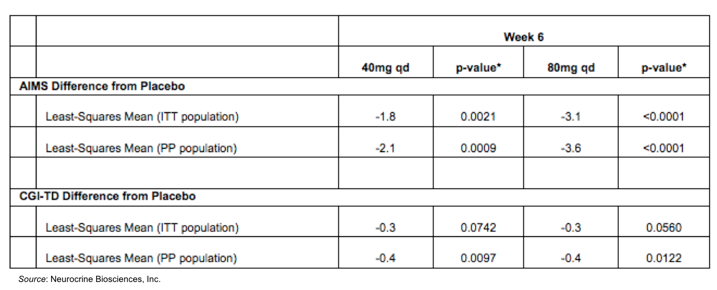
The primary endpoint of the study was the change from baseline in the Abnormal Involuntary Movement Scale (AIMS) at Week 6 as determined by centrally blinded video raters. Secondary endpoints in the study included the Clinical Global Impression of Change (CGI-TD). The AIMS rating at Week 6 was reduced 3.1 points more than placebo, which was a highly significant result (p<0.0001). For comparisons sake, in the Kinect-2 study the results showed the AIMS rating at Week 6 was reduced by 2.4 points more than placebo in the intent to treat (ITT) population and 3.0 points more than placebo in the per protocol (PP) population. The ITT population includes any subject with at least one dose of blinded study drug (active or placebo) and one post-treatment AIMS assessment at week 6, while the PP population excluded any subject randomized to valbenazine with levels of drug below the limit of quantitation (i.e., the subject had not ingested the drug).
Importantly, the frequency of adverse events in the Kinect-3 trial was similar among all treatment groups and treatment emergent adverse effects were consistent with those of prior studies. Participants in the trial were also assessed for akathisia and parkinsonism and minimal symptoms were present at baseline and there was no worsening during the six-week treatment period. Lastly, clinical hematology, chemistry, and ECG monitoring indicated no emergent safety signals.
The Kinect-3 study is now complete, as study subjects were eligible to continue in Kinect-3 for up to 42 weeks of additional valbenazine treatment. The company is currently conducting a separate one-year open-label safety study (Kinect-4), which is now fully enrolled and will complete one year of dosing in early 2017. Lastly, the company is supporting a roll-over study for patients who completed one year of dosing in either Kinect-3 or Kinect-4 (NCT02736955). This roll-over study will allow these patients to continue taking valbenazine for up to an additional 72 weeks, by which time the drug is likely to be approved.
On October 11, 2016, Neurocrine announced that the FDA had accepted the New Drug Application (NDA) for valbenazine in TD. The NDA was accepted for Priority Review and assigned a PDUFA date of April 11, 2017. The company anticipates that an Advisory Committee meeting will be scheduled for February 2017.
Valbenazine in Tourette Syndrome
In addition to TD, Neurocrine is also developing valbenazine as a treatment for Tourette syndrome (TS), a childhood neuropsychiatric disorder that is characterized by repetitive movements and unwanted sounds that are not easily controlled. TS is a genetically inherited condition that is passed on through families, however the precise abnormality responsible for the condition has not yet been elucidated. Diagnostic criteria for TS include multiple motor and vocal tics that occur many times a day nearly every day for one year, an age of onset of less than 18, and symptoms that are not due to any direct effects from substances or other conditions. Previously, diagnosis was also contingent on the condition causing marked distress or impairment in social, occupational, or other important areas of function. However, since a number of patients have a mild form of TS that does not interfere with their daily lives, this criterion was removed so that patients with TS would not be stigmatized.
The tics associated with TS are diverse and sometimes bizarre. They are divided into motor or vocal and can be simple or complex. Simple motor tics involve a single muscle or group of muscles, while complex motor tics are movements that involve multiple muscle groups and may appear semi-purposeful. Simple vocal tics are basic vocalizations or sounds while complex vocal tics involve words and/or complex phrases. Copralalia is a complex phonic tic characterized by the shouting of socially inappropriate language. While copralalia is often associated with TS, it occurs in fewer than half of TS patients, although it can be one of the most distressing symptoms of the condition.
TS symptoms can be evaluated by a number of different clinical measurements, including the Yale Global Tic Severity Scale (YGTSS) and the Premonitory Urge for Tics Scale (PUTS).
- YGTSS: This is a 10-item clinician-rating instrument that provides an evaluation of the number, frequency, intensity, complexity, and interference of motor and phonic tics. The items are scored on two subscales, one for motor and one for phonic, and are rated on a 6-point scale (Leckman et al., 1989).
- PUTS: Older children and adolescents often report tics to be preceded by an unpleasant sensation known as “premonitory urge”, examples of which include a burning feeling in the eye before an eye blink, tension in the neck that is relieved by stretching the neck or jerking of the head, and nasal stuffiness before a sniff.
PUTS is a means to quantify these urges, and data shows that the scale is internally consistent and correlates with overall tic severity in children older than 10 years of age (Woods et al., 2005).
Physicians typically take a multifaceted approach to treating TS using medication to control severe or frequent tics, behavioral modifications, and patient education. Medications given to suppress tics include dopamine receptor antagonists (pimozide, fluphenazine), alpha-2-adrenergic agonists (clonidine), benzodiazepines, dopamine depletors (tetrabenazine), and dopamine agonists (ropininirole). The only two medicines currently approved by the FDA for treating tics are haloperidol (Haldol®) and pimozide (Orap®).
On October 20, 2015, the company announced the initiation of the Phase 2 T-FORWARD study of valbenazine in adults with TS (NCT02581865). The T-FORWARD study is a randomized, double blind, placebo controlled, multi dose, parallel group study that is now fully enrolled with more than 90 patients. Study participants are receiving once-daily dosing of valbenazine during an eight-week treatment period to assess the safety, tolerability, and efficacy in adults with TS. The primary endpoint of the study is the change in baseline of placebo vs. active scores utilizing the YGTSS at the end of Week 8. We anticipate topline results from the T-FORWARD study in January 2017.
In December 2015, the company announced the successful completion of the Phase 1b trial of valbenazine in both children and adolescents with TS (NCT02256475). The T-FORCE study was an open-label, multiple ascending dose, pharmacokinetic and pharmacodynamics two-week study of 36 subjects with TS. The study participants received once-daily dosing of valbenazine during a two-week treatment period to assess both the safety and tolerability followed by seven days off-drug. Results from the trial showed a 31% reduction from baseline in the YGTSS, which was corroborated by an improvement in Tourette symptomology as assessed by the treating physician using the Clinical Global Impression in Tourette Syndrome Scale.
To follow up on the encouraging results seen in the T-FORCE study, Neurocrine initiated the T-Force GREEN study to evaluate safety, tolerability, and efficacy of valbenazine in children and adolescents with TS (NCT02679079). The T-Force GREEN study is a randomized, double blind, placebo controlled, multi-dose, parallel group trial of up to 90 children and adolescents. Patients are receiving once-daily dosing of valbenazine or placebo in a 1:1:1 fashion during a six-week treatment period. Thus far the study is two-third’s enrolled as it is taking a bit longer to enroll patients in this trial than in the T-FORWARD. The primary endpoint of the study is the change in baseline of the YGTSS between placebo and active groups at the end of six weeks. We anticipate results from this study being released in the second quarter of 2017, or approximately three months after the results of the T-FORWARD study.
The company also announced the initiation of a long-term Phase 2 clinical study of valbenazine in patients with TS. The study is an open label, fixed dose study of up to 180 patients (90 children/adolescents and 90 adults) with the primary purpose being the assessment of long-term safety and tolerability of valbenazine. Enrollment is limited to subjects who completed either the T-Forward or T-Force GREEN studies. Patients are receiving once daily dosing of valbenazine for a 24-week treatment period.
Essential Tremor
Neurocrine is developing NBI-640756 for the treatment of essential tremor (ET), which is the most common movement disorder and affects an estimated 10 million people in the U.S. (American Academy of Neurology). That is ten times more Americans than have Parkinson’s disease. The syndrome is characterized by a slowly progressing postural and/or kinetic tremor and usually affects both upper extremities. The condition affects all ethnic and geographic populations and while it can become apparent during childhood or adolescence, onset is typically in adulthood, with a mean age of approximately 45.
While ET is rarely if ever fatal, the condition does cause significant functional disability that can affect handwriting, speech, and various activities of daily living including the ability to feed oneself, drink from a cup, or dress. In addition, the disability associated with ET can cause embarrassment that results in withdrawal from social activities, leading to a decreased quality of life.
Current treatment options for patients with ET include primidone, a structural analog of phenobarbital, and propranolol, a beta-andrenergic receptor antagonist. Surgical management of ET is typically reserved for patients with severe ET that does not respond to medication and includes ablative therapy through stereotactic thalamotomy (destruction of the thalamus) and deep-brain stimulation, which involves the placement of electrodes into the thalamus that are connected to a pulse generator that is implanted subcutaneously in the shoulder.
Neurocrine has successfully completed a Phase 1 single site, randomized, double blind, placebo controlled, sequential dose escalation, pharmacokinetic study to assess the safety and tolerability of a single dose of NBI-640756 in up to 32 healthy volunteers. Based on the results of that study, the company has initiated a second Phase 1, single site, randomized, double blind, placebo controlled, multiple dose, sequential dose escalation study to evaluate the safety, tolerability, and pharmacokinetics of NBI-640756 in up to 30 healthy volunteers over a week of continuous dosing. We anticipate data from this study later in 2016. Since the compound is just starting out in clinical trials we are not yet including it in our financial model, however with a patient population totaling 10 million, there is certainly a large potential opportunity for the company in ET.
Conclusion
The treatment of TD is a very meaningful market opportunity for Neurocrine. There are an estimated 500,000 TD patients in the U.S. with no real treatment options besides tetrabenazine. For valuation purposes, we assume U.S. approval of valbenazine in TD will target roughly 150,000 of the total patients in the U.S. that are moderate-to-severe in disease state. For modeling purposes, we estimate the yearly cost of valbenazine will be $20,000. If Neurocrine can capture 33% market share, which we believe is reasonable given the superior characteristics of valbenazine vs. generic tetrabenazine, then peak sales estimates are approximately $1.6 billion in this indication in the U.S. alone.
For valbenazine in TS, we estimate there are approximately 200,000 patients (both children and adults) with TS severe enough to require treatment in the U.S. Even with a conservative 15% peak market share, the opportunity for valbenazine in TS is another billion-dollar opportunity.
We believe AbbVie will file an NDA for elagolix for endometriosis in 2017 and approval will occur in 2018. We model for peak sales of elagolix in endometriosis of $1.5 billion worldwide. Using a composite 20% royalty rate, we estimate peak royalties to Neurocrine of approximately $300 million from sales in endometriosis.
For elagolix in UF, we estimate that the Phase 3 program will take approximately two years to complete, based on the two years it took for the Phase 2b study, thus an NDA filing would most likely not occur until the end of 2018, putting approval for elagolix in UF in 2019. We estimate that peak sales of elagolix in UF could top $2.6 billion worldwide. Using a composite 20% royalty rate, we estimate peak royalties to Neurocrine of over $500 million from sales in UF.
Based on the long run of positive news for the company going back over the past year, we believe the future is bright for Neurocrine and that the stock would make a solid core holding in the portfolio of any investor interested in the biotechnology sector. We have built a probability adjusted discounted cash flow model that yields a current valuation for Neurocrine’s shares of $75.
For a free copy of the full research report, please email scrinvestors@zacks.com with NBIX as the subject.
SUBSCRIBE TO ZACKS SMALL CAP RESEARCH to receive our articles and reports emailed directly to you each morning. Please visit our website for additional information on Zacks SCR and to view our disclaimer.