By David Bautz, PhD
NASDAQ:NBIX
Synopsis
- Positive clinical results continue for Neurocrine (NASDAQ:NBIX) with AbbVie reporting positive results from the second Phase 3 clinical trial of elagolix in endometriosis. An NDA is likely to be filed in 2017.
- Neurocrine remains on track to file an NDA for valbenazine in tardive dyskinesia later in 2016.
- There are two Phase 2 clinical trials currently ongoing for valbenazine in Tourette syndrome (one in adults and one in children and adolescents), with both likely to have data read-outs near the end of 2016.
- NBI-640756 is a new clinical compound that the company is developing for the treatment of essential tremor. A Phase 1 trial is currently ongoing in healthy volunteers with a data read-out in mid 2016.
- The company is likely to end 2016 with approximately $320 million in cash, thus there will be no need to raise additional capital during the current downturn in the biotechnology sector.
Financial Results
On February 11, 2016, Neurocrine Biosciences, Inc. (NBIX) announced financial results for the fourth quarter and full year ending December 31, 2014. The company did not have any revenues for the quarter, as expected. Neurocrine reported a net loss of $29.3 million, or $0.34 per share, for the fourth quarter, while for the full year the net loss totaled $88.9 million, or $1.05 per share. This compares to a net loss of $60.5 million, or $0.81 per share, for the full year ending 2014.
The net loss in 2015 was comprised of $81.5 million in research and development expenses and $32.5 million in general and administrative expenses, compared with $46.4 million in research and development and $18.0 million in general and administrative expenses for 2014. The increase in research and development expense was due to in part to increased external development costs of $19.4 million associated mainly with the VMAT2 Phase 3 clinical program and $12.6 million of increased personnel costs. The majority of the increase in general and administrative expenses between 2014 and 2015 was due to increased personnel expenses. The company exited 2015 with $461.7 million in cash, cash equivalents, and long-term investments.
The company has provided initial financial guidance for 2016. Management expects total cash burn to be between $135-145 million, which includes $15 million in revenue from AbbVie upon dosing of the first patient in the Phase 3 study of elagolix in uterine fibroids, with total operating expenses of $185-195 million, of which approximately $30 million will be non-cash share-based compensation expense. The sizable increase in expected operating expenses in 2016 is due to four main factors as the company transitions to a fully-integrated commercial company:
1) External development costs are expected to increase by approximately $14-17 million as the company completes the Phase 3 program in tardive dyskinesia, the two Phase 2 Tourette syndrome studies, the Phase 1 studies in essential tremor, as well as other CMC and preclinical work.
2) The company will increase its work force from the current 120 full-time individuals by hiring up to an additional 100 personnel, primarily in sales and marketing and medical affairs.
3) The expenses associated with precommercialization will increase significantly as the company prepares the launch of valbenazine in tardive dyskinesia (TD). These costs are associated with medical affairs outreach, marketing, market access activities, health economics and outcomes, as well as national meetings and presentations.
4) The NDA for valbenazine in TD will cost approximately $6-7 million, with $2.6 million of that being the new drug application (NDA) filing fee.
We anticipate the company exiting 2016 with approximately $320 million in cash and investments, meaning it will not be necessary to approach the financial markets for additional capital, which with the current negative sentiment surrounding the biotechnology industry is a strong position to be in.
AbbVie Reports Positive Top-Line From Second Phase 3 Study of Elagolix in Endometriosis
On February 10, 2016, AbbVie announced positive topline results from the second Phase 3 study of elagolix in patients with endometriosis, the Solstice study (NCT01931670). This was a 24-week, randomized, double blind, placebo controlled study evaluating the safety and efficacy of elagolix in 815 women age 18-49 with moderate to severe endometriosis-associated pain. The study was conducted across 226 sites in 13 countries, with equal representation of enrollment between U.S. and ex-U.S. countries. The Solstice study followed the Violet Petal study (NCT01620528), which was designed just as the Solstice study but enrolled 872 women at 160 sites in the U.S., Canada, and Puerto Rico.
Results from the Solstice study showed that after six months of continuous treatment, both doses of elagolix (150 mg once daily and 200 mg twice daily) met the study’s co-primary endpoints of reducing scores of non-menstrual pelvic pain (NMPP) and menstrual pain (or dysmenorrhea), associated with endometriosis as measured by the Daily Assessment of Endometriosis Pain scale. The responder rates from the second Phase 3 study were consistent with the results from the Violet Petal study, the results of which were released in January 2015. The results from the Solstice study are presented in the table below.
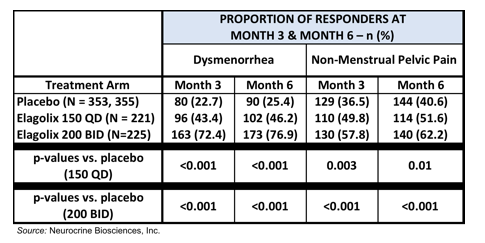
The side effect profile for elagolix in the Solstice study was consistent with what was seen in the previous Phase 3 study as well as prior elagolix studies. The most common treatment-related adverse events (TEAEs) included hot flush, headache, and nausea. Overall discontinuation rates were similar between treatment groups (25.3%, 21.2%, 19.7% for placebo, 150 mg once daily, and 200 mg twice daily, respectively) while discontinuation due to TEAEs were 6.1%, 4.4%, and 10.0% for placebo, 150 mg once daily, and 200 mg twice daily, respectively.
Based upon it mechanism of action (discussed below), a loss in bone mineral density (BMD) is a potential side effect of elagolix treatment. AbbVie reported the following results in regards to mean percent change from baseline in BMD at the lumbar spine.
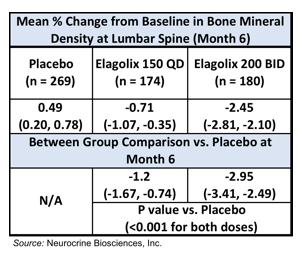
While both doses of elagolix resulted in a statistically significant decrease in BMD compared to placebo at the six month mark, the results for the 150 mg once daily dose were consistent with what had been seen in previous studies, while the 200 mg twice daily dose is indicative of a dose dependent effect. To put these data into perspective, after six months of treatment with Lupron, patients experienced an average loss in BMD of 3.2% (Lupron prescribing information). We do not find the loss in BMD caused by elagolix to be concerning and do not think it will interfere with getting elagolix approved, particularly given the statistically significant effect in the 150 mg once daily dosing group compared to placebo that resulted in much lower loss of BMD compared to Lupron.
Patients in the Solstice trial will continue in either post-treatment follow-up or a blinded extension study for an additional six-month safety and efficacy evaluation. AbbVie has indicated that full results from both Phase 3 trials will be presented at future medical conferences in 2016, and a new drug application (NDA) for elagolix in endometriosis will be filed in 2017.
We continue to believe that elagolix is roughly a one billion drug in the U.S. based on the following key pieces of information and market dynamics.
- AbbVie is a pioneer and market leader in GnRH agonists with Lupron for the treatment of hormone-responsive cancers such as prostate cancer or breast cancer.
-We believe that AbbVie will look to replace Lupron in the Ob/Gyn market with elagolix thanks to superior efficacy and tolerability, as well as patent protection.
- Prevalence of endometriosis at around 10% of the general female population between the ages of 18 and 49. This is roughly 10 million women in the U.S.
- 25% of these women are asymptomatic.
-In 2009, Datamonitor cited 7.5 million women in the U.S. suffer from clinically significant endometriosis.
- Neurocrine notes that 75% of endometriosis sufferers have symptoms defined as moderate or severe.
-Data from IMS Health suggests that 10-20% of all oral contraceptive prescriptions are written off-label for endometriosis,
-Ob/Gyn's prescribe NSAIDs and opioids off-label to approximately 25% of their endometriosis patients.
- Approximately 400,000 hysterectomies per year are attributed to endometriosis.
-We suspect that another 300-400,000 women are to the point that they are failing these other medications and nearing a hysterectomy (essentially pulling forward one year all the women that are heading towards a hysterectomy next year).
- As such, we believe there are approximately 750,000 women in the U.S. that are ideal potential candidates for elagolix. We think it is realistic for AbbVie to penetrate 30% of this market.
- We believe that elagolix will launch competitively priced with branded neurological or fibromyalgia pain medications such as Cymbalta or Lyrica, or around $12-15 per day.
- We believe a typical course of treatment will include eight months on therapy.
Multiplying all this through, we arrive at a peak U.S. opportunity for elagolix in endometriosis of $825 million (750k patients x 30% penetration x $15 per day x 245 days).
Elagolix in Uterine Fibroids
We remind investors that AbbVie is also evaluating elagolix in women with uterine fibroids (UF). Neurocrine recently announced that AbbVie initiated enrollment of the first patient in the first of two planned Phase 3 clinical trials evaluating elagolix either alone or with add-back therapy for the treatment of UF (NCT02654054). The two Phase 3 studies will be randomized, double blind, placebo controlled trials and are expected to enroll 400 subjects for an initial six-month placebo-controlled dosing period followed by an additional six-month dosing period in a safety and efficacy extension study.
In September 2015, AbbVie announced plans to proceed to the Phase 3 program for elagolix in UF following successful completion of a Phase 2b clinical trial (NCT01817530) evaluating the change in menstrual blood loss of 520 women, age 18-51, with heavy menstrual bleeding associated with UF. The study enrolled 561 premenopausal women, age 18-51, at approximately 100 sites around the world. Patients were administered elagolix in two dosing cohorts: 300 mg BID or 600 mg QD either alone or in combination with two different strengths of add-back therapy (estradiol/norethindrone acetate). The primary endpoint of the trial was a composite design where subjects had to achieve a menstrual blood loss volume of less than 80 mL as well as a 50% or greater reduction in menstrual blood loss volume at the final study month as measured by alkaline hematin method.
Although AbbVie did not release many details in the press release, they did indicate that preliminary results showed that all of the elagolix treatment arms, with and with-out add-back therapy, reduced heavy menstrual bleeding compared to placebo (P<0.001). The most common adverse events (AEs) were hot flush, headache, nausea, and vomiting, with some AEs such as hot flush being more frequent in the elagolix only cohort compared to the placebo and elagolix treatment with add-back therapy. Importantly, it was noted that reduction in BMD associated with elagolix alone was attenuated when elagolix was combined with add-back therapy. Full results from the trial will be presented at an upcoming medical conference.
We estimate that of the 65 million women age 14-49 in the U.S., approximately 13% of those will have UF. We then presume that 25% of those with UF will seek treatment due to severity of menstrual bleeding or other symptoms. Of those that begin treatment with hormone therapy, we estimate that approximately 50% will be refractory and require another treatment option, thus putting the target patient population in the U.S. at approximately 1 million. The prevalence of UF appears to vary considerably in different countries in the E.U., and we are using a composite prevalence of approximately 10%, with similar numbers of women seeking treatment and failing first-line drug therapy as that found in the U.S. This puts the target patient population in the E.U. at approximately 1.3 million.
We estimate that the Phase 3 program will take approximately two years to complete, based on the two years it took for the Phase 2b study, thus an NDA filing would most likely not occur until the end of 2018, putting approval for elagolix in UF in 2019. We estimate that peak sales of elagolix in UF could top $2.6 billion worldwide. Using a composite 20% royalty rate, we estimate peak royalties to Neurocrine of over $500 million from sales in UF.
Valbenazine Update
In early October 2015, Neurocrine announced positive results from the Phase 3 Kinect-3 clinical trial of valbenazine in tardive dyskinesia (NCT02274558). The Kinect-3 study is a randomized, parallel group, double blind, placebo controlled Phase 3 clinical trial testing valbenazine in moderate to severe tardive dyskinesia patients with underlying schizophrenia, schizoaffective disorder, or mood disorder. A total of 234 patients were randomized to receive placebo, 40 mg of valbenazine, or 80 mg of valbenazine once daily for six weeks. The results showed a highly significant change from baseline in the Abnormal Involuntary Movement Scale (AIMS) at Week 6 (p<0.0001).
The topline data that was released for Kinect-3 shows that the trial was very successful, as shown in the following table.
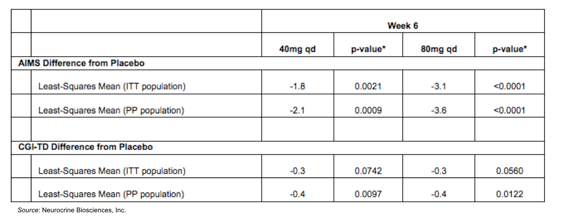
The primary endpoint of the study was the change from baseline in the Abnormal Involuntary Movement Scale (AIMS) at Week 6 as determined by centrally blinded video raters. Secondary endpoints in the study included the Clinical Global Impression of Change (CGI-TD). The AIMS rating at Week 6 was reduced 3.1 points more than placebo, which was a highly significant result (p<0.0001). For comparisons sake, in the Kinect-2 study the results showed the AIMS rating at Week 6 was reduced by 2.4 points more than placebo in the intent to treat (ITT) population and 3.0 points more than placebo in the per protocol (PP) population. The ITT population includes any subject with at least one dose of blinded study drug (active or placebo) and one post-treatment AIMS assessment at week 6, while the PP population excluded any subject randomized to valbenazine with levels of drug below the limit of quantitation (i.e., the subject had not ingested the drug). Data not released at this time includes what the reduction in AIMS rating was for placebo treated patients and what the baseline AIMS rating for each group was. However, since the results shown above are the difference from placebo, it is clear that the results in regards to AIMS rating from the Kinect-3 study were superior to the results seen in the Kinect-2 study. The CGI-TD results were not statistically significant for the ITT population, however since that was a secondary endpoint we do not believe this will hinder the approval of the drug.
Teva Pharmaceuticals is developing SD-809, which is a deuterium-modified version of tetrabenazine. In June 2015, Teva announced positive top-line results for SD-809 in the treatment of TD. The primary endpoint of that trial was also the change in AIMS from baseline, however that trial examined results after 12 weeks of treatment. Results showed that patients taking SD-809 had a reduction in AIMS of 3.0 points compared to 1.6 points for those taking placebo, representing a placebo-adjusted reduction of 1.4 points. While impossible to make direct comparisons between results from different clinical trials, the Kinect-3 results showing a placebo-adjusted reduction of 3.1 points look quite good in comparison to the results reported by Teva.
Importantly, the frequency of adverse events in the Kinect-3 trial was similar among all treatment groups and treatment emergent adverse effects were consistent with those of prior studies. Participants in the trial were also assessed for akathisia and parkinsonism and minimal symptoms were present at baseline and there was no worsening during the six-week treatment period. Lastly, clinical hematology, chemistry, and ECG monitoring indicated no emergent safety signals.
The Kinect-3 study, along with the previous efficacy studies of valbenazine, is designed to complete the clinical efficacy evaluation of the drug in TD. The company is now turning its attention to completing the one-year open-label safety study (Kinect-4) in TD patients with all data to be included in the company’s NDA, which we continue to anticipate will be filed in 2016.
Development of Valbenazine in Tourette Syndrome Continues
In addition to TD, Neurocrine is also developing valbenazine as a treatment for Tourette syndrome (TS), a childhood neuropsychiatric disorder that is characterized by repetitive movements and unwanted sounds that are not easily controlled. TS is a genetically inherited condition that is passed on through families, however the precise abnormality responsible for the condition has not yet been elucidated. Diagnostic criteria for TS include multiple motor and vocal tics that occur many times a day nearly every day for one year, an age of onset of less than 18, and symptoms that are not due to any direct effects from substances or other conditions. Previously, diagnosis was also contingent on the condition causing marked distress or impairment in social, occupational, or other important areas of function. However, since a number of patients have a mild form of TS that does not interfere with their daily lives, this criterion was removed so that patients with TS would not be stigmatized.
The tics associated with TS are diverse and sometimes bizarre. They are divided into motor or vocal and can be simple or complex. Simple motor tics involve a single muscle or group of muscles, while complex motor tics are movements that involve multiple muscle groups and may appear semi-purposeful. Simple vocal tics are basic vocalizations or sounds while complex vocal tics involve words and/or complex phrases. Copralalia is a complex phonic tic characterized by the shouting of socially inappropriate language. While copralalia is often associated with TS, it occurs in fewer than half of TS patients, although it can be one of the most distressing symptoms of the condition.
TS symptoms can be evaluated by a number of different clinical measurements, including the Yale Global Tic Severity Scale (YGTSS) and the Premonitory Urge for Tics Scale (PUTS).
- YGTSS: This is a 10-item clinician-rating instrument that provides an evaluation of the number, frequency, intensity, complexity, and interference of motor and phonic tics. The items are scored on two subscales, one for motor and one for phonic, and are rated on a 6-point scale (Leckman et al., 1989).
- PUTS: Older children and adolescents often report tics to be preceded by an unpleasant sensation known as “premonitory urge”, examples of which include a burning feeling in the eye before an eye blink, tension in the neck that is relieved by stretching the neck or jerking of the head, and nasal stuffiness before a sniff. PUTS is a means to quantify these urges, and data shows that the scale is internally consistent and correlates with overall tic severity in children older than 10 years of age (Woods et al., 2005).
Physicians typically take a multifaceted approach to treating TS using medication to control severe or frequent tics, behavioral modifications, and patient education. Medications given to suppress tics include dopamine receptor antagonists (pimozide, fluphenazine), alpha-2-adrenergic agonists (clonidine), benzodiazepines, dopamine depletors (tetrabenazine), and dopamine agonists (ropininirole). The only two medicines currently approved by the FDA for treating tics are haloperidol (Haldol®) and pimozide (Orap®).
On October 20, 2015, the company announced the initiation of the Phase 2 T-FORWARD study of valbenazine in adults with TS (NCT02581865). The T-FORWARD study is a randomized, double blind, placebo controlled, multi dose, parallel group study of up to 90 adults with TS. Study participants will receive once-daily dosing of valbenazine during an eight-week treatment period to assess the safety, tolerability, and efficacy in adults with TS. The primary endpoint of the study is the change in baseline of placebo vs. active scores utilizing the YGTSS at the end of Week 8. We anticipate topline results from the T-FORWARD study near the end of 2016.
In December 2015, the company announced the successful completion of the Phase 1b trial of valbenazine in both children and adolescents with TS (NCT02256475). The T-FORCE study was an open-label, multiple ascending dose, pharmacokinetic and pharmacodynamics two-week study of 36 subjects with TS. The study participants received once-daily dosing of valbenazine during a two-week treatment period to assess both the safety and tolerability followed by seven days off-drug. Results from the trial showed a 31% reduction from baseline in the YGTSS, which was corroborated by an improvement in Tourette symptomology as assessed by the treating physician using the Clinical Global Impression in Tourette Syndrome Scale.
To follow up on the encouraging results seen in the T-FORCE study, Neurocrine recently initiated the T-Force GREEN study to evaluate safety, tolerability, and efficacy of valbenazine in children and adolescents with TS (NCT02679079). The T-Force GREEN study is a randomized, double blind, placebo controlled, multi-dose, parallel group trial of up to 90 children and adolescents. Patients will receive once-daily dosing of valbenazine or placebo in a 1:1:1 fashion during a six-week treatment period. The primary endpoint of the study is the change in baseline of the YGTSS between placebo and active groups at the end of six weeks. We anticipate results from this study being released near the end of 2016.
New Compound Enters the Clinic for Essential Tremor
On November 4, 2015, Neurocrine announced the addition of NBI-640756 as a new compound into the company’s clinical pipeline. NBI-640756 is being developed for the treatment of essential tremor (ET), which is the most common movement disorder and affects an estimated 10 million people in the U.S. (American Academy of Neurology). That is ten times more Americans than have Parkinson’s disease. The syndrome is characterized by a slowly progressing postural and/or kinetic tremor and usually affects both upper extremities. The condition affects all ethnic and geographic populations and while it can become apparent during childhood or adolescence, onset is typically in adulthood, with a mean age of approximately 45.
While ET is rarely if ever fatal, the condition does cause significant functional disability that can affect handwriting, speech, and various activities of daily living including the ability to feed oneself, drink from a cup, or dress. In addition, the disability associated with ET can cause embarrassment that results in withdrawal from social activities, leading to a decreased quality of life.
Current treatment options for patients with ET include primidone, a structural analog of phenobarbital, and propranolol, a beta-andrenergic receptor antagonist. Surgical management of ET is typically reserved for patients with severe ET that does not respond to medication and includes ablative therapy through stereotactic thalamotomy (destruction of the thalamus) and deep-brain stimulation, which involves the placement of electrodes into the thalamus that are connected to a pulse generator that is implanted subcutaneously in the shoulder.
Neurocrine has recently initiated a Phase 1 single site, randomized, double blind, placebo controlled, sequential dose escalation, pharmacokinetic study to assess the safety and tolerability of a single dose of NBI-640756 in up to 32 healthy volunteers. Assuming positive results from that study (results should be available in mid-2016), the company will then initiate a Phase 1 multiple dose study. Since the compound is just starting out in clinical trials we are not yet including it in our financial model, however with a patient population totaling 10 million, there is certainly a large potential opportunity for the company in ET.
Conclusion and Recommendation
The treatment of TD is a very meaningful market opportunity for Neurocrine. There are an estimated 500,000 TD patients in the U.S. with no real treatment options besides tetrabenazine. For valuation purposes, we assume U.S. approval of valbenazine in TD will target roughly 150,000 of the total patients in the U.S. that are moderate-to-severe in disease state. For modeling purposes, we estimate the yearly cost of valbenazine will be $20,000. If Neurocrine can capture 33% market share, which we believe is reasonable given the superior characteristics of valbenazine vs. generic tetrabenazine, then peak sales estimates are approximately $1.6 billion in this indication in the U.S. alone. We remind investors that valbenazine has received breakthrough designation from the U.S. FDA for the treatment of TD.
For valbenazine in TS, we estimate there are approximately 200,000 patients (both children and adults) with TS severe enough to require treatment in the U.S. Even with a conservative 15% peak market share, the opportunity for valbenazine in TS is another billion-dollar opportunity.
We believe AbbVie will file an NDA for elagolix for endometriosis in 2017 and approval will occur in 2018. We model for peak sales of elagolix in endometriosis of $1.5 billion worldwide. Using a composite 20% royalty rate, we estimate peak royalties to Neurocrine of approximately $300 million from sales in endometriosis.
For elagolix in UF, we estimate that the Phase 3 program will take approximately two years to complete, based on the two years it took for the Phase 2b study, thus an NDA filing would most likely not occur until the end of 2018, putting approval for elagolix in UF in 2019. We estimate that peak sales of elagolix in UF could top $2.6 billion worldwide. Using a composite 20% royalty rate, we estimate peak royalties to Neurocrine of over $500 million from sales in UF.
Based on the long run of positive news for the company going back over the past year, we believe the future is bright for Neurocrine. The negative sentiment that has plagued the biotechnology sector for the past few months has affected all companies indiscriminately, which has resulted in quality companies, such as Neurocrine, trading at significant discounts to their fair value. We view the downturn as an attractive opportunity for investors and would recommend Neurocrine as a core, long-term holding for those invested in the biopharmaceutical market. We are maintaining a ‘Buy’ rating on the stock with a price target of $75.
READ THE LATEST FULL RESEARCH REPORT HERE
SUBSCRIBE TO ZACKS SMALL CAP RESEARCH to receive our articles and reports emailed directly to you each morning. Please visit our website for additional information on Zacks SCR and to view our disclaimer.