By
David Bautz, PhD
OTC:NSPX
Business Update
Inspyr Therapeutics, Inc. (OTC:NSPX) is a biotechnology company focused on the targeted delivery of a novel anti-cancer agent specifically to cancerous tissue, thus mitigating systemic adverse effects that are typical with standard chemotherapeutic agents. The novel cytotoxic therapeutic agent is thapsigargin, which is a potent inhibitor of the intracellular sarcoplasmic/endoplasmic reticulum calcium adenosine triphosphastase (SERCA) pump protein. This inhibition causes calcium levels to rise significantly and triggers apoptosis (cell death).
The company’s major focus over the next 12-18 months will be on: 1) selectively building an experienced leadership team following the change in management; 2) completing the ongoing Phase 2 clinical trial in glioblastoma multiforme (GBM); 3) development of a clinical protocol for the next clinical trials in HCC and GBM; 4) partnering discussions with larger pharmaceutical companies; and 5) prioritization of the next thapsigargin prodrug development candidate.
Thapsigargin as an Anti-Cancer Agent
Unlike traditional chemotherapeutic agents, which are somewhat selective based on the blockage of pathways that are required for rapid proliferation, thapsigargin inhibits the SERCA pump, which is required for both quiescent as well as proliferating cells. Thus, there is no selectivity with thapsigargin between benign and cancerous cells and systemic administration of thapsigargin is highly toxic (Denmeade et al., 1993). To overcome this limitation, a protease-activated prodrug strategy was developed whereby a chemically modified derivative of thapsigargin (12ADT) was produced and coupled to a protease-specific peptide carrier (Denmeade et al., 1998). 12ADT was shown to retain the cytotoxicity of thapsigargin while allowing the easy coupling of different peptides (Jakobsen et al., 2001).
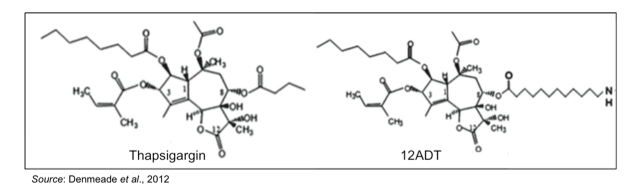
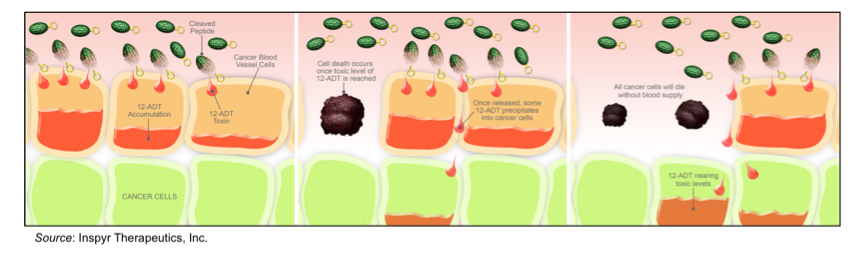
In order to target 12ADT to different types of cancers, specific enzymes that are found in high levels in tumors relative to other tissues in the body are identified and a peptide is designed that is recognized predominantly by that enzyme. The peptide is then covalently linked to 12ADT to create a prodrug, with the end result being that the prodrug can safely travel through the body without eliciting harmful side effects and 12ADT is only liberated in the presence of tumor specific enzymes. This is akin to a hand grenade, where the peptide acts as the “pin” and 12ADT is the “bomb”. When the “pin” is removed, the insoluble 12ADT immediately enters the nearby cancer cells, and after sufficient quantities of 12ADT have accumulated, the cell dies. This is depicted in the following graphic.
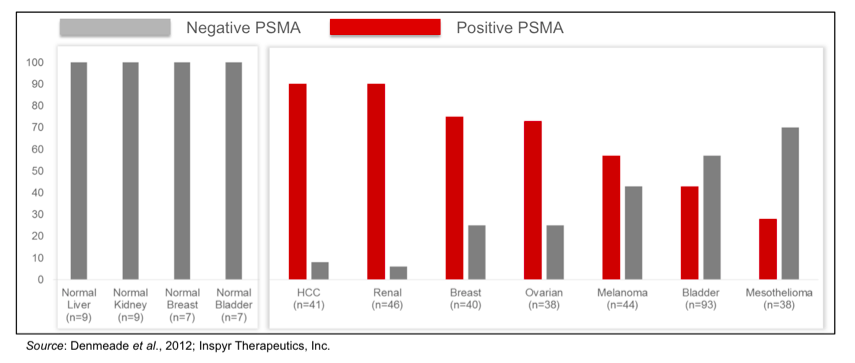
The company’s lead compound, mipsagargin, harbors a peptide that is recognized by prostate specific membrane antigen (PSMA), an enzyme that is expressed on the vasculature of almost all solid tumors while have little to no expression on normal tissue, as shown in the following figure.
Update on Mipsagargin in Glioblastoma Multiforme
In February 2014, Inspyr initiated a Phase 2 investigator-sponsored clinical trial of mipsagargin in patients with glioblastoma multiforme (GBM) at the University of California, San Diego Moores Cancer Center, which is funding the trial, and is being led by Dr. David Piccioni and Dr. Santosh Kesari (NCT02067156). The study is a two-stage, single-arm, open-label study designed to evaluate the activity, safety, and central nervous system (CNS) exposure of mipsagargin in up to 34 patients with recurrent or progressive GBM. After enrolling the first 12 patients, the study has now advanced to the second stage, where enrollment will continue up to 34 patients total, indicating that the first cohort of patients exhibited potential signs of efficacy and that mipsagargin was well-tolerated. As of July 22, 2016 a total of 25 patients have been treated as part of the trial.
On November 18, 2015, the company announced that mipsagargin demonstrated clinical benefit in a subset of glioblastoma patients, with the results being presented in a poster at the Society for Neuro-Oncology 20th Annual Scientific Meeting. Below is an overview of GBM as well as the data presented on the Phase 2 clinical trial.
Mipsagargin for the Treatment of GBM
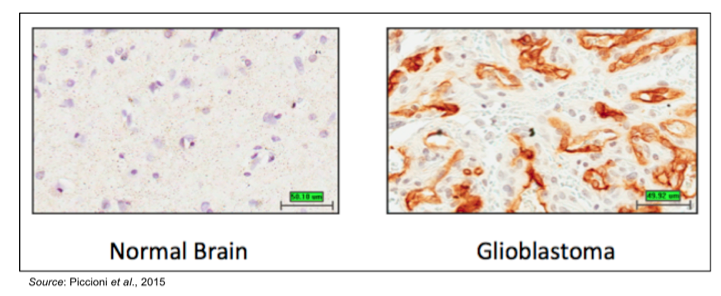
Mipsagargin is being tested as a potential therapy for GBM based on data showing PSMA expression in GBM samples but not in normal brain tissue (Nomura et al., 2014). This is depicted in the following figure, which shows how normal brain tissue shows little to no PSMA expression, but expression of PSMA is quite strong in glioblastoma (denoted by the brown staining). One study found 91% of GBM patient samples had ≥2+ PSMA staining (Wernicke et al., 2011).
The following images show brain scans from one of the patients in the ongoing Phase 2 trial that had a response to mipsagargin treatment. The image on the left was taken prior to treatment while the image on the right was taken after eight months of treatment, which shows a clear decrease in the size of the lesion.
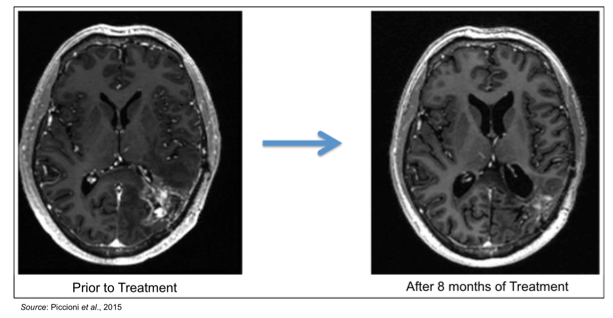
Thus far, three of 11 evaluable patients have demonstrated at least stable disease at the first disease assessment (2 stable disease and 1 partial response), one of which met the primary endpoint of six-month progression-free survival. There were no dose-limiting toxicities noted. Importantly, while PSMA staining of tumor tissue samples taken from patients has shown variability, all three responders have >2+ staining, suggesting that an enrichment strategy could be employed in future studies by only including those patients with PSMA expression in their tumors. We anticipate topline results from the study being available in mid-year 2017.
Update on Mipsagargin in Prostate Cancer
Prostate cancer is the most common noncutaneous cancer diagnosed in men. It is typically a slow growing cancer, although it still accounts for approximately 10% of all cancer related deaths in men. Currently, most of the cases of prostate cancer are found through routine screening of prostate specific antigen (PSA) level, although some cases are also identified as an incidental pathological finding when tissue is removed during transurethral resection to manage obstructive prostatic symptoms. Almost 95% of all prostate cancers are adenocarcinomas (American Cancer Society), meaning that it arises from epithelial tissue that has glandular origin.
The American Cancer Society estimates that approximately 220,000 men will be diagnosed with prostate cancer in 2015, while approximately 30,000 men will die from the disease. The disease is quite rare in men less than 40 years of age, and is still uncommon in men younger than 50. Sixty percent of cases are in men aged 65 or older and the average age of diagnosis is 66.
On August 17, 2016, the company announced the initiation of an investigator-sponsored clinical trial of mipsagargin in patients with newly diagnosed prostate cancer (NCT02381236). This trial is being conducted at the University of Texas Health Science Center and Dr. Robert Amato is serving as the principal investigator. The open label, single arm, Phase 2 clinical trial will involve patients being administered mipsagargin for three consecutive days of a 28-day cycle over a total of three cycles. The trial will evaluate the effect of mipsagargin on the perfusion and volume of the prostate. We anticipate topline results being reported in mid-2017.
Mipsagargin Phase 2 Clinical Results in Hepatocellular Carcinoma
Inspyr previously tested mipsagargin in a multi-site, single arm Phase 2 clinical trial in 25 hepatocellular carcinoma (HCC) patients with advanced stage liver disease who had failed first line treatment with sorafenib (Nexavar®) (NCT01777594). Eighteen of the 25 patients were Child Pugh A while seven were Child Pugh B, which is indicative of more advanced liver disease. Nineteen patients were dosed with 40 mg/m2 on days 1, 2 and 3, of a 28-day cycle while six patients were treated with 40 mg/m2 on day 1 and 66 mg/m2 on days 2 and 3 of a 28-day cycle. Of the 19 evaluable patients, 24% had received two or more prior systemic therapies.
The results from the study showed that mipsagargin was well tolerated, with the most frequently occurring grade ≥ 2 adverse events being increased creatinine (n=8, 32%), fatigue (n=7, 28%), and increased ALT and AST (n=6, 24%). Notably, typical side effects of standard chemotherapeutic agents such as severe nausea, vomiting, diarrhea, neuropathy, evidence of bone marrow suppression, and hair loss were not seen in the study. In addition, there were no immunosuppressive side effects seen with treatment, which means the drug could potentially be paired with an immunotherapy. There were five serious adverse events that were determined to be mipsagargin-related: 3 patients had acute renal failure or acute renal injury, 1 patient had congestive cardiac failure, and 1 patient experience grade 3 chest pain. The company has stated that the effect on the kidney is dose dependent, non-cumulative, and 100% rapidly reversible with hydration. The following table gives the final results from the study.
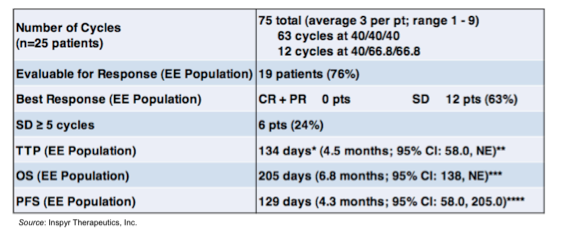
Some may look at a treatment with no complete responses (CR) or partial responses (PR) and think that it is not effective. Liver cancer is unique in that it is quite rare to see tumor regression due to the advanced nature of liver disease and cirrhosis outside of the cancer that exists in most HCC patients, particularly those patients who are Child-Pugh B or C. What may be occurring is that as mipsagargin kills the tumor cells, they are being replaced with scar tissue, thus on standard imaging there doesn’t appear to be a change in size where the tumor was located. However, the time to progression (TTP) of 4.5 months in a patient population refractory to sorafenib was highly favorable to the TPP of 2.7 months seen historically in this patient population.
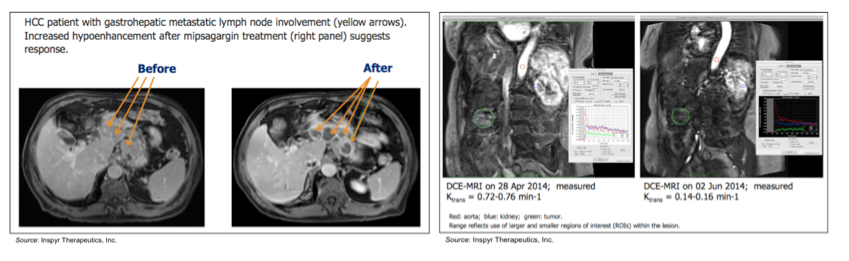
To better understand mipsagargin’s anti-tumor effect, the company performed dynamic contrast enhanced magnetic resonance imaging (DCE-MRI), which allows for analysis of the vascular blood flow within the tumor. The DCE-MRI data demonstrated substantially decreased blood flow in the tumors, indicative of a pharmacodynamic proof-of-concept for the mechanism of action of mipsagargin. The following images show DCE-MRI images taken from two HCC patients before and after treatment with mipsagargin. The images on the left shows metastatic lymph nodes, which after treatment appear to show a “necrotic hole” where there does not appear to be cancer present. However, since the size of the “hole” did not change, the patient is graded as having stable disease even though all cancer cells may be gone. The images on the right are DCE-MRI scans that show decreased vascular enhancement, indicative of the cancer no longer being present.
Mipsagargin Development Plan in HCC
Inspyr now has the final report and full data set from the Clinical Research Organization that conducted the HCC Phase 2 trial. With the full data set, the company can now conduct more definitive discussions with potential corporate partners that they had previously engaged. The plan is to move into a large, international Phase 3 trial after a partnership agreement is signed, however the company is also prepared to initiate the Phase 3 trial alone.
From a strategy standpoint, the unique mechanism of action offered by mipsagargin means that the drug could be paired with another therapeutic to increase the overall efficacy. Mipsagargin is a targeted chemotherapeutic agent, thus the side effects typically seen with chemotherapeutic agents, particularly in regards to reduction in leukocytes, are not seen with mipsagargin treatment. This means that pairing mipsagargin with an immuno-oncology agent, which relies on a healthy immune system to drive an anti-cancer response, could be a good fit for the drug.
Mipsagargin may also be a good fit for pairing with trans-arterial chemo-embolization (TACE), which is the standard of care for intermediate stage HCC, particularly in Asia (Bruix et al., 2011). TACE has been previously combined with sorafenib in a number of trials, which showed an improvement in overall survival, albeit with increased side effects (Zhang et al., 2014). TACE leads to a hypoxic environment in the tumor, which ultimately leads to an increase in angiogenesis that can lead to tumor recurrence (Sergio et al., 2008). Since mipsagargin targets PSMA, which is overexpressed in the vasculature (blood vessels), it seems logical that an increase in blood vessel formation induced by TACE could be counteracted by mipsagargin, thereby making both treatments more effective when used together.
Whatever path the company decides to take, we believe there will be a definite focus on the Asian market, as that is where a majority of the liver cancer cases are located, and if mipsagargin is ultimately used in combination with TACE, where most of those procedures are performed. Before beginning a Phase 2b/3 trial, the company will need to conduct a small Phase 1/2 clinical trial in East Asian patients, as we believe they will make up the majority of patients in the global Phase 3 trial. This will likely be a dosing and pharmacokinetic study that could start in the first half of 2017 and be completed within nine months. The global Phase 2b/3 study could then initiate after the completion of the East Asian study, which we estimate would be late 2017 to first half of 2018.
Management and Name Change
On August 1, 2016, GenSpera, Inc. announced it is changing it corporate name to Inspyr Therapeutics, Inc. and began trading under the ticker symbol NSPX. On August 4, 2016, the company announced that Christopher Lowe was appointed as President and Chief Executive Officer as well as a member of the company’s Board of Directors, after serving as an advisor to the company since March 2016. Mr. Lowe brings more than 15 years of executive management and operating experience in life science companies as CEO, CFO, and CBO and has a successful track record in raising more than $500 million in private and public financings, completing more than $1 billion in M&A transactions and negotiating more than $300 million in debt instruments. On August 8, 2016, the company announced that Ronald Shazer M.D. was appointed Senior Vice President and Chief Medical Officer. Dr. Shazer has led the clinical development of multiple oncology compounds as the CMO of TRACON Pharmaceuticals and as Senior Director, Clinical Lead Oncology at Pfizer and has led teams which have successfully developed FDA-approved new drugs while at Bristol-Myers Squibb and Arena Pharmaceuticals.
Financial Update
On August 15, 2016, Inspyr filed form 10-Q with financial results for the second quarter of 2016. The company reported a net loss of $0.5 million, or $0.01 per share, which consisted of $0.32 million of R&D expenses and $0.38 million of G&A expenses partially offset by $0.2 million in a non-cash gain due to the change in the fair value of derivative liability. Total cash burn for the quarter was $0.6 million and the company exited the second quarter with approximately $0.9 million in cash and cash equivalents. We estimate this will fund operations through September 2016. The company is currently exploring various options for raising additional capital, which may include the sale of equity or debt securities, or entering into strategic collaborative and/or licensing collaborations.
As of August 5, 2016, Inspyr had approximately 41.8 million shares of common stock outstanding. When factoring in the conversion of the Series A convertible preferred (12.4 million shares), outstanding stock options (5.6 million), and outstanding warrants (40.1 million), the fully diluted share count currently stands at approximately 100 million shares.
Valuation
We value Inspyr using a probability-adjusted discounted cash flow model that takes into account potential revenues from the sale of mipsagargin in HCC and GBM, as these two programs are the furthest along in development. We estimate that for HCC, a Phase 3 trial will commence in 2017, an NDA will be filed in 2020, and approval of mipsagargin will occur in 2021. For GBM, we estimate a Phase 3 trial commencing in 2018, with an NDA filing in 2021 and approval in 2022. We model for peak revenues of $600 million in GBM and $2 billion in HCC. Using a 20% discount rate, this leads to a valuation of $0.40.
READ THE FULL RESEARCH REPORT HERE
SUBSCRIBE TO ZACKS SMALL CAP RESEARCH to receive our articles and reports emailed directly to you each morning. Please visit our website for additional information on Zacks SCR and to view our disclaimer.