For the purpose of this research report, we will offer a business update and a review of notable events and milestones for InVivo Therapeutics (NASDAQ:NVIV), a biomaterials and biotechnology company focused on technologies and treatments for acute and chronic spinal cord injury (SCI). InVivo currently has two spinal cord injury programs in place: The Neuro-Spinal Scaffold™ pilot study for acute SCI which was recently converted to the probable benefit INSPIRE Study, and the recently announced pre-clinical Bioengineered Neural Trails™ Program for chronic SCI where neural stem cells are delivered in biomaterials by a novel, minimally invasive delivery system.
BUSINESS UPDATE
InVivo Therapeutics was conducting an early pilot study of the Neuro-Spinal Scaffold™ (NSS) under an approved Investigational Device Exemption (IDE) application for the treatment of complete traumatic acute spinal cord injury (SCI). We remind investors that InVivo received a Humanitarian Use Device (HUD) designation for the NSS in April 2013. The FDA approved pilot study was intended to capture data on the safety and feasibility of using the NSS along with gathering preliminary evidence of clinical effectiveness. The pilot study was initially approved to enroll five patients, but InVivo announced that the FDA approved expansion of the study to permit enrollment to ten patients in October 2015, which we viewed as a positive development to the InVivo story. We believe that expansion of the pilot study set the stage for transition into the pivotal probable benefit study, and to use this single study as the basis for a Humanitarian Device Exemption (HDE) application would dramatically reduce clinical trial timelines and time to potential approval and commercialization.
Thus far, there are 15 clinical sites open, and 5 patients have been enrolled in the study and implanted with the NSS. The University of California, San Diego Medical Center was the most recent site to be added on February 3, 2016. The last patient (Patient #5) was enrolled back in September 2015, and we believe that some investors have moved away from the InVivo story due to slow enrollment. We think it’s important for investors to keep in mind that not every spinal cord injury patient at each of the centers will qualify for participation into the trial, but we do believe that approximately 9 more trial sites should be added this year, which should help with trial enrollment. We believe that the majority of these sites will be in the U.S.; however there have been talks of opening up trial sites in both Canada and the United Kingdom.
FDA Approves INSPIRE Probable Benefit Study of the Neuro-Spinal Scaffold™
On January 4, 2016, InVivo received approval of a protocol amendment from the FDA, which converted its ongoing pilot study into a pivotal probable benefit study. As a reminder, on December 3, 2015, InVivo announced that it has received conditional approval of the protocol amendment, and the approval was conditional solely upon a minor change to the informed consent form. We were expecting full approval of the amendment within 30 days of the conditional approval announcement, and are happy to report that this occurred within the expected timeframe. We see the approval by the FDA for the conversion of the pilot study into a pivotal probable benefit study as good news and as a major milestone for InVivo. It is important to understand that the original pilot study has been converted into the probable benefit study, and that the probable benefit study will not be a new study. We think that InVivo was able to receive approval for the probable benefit study largely due to the fact that both studies have similar outcome measures, and thus rolling the pilot study into the probable benefit study was much easier for the FDA to accept and approve. The company expects completing enrollment of the pivotal probable benefit study and submitting an application for Humanitarian Device Exemption (HDE) approval in late 2017. If all goes well, we believe this supports obtaining FDA approval to commence commercialization under an HDE.
Going forward, the study will be known as “The INSPIRE Study: InVivo Study of Probable Benefit of the Neuro-Spinal ScaffoldTM for Safety and Neurologic Recovery in Subjects with Complete Thoracic AIS A Spinal Cord Injury,” and is designed to enroll 20 implanted patients, which includes the 5 patients already enrolled from the original pilot study. The primary objective of INSPIRE is to evaluate whether the NSS is safe and demonstrates probable benefit for the treatment of patients with complete T2-T12/L1 SCI. The primary endpoint is defined as the proportion of patients achieving an improvement of at least one American Spinal Injury Association (ASIA) impairment scale (AIS) grade at 6 months post-implantation. What this means is that by the 6-month mark, it is expected that a certain proportion of patients will no longer have a complete spinal cord injury, and will have regained some sensory function, and even perhaps both motor and sensory function. Additional endpoints of the trial are mainly various measures of neurological function, and include: ISNCSCI sensory and motor scores, bladder and bowel function, Spinal Cord Independence Measure (SCIM III), pain, Quality of Life and MRI measures (mainly to see cyst formation, which often happens in patients that are untreated). The INSPIRE study is currently approved to enroll up to 12 patients, but InVivo expects that the FDA will approve the full 20 patients following the review of 6-month safety data for the first 5 patients. The company plans to submit this data in the second quarter of 2016.
The inclusion criteria for the trial have been widened to include patients with T2 injuries (new range: T2-T12/L1; original range: T3-T12/L1) and ages 16-17 (new range: ages 16-70; original range: ages 18-70). We believe that lowering the age limit makes a lot of sense, as there are many cases of motor vehicle accidents in adolescents as they are learning to drive. Additionally, including more thoracic segment injuries allows for more potential patients to qualify for the study. The FDA has also agreed to increase the total number of allowable U.S. sites to 40. In addition to the U.S. sites, the company plans to initiate the study in Canada as well as the United Kingdom as mentioned above. Full inclusion criteria can be found on ClinicalTrials.gov. Other inclusion criteria include: (1) Recent injury: Must receive NSS within 96 hours from injury, and (2): Non-penetrating contusion injury no less than approximately 4 mm diameter by MRI. We believe that the exclusion criteria is typical for such a trial, and can be reviewed on the website mentioned above. We think that widening the criteria makes sense, and we are hoping it will allow for more patients to qualify for the trial (and also bring on more neurosurgeons/investigators) as the population criteria is now expanded. Overall, we believe that by widening the inclusion criteria and adding more trial sites should help patient enrollment pick up during 2016.
Establishing Objective Performance Criterion (OPC)
As a reminder, obtaining marketing approval for the NSS is very different as compared to other devices as InVivo is pursuing the accelerated regulatory Humanitarian Device Exemption (HDE) pathway. An HDE only requires the demonstration of safety and probable benefit, which in our opinion, is a lower regulatory hurdle. InVivo is able to pursue the HDE pathway, which is an efficient pathway to approval, because the company is focused on an area of significant unmet medical need as there are currently no approved therapeutics for these types of SCI patients in a relatively small population. The FDA accepts that there are no approved devices or drugs to treat this patient population. InVivo needs to demonstrate probable benefit of the NSS device in order to get it approved.
As per the FDA and the FD&C Act Section 520(m), probable benefit under an HDE is defined as, “The device will not expose patients to an unreasonable or significant risk of illness or injury and the probable benefit to health from the use of the device outweighs the risk of injury or illness from its use, taking into account the probable risks and benefits of currently available devices or alternative forms of treatment.” We think the definition of probable benefit is vaguely defined for a reason. It really allows for a proposal to be made to the FDA, and is dependant on what one is trying to treat and what one is trying to treat it with, which is what InVivo has clearly done.
To assess probable benefit, InVivo will establish an Objective Performance Criterion (OPC) to define success in this uncontrolled study, which is primarily based on AIS conversion rates. We think that once the OPC is set, we should have a better understanding of the likely path to commercialization. InVivo is currently in late-stage discussions with the FDA regarding the OPC for the study to support probable benefit, and the company’s proposal is largely based on data from longitudinal, natural history databases. In large European and U.S. databases [European Multicenter Study about Spinal Cord Injury (EMSCI) - Zaffira et al., 2011; Spinal Cord Injury Model System (U.S. database) – Lee et al., 2014; Sygen clinical trial in spinal cord injury – Fawcett et al., 2007], the published rates of spontaneous improvement of at least one AIS grade for complete (AIS-A), thoracic SCI patients at six months are less than 16% (below). In other words, when looking across the large European/U.S. databases, as well as the newer and older databases, it can be seen that patients with thoracic complete injuries typically do not have favorable outcomes, and less than 16% of those patients can be expected to have any type of improvement in AIS scores by six or twelve months. We think it’s important to point out that over the last ten years, this percentages really haven’t changed all that much in terms of neurological outcome, which leads us to believe that there really hasn’t been much progress in regards to new therapeutic options for these particular patients.
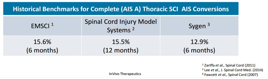
We believe an additional study protocol amendment may be required to establish the OPC, which could potentially be based on an additional neurological scale such as ISNCSCI sensory and motor scores, bladder and bowel function, Spinal Cord Independence Measure (SCIM III), pain, Quality of Life, and/or MRI measures.
We do not know what the actual OPC is yet, but we do not believe that InVivo will not have any trouble exceeding the historical benchmark range mentioned above (12.9% to 15.6%). We do think the OPC will end up being some percentage or range above 15%. At this point, we are thinking it could be anywhere between 20% and 35%. As a reference point, a 15% responder rate would mean that only one more patient (a total of 3 out of the 20 total enrolled patients) would need to demonstrate an AIS conversion as 2 out of 5 enrolled patients (or 40%) have already improved from AIS-A at 6 months. As a reminder, Patient #1 improved from AIS-A to AIS-C, and Patient #3 improved from AIS-A to AIS-B after following NSS implantation. In the first 3 subjects enrolled (Patients #1, #2, #3), all demonstrated some degree of neurological improvement. If we assume a 20% responder rate, this would require 4 out of the total 20 patients to convert while a 25% rate would require 5 out of the total 20 patients to convert. If we are even more aggressive and assume a 30% or even 35% responder rate, this would require 6 or 7 patients, respectively, out of the total 20 patients to demonstrate an AIS conversion. Regardless of what the final OPC ends up being, we think that InVivo is on the right track.
Addressing Chronic Spinal Cord Injury: Bioengineered Neural Trails™ Program
On December 2, 2015, InVivo announced a strategy for the treatment of chronic spinal cord injury (SCI) through its Bioengineered Neural Trails™ Program in order to restore neuronal connectivity and promote neurological recovery in patients with chronic SCI. Although it is in the pre-clinical stage, we believe it is important to offer some insight into chronic SCI program.
The program was further highlighted on December 3, 2015 during the Key Opinion Leader (KOL) Event and Company Update in New York City at the Palace Hotel. The event included presentations by key opinion leaders (KOLs) Bob Langer, ScD, the David H. Koch Institute Professor at Massachusetts Institute of Technology and co-founder of InVivo; and Nick Theodore, MD, Chief of Spinal Surgery at the Barrow Neurosurgical Institute and the neurosurgeon who performed the first Neuro-Spinal Scaffold™ implantation. Dr. Langer discussed his contributions to the development of the field of biomaterials and InVivo’s product candidates that evolved from work performed in his laboratory. Dr. Theodore presented on current state-of-the-art surgical treatment of spinal cord injury patients and a case study of the first patient in InVivo’s ongoing Neuro-Spinal Scaffold study. Additionally, management also provided several company updates including introduction of its chronic spinal cord injury Bioengineered Neural Trails™ Program during the event.
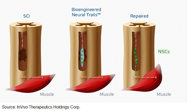
Bioengineered Neural Trails™ are injectable combinations of biomaterials and neural stem cells (NSCs) delivered using minimally invasive surgical instrumentation and techniques to create trails across the chronic injury site. Another way to look at the program is to think of it as the NSS device with stem cells. The multimodal approach aims to bridge the spinal cord lesion at the time of implantation with a trail of neural stem cells (NSCs) delivered in a soft, gel-like scaffold that is both injectable and biodegradable.
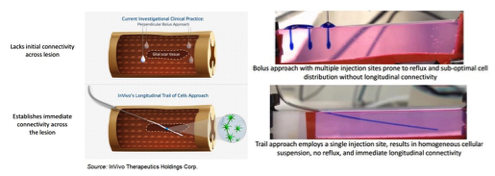
As per InVivo, the current practice is to inject boluses of stem cells in a perpendicular fashion via a needle, which lacks connectivity across the injury site, and can result in pressure/reflux issues as well as multiple injection sites and cell settling. InVivo is proposing to use a guide needle with a shape retaining injection needle in order to create a trail of stem cells across the lesion (above). The injected material is a soft, biomatrix containing neural stem cells that differentiate into neurons. InVivo’s technique involves advancing the injection needle through a guide needle (with the assistance of fluoroscopy and ultrasound), and once fully extended, it is retracted with a motor. Subsequently, a syringe pump shoots out cells that create the neural trail. As the needles are retracted, a trail of cells is left behind, which InVivo believes will establishes immediate connectivity across the lesion site. As per InVivo, the injectable scaffold is a soft, biomaterial aimed to improve the viability, delivery and differentiation of the NSCs. The biomaterial is formed of a polymer, and serves as a scaffold with attachment sites for receptors on NSCs, which promotes migration of the cells. The biomaterial maintains homogenous cell suspension during shipment, and has the unique property of liquefying as it is injected, to only return back to a gel state in the body.
We believe what sets InVivo apart is that the company is focused on using neural stem cells that create neural connections as opposed to just injecting mesenchymal stem cells that give trophic support to existing cells within the spinal cord or just injecting cells that will turn into myelinating cells/axons. NSCs are able to differentiate into the 3 main cell types of the central nervous system (CNS): astrocytes, oligodendrocytes, and neurons, and these NSCs can help to repair the spinal cord via regeneration by secreting trophic factors, remyelinating bare axons, and/or establishing new neuronal connections.
In order to support this strategy, InVivo has entered into agreements with the University of California, San Diego and James Guest, M.D., Ph.D., to expand the company’s intellectual property portfolio. InVivo entered into an exclusive license agreement with UC San Diego for issued patent US 9,011,410 titled “Spinal Multisegmental Cell and Drug Delivery System,” and into an assignment agreement with Dr. Guest for issued patent US 7,666,177 titled “Method and System for Cellular Transplantation in the Spinal Cord.” InVivo also has filed a provisional application in support of the Bioengineered Neural Trails™ Program titled “Methods and Systems for Delivery of a Trail of a Therapeutic Substance.” We believe that the patents in addition to the provisional patent application help solidify the IP portfolio for the Bioengineered Neural Trails for InVivo.
Next Steps for Bioengineered Neural Trails™
According to the National Spinal Cord Injury Statistical Center, approximately 276,000 patients currently live with spinal cord injury in the U.S. with limited therapeutic options. Neural stem cell transplantation offers some therapeutic promise, and we believe InVivo aims to tackle a huge unmet clinical need with its Bioengineered Neural Trails™ Program. The goal of the program to improve neurological function in chronically injured patients. We think it makes a lot of sense for the company to pursue this chronic SCI strategy, and in our opinion, is a natural course of progression to the InVivo story. Although it is too early for us to include sales of this product in our current model, the Bioengineered Neural Trails™ Program presents with enormous potential upside to the InVivo story as the chronic SCI market is approximately 25x that of the acute SCI market.
We will proceed to highlight some of the next steps for InViVo as it pertains to the chronic SCI program:
-Optimize all aspects of product profile in preparation for IND: instrumentation, biomaterial, and NSCs
-Strengthen and broaden intellectual property portfolio
-Aim to partner with a stem cell company to accelerate project timelines
-Target pre-IND meeting with the FDA by the end of 2016
Overall, we think using the NSS device with neural stem cells makes a lot of sense in the setting of chronic SCI patients. We look forward to hearing more about the program, and would like to point out that the company hopes to have a pre-IND meeting with the FDA by the end of 2016.
Conclusion
There remains a huge unmet need in spinal cord injury as there are currently no commercially approved therapeutics (devices or drugs) to treat SCI. Currently, surgical intervention with rehabilitation is the standard-of-care in dealing with SCI patients. There is a great need for new therapeutics and regenerative surgical techniques to address the pathophysiology of spinal cord injury, and we continue to believe that InVivo is working very hard to solve this problem.
To summarize what we have seen so far in the pilot study, which has recently been converted to the INSPIRE probable benefit study, of the NSS:
-Patient #1 has gone from AIS-A to AIS-C in one month, which occurs in fewer than 5% of AIS-A patients with a T10-T12 injury, and has lower limb motor and sensory improvement in addition to regained bowel function and improved bladder function.
-Patient #2 remains AIS-A but has seen improvement in trunk stability, self-care, mobility, bowel and bladder function, and has regained partial sensation from the lower ribs to the hip on the right side of her body.
-Patient #3 went from AIS-A to AIS-B in the first month after his accident, which is observed in fewer than 4% of patients with a T4 injury, and has sensory improvement from mid-chest to mid-abdomen.
-There is no follow-up data reported on Patients #4 and #5 to date, but both remain at AIS-A at three (3) months.
-Perhaps most importantly of all, there have been no serious adverse events due to the NSS or the surgical procedure.
Looking at the results thus far, it appears as though a trend is developing in regards to the safety and efficacy of the NSS. Although enrollment has slowed down, it’s hard not to be impressed with the level of efficacy seen thus far with the first three patients. As mentioned above, the last patient was enrolled back in September 2015, and we are hoping that by adding more sites in 2016 and widening the entry criteria, will allow for enrollment to pick up.
Despite there being a stream of news that indicates that InVivo remains on the right track, with the FDA approving conversion of its pilot study into a pivotal probable benefit, and the announcement of the new Bioengineered Neural Trails™ Program for chronic SCI, the stock continues to languish. We believe that slow enrollment and lack of patient updates have led some investors to leave the InVivo story.
In August 2015, InVivo’s common stock was transferred from the Nasdaq Capital Market to the Nasdaq Global Market, following an announcement that the company has been added to the Russell Global, Russell 3000®, Russell 2000®, and Russell Microcap indexes. We believe that being listed on the Global Market allows for greater visibility for InVivo, but as of yet has not helped support the share price. Additionally, we believe the broad sell-off in the biotechnology and pharmaceutical sectors has impacted the small cap names even more so than the larger cap companies. We believe the recent pullback presents investors with an interesting long-term buying opportunity. As of September 30, 3015, InVivo had $22.1 million in cash on the books. We believe the current cash should fund activities through September 2016.
If the pivotal probable benefit study is completed in 2017, InVivo could likely apply for approval under HUD in late 2017 and receive approval in 2018. Our detailed model assumes the INSPIRE trial reaches full enrollment on time, and that approval will be contingent upon showing safety and probably benefit in a larger number of patients, and while we think that a trend has certainly been established with the first 3 patients, we would like to see additional safety and recovery data. That being said, the company looks to have gone “3 for 3” with respect to improving function for the first 3 patients in the pilot study. We are interested in reviewing patient updates on Patients #4 and #5 once available, as well as learning more about the additional patients that will be enrolled. As an aside, if patient enrollment does not pick up in the near term, we may need to revisit our valuation and price target. However, currently we continue to rate the stock a “Buy”, and are maintaining our price target of $24. Accordingly, we recommend the stock for long-term investors.
READ THE LATEST FULL RESEARCH REPORT HERE
Follow Nisha on Twitter @HiraniMD
SUBSCRIBE TO ZACKS SMALL CAP RESEARCH to receive our articles and reports emailed directly to you each morning. Please visit our website for additional information on Zacks SCR and to view our disclaimer.