By
John Vandermosten, CFA
NASDAQ:NVIV
InVivo Reports 2Q:16 Financial Results
InVivo Therapeutics Holdings Corp. (NASDAQ:NVIV) released second quarter 2016 financial results and an operational update for the three month period ending June 30, 2016. Loss per share of ($0.16) was better than our estimate of ($0.20) due to lower research & development and general & administrative expenses. A $600 thousand derivative gain also reduced the loss by approximately two cents. During this period, no revenues were reported. Operating expenses for the second quarter were $5.8 million, which was flat with the second quarter of the prior year.
Research and development expenses, which are primarily amounts spent on contract research organization services and payroll were $2.8 million and rose by $0.3 million or 10% compared to 2Q:15. This was less that the $3.0 million we expected but up on a sequential basis. The year over year increase was due to higher salaries, the addition of new clinical trial sites and patients, and other miscellaneous expense category increases.
General and administrative expenses of $3.0 million fell 7% in the second quarter due to lower legal expenses, exchange filing fees partially offset by higher stock compensation expense compared to 2Q:15. Our estimates called for a modest increase in G&A expenses to $3.5 million.
2Q:15 net Interest expense was $7 thousand in the quarter and InVivo experienced a derivative gain of $0.6 million due to the decline in the stock price over the quarter.
In July, InVivo added two new clinical sites and received approval from the Canadian authorities to enroll patients in Canada. InVivo also received a Notice of Allowance for its patent entitled “Methods and Compositions for the Treatment of Open and Closed Wound Spinal Cord Injuries”
Also in July, the FDA provided its critically important consent to expand the INSPIRE trial to 20 patients. During the period of discussions with the FDA, InVivo chose to delay updates related to the study and enrollment of new patients as there were several minor modifications related to protocol and informed consent documents. This caused a several week hold on trial progress which was necessary to implement the changes for new enrollees. As part of the review, the FDA recommended that a control arm be added as part of the study design. Being a control arm, and given the lack of alternative therapy, it is possible that existing data may be used to satisfy this requirement. However, at this time the determination of how to approach the recommended control arm has not been made and InVivo is still in discussions with the FDA to determine the best way to satisfy this recommendation.
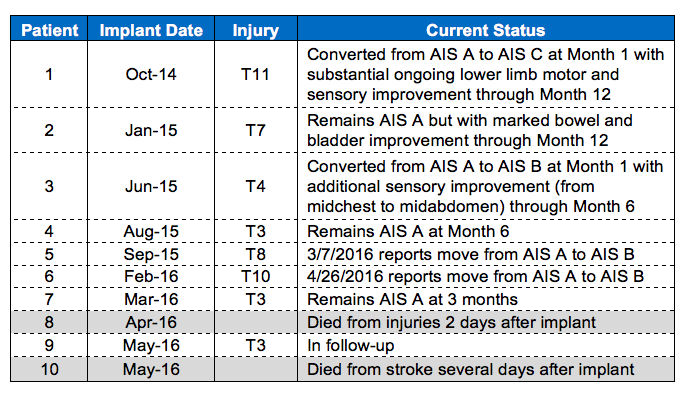
In conjunction with the FDA output, NVIV also announced the 9th and 10th patients implanted with the Neuro-Spinal Scaffold. Unfortunately, the 10th patient died from a stroke several days after the implantation and the cause of death was determined to not be related to the NSS or the implantation procedure. Currently there are eight active implanted patients who have received the NSS, of which four have seen an improvement in AIS grade of one or more levels.
Forecast
We anticipate that InVivo will launch the Neuro-Spinal Scaffold (NSS) in 2018 following a successful approval of the device in 2017. Currently, the company expects to approach full enrollment in the trial by the end of the year. Concurrent with the approval process for the complete thoracic indication, InVivo has announced an intention to begin pivotal trials for a complete cervical indication as well, which we forecast will be completed by 2020. We believe that sales will rise from $51 million in 2018 rising to $600 million over the next ten years. These estimates do not include any revenues from approval of the device related to incomplete thoracic or cervical indications nor do they include any revenues for the Bioengineered Neural Trails initiative.
Other Material Events Year to Date 2016
- On July 13, 2016, InVivo received approval from Health Canada to begin clinical studies in Canada. The following day, the company welcomed approval for Toronto Western Hospital to serve as a clinical site for the INSPIRE study.
- On March 14, 2016, NVIV announced that it would offer common shares and warrants through Raymond James & Associates to fund the current and forthcoming clinical trials and support general corporate expenses. InVivo received $29.91 million in net proceeds after commissions.
- On February 29, the company received a protocol amendment approval from the FDA to establish the Objective Performance Criterion (OPC) for the INSPIRE study. The OPC was defined as a 25% or higher proportion of the study participants demonstrating a one ASIA Impairment Scale (AIS) grade improvement six months following the procedure. This compares to historical six-month improvement rates in the 12% to 16% range.
- InVivo has added several new clinical trial locations so far this year and now has 22 sites that are participating in the INSPIRE study. Over the next few quarters we anticipate some additional sites to be opened. Below we list the sites added year to date.
- February 3, UCSD Medical Center, San Diego, California
- March 2, Vidant Medical Center in Greenville, North Carolina
- March 3, University of Louisville Hospital in Louisville, Kentucky
- March 8, Thomas Jefferson University Hospital in Philadelphia, Pennsylvania
- April 5, University of Virginia Health System in Charlottesville, Virginia
- May 11, Hospital of the University of Pennsylvania, Philadelphia, PA
- July 14, Toronto Western Hospital, Toronto, Canada
- July 18, Ben Taub Hospital/Baylor College of Medicine, Houston, TX
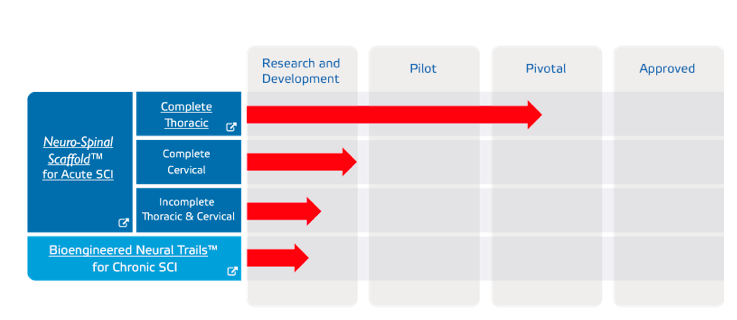
- We anticipate that the complete thoracic program (the INSPIRE study) will complete sometime in early 2017, followed soon after by a filing with the FDA and, if successful, FDA approval in early 2018 and a launch of the NSS shortly after. InVivo plans to begin with the complete cervical trial in the third quarter and is still in conversations with the FDA in terms of trial design. We anticipate this will commence as a pivotal trial also using the Humanitarian Device Exemption (HDE) pathway. The population size for the cervical group is similar to the thoracic group at about 2,000 patients and we believe that NVIV will be able to take advantage of the HDE due to the population size and only be required to show probable benefit. No announcement regarding timing for the incomplete thoracic and cervical trial has been made, but we foresee clinical trials beginning in the next few years. However, we note that due to the addressable population size in excess of 12,000 patients annually, the Premarket Approval (PMA) pathway must be used for this group, requiring a statistically significant study to support evidence of effectiveness, which will require a larger trial and potentially greater duration as compared to the complete thoracic and complete cervical efforts. InVivo has not provided detail regarding the clinical development program for the Bioengineered Neural Trails initiative, but has indicated that they are targeting a pre-IND meeting with the FDA by year end 2016. See below for a graphic summary of the current programs.
- NVIV has performed five implantations since the beginning of the year. Unfortunately, two of the patients died due to injuries and complications of those injuries sustained in their accidents. The patients who died will not be included as part of the study as there was no opportunity to observe the outcome of the implantation procedure. Below we summarize the status of the patients currently enrolled in the study.
Conclusion
There remains a huge unmet need in spinal cord injury as there are currently no commercially approved therapeutics (devices or drugs) to treat SCI. Currently, surgical intervention with rehabilitation is the standard-of-care in dealing with SCI patients.
InVivo’s news regarding the successful conversion of four patients to date is a strong positive for the stock. While some have postulated that this early success may indicate an early filing for approval due to the one additional conversion needed to achieve the Objective Performance Criterion, we remind investors that the objective of the pivotal study is to show both probable benefit (which will be supported by surpassing the 25% hurdle) and safety, which may require observation of the full complement of patients throughout the six month term. While it is possible that the company may file early, we do not incorporate this into our expectations. InVivo anticipates completing the enrollment process by year end, however, they will have to accelerate their run rate to achieve this goal. With the addition of two sites in July, the probability of improving the number of patients increases.
Shares of InVivo are well below their 12-month high despite continued progress in their pivotal trial. We believe the current price of the shares presents substantial upside as determined by our target price. As of June 30, 2016, InVivo held $42 million in cash on hand. The company, in our opinion conservatively, believes that the funds will meet operating and capital requirements through the end of 2017. We anticipate the $1.4 million monthly cash burn rate to increase slightly through the end of the year as new patients are added to the trial.
We currently forecast the completion of the pivotal probable benefit study in 2017, an application for approval under HUD in late 2017 and ultimate approval in 2018. We additionally assume the INSPIRE trial reaches full enrollment on time, and that approval will be contingent upon showing safety and probable benefit in a larger number of patients.
READ THE FULL RESEARCH REPORT HERESUBSCRIBE TO ZACKS SMALL CAP RESEARCH to receive our articles and reports emailed directly to you each morning. Please visit our website for additional information on Zacks SCR and to view our disclaimer.