By Grant Zeng, CFA
NASDAQ:ONCS
Over the weekend, an abstract entitled “Intratumoral electroporation of plasmid IL-12 can prime response to anti-PD1/PD-L1 blockade in patients with Stage III/IV-M1a melanoma” (Abstract #CT134) was published in the 2016 Proceedings for the American Association for Cancer Research (AACR) Annual Meeting.
The new data from the Abstract supports the hypothesis that ImmunoPulse™ IL-12 can prime the immune system for enhanced response to anti-PD1 therapies.
These new data were generated from a single-site retrospective analysis of the Company’s (NASDAQ:ONCS) Phase II monotherapy clinical study of ImmunoPulse™ IL-12 in patients with advanced melanoma. After completing treatment with ImmunoPulse™ IL-12, a subset of patients subsequently received an anti-PD-1/PD-L1 therapy either as their next line of treatment or a later line of treatment. Patients with documented follow-up history and evaluable for anti-PD-1/PD-L1 response were included in this analysis.
In this study, 34 patients were enrolled and treated with ImmunoPulse™ IL-12 alone. Fourteen of these 34 patients went on to receive a systemic anti-PD-1/PD-L1 therapy and were evaluable for PD-1/PD-L1 best overall response (BOR) using immune-related response criteria. The PD1/PD-L1-associated BOR among patients was 64% (9/14). The analysis showed 36% of patients (5/14) had a complete response (CR), 29% of patients (4/14) had a partial response (PR), 14% percent of patients (2/14) experienced stable disease, and 21% of patients (3/14) had progressive disease.

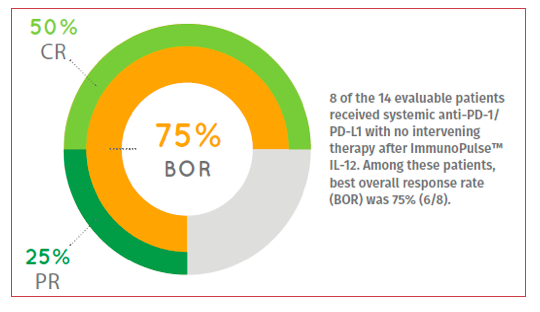
Furthermore, 8 of these 14 evaluable patients received a systemic anti-PD-1/PD-L1 antibody with no intervening therapy after treatment with ImmunoPulse™ IL-12. Of these 8 patients, a BOR of 75% was observed (50% CR and 25% PR).
As a comparison, the company’s original Phase II melanoma trial (OMS-I100) generated best ORR of 31% (9/29), which included a complete response rate of 14% (4/29) and a disease control rate of 48% (14/29).

We are excited about the new data which, so far, are the best melanoma data published in terms of overall response rates – albeit the caveat of it being retrospective and a small number of patients.
These new data strongly support the hypothesis that ImmunoPulse IL-12 can convert checkpoint therapy non-responders into responders, thereby addressing one of the greatest unmet needs in oncology.
[endif]
Results from Newly Initiated Phase II Combination Trial Could Lead to a Big License Deal
In November 2014, OncoSec initiated a landmark Phase II combination trial in collaboration with the University of California, San Francisco (UCSF) and Merck to evaluate the safety, tolerability and efficacy of Merck’s anti-PD-1 drug, KEYTRUDA® (pembrolizumab) in combination with OncoSec’s ImmunoPulse™ IL-12 therapy for the treatment of metastatic melanoma patients, who are non-responsive to KEYTRUDA®.
This Phase II clinical trial is an investigator sponsored trial (IST), with UCSF and Dr. Alain Algazi as the lead investigator. This is a multi-center, open label, single-arm trial, which will enroll approximately 42 patients with unresectable, "low-TIL" metastatic melanoma. The key endpoints of the study include: best Overall Response Rate by RECIST v1.1 and immune related-Response Criteria (irRC); safety and tolerability; duration of response; 24-week landmark progression-free survival; median progression-free survival; and overall survival.
The treatment schedule for the trial follows the standard schedule for pembrolizumab. Pembrolizumab will be administered systematically once every three weeks and ImmunoPulse™ IL-12 will be administered on three separate days every six weeks. ImmunoPulse™ IL-12 employs intratumoral delivery of DNA-based IL-12 followed by electroporation. Merck will supply pembrolizumab, and OncoSec will provide ImmunoPulse™ IL-12.
This is the first study in the field of immuno-oncology to evaluate the combination of DNA-based interleukin-12 with electroporation and an anti-PD-1/PD-L1 inhibitor.
The Phase II combination study will provide the Company with information for a key inflection point in the development of its lead ImmunoPulse™ program. We believe positive data from the Phase II combination study may lead to a major license deal for OncoSec. If the Phase II combination study can confirm safety and efficacy of both agents, a pivotal trial could follow by either OncoSec or Merck in late 2016. And we estimate approval of ImmunoPulse™ for the treatment of melanoma may be obtained as early as in 2018 if the pivotal trial data prove to be positive.
We believe the combination has the potential to be a powerful approach in the fight against melanoma and other cancers. This Phase II combo study presents a potential to address the unmet medical need of vast majority of the metastatic melanoma patients and has profound implications on many other tumor indications.
SUBSCRIBE TO ZACKS SMALL CAP RESEARCH to receive our articles and reports emailed directly to you each morning. Please visit our website for additional information on Zacks SCR and to view our disclaimer.