By
David Bautz, PhD
OTC:OPNT
Business Update
Opiant Pharmaceuticals, Inc. (OTC:OPNT) is a specialty pharmaceutical company developing treatments for substance use, addictive, and eating disorders using the company’s expertise in opioid antagonists. Opiant has developed a novel nasal spray formulation of naloxone as a treatment for opioid overdose, which was approved by the U.S. Food and Drug Administration (FDA) in November 2015. The company is also working on treatments for eating disorders, cocaine use disorder, and has recently licensed the rights to a preclinical heroin vaccine from the National Institute on Drug Abuse.
NARCAN® Nasal Spray
The U.S. is currently experiencing what many consider to be an epidemic of opioid overdose deaths and addiction. Opioids are a class of drugs that are chemically similar to alkaloids found in opium poppies. They are typically utilized to manage pain, however they have a high potential for misuse and abuse. Opioid medications are the most commonly prescribed class of drugs in the U.S., where in 2015 a total of 227 million prescriptions were dispensed (IMS Health).
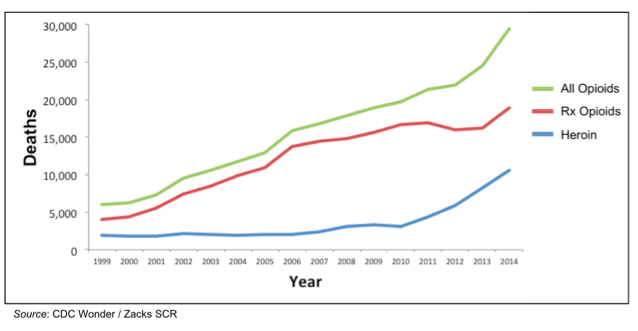
In 2014, more people died from drug overdoses than in any year on record, with more than 60% of the drug overdose deaths involving an opioid (CDC). This translates to approximately 29,000 deaths due to prescription opioids and heroin. The following graph shows the rise in opioid overdose deaths from 1999-2014, including a very large increase in heroin overdose deaths since 2010.
Naloxone was approved by the FDA for the treatment of opioid overdose in 1971. It is a competitive opioid receptor antagonist with greater affinity for opioid receptors than agonists such as opioids, however it does not activate the receptors. Naloxone can be administered through intravenous injection, intramuscularly, or intranasally. It has a very rapid onset of action (typically within minutes for intravenous or intramuscular administration; less than a minute for intranasal administration) and its effects last for between 30 and 60 minutes. When administered to an individual who does not have opioids in their system there are few if any effects. For a patient suffering from an opioid overdose, side effects include restlessness, agitation, nausea, vomiting, and increased heart rate (similar to symptoms of withdrawal). Since there is no euphoric effect upon naloxone administration there is no potential for abuse.
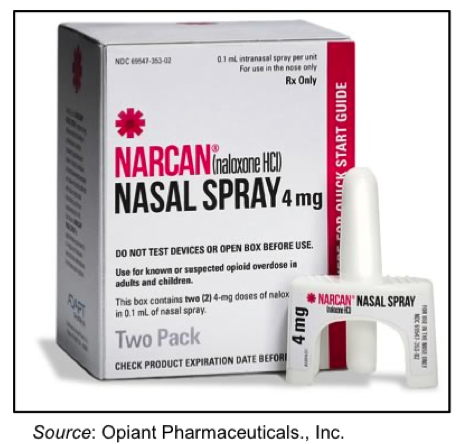
In an effort to make naloxone administration easier and more reliable, Opiant collaborated with the National Institute on Drug Abuse to develop an intranasally administered naloxone product. NARCAN® Nasal Spray was approved by the FDA in November 2015 for the treatment of opioid overdose. Since it is administered intranasally, NARCAN® Nasal Spray can be more easily used by friends, family members, or others to treat suspected opioid overdose until first responders arrive. It does not require any type of special training to use and eliminates any risk associated with needles with an injectable formulation. In contrast to the intranasal “kits” that are sold to convert the injectable naloxone formulation for intranasal administration, there is no assembly required to use NARCAN® Nasal Spray.
On December 15, 2014, Opiant and Adapt Pharma, Ltd entered into a license agreement whereby Adapt received a global license to develop and commercialize Opiant’s naloxone overdose reversal treatment for an upfront payment of $500,000, potential milestone payments of more than $55 million, and up to double-digit percentage royalties based on net sales. Thus far, Opiant has received the following payments from Adapt stemming from the license agreement:
On December 15, 2015, Opiant received a milestone payment of $2 million from Adapt based on the FDA approval of NARCAN® Nasal Spray.
- On March 7, 2016, Opiant received a milestone payment of $2.5 million from Adapt based on the first commercial sale of NARCAN® Nasal Spray.
- On April 29, 2016, Opiant received $105,097 in royalty payments from Adapt from commercial sales of NARCAN® Nasal Spray in the U.S. during the first quarter of 2016.
- On August 8, 2016, Opiant received $234,498 in royalty payments from Adapt from commercial sales of NARCAN® Nasal Spray in the U.S. during the second quarter of 2016.
- On October 6, 2016, Opiant received a milestone payment of $500,000 from Adapt based on the Health Canada approval of NARCAN® Nasal Spray.
On Oct. 5, 2016, Adapt announced that Medi-Cal, which is California’s Medicare program, would provide NARCAN® Nasal Spray to its beneficiaries for a $0 co-pay from pharmacists across the state. In addition, the state recommends co-prescribing naloxone for all patients exposed to opioids.
On Oct. 27, 2016, Opiant announced that U.S. Patent #9,468,747 is now listed in the FDA “Orange Book” and provides product exclusivity for NARCAN® Nasal Spray until 2035. U.S. Patent #9,211,253 was previously listed in the “Orange Book”.On Sep. 15, 2016, Opiant and Adapt received a Notice Letter from Teva Pharmaceuticals stating Teva had filed an Abbreviated New Drug Application (ANDA) with the FDA seeking regulatory approval to market a generic version of NARCAN® Nasal Spray before the expiration of the ‘253 patent. On Oct. 21, 2016, Adapt and Opiant filed a complaint for patent infringement against Teva based on the filing of Teva’s ANDA. We will continue to keep a close eye on the legal proceedings.
Market Opportunity
We believe that Adapt Pharma will attempt to reach three target markets with NARCAN® Nasal Spray: 1) Current heroin addicts; 2) first responders who could administer naloxone in an emergency response situation; and 3) those who have opioid prescriptions.
According to the National Survey on Drug Use and Health, which is compiled by the Substance Abuse and Mental Health Services Administration (SAMHSA), there are an estimated 2.5 million individuals addicted to opioid medications or heroin in the U.S. A number of these addicts are prescribed buprenorphine, an opioid agonist, to help minimize withdrawal symptoms while trying to quit. We estimate approximately one million addicts are prescribed buprenorphine, either as a generic or as Suboxone (a mixture of buprenorphine and naloxone to deter abuse), and would be suitable for NARCAN® Nasal Spray being co-prescribed along with it.
We estimate there are approximately 67,000 first responder units in the U.S., which are comprised of emergency room departments, fire and police departments, and emergency medical services (EMS) agencies. Police officers are typically the first to arrive on the scene of an overdose, thus a large number of the approximately 18,000 police departments in the U.S. are beginning to enact programs to allow their officers to carry naloxone. We believe that NARCAN Nasal Spray would be the preferred formulation for police officers as it requires no special training or assembly to be used.
The largest target market is individual’s who take opioids for pain management. Given an estimated 227 million opioid prescriptions in the U.S. every year, we estimate a reasonable target market of approximately 20 million unique users of opioids who could be co-prescribed NARCAN® Nasal Spray as a universal precaution. The American Medical Association (AMA) recently announced that it will encourage doctors to co-prescribe naloxone with opioid painkillers. The AMA is also working to encourage both private and public payers to include all forms of naloxone on their preferred drug lists and formularies with little to no cost sharing.
With an estimated average selling price of $100 per pack, the total addressable market for NARCAN® Nasal Spray is over $2 billion.
Heroin Vaccine
On October 28, 2016, Opiant announced the signing of an agreement for exclusive rights to a heroin vaccine being developed by the Walter Reed Army Institute of Research (WRAIR) and the National Institute on Drug Abuse (NIDA). The vaccine is currently in preclinical development and works through the induction of anti-heroin antibodies in the bloodstream by immunization with “heroin-like” haptens (Li et al., 2014). The antibodies bind to heroin and prevent the drug from crossing the blood-brain barrier and the subsequent euphoric and addictive effects. Opiant is planning to work with researchers at the U.S. Military HIV Research Program to eventually combine the heroin vaccine with an HIV vaccine candidate.
Eating Disorders
Binge Eating Disorder (BED) is the most common eating disorder in the U.S. and affects approximately 8 million individuals (National Institute of Mental Health). The condition is characterized by recurrent binge-eating episodes where a person does not feel in control during the binge. Unlike Bulimia Nervosa, purging does not follow the binge eating, thus many people with BED are overweight or obese. In addition to a loss of control, many BED patients experience shame or guilt and the condition is commonly associated with a number of comorbid conditions such as functional impairment, suicide ideation, and various other psychiatric conditions.
Current treatment options include both pharmacological and behavior modification therapies. The treatment of choice for BED is cognitive behavior therapy (CBT), which was found to be superior to fluoxetine (Prozac®) in a randomized, placebo-controlled clinical trial (Grilo et al., 2012). CBT encompasses numerous specific approaches for various psychiatric disorders, with the unifying theme being a combination of both cognitive and behavioral adaptations to change unhelpful thinking and actions. Additional types of psychotherapy shown to be effective for treating BED include family therapy, interpersonal therapy, and dialectic behavior therapy.
Pharmacological treatments include fluoxetine and other medications typically used to treat depression including sertraline (Zoloft®), fluvoxamine (Luvox®), paroxetine (Paxil®), and escitalopram (Lexapro®). However, these medications all are associated with weight gain, which can preclude their successful use in BED patients. In January 2015, the FDA approved lisdexamfetamine (Vyvanse®) to treat patients with moderate-to-severe BED, which was the first FDA-approved medication for that condition. Two clinical studies involving 724 adults with moderate-to-severe BED showed that treatment with Vyvanse® led to a decrease in the number of binge eating days per week and fewer obsessive-compulsive binge eating behaviors compared to placebo (Vyvanse® prescribing information). Vyvanse® was already approved for the treatment of attention deficit hyperactivity disorder (ADHD), and sales of the drug are expected to grow to approximately $500 million for BED treatment in 2022 (EvaluatePharma).
While shown to be effective in treating BED, Vyvanse® does have a number of significant drawbacks that do not make it suitable for all patients. Vyvanse® is a controlled substance with a “black box” warning about the potential for abuse and dependence. In addition, a vast majority of those taking Vyvanse® will experience side effects that can include dry mouth, sleeplessness, increased heart rate, constipation, and anxiety. More serious side effects include cardiac complications (e.g., stroke and heart attack) and psychiatric problems (e.g., hallucinations and delusional thinking).
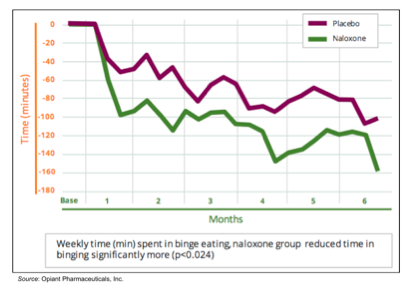
In 2012, a clinical trial was conducted testing intranasally administered naloxone as a treatment for BED (NCT01567670). Results of the Phase 2, randomized, double blind, placebo controlled study were presented at the American Psychiatric Association’s 2013 Annual Meeting. The 24-week study included 127 adults with BED, with the majority being female and obese or severely obese. Since the urge to binge in BED has a rapid onset, participants in the study were told to carry the spray (either naloxone or placebo) with them at all times and administer it (up to two doses of 2 mg each) prior to binging. The primary outcomes of the study were the mean minutes spent binge eating and the mean scores on the Binge Eating Scale (BES). The following chart shows the reduction in time spent binge eating for treatment and placebo groups, with those taking naloxone experiencing a significant reduction compared to the placebo group (P=0.024).
Opiant is planning to initiate a Phase 2 clinical trial in BED by the second quarter of 2017. Based upon the previous results in BED, the company may also initiate a clinical trial in an additional eating disorder as well.
Bulimia Nervosa
Bulimia Nervosa (BN) is a serious and potentially life-threatening eating disorder characterized by a cycle of binge eating and purging. BN affects approximately 1-2% of the adult population with 80% of those affected being female. Complications of BN include dehydration, heart problems, severe tooth decay and gum disease, anxiety and depression, and increased risk of suicide.
Just as with BED, CBT has been shown to be effective in those suffering from BN. The only pharmacological agent approved to treat BN is fluoxetine (Prozac®). Two multicenter, double blind, placebo controlled randomized clinical trials of fluoxetine found that a 60 mg dose resulted in a statistically significant reduction in binge eating and vomiting episodes compared to placebo regardless of whether a patient was also suffering from depression, while a 20 mg dose of fluoxetine was only effective in those that did not also have depression (Goldstein et al., 1999). While effective, fluoxetine has a number of potential adverse side effects including increased suicidal thoughts, sleep problems, headache, dizziness, and gastrointestinal issues.
Opiant is planning to evaluate the use of a nasal opioid antagonist to treat BN, with a clinical study expected to initiate before the second quarter of 2017.
Cocaine Use Disorder
Cocaine is a highly addictive stimulant produced from the leaves of coca plant of South America. While it can be used for legitimate medical purposes (e.g., numbing during surgery), it is an illegal compound that is mostly used as a recreational drug. Users typically ingest the drug through snorting, inhalation, or injection. Following ingestion, users report intense feelings of happiness, which lasts for anywhere from five to 90 minutes. There is a very high risk of dependence after using cocaine for only a short period of time due to the fact that the drug affects the reward pathway in the brain. There are approximately 1.5 million individuals in the U.S. that meet the diagnosis for cocaine use disorder.
Cocaine use leads to the blocking of dopamine reuptake, thus increasing the amount of dopamine in the brain and resulting in the euphoria most often reported by cocaine users. Over time a tolerance develops, as more opioid receptors are expressed by neurons, meaning that more and more cocaine is required to get the same effect. Suddenly stopping cocaine use results in withdrawal and an extremely strong craving for more cocaine. It can also lead to fatigue, depression, anxiety, and suicide ideation. Medical complications from continued use of cocaine include cardiac abnormalities, stroke, and sudden death.
There are no pharmacological treatments for cocaine use disorder, thus treatment is typically centered on behavioral interventions. Therapies such as contingency management, which uses motivational incentives as a means to induce initial abstinence, and CBT, which can help patients develop critical skills that support long-term abstinence, have both been shown to be somewhat effective for a minority of patients, however all behavioral interventions suffer from a lack of strong efficacy and high relapse rates.
On December 23, 2015, Opiant announced a collaboration with the National Institute on Drug Abuse (NIDA) and the University of Pennsylvania whereby an opioid antagonist drug will be tested in patients with cocaine use disorder. The study will involve 12 patients with cocaine use disorder. Each patient will undergo functional magnetic resonance imaging (fMRI) to examine neural networks related to addiction in the presence and absence of an opioid antagonist. The first patient was recruited in the fourth quarter of 2015 and we anticipate results from this study being in the first half of 2017.
Financial Update
On October 31, 2016, Opiant announced financial results for fiscal year 2016 that ended July 31, 2016. For the year the company reported revenues of $9.9 million, which included the recognition of $4.8 million of revenue from the sale of net profit interests related to NARCAN® Nasal Spray. Revenue of approximately $5.1 million was also derived from the licensing agreement with Adapt, including $4.5 million in milestone payments related to the approval and the first commercial sale of NARCAN® Nasal Spray in the U.S.
Net loss for fiscal year 2016 was $7.8 million, or $4.09 per share, and included $1.7 million in R&D and $15.6 million in G&A expenses. This compared to R&D and G&A expenses of $2.4 million and $6.0 million, respectively, in fiscal year 2015. The decrease in R&D expenses from 2015 to 2016 was due in part to decreased spending on NARCAN Nasal Spray while the increase in G&A expenses was mostly the result of an increase in stock-based compensation.
The company ended fiscal year 2016 with approximately $1.5 million in cash and cash equivalents. While the company will continue to receive royalties from Adapt Pharma from the sale of NARCAN® Nasal Spray, Opiant will need to raise additional capital to continue the planned clinical development of its pipeline. We estimate Opiant currently has enough capital to fund operations through the first quarter of 2017.
Valuation and Conclusion
We value Opiant using a probability adjusted discounted cash flow model that takes into account potential future revenues from the sale of NARCAN® Nasal Spray and binge eating disorder and cocaine use disorder treatments. We do not currently include BN or the heroin vaccine in our model as they are not as far along in clinical development. For all indications we model for a 10% royalty to Opiant, which we believe is an appropriate approximation based on the disclosure of “up to double digit royalties” from Adapt.
For NARCAN® Nasal Spray, we model for peak sales of approximately $200 million, which is derived from selling the drug to first responders, heroin addicts, and opioid prescription drug users. We believe that awareness of opioid drug overdose deaths will continue, and with the possibility of co-prescribing of an opioid receptor antagonist as a precautionary measure for all opioid prescriptions, there is additional upside possible for our current forecasts. Using a 12% discount rate yields a net present value for NARCAN® Nasal Spray of $63 million.
For BED, we model for an NDA filing in 2019 and approval in 2020. We estimate there are approximately eight million individuals who suffer from BED in the U.S. and that 45% of them will seek treatment for their condition. Based on a yearly cost of $2500 (which is in line with the cost of Vyvanse®), we model for peak sales of approximately $500 million. We assign a 12% discount rate and a 50% probability of approval to arrive at a net present value for the BED program of $52 million.
For Cocaine Use Disorder, we model for an NDA filing in 2019 and approval in 2020. We estimate that approximately 1.5 million individuals in the U.S. suffer from cocaine use disorder, and with no other pharmacological treatments available we believe all of them would be targeted for treatment. We model for a yearly cost to treat of $2500 and peak sales of approximately $300 million. We assign a 12% discount rate and a 50% probability of approval, which yields a net present value for the cocaine use disorder program of $30 million.
Combining the net present value for the company’s three programs along with the current cash position and an expected $10 million net operating burn we arrive at a net present value for the company of $138 million. Dividing by the company’s reasonable fully diluted share count of approximately 6.8 million shares leads to a valuation of approximately $20. The stock is currently trading at less than 50% of this valuation, and data from the ongoing Phase 2 study in cocaine use disorder and additional measures to increase access to naloxone products to combat opioid drug overdose could move the stock price closer to our valuation.
For a free copy of the full research report, please email scrinvestors@zacks.com with OPNT as the subject.
SUBSCRIBE TO ZACKS SMALL CAP RESEARCH to receive our articles and reports emailed directly to you each morning. Please visit our website for additional information on Zacks SCR and to view our disclaimer