By
Grant Zeng, CFA
NASDAQ:ORMP
Background of the Phase IIb (ORA-D-007) Study
ORA-D-007 is a double-blind, randomized, 28-day Phase IIb clinical trial designed to assess the safety and efficacy of ORMD-0801 in type II diabetics. The trial will evaluate ORMD-0801 over a longer treatment period (28-day vs 7-day in the Phase IIa study) and will have statistical power to give greater insight into the drug’s efficacy.
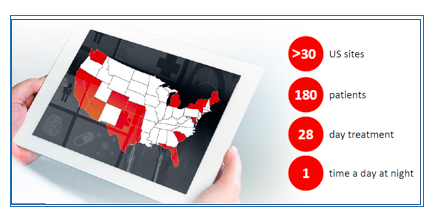
The Phase IIb trial was initiated on June 30, 2015 and conducted at 33 clinical sites in the United States.
Primary Objectives:
- To evaluate the pharmacodynamics effects of ORMD-0801 on mean nighttime glucose (determined using continuous glucose monitoring (CGM)).
- To evaluate the safety of ORMD-0801, including incidence of hypoglycemia.
Secondary Objectives:
- To evaluate changes from baseline in fasting blood glucose (FBG), morning fasting serum insulin, c-peptide, and triglycerides.
Exploratory Objectives:
- To evaluate the immunogenicity of ORMD-0801 through quantitation of anti-insulin antibodies.
- To evaluate changes from baseline in HbA1c, 24-hour, fasting and daytime glucose levels on CGM, weight, and C-Reactive Protein (CRP).
Initial Top Line Data
On May 18, 2016, Oramed (NASDAQ:ORMP) announced positive top-line data from the Phase IIb study. The study achieved its primary objective: a significant reduction of weighted mean night-time glucose in patients treated with oral insulin ORMD-0801.
This study showed a statistically significant decrease in the primary endpoint, pooled night-time glucose mean percentage change of 6.47% from run-in, between placebo and active cohorts (p=0.0268).
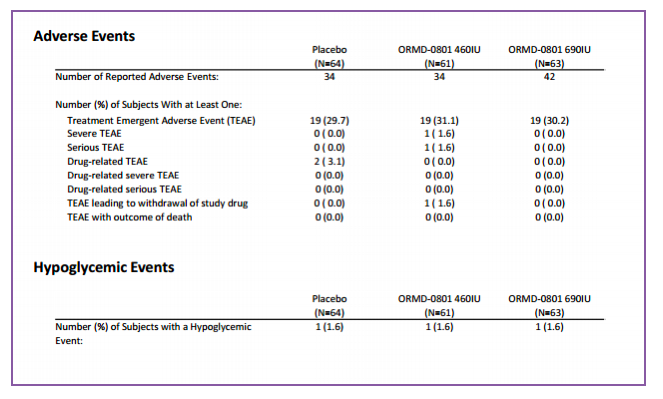
Further, the study demonstrated a good safety profile of ORMD-0801 with no drug related serious adverse events.
Additional Data
On July 28, Oramed reported additional data from the Phase IIb trial. In addition to positive topline data showing the study successfully met its primary efficacy and safety endpoints announced on May 18, the new data indicated a statistically significant lowering of glucose relative to placebo across several endpoints.
Due to technical inaccuracies that can occur in any diabetes study, measuring glucose changes with continuous glucose monitors (CGM), data can include extreme outliers. To reduce variability, trimming of unlocked, fully blinded information was conducted. In the current summary, the 80% trimmed data (data excluding the 10% highest and lowest values) is presented.
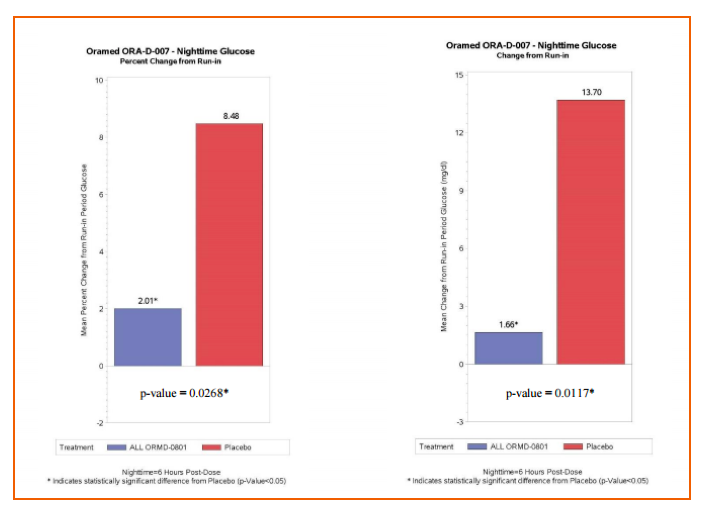
In the study, the mean nighttime glucose showed a significant difference in mean change from run-in (13.70 mg/dL for placebo vs. 1.66 mg/dL for the pooled ORMD-0801 arms with a p= 0.0117). ORMD-0801 was safe and well tolerated, with no drug related serious or severe adverse events and no statistically significant differences in laboratory values or vital signs.
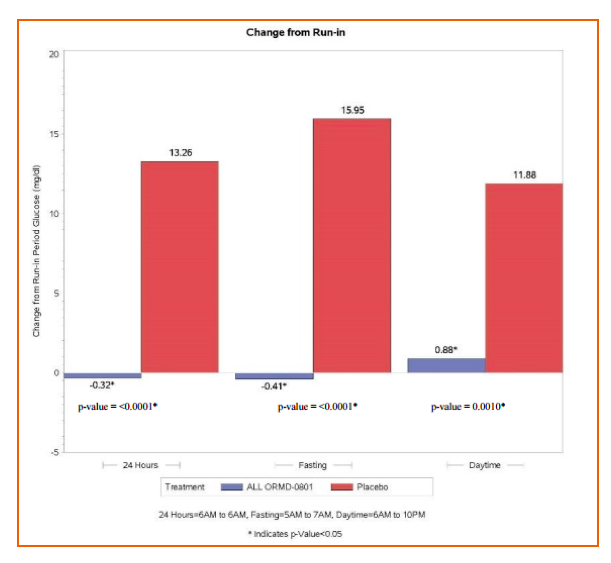
Other secondary and exploratory objectives of the study included evaluating the effect of ORMD-0801 on mean 24-hour glucose, fasting glucose, and daytime glucose. The mean 24-hour glucose showed a highly significant difference in mean change from run-in (13.26 mg/dL for placebo vs. -0.32 mg/dL for ORMD-0801, p <0.0001). The mean fasting glucose showed a highly significant difference in mean change from run-in (15.95 mg/dL for placebo vs. -0.41 mg/dL for ORMD-0801, p <0.0001). The mean daytime CGM glucose showed a highly significant difference in mean change from run-in (11.88 for placebo vs. 0.88 for ORMD-0801, p= 0.0010).
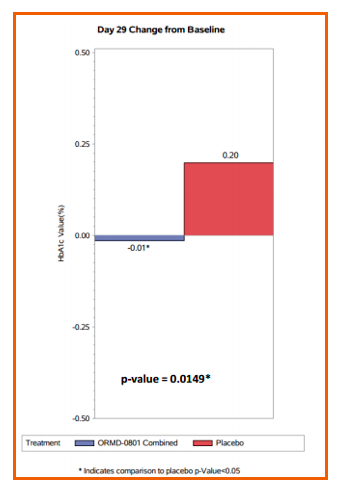
There was a statistically significant difference in change in HbA1c at Day 29 (0.20% for placebo vs.-0.01% for ORMD-0801, p= 0.0149). It is important to note that due to the kinetics of change of HbA1c, a four week study is insufficient to fully appreciate the potential positive impact of ORMD-0801 on HbA1c.
ORMD-0801 did not show a significant difference in change in morning fasting serum insulin, C-Peptide, or triglycerides.
The study demonstrated a good safety profile of ORMD-0801 with no drug related serious adverse events.
Our Takeaways from the Phase IIb Study
The positive data from the Phase IIb trial is a significant de-risk event for Oramed in our opinion. The top line data further confirm the efficacy and safety of ORMD-0801, an orally delivered intestinally absorbed insulin, from previously reported results including the Phase IIa study.
With the positive top line data from the Phase IIb trial, we believe the company will move forward with a pivotal Phase III trial when they get some feedback from the FDA. We estimate a Phase III trial could start as early as in late 2016 or early 2017.
The positive top line results also triggered some milestone payments from HTIT.
On June 21, Oramed received $6.5 million milestone payment from Hefei Tianhui Incubator of Technologies Co. Ltd. (HTIT). The payment follows Oramed’s positive top-line results from its Phase IIb trial.
On August 2, Oramed received another milestone payment of $4 million from HTIT, following Oramed’s report of additional positive efficacy and safety data from the Phase IIb trial.
Per the terms of the agreement signed in December 2015, Oramed granted HTIT exclusive rights for commercialization of ORMD-0801 in Greater China. The up to $50 million license deal includes multiple milestone payments aggregating $38 million, with a $3 million upfront payment received by Oramed upon execution of the agreement, plus a $12 million investment made by HTIT in Oramed at $10.39 per share in December 2015. Oramed will receive a 10% royalty on net sales of ORMD-0801 and related commercialized products in Greater China.
READ THE FULL RESEARCH REPORT HERE
SUBSCRIBE TO ZACKS SMALL CAP RESEARCH to receive our articles and reports emailed directly to you each morning. Please visit our website for additional information on Zacks SCR and to view our disclaimer.