By Grant Zeng, CFA
NASDAQ:ORMP
Oramed Pharmaceuticals (NASDAQ:ORMP) is an Israel-based clinical stage biotech company focused on the research, development and commercialization of oral insulin capsules to be used for the treatment of diabetes and orally ingestible capsules or pills for delivery of other polypeptides.
Oramed has developed a proprietary drug delivery technology POD™ (Protein Oral Delivery) to orally deliver peptides or proteins. The POD technology has been uniquely designed to prevent degradation of the protein in the gastrointestinal tract and enhance its absorption. Based on this breakthrough technology, the company is currently developing two oral peptides: oral insulin and oral GLP-1 for the treatment of diabetes.
The Unique Protein Oral Delivery (PODTM) Technology
Over the years, Oramed has developed a unique proprietary platform technology: protein oral delivery (PODTM) that allows for the oral delivery of protein drugs presently administrated only via injection.
There are many attractive advantages of oral drug delivery. These include increased patient comfort and compliance, reduced risk of infection, simpler application in pediatric medicine, first-pass metabolism preceding systemic exposure, and cost effectiveness. All these advantages have positioned oral delivery the most popular and preferred route of drug administration, especially for small molecules.
However, there are two major obstacles to the oral delivery of protein-based medications:
- Degradation by harsh acids and proteolytic enzymes within the gut;
- Absorption blocked by the physical barrier posed by the wall of the small intestine, which blunts translocation of large particles.
The end result is the jeopardization of the integrity and potency of orally ingested proteins. Thus, most protein-based pharmaceuticals cannot be taken in tablet form, and are typically provided in injectable forms, where they are delivered directly to the blood circulation.
Oramed POD™ (Protein Oral Delivery) technology has been uniquely designed to:
- protect orally delivered proteins from detrimental enzymatic activity within the gastrointestinal tract;
- and to enhance their absorption across the intestinal wall.
In order to prevent the degradation of proteins in the gastrointestinal tract, the active protein is encapsulated in a capsule that features a highly protective coating that remains intact in the most acidic segments of the gut, as well as enzymatic support provided by specialized protease inhibitors.
To promote the protein’s absorption, an absorption enhancer supplement is used to facilitate protein passing across the intestinal barrier.
By preventing protein breakdown in the gastrointestinal tract and promoting its crossing the small intestine, this breakthrough solution brings oral protein drug delivery significantly closer to a reality.
Oramed PODTM technology allows insulin to travel from the gastrointestinal tract via the portal vein to the liver and then the bloodstream, revolutionizing the manner in which insulin is delivered. It enables its passage in a more physiological manner than current delivery methods of insulin. This technology is a platform that has the potential to deliver medications and vaccines orally that today can only be delivered via injection.
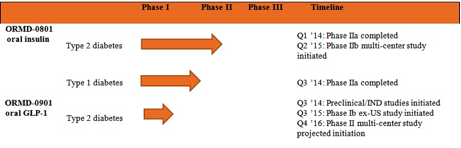
ORMD-0801 for Type 2 Diabetes (T2DM)
ORMD-0801 is an oral insulin capsule, the company’s flagship candidate developed using the company’s unique PODTM technology for the treatment of type 2 diabetes (T2DM).
Oramed completed a Phase IIa study of ORMD-0801 in 1Q14. This is a randomized, double-blind, placebo-controlled 7-day study to assess the safety, PK and PD of multiple oral bedtime doses of ORMD-0801 in adult patients with T2DM. This study enrolled 30 T2DM patients. The primary objective of this Phase IIa study is to evaluate the safety and tolerability of ORMD-0801. Secondary objective is to evaluate the pharmacodynamic effects on mean nighttime glucose level.
ORMD-0801 was safe and well tolerated for dosing regimen. No hypoglycemic events were observed at any point during the study in any member of the treatment group. No related adverse events were observed.
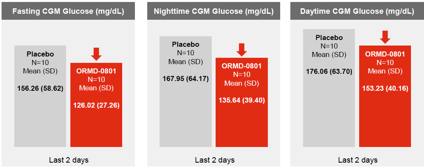
In this trial, ORMD-0801 also demonstrated sustained glucose reduction at night, day and mean fasting glucose test compared to placebo as measured by continuous glucose monitoring (CGM).
Based on the encouraging Phase IIa data, Oramed initiated a Phase IIb trial of ORMD-0801 for the treatment of T2DM in June 2015.
This is a double-blind, randomized, 28-day clinical trial designed to assess the safety and efficacy of ORMD-0801. The trial will evaluate ORMD-0801 over a longer treatment period (28-day vs 7-day in the Phase IIa study) and will have statistical power to give greater insight into the drug’s efficacy.
The primary objective is the effect of ORMD-0801 on weighted mean night time glucose levels based on 2 nights of Continuous Glucose Monitor (CGM) data by comparison of the mean % change between baseline and week 4 of ORMD-0801 treatment and placebo groups. Safety and tolerability will also be assessed.
The trial will enroll up to 180 T2DM patients. In September 2015, Oramed announced that 98 patients were already enrolled in the study, which represented more than 50% of the 180 patients expected to be recruited for the trial.
The company anticipates the last patient will complete this trial during the first quarter of calendar year 2016. Based on this time frame, we estimate full data to be available in the summer of 2016. And a pivotal Phase III trial could start in late 2016 or early 2017 if Phase IIb data are positive.
ORMD-0801 for Type 1 Diabetes (T1DM)
Oramed is also evaluating ORMD for the treatment of type 1 diabetes (T1DM).
T1DM patients are usually treated with 2 types of injectable insulin replacement therapy. Long-acting insulin (basal) helps maintain stable insulin levels during fasting periods and rapid-acting insulin (bolus) prior to each meal helps to stabilize blood sugar.
Oramed seeks to replace the mealtime (bolus) insulin doses with oral insulin ORMD-0801.
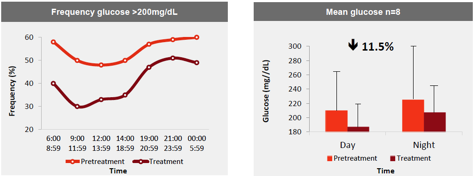
In a preliminary clinical study, ORMD-0801 demonstrated consistent lowering of glucose levels in uncontrolled/brittle type 1 diabetic patients both at day and night. The agent also reduced the frequency of glucose above the level of 200 mg/dL.
Oramed completed a FDA approved Phase IIa study of ORMD-0801 in 3Q14 for the treatment of T1DM. This was a prospective, randomized, double-blind, placebo controlled study. 25 patients with established Type 1 diabetes were enrolled into the study. Patient (15/25) took ORMD-0801 3 times a day at mealtime for 7days. Glucose level was measured using a continuous glucose monitoring (CGM) device.
The primary objective of this Phase IIa study is to evaluate the change in exogenous insulin requirements in T1DM patients.
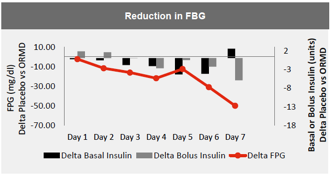
ORMD-0801 showed consistent and accumulative effect of lowering blood glucose levels (fasting blood glucose/fasting plasma glucose, FBG/FPG, red line), day and night, compared to control group. ORMD-0801 also reduced the use of both basal insulin and bolus insulin.
The oral insulin was safe and well tolerated for the pre-meal dosing regimen in this study.
The company has meetings planned in the next couple weeks with the JDRF to look at doing something together in pushing forward T1DM. In addition, the company is getting feedback from our KOLs on the best path forward for this indication. Some of the feedback to date has been to simply have a small T1DM population within the Phase III study (along with T2DM). This seems like the likely best path forward to inexpensively include T1DM on the FDA label.
ORMD-0901 for Type 2 Diabetes
Glucagon-like peptide 1 (GLP-1) belongs to the hormonal family of incretins that enhance the secretion of insulin. The major sources of GLP-1 are the L-cells in the lining of small intestine. The pancreas and the central nervous system (CNS) also secrete this hormone in smaller quantities. GLP-1 stimulates the release of insulin from the pancreas; it also increases the volume of cells in the pancreas which produces insulin (beta cells) and regulates and controls the release of glucagon. GLP-1 acts on appetite centers in brain, slowing the emptying process in stomach and increasing the feeling of fullness during and between the meals.
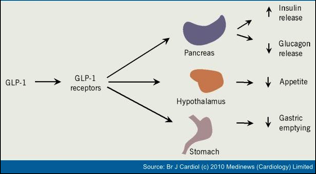
ORMD-0901 is oral GLP-1 analog (oral exenatide). Exenatide, a GLP-1 analog, is currently marketed in injectable form only, and is indicated for treatment of type 2 diabetes. Exenatide induces insulin release at increased glucose levels and causes a feeling of satiety, which results in reduced food intake and weight loss.
ORMD-0901, based on the company’s PODTM technology, could significantly increase compliance and become a valuable tool in the treatment of diabetes.
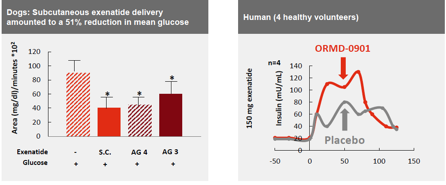
In a small scale preliminary proof of concept study, ORMD-0901 demonstrated excellent glucose reduction efficacy in both animals (dogs) and human healthy volunteers.
In the following graph, the left showed a couple formulations of ORMD-0901 seemed to have similar efficacy to the injectable GLP-1 (lowering glucose). The right showed increase insulin in humans after taking ORMD-0901– as GLP-1 promotes insulin production/secretion.
Oramed submitted the pre-IND package to the FDA in 3Q13, and is currently conducting IND-enabling toxicity studies.
The company hopes to finish off the 90-day toxicity studies by 3Q16, and files an IND and start a Phase II study in 4Q16. The company may pursue the 505(b)(2) pathway.
The 505(b)(2) regulatory pathway may reduce the drug development risks and costs by using prior findings of safety and/or efficacy for an approved product. In ORMD-0901 case, part of the safety and efficacy data from the injectable exenatide formulation may be used for the filing of a NDA for ORMD-0901.
An ex-US Phase Ib study of ORMD-0901 has been initiated in Israel. It’s a small study to look at proof of concept (POC) and to glean some small dosing information. Data from this trial will be available by 1Q/2Q16. Data from this small study will help the company design the Phase II study.
ORMD-0801 Target the Huge Insulin Market
Oramed is developing ORMD-0801 for both T1DM and T2DM, a multibillion-dollar market.
The Insulin Market
Insulin is one of the most important pharmaceuticals in the world and represents a multibillion dollar market. More than ninety years after the discovery of insulin, the therapy remains a staple of treatment for both type 1 and type 2 diabetes.
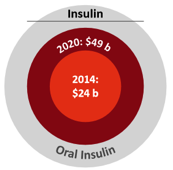
According to P&S Market Research, the global human insulin market was valued at $24 billion in 2014. The market is expected to grow at a compound average growth rate (CAGR) of 12.5% during the period 2015 to 2020, to reach $49 billion by 2020. This doesn’t take into account oral insulin and the potential to really enlarge this market via giving insulin earlier in the therapeutic paradigm. The growth is fueled by the growing prevalence of diabetes and the progressive nature of the disease.
On the basis of insulin type, the insulin analogs (modern human insulin) commands the larger share in the global market. The modern human insulin is expected to grow at a CAGR of 13% during 2015 to 2020. The modern human insulin can be further categorized as long acting human insulin, rapid acting human insulin and premixed human insulin; wherein, the long acting human insulin commands the largest share in modern human insulin market but the premixed human insulin exhibited the highest growth rate.
In Asia-Pacific, the human insulin market is expected to witness a higher CAGR of 13.9% during the period 2015 to 2020, to achieve $12 billion value by 2020.
The global human insulin market has a fragmented structure with large number of companies operating in the market. The key players in the human insulin market include Sanofi, Novo Nordisk A/S, Eli Lilly and Company, GlaxoSmithKline Plc, Pfizer, Inc., Merck & Co., and Julphar.
Advantage and Opportunity for ORMD-0801
We believe ORMD-0801 could command a nice market share in the global insulin market if approved. ORMD-0801 is an oral formulation of insulin and holds many advantages compared to injectable insulin including increased patient comfort and compliance, reduced risk of infection, simpler application in pediatric medicine, first-pass metabolism preceding systemic exposure, and cost effectiveness.
Specifically, endogenous insulin is produced by the pancreas and delivered to the body via the liver. Injected insulin is introduced directly to the bloodstream with only a fraction of it reaching the liver. This can cause excess sugar to be stored in fat and muscle which often results in weight gain. This may also cause hypoglycemia. While oral insulin (such as ORMD-0801) like natural insulin is delivered first to the liver. This should lead to:
- Better blood glucose control;
- Reduced hypoglycemia: liver metabolizes 80%;
- Reduced hyperglycemia: insulin closes down glucose overproduction/secretion;
- Reduced weight gain (neutral): vs. SC insulin focus on glucose disposal leads to substantial weight gain.
All these advantages position ORMD-0801 as a key player in the global inulin market.
Oramed is developing ORMD-0801 for both type 1 and type 2 diabetes, and targeting this new agent for the management of excessive production of glucose at night: a significant challenge in diabetes management.
Excessive nocturnal glucose production by the liver is frequently demonstrated in diabetes patients, which leads to a high fasting blood sugar (FBG), measured after an 8-hour fast. High FBG test results are a key concern in diabetes management. Current treatment is suboptimal. In only 20% of patients, blood sugar is regulated with medication and return FBG to normal levels.
The first indication of ORMD-0801 reduces excessive nocturnal glucose production in the liver by acting the same way that natural insulin does.
Based on the company’s current development plan, we estimate ORMD-0801 to be approved by the FDA in late calendar 2018 for both type 1 and type 2 diabetes. Peak sales could be well over $1 billion in 5 years after approval.
Another Big Market for Oramed ORMD-0901 (Oral GLP-1)
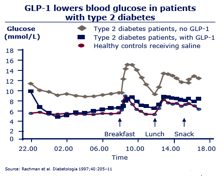
The glucagon-like peptide-1 (GLP-1) analogs mimic the action of GLP-1 and increase the incretin effect in patients with type 2 diabetes, stimulating the release of insulin. GLP-1 analogs have additional effects in reducing glucagon, slowing gastric emptying, and inducing satiety. In clinical practice they are associated with significant reductions in glycosylated haemoglobin (HbA1c), weight loss and a low risk of hypoglycaemia. Beneficial effects have also been observed on blood pressure and lipids.
Endogenous GLP-1 is rapidly cleaved by dipeptidyl peptidase-4 (DPP-4). GLP-1 analogues mimic endogenous GLP-1 activity but are resistant to DPP-4 deactivation, resulting in prolonged activity. Therefore, both GLP-1 analogs and DPP-4 inhibitors are a new class of drugs for the treatment of type 2 diabetes.
There are quite a few GLP-1 analogs currently available in the market. Exenatide (Byetta) was approved by the FDA in 2005. Bydureon (once-weekly formulation of exenatide) was approved by the FDA in 2012. Both Byetta and Bydureon were developed by Amylin Pharmaceuticals. Bristol-Myers Squibb acquired Amylin in 2012 and sold its global diabetes business to its collaboration partner AstraZeneca in 2013.
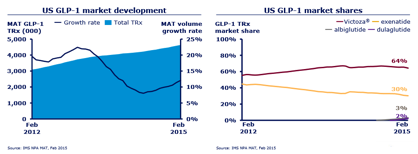
Liraglutide (Victoza, Saxenda) was approved in 2010 by the FDA and is marketed by Novo Nordisk. With 71% global market share, Victoza is currently the market leader in the GLP-1 segment.
Other big players in the GLP-1 market include Sanofi (Lixisenatide/Lyxumia, approved in 2013 in EU, under the FDA review), GSK (Albiglutide/Tanzeum, approved by the FDA in 2014) and Eli Lilly (Dulaglutide/Trulicity, approved by the FDA in 2014).
In the US, GLP-1 market continues to grow with Victoza and exenatide holding the majority of market share (over 94%). Victoza sales reached $2 billion while exenatide franchise sales reached $0.8 billion in 2014.
Like oral insulin, oral exenatide will have the same advantages as oral insulin.
When we discuss the market opportunity for ORMD-0901, we not only look at the current GLP-1 market, but also need to look at the DPP-4 inhibitors market since DPP-4 inhibitors are orally available. It is estimated that DDP-4s have a market of 3-5x the GLP-1 market due to its oral availability.
Merck’s Januvia was the first DPP-4 inhibitor approved for type 2 diabetes. Newer drugs in this family include Onglyza (AstraZeneca), and Trajenta (Eli Lilly), as well as combinations which mix the DPP-4 inhibitor with metformin. These drugs are Janumet (Merck), Kombiglyze (AstraZeneca), and Jentadueto (Eli Lilly). Takeda is the new comer in this market with three DPP-4 inhibitor products approved: Nesina (alogliptin), Kazano (alogliptin and metformin HCl), and Oseni (alogliptin and pioglitazone).
Merck’s Januvia/Janumet dominate the DPP-4 world with a total of $6 billion in 2014 sales followed by Onglyza/Kombiglyze franchise sales of $820 million in 2014. Trajenta/Jentadueto sales was $329 million and Nesina franchise sales was $369 million (¥44.3 billion) in 2014.
Oramed plans to start a Phase II study of ORMD-0901in 4Q16 pursuing the 505(b)(2) pathway. We estimate ORMD-0901 to be approved in late 2019. Peak sales should also be over $1 billion.
Strong Balance Sheet
As of August 31, 2015, Oramed held $26 million in cash and investment with no debt.
In December 2015, the company completed deal valued at up to $50 million in investment and milestone payment with China based Hefei Tianhui Incubator of Technologies Co., Ltd. (HTIT) for exclusive rights to market ORMD-0801 in China, Hong Kong and Macau.
Pursuant to the agreements, Oramed sold HTIT 1,155,367 restricted shares of Common Stock at a price of $10.39 per Share, for an aggregate amount of $12 million. Under the terms of the agreement, Oramed has granted HTIT exclusive rights for commercialization of ORMD-0801 in Greater China. The license includes multiple milestone payments aggregating $38 million and up to a 10% royalty, based on net sales of the product in China.
HTIT (partially owned by Sinopharm Group Company Limited) has state of the art insulin production facilities in Hefei, China. China has the largest number of diabetics in the world. If ORMD-0801 is finally approved in China, we believe the royalties from China sales will have a significant impact on Oramed’s future revenues and earnings.
We welcome this deal, which not only boosts the company’s balance sheet, but more importantly validates the company’s POD technology and its clinical programs.
Oramed has a burn rate at about $10 million per year. Current cash plus the proceeds from this deal will be able to fund the company’s operations well into calendar 2018 according to our financial model.
READ THE FULL INITIATION REPORT HERE
SUBSCRIBE TO ZACKS SMALL CAP RESEARCH to receive our articles and reports emailed directly to you each morning. Please visit our website for additional information on Zacks SCR and to view our disclaimer.