By
Grant Zeng, CFA
NASDAQ:ORMP
On Nov. 29, Oramed (NASDAQ:ORMP) announced that it successfully concluded a Phase Ib study of ORMD-0901, the Company’s proprietary oral GLP-1 analog.
This ex-US Phase Ib study of ORMD-0901 is conducted in Israel. It’s a small study to look at proof of concept (POC) and to glean some small dosing information. Data from this small study will help the company design the Phase II study.
The study on type 2 diabetic patients showed ORMD-0901 to be safe and well tolerated, having no serious adverse events, adverse events or abnormal laboratory findings during the study. In addition, the active oral GLP-1 arms of the study showed encouraging trending efficacy.
Currently Oramed is preparing to submit an IND with the FDA and anticipate initiating a Phase IIb study in 2017.
Background of ORMD-0901 (GLP-1 Analog) Program
Glucagon-like peptide 1 (GLP-1) belongs to the hormonal family of incretins that enhance the secretion of insulin. The major sources of GLP-1 are the L-cells in the lining of small intestine. The pancreas and the central nervous system (CNS) also secrete this hormone in smaller quantities. GLP-1 stimulates the release of insulin from the pancreas; it also increases the volume of cells in the pancreas which produces insulin (beta cells) and regulates and controls the release of glucagon. GLP-1 acts on appetite centers in brain, slowing the emptying process in stomach and increasing the feeling of fullness during and between the meals.
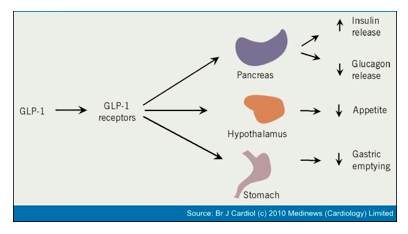
ORMD-0901 is oral GLP-1 analog (oral exenatide). Exenatide, a GLP-1 analog, is currently marketed in injectable form only, and is indicated for treatment of type 2 diabetes. Exenatide induces insulin release at increased glucose levels and causes a feeling of satiety, which results in reduced food intake and weight loss.
ORMD-0901, based on the company’s PODTM technology, could significantly increase compliance and become a valuable tool in the treatment of diabetes.
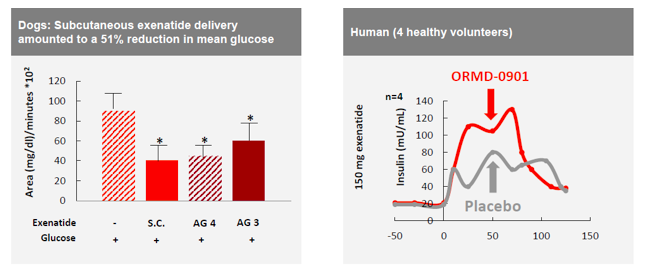
In a small scale preliminary proof of concept study, ORMD-0901 demonstrated excellent glucose reduction efficacy in both animals (dogs) and human healthy volunteers.
In the following graph, the left showed a couple formulations of ORMD-0901 seemed to have similar efficacy to the injectable GLP-1 (lowering glucose). The right showed increase insulin in humans after taking ORMD-0901– as GLP-1 promotes insulin production/secretion.
Oramed is currently conducting IND-enabling toxicity studies. The company hopes to finish off the 90-day toxicity studies soon, and files an IND and start a Phase II study in 2017. The company may pursue the 505(b)(2) pathway.
The 505(b)(2) regulatory pathway may reduce the drug development risks and costs by using prior findings of safety and/or efficacy for an approved product. In ORMD-0901 case, part of the safety and efficacy data from the injectable exenatide formulation may be used for the filing of a NDA for ORMD-0901.
Balance Sheet Remains Strong
As of August 31, 2016, Oramed held $42.6 million in cash, deposits and marketable securities with no debt.
In December 2015, the company completed deal valued at up to $50 million in investment and milestone payment with China based Hefei Tianhui Incubator of Technologies Co., Ltd. (HTIT) for exclusive rights to market ORMD-0801 in China, Hong Kong and Macau.
Pursuant to the agreements, Oramed sold HTIT 1,155,367 restricted shares of Common Stock at a price of $10.39 per Share, for an aggregate amount of $12 million. Under the terms of the agreement, Oramed has granted HTIT exclusive rights for commercialization of ORMD-0801 in Greater China. The license includes multiple milestone payments aggregating $38 million and up to a 10% royalty, based on net sales of the product in China.
Total $29.5 Million in payments from HTIT has been received to date.
HTIT (partially owned by Sinopharm Group Company Limited) has state of the art insulin production facilities in Hefei, China. China has the largest number of diabetics in the world. If ORMD-0801 is finally approved in China, we believe the royalties from China sales will have a significant impact on Oramed’s future revenues and earnings.
This deal not only boosted the company’s balance sheet, but more importantly validates the company’s POD technology and its clinical programs.
Current cash plus the proceeds from this deal will be able to fund the company’s operations well into calendar 2019 according to our financial model.
For a free copy of the full research report, please email scrinvestors@zacks.com with ORMP as the subject.
SUBSCRIBE TO ZACKS SMALL CAP RESEARCH to receive our articles and reports emailed directly to you each morning. Please visit our website for additional information on Zacks SCR and to view our disclaimer.