By David Bautz, PhD
NASDAQ:PIRS
Financial Update
On March 22, 2016, Pieris Pharmaceuticals, Inc. (NASDAQ:PIRS) announced financial results for the fourth quarter and full year 2015 and provided a business update. The company reported $2.1 million in revenue for the fourth quarter of 2015, which was related to milestone payments from the company’s current collaborations. Net loss for the fourth quarter was $2.7 million, or $0.07 per share, and was comprised of $2.9 million in R&D and $1.8 million in G&A expenses. For the full year 2015, the company reported revenues of $2.9 million, which included $2.0 million in milestone payments from the collaboration with Daiichi Sankyo, $0.5 million in milestones from the collaboration with Sanofi, and $0.4 million in grant revenue from EUROCALIN – European consortium for antiCALINs as next generation high-affinity protein therapeutics. The company reported a net loss in 2015 of $14.1 million, or $0.41 per share, which was comprised of $8.2 million in R&D and $8.4 million in G&A expenses. Included in these expenses was $1.2 million in stock based compensation, with approximately $0.4 million of that recorded as R&D expense and $0.8 million recorded as G&A expense.
Pieris exited 2015 with approximately $29.3 million in cash and cash equivalents. Importantly, this does not include the $6.4 million up-front payment from Roche (Pieris received it in January 2016) that was derived from the research collaboration entered into by the two companies in December 2015. We anticipate that the company’s current cash position should be sufficient to fund operations into the second half of 2017.
Business Update
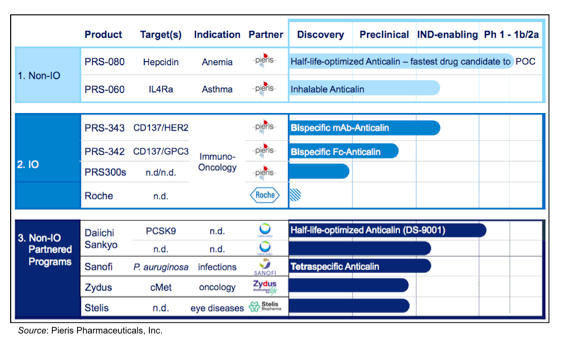
Pieris is developing the Anticalin® class of biotherapeutic compounds targeting a wide range of medical conditions. Anticalins® are a new class of novel, engineered proteins that are based on lipocalins, which are naturally occurring human proteins with variable loop regions supported by a rigid framework that bind a wide array of compounds. Pieris scientists have developed a means of modifying the lipocalins to confer unique binding specificities against virtually any biological target (similar to monoclonal antibodies), and dubbed the new compounds ‘anticalins’ (antibody + lipocalin). The company’s lead compounds are PRS-080, which targets hepcidin for the treatment of functional iron deficiency in patients with chronic kidney disease; PRS-060, which targets the interleukin 4 receptor (IL4Ra) for the treatment of asthma; and PRS-343, an immunooncology product that works by “stepping on the gas” to ramp up an immune response in the tumor microenvironment. In addition, the company has a number of partnered programs targeting a variety of indications including dyslipidemia, infectious disease, and immunooncology.
Immunooncology – PRS-300 Series
Pieris has disclosed two immunooncology (IO) candidates thus far and is performing preclinical validation work on a handful of others, but is not disclosing those targets at this time for intellectual property (IP) purposes. PRS-343 is a monoclonal antibody/Anticalin® bispecific compound that targets the cellular receptor HER2 and the T-cell receptor CD137. PRS-342 is an Fc/Anticalin® bispecific compound that targets glypican-3 (GPC3), an oncofetal antigen with almost no expression in normal adult tissue, and the T-cell receptor CD137.
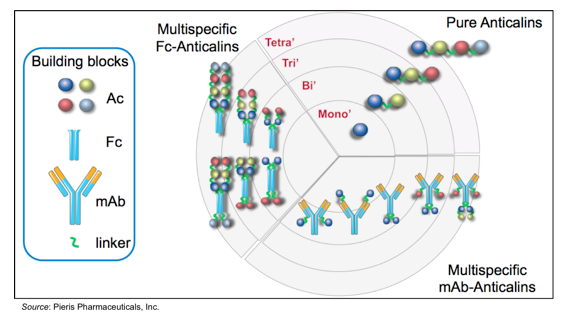
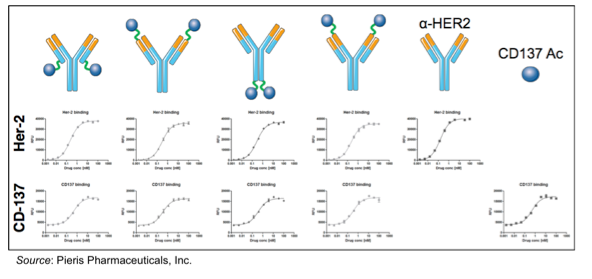
Pieris is utilizing the Anticalin® platform in its IO products to differentiate them from other IO products currently available and under development. The company’s platform allows for a multimeric approach (i.e., the use of mono-, bi-, tri-, and tetra-specific molecules) that can be utilized to drive a multi-faceted response coupled with a high degree of tumor specificity. As the following figure shows, there are a multitude of potential combinations when using Anticalins®, monoclonal antibodies, and Fc regions (the “constant” region of antibodies). This allows for an immensely flexible platform that can be uniquely tailored for each specific indication.
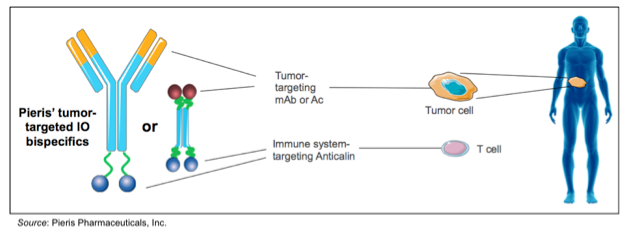
The company’s lead IO products are novel bispecific compounds that utilize an Anticalin® targeted to a T-cell receptor genetically linked to a tumor targeting antibody or Anticalin®. This formulation attempts to overcome the shortcomings of systemically targeted IO products that can result in an unacceptable side effect profile and inefficient efficacy through a lack of a tumor-localized response.
PRS-343
PRS-343 is a bispecific compound that contains a CD137-specific Anticalin® genetically linked to a HER2-specific monoclonal antibody (trastuzumab), and is the lead compound from the company’s IO program. CD137 is expressed on activated CD8+ T-cells. Since CD8+ T-cells play a pivotal role in tumor immunity, enhancing CD137 costimulation could promote the generation of protective antitumor immune responses. This idea has been validated through enhanced immunogenicity in tumor cells engineered to express CD137 ligand (Mogi et al., 2000) or anti-CD137 antibodies (Ye et al., 2002). Unfortunately, the use of systemic anti-CD137 antibodies can result in severe side effects such as liver toxicity (Grade 4 hepatitis), which resulted in the cancellation of a Phase 1 clinical trial (Yao et al., 2013). Thus, Pieris is utilizing the HER2-specific antibody to localize T-cell activation inside the tumor microenvironment, which could help to mitigate potential systemic toxic effects.
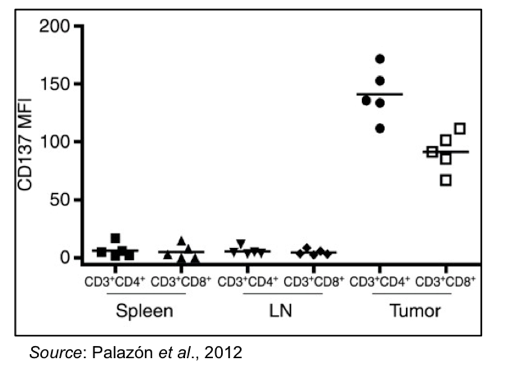
Another important aspect of CD137 is that it is preferentially expressed in high levels on intratumoral T-cells (Palazón et al., 2012). This is shown in the following graph, where CD4+ and CD8+ T-cells were extracted from the spleen, lymph nodes, and tumor of mice bearing CT26 tumors (murine colon cancer). Only T-cells purified from tumors showed expression of CD137, whereas T-cells from other locations from the same mice did not show increased expression of CD137.
These data were further corroborated in tissue samples from patients with ovarian cancer (Ye et al., 2014). Results from that study showed that tumor-infiltrating lymphocytes (TILs; found in the tumor microenvironment) and tumor-associated lymphocytes (TALs; found surrounding the tumor microenvironment) naturally expressed higher levels of CD137 than circulating T cells. In addition, CD137-expressing TILs, but not PD-1 positive or PD-1 negative CD137-negative cells, possessed autologous tumor reactivity both in vitro and in vivo. All told, there is significant data to support the use of CD137-targeting therapeutics as anti-cancer agents.
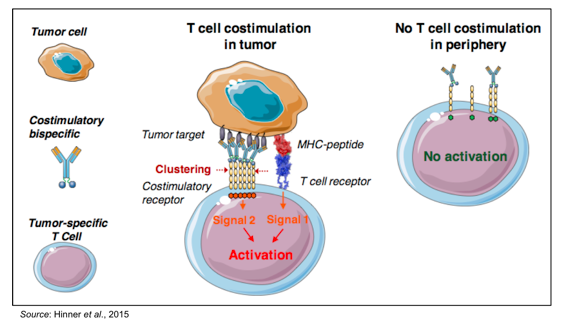
The CD137 directed T-cell response is generated through a “clustering” phenomenon, where the more CD137 molecules that are activated together in a group leads to a greater activation signal. For PRS-343, this “clustering” occurs because of the overexpression of HER2 (tumor target) on the tumor cell surface. By bringing together the tumor cell and the T-cell, the T-cell receptor can then interact with any peptides presented on the tumor cell surface through the major histocompatibility complex (MHC), further enhancing the anti-tumor response by the T-cell. This is all depicted in the following graphic.
Pieris has done a number of studies on different CD137-specific Anticalin’s® to identify the lead molecule to advance into clinical testing. The company revealed that this lead compound has a very high affinity for CD137 (~2 nM), activates T-cells in an ex vivo model, and binds to CD137 in a “non-competitive fashion”. What this means is that binding of the Anticalin® to CD137 does not interfere with the binding of CD137 and its natural ligand. The flexibility of the Anticalin® platform is exemplified in the following graphic, which shows that no matter how the Anticalin® is attached to the monoclonal antibody, both entities retain the ability to bind to their respective ligands with essentially the same affinity.
Pieris will be presenting a poster at the 2016 AACR annual meeting on Apr. 17 titled “Costimulatory T-cell engagement by the HER2/CD137 bispecific PRS-343 leads to strong antitumor effect in humanized mouse model”. This will be the first in vivo preclinical data that the company has presented for PRS-343. The abstract states: “We found that PRS-343 led to strong tumor growth inhibition and a significantly better response compared to either isotype control or anti-CD137 benchmark mAbs.” We are looking forward to reviewing the poster when it is presented, and a full analysis of the data will be forthcoming after it is published.
The company will continue IND-enabling studies of PRS-343 throughout 2016, and we anticipate first-in-human studies to commence in the first half of 2017.
PRS-342
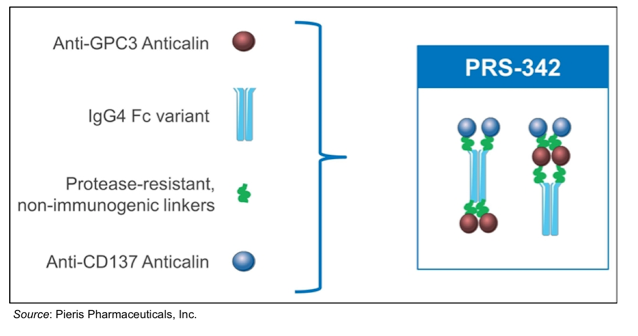
PRS-342 is a bispecific compound that contains a CD137-specific Anticalin®, an Fc molecule, and a GPC3-specific Anticalin®. The compound contains the Fc portion of an IgG4 antibody, which is the constant region of those molecules. The following figure shows the potential configurations for PRS-342.
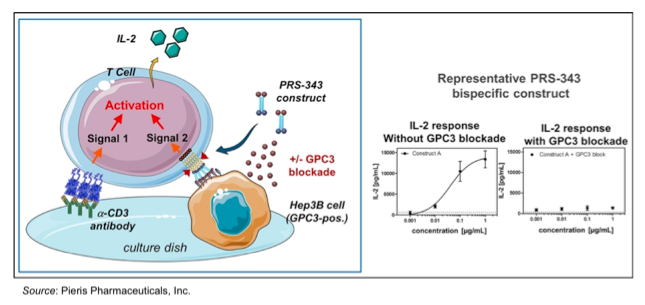
The following figure shows that just as with PRS-343, the activation of the T-cell is tumor dependent, thus mitigating the chance for systemic effects due to T-cell activation outside of the tumor microenvironment. The data in the following figure shows how the IL-2 response is only generated through a costimulatory approach when the T-cell is activated through two pathways, binding of the T-cell receptor (through an anti-CD3 antibody in the assay or an MHC-peptide in vivo) and clustering of CD137 through engagement of GPC3 on the tumor cell surface. Most importantly, these results show that the costimulatory approach taken by Pieris is amenable to multiple tumor targets, again highlighting the power of the Anticalin® platform.
Other Disease Areas
In addition to IO, Pieris is developing Anticalin® products for diseases with high unmet medical needs and validated disease targets.
PRS-080
PRS-080 is an Anticalin® that targets hepcidin, a 25 amino acid peptide produced in the liver and excreted into the bloodstream where it binds to ferroportin, an iron transporter found on duodenal enterocytes, reticuloendothelial macrophages, and hepatocytes (Donovan et al., 2006). Binding of hepcidin to ferroportin induces its internalization and degradation, resulting in iron accumulation in enterocytes, macrophages, and the liver. Hepcidin expression is induced by inflammatory cytokines, which is hypothesized to result in the sequestration of iron from invading pathogens (Babitt et al., 2010). This increased hepcidin expression results in many of the hallmarks of chronic diseases, including iron sequestration, hypoferremia, and anemia.
Pieris is developing PRS-080 as a treatment for functional iron deficiency (FID) in anemic patients with chronic kidney disease (CKD), which is a progressive loss of kidney function over a period of months or years. FID in CKD patients is characterized by low circulating iron levels that limits erythropoiesis even when these patients have sufficient iron stores in their body. These patients have low serum transferrin (a measure of circulating iron) and normal or high serum ferritin (a marker of body iron stores). FID is characteristic of a chronic inflammatory state, which in CKD patients may be due to an increased incidence of infections and/or the induction of inflammatory cytokines by the hemodialysis procedure.
The company presented results at the American Society of Hematology (ASH) 2015 annual meeting from a placebo controlled, double blind, Phase 1 study, which consisted of six cohorts of healthy volunteers treated with ascending doses of PRS-080 in of 0.08, 0.4, 1.2, 4.0, 8.0, and 16.0 mg/kg (NCT02340572). Six patients in each cohort received drug while two patients received placebo through a two hour intravenous infusion. A total of 39 adverse events (AEs) were reported during or after treatment in 22 subjects. All AEs were mild or moderate and there were no serious AEs reported. Importantly, there were no infusion reactions or hypersensitivities noted during the study. In addition, no anti-drug antibodies were detected from participants treated with PRS-080.
A decrease in free hepcidin was noted beginning one hour after administration of PRS-080 along with a transient increase in serum iron concentration and transferrin saturation. Serum iron concentrations reached approximately 50 μM in individual subjects but did not increase further with increasing dose. The normal range for serum iron concentration is approximately 11-30 μM. We believe this is a very important data point to come out of this trial, because if PRS-080 is able to increase normal iron levels to above normal, it stands to reason that it should be able to increase anemic patients iron levels to within the normal range.
The company is currently conducting a single ascending dose Phase 1b clinical trial of PRS-080 in hemodyalisis-dependent patients with end-stage renal disease (ESRD), with results from this first-in-patient study expected in the second half of 2016. Following that trial, the company will move quickly into a multiple ascending dose trial in order to evaluate the effects on hemoglobin levels. We believe results from the multi-dose trial will be reported in mid-2017. With approximately 180,000 dialysis patients worldwide having functional iron deficiency, we estimate PRS-080 could have greater than $1 billion in peak sales.
PRS-060
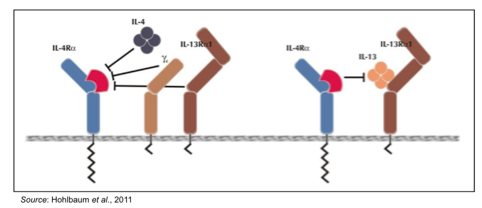
PRS-060 is an Anticalin® that has very high affinity for IL4Ra (Kd ~ 20 pM) and does not bind to the related cytokine receptors IL6R, IL18R, and IL23R. By targeting IL4Ra, PRS-060 inhibits binding of both IL-4 and IL-13, as depicted in the following graphic.
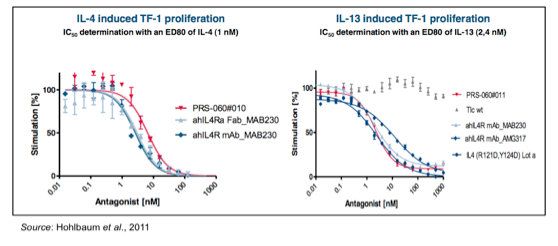
The inhibition of IL-4 and IL-13 binding by PRS-060 was shown in a series of preclinical experiments involving erythroleukemic (TF-1) cells that proliferate upon stimulation with a wide range of cytokines. The cells were preincubated for 30 min with PRS-060 or other IL4Ra antagonists prior to stimulation with IL-4 (left) or IL-13 (right). Cell proliferation was measured five days after treatment and graphed as a function of increasing amounts of IL4Ra antagonist. The results show that PRS-060 is able to inhibit both IL-4 and IL-13 dependent proliferation.
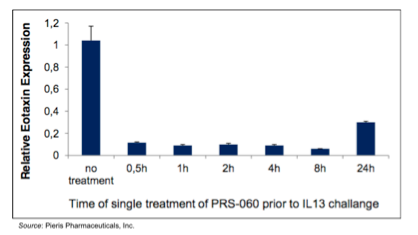
Pieris has formulated PRS-060 for pulmonary delivery by inhalation, which further shows the flexibility of the Anticalin® platform as monoclonal antibodies are currently unable to be dosed through inhalation. Efficacy of inhaled PRS-060 is shown in the following graphic, in which eotaxin expression (a marker of airway inflammation) was induced by administration of IL-13 to the lungs of mice after pre-treatment with inhaled PRS-060. The data shows that eotaxin expression is inhibited for up to 24 hours following a single inhaled dose of PRS-060.
IL4Ra is a clinically validated target for the treatment of asthma, as shown by clinical trial results with the IL4Ra specific monoclonal antibody dupilumab, which is being developed by Regneron Pharmaceuticals (REGN) and Sanofi. The results from a Phase 2a study showed that treatment with dupilumab resulted in a significant decrease in asthma exacerbations and an improvement in the ACQ5 score that was maintained through 12 weeks of treatment (Wenzel et al., 2013). In 2015, the two companies announced an interim analysis of a pivotal Phase 2b study of dupilumab in adults with asthma showed the study met its primary endpoint of improving lung function in both unselected severe asthma patients and those with “allergic” asthma. Dupilumab is administered subcutaneously, and in the Phase 2a study the most common adverse events were injection-site reaction, nasopharyngitis, and upper respiratory tract infection. While dupliumab has shown clinical efficacy in treating asthma, we believe administering PRS-060 through inhalation could offer a number of potential advantages, including lower systemic side effects, a smaller dose, and a more convenient dosing method.
Currently, PRS-060 is still in preclinical development with the final IND enabling studies being conducted in 2016 in preparation for a first-in-man study to be initiated in the first half of 2017. With well over 1 million potential patients worldwide, PRS-060 has blockbuster potential.
Update on Collaborations
On November 19, 2015, Pieris announced that collaborator Daiichi Sankyo Company, Ltd. dosed the first subject in a Phase 1 clinical study for the lead partnered Anticalin® program, which also triggered an undisclosed milestone payment. Pieris recently announced that the target of the partnered program is proprotein convertase subtilisin/kexin type 9 (PCSK9) and is being developed for dyslipidemia. Two monoclonal antibodies targeting PCSK9 have recently been approved by the FDA (alirocumab and evolocumab) while a third is currently in Phase 3 clinical trials (bococizumab). The compounds work by binding to the PCSK9 protein, thereby preventing it from binding to LDL receptors on the liver. The end result is additional LDL binding to those receptors, which leads to LDL clearance out of the bloodstream. The anti-PCSK9 antibodies are forecast to have peak revenues of $1 billion each.
On November 30, 2015, Pieris announced a third milestone was achieved in the company’s R&D collaboration with Sanofi, which triggered an undisclosed payment to Pieris. The milestone payment is due to Sanofi’s decision to continue development of the tetra-specific Anticalin®-based program for infectious disease. As a reminder, Sanofi presented preclinical data on this program at the 2015 American Society of Microbiology Conference that included promising in vivo activity in a chronic Pseudomonas aeruginosa infection animal model along with desirable manufacturing and stability criteria. Pieris originally entered into a collaboration and licensing agreement with Sanofi in 2010. Upon signing the agreement, Pieris received an upfront payment of $4.2 million along with research funding with up to $31.5 million available upon the achievement of development milestones and up to $21.8 million available upon the achievement of commercialization milestones for the product. In addition, royalties of mid- to mid-high single digits are payable based upon the sale of products originating from this collaboration.
On December 8, 2015, Pieris announced it entered into a research collaboration and license agreement with Roche in cancer immunotherapy. At this point, the agreement only covers one target, but the potential exists for it to turn into a multi-program agreement. Pieris received an upfront payment of $6.4 million along with Roche fully funding the collaborative research phase. The deal could potentially be worth up to $400 million, with most of that money tied to development milestones, and does not include the potential for up to low double-digit royalties. This was an important milestone for the company, since working with an industry leader like Roche helps to further validate the Anticalin® platform while providing the opportunity to sign additional partnership deals and use the upfront payment to fund the company’s proprietary programs.
Conclusion and Recommendation
Pieris’ balance sheet is rock solid. As of December 31, 2015 the company had $29.3 million in cash and equivalents, which does not include the upfront payment from Roche that was received in the first quarter of 2016, along with no debt. This should be sufficient to fund operations into the second half of 2017 and is a very important metric for the company given the recent negative sentiment in the biotechnology sector.
The Anticalin® platform is unrivaled at this moment in terms of both its flexibility and adaptability, and Pieris owns the exclusive worldwide rights the platform. With a near 100% success rate in identifying Anticalin’s® that bind to a target of choice, along with the ability to combine Anticalin’s® together in a virtually limitless combination, the full capability of the platform is only limited by the imagination of those using it. In addition, the company’s focus on IO is the right move, as real success with IO treatments will necessitate a multi-target approach, something for which the Anticalin® platform is particularly well-suited.
We believe the company continues to be quite undervalued with a current market cap of only $77 million. This is perplexingly low, since it is conceivable that Anticalin’s® could (and likely will) be produced for any number of multi-billion dollar indications. The fact that a number of leading biopharmaceutical companies have entered into collaboration with Pieris gives further validation to the platform, and the wide range of targets being exploited through the partnerships (PCSK9, P. aeruginosa, undisclosed immunotherapy target) underscores the flexibility of the platform to suit multiple therapeutic needs.
The recent negative sentiment in the biotechnology sector has indiscriminately affected every biotechnology company, which in the case of Pieris should be viewed by investors as an attractive opportunity to pick up shares in one of the top small-cap biotechnology companies. We view the Anticalin® platform as a transformative technology that will lead to novel treatments in a variety of disease areas. Our price target is $8, and we are maintaining a ‘Buy’ rating on the shares.
READ THE FULL RESEARCH REPORT HERE
SUBSCRIBE TO ZACKS SMALL CAP RESEARCH to receive our articles and reports emailed directly to you each morning. Please visit our website for additional information on Zacks SCR and to view our disclaimer.