By David Bautz, PhD
NASDAQ:PIRS
Business Update
“What if a single company owned an entire drug class? A class of drugs that were safe, well behaved, differentiated, and very complementary with other drug modalities. This is the story of Pieris Pharmaceuticals.”
The above quote is from Stephen Yoder, the CEO of Pieris Pharmaceuticals (NASDAQ:PIRS), in the beginning of his recent presentation at the BIO CEO and Investor Conference. Pieris is developing the Anticalin® class of biotherapeutic compounds, for which they have exclusive worldwide rights. Anticalins® are a new class of novel, engineered proteins that are based on lipocalins, which are naturally-occurring proteins with variable loop regions supported by a rigid framework that bind a wide array of compounds (just like antibodies). Pieris scientists have developed a means of modifying the lipocalins to confer unique binding specificities against virtually any biological target, and dubbed the new compounds ‘Anticalins®’ (antibody + lipocalin).
The company is increasingly focusing on the application of Anticalins® in immunooncology, as the natural strengths of the platform are well-suited to that area. In addition, the company continues development of Anticalins® for diseases of high unmet need, including iron deficiency in patients with chronic kidney disease and uncontrolled asthma. Pieris has entered into a number of partnerships with companies such as Roche, Daiichi Sankyo, and Sanofi. These partnerships are an important source of cash to fund the company’s pipeline products, but perhaps more importantly, serve as a validation for the Anticalin® platform.
Pipeline Update

Immunooncology – PRS-300 Series
Pieris has disclosed two immunooncology (IO) candidates thus far and is performing preclinical validation work on a handful of others, but is not disclosing those targets at this time for intellectual property (IP) purposes. PRS-343 is a monoclonal antibody/Anticalin® bispecific compound that targets the cellular receptor HER2 and the T-cell receptor CD137. PRS-342 is an Fc/Anticalin® bispecific compound that targets glypican-3 (GPC3), an oncofetal antigen with almost no expression in normal adult tissue and the T-cell receptor CD137.
Pieris is utilizing the Anticalin® platform in its IO products to differentiate them from other IO products currently available and under development. The company’s platform allows for a unique costimulatory approach, where on the one hand the compound enhances the immune response, but only after being steered to the proper location. In other words, while the systemic generation of an amplified immune response may lead to unwanted and potentially deleterious side effects, Pieris is devising compounds that are able to direct the amplified immune response to the tumor, thereby localizing the effects and limiting systemic side effects. This is shown in the following graphic from the company’s recent presentation.
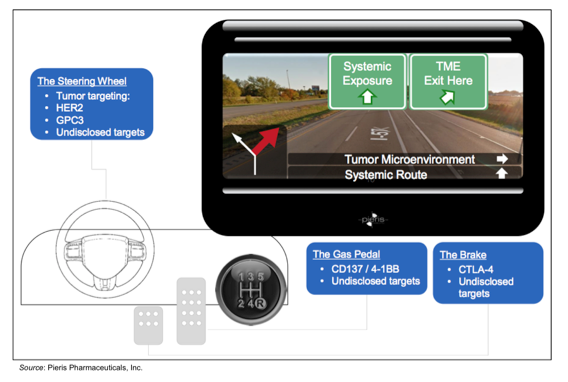
The Steering Wheel: In order to target an immunological response specifically to the tumor, it is necessary to have a guide, or “steering wheel”, that directs the immune system cells to the proper area in the body. Ideally, these targets would be uniquely expressed, or at least overexpressed, by tumors, while having little to no expression in normal tissues. HER2 and GPC3 are two such targets that have been disclosed thus far by Pieris. HER2 is a clinically validated tumor associated antigen that has been shown to play a role in the development and progression of a number of different cancer types, most notably in breast cancer, where it is overexpressed in 20-30% of breast tumors (Mitri et al., 2012). Trastuzumab (Herceptin™) is a monoclonal antibody that targets HER2 that has been shown to improve overall survival and disease-free survival in patients with HER2-positive breast cancer (Moja et al., 2012). GPC3 is a cell surface protein that is overexpressed in hepatocellular carcinoma (Hsu et al., 1997) and melanoma (Nakatsura et al., 2004) while having almost no expression in normal tissue.
The Gas Pedal: Activating an immunological response to cancer is mediated through various cell surface receptors, one of which is CD137 (4-1BB, TNFSFR9), which is a tumor necrosis factor receptor (TNFR) family member with costimulatory function that regulates T-cell proliferation and survival and is expressed on activated CD8+ and CD4+ T-cells (Watts, 2005). Activation of CD137 is akin to “stepping on the gas” of the immune system to generate a robust antitumor response.
PRS-343
PRS-343 is a bispecific compound that contains a CD137-specific Anticalin® genetically linked to a HER2-specific monoclonal antibody (trastuzumab), and is the lead compound from the company’s IO program. As mentioned above, CD137 is expressed on activated CD8+ T-cells. Since CD8+ T-cells play a pivotal role in tumor immunity, enhancing CD137 costimulation could promote the generation of protective antitumor immune responses. This idea has been validated through enhanced immunogenicity in tumor cells engineered to express CD137 ligand (Mogi et al., 2000) or anti-CD137 antibodies (Ye et al., 2002). Unfortunately, the use of systemic anti-CD137 antibodies can result in severe side effects such as liver toxicity (Grade 4 hepatitis), which resulted in the cancellation of a Phase 1 clinical trial (Yao et al., 2013). Thus, the ability to “steer” the CD137-stimulated T-cells into the tumor microenvironment could mitigate these systemic toxic effects.
Another important aspect of CD137 is that it is preferentially expressed in high levels on intratumoral T-cells (Palazón et al., 2012). This is shown in the following graph, where CD4+ and CD8+ T-cells were extracted from the spleen, lymph nodes, and tumor of mice bearing CT26 tumors. Only T-cells purified from tumors showed expression of CD137, whereas T-cells from other locations from the same mice did not show increased expression of CD137.
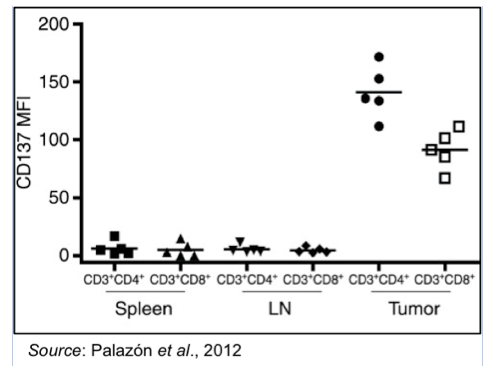
These data were further corroborated in tissue samples from patients with ovarian cancer (Ye et al., 2014). Results from that study showed that tumor-infiltrating lymphocytes (TILs; found in the tumor microenvironment) and tumor-associated lymphocytes (TALs; found surrounding the tumor microenvironment) naturally expressed higher levels of CD137 than circulating T cells. In addition, CD137-expressing TILs, but not PD-1 positive or PD-1 negative CD137-negative cells, possessed autologous tumor reactivity both in vitro and in vivo. All told, there is significant data to support the use of CD137-targeting therapeutics as anti-cancer agents.
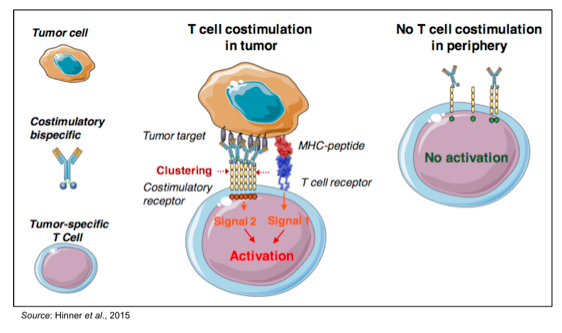
The CD137 directed T-cell response is generated through a “clustering” phenomenon, where the more CD137 molecules that are activated together in a group leads to a greater activation signal. This “clustering” occurs because of the overexpression of HER2 on the tumor cell surface. By bringing together the tumor cell and the T-cell, the T-cell receptor can then interact with any peptides presented on the tumor cell surface through the major histocompatibility complex (MHC), further enhancing the anti-tumor response by the T-cell. This is all depicted in the following graphic.
Pieris has done a number of studies on different CD137-specific Anticalin’s® to identify the lead molecule to advance into clinical testing. The company revealed that this lead compound has a very high affinity for CD137 (~2 nM), activates T-cells in an ex vivo model, and binds to CD137 in a “non-competitive fashion”. What this means is that binding of the Anticalin® to CD137 does not interfere with the binding of CD137 and its natural ligand. The flexibility of the Anticalin® platform is exemplified in the following graphic, which shows that no matter how the Anticalin® is attached to the monoclonal antibody, both entities retain the ability to bind to their respective ligands with essentially the same affinity.
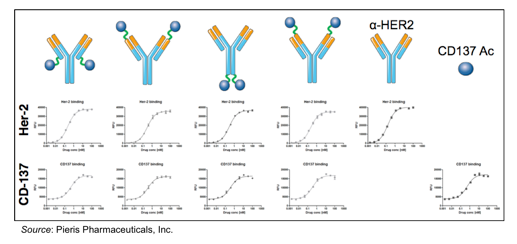
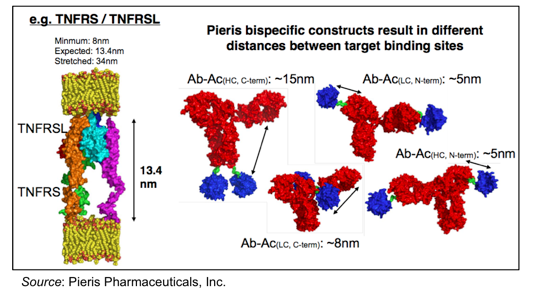
Another advantage of the flexibility of the Anticalin® platform is that the bispecific geometry of the molecule can be manipulated to create different pharmacodynamic effects. This is shown in the following graphic, where multiple distances between HER2 and CD137 binding can be tested to determine the optimal target synapse.
The company has nominated a PRS-343 development candidate that has shown the ability to activate human T-cells in a tumor-dependent fashion that is differentiated from anti-CD137 monoclonal antibodies. IND-enabling studies are currently underway, and we believe that the first-in-man studies will begin with this compound in the first half of 2017.
PRS-342
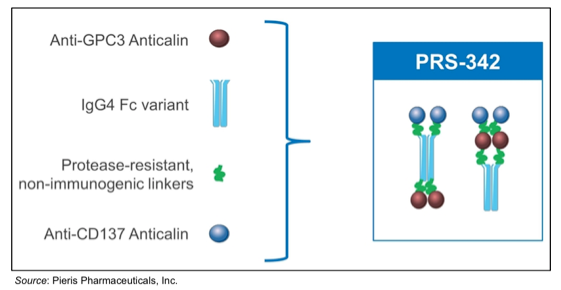
PRS-342 is a bispecific compound that contains a CD137-specific Anticalin®, an Fc molecule, and a GPC3-specific Anticalin®. The compound contains the Fc portion of an IgG4 antibody, which is the constant region of those molecules. The following figure shows the potential configurations for PRS-342.
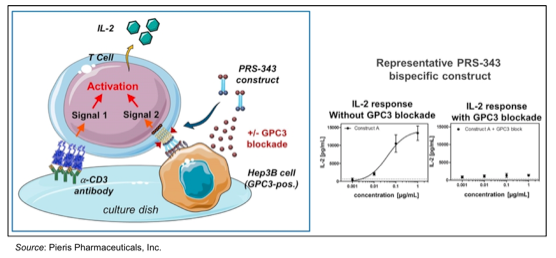
The following figure shows that just as with PRS-343, the activation of the T-cell is tumor dependent, thus mitigating the chance for systemic effects due to T-cell activation outside of the tumor microenvironment. The data in the following figure shows how the IL-2 response is only generated through a costimulatory approach when the T-cell is activated through two pathways, binding of the T-cell receptor (through an anti-CD3 antibody in the assay or an MHC-peptide in vivo) and clustering of CD137 through engagement of GPC3 on the tumor cell surface. Most importantly, these results show that the costimulatory approach taken by Pieris is amenable to multiple tumor targets, again highlighting the power of the Anticalin® platform.
Other Disease Areas
In addition to IO, Pieris is developing Anticalin® products for diseases with high unmet medical needs and validated disease targets.
PRS-080
PRS-080 is an Anticalin® that targets hepcidin, a 25 amino acid peptide produced in the liver and excreted into the bloodstream where it binds to ferroportin, an iron transporter found on duodenal enterocytes, reticuloendothelial macrophages, and hepatocytes (Donovan et al., 2006). Binding of hepcidin to ferroportin induces its internalization and degradation, resulting in iron accumulation in enterocytes, macrophages, and the liver. Hepcidin expression is induced by inflammatory cytokines, which is hypothesized to result in the sequestration of iron from invading pathogens (Babitt et al., 2010). This increased hepcidin expression results in many of the hallmarks of chronic diseases, including iron sequestration, hypoferremia, and anemia.
Pieris is developing PRS-080 as a treatment for functional iron deficiency (FID) in anemic patients with chronic kidney disease (CKD), which is a progressive loss of kidney function over a period of months or years. FID in CKD patients is characterized by low circulating iron levels that limits erythropoiesis even when these patients have sufficient iron stores in their body. These patients have low serum transferrin (a measure of circulating iron) and normal or high serum ferritin (a marker of body iron stores). FID is characteristic of a chronic inflammatory state, which in CKD patients may be due to an increased incidence of infections and/or the induction of inflammatory cytokines by the hemodialysis procedure.
The company presented results at the American Society of Hematology (ASH) 2015 annual meeting from a placebo controlled, double blind, Phase 1 study with ascending doses of PRS-080 in six cohorts of healthy volunteers of 0.08, 0.4, 1.2, 4.0, 8.0, and 16.0 mg/kg (NCT02340572). Six patients in each cohort received drug while two patients received placebo through a two hour intravenous infusion. A total of 39 adverse events (AEs) were reported during or after treatment in 22 subjects. All AEs were mild or moderate and there were no serious AEs reported. Importantly, there were no infusion reactions or hypersensitivities noted during the study. In addition, no anti-drug antibodies were detected from participants treated with PRS-080.
A decrease in free hepcidin was noted beginning one hour after administration of PRS-080 along with a transient increase in serum iron concentration and transferrin saturation. Serum iron concentrations reached approximately 50 μM in individual subjects but did not increase further with increasing dose. The normal range for serum iron concentration is approximately 11-30 μM. We believe this is a very important data point to come out of this trial, because if PRS-080 is able to increase normal iron levels to above normal, it stands to reason that it should be able to increase anemic patients iron levels to within the normal range.
The company is currently conducting a Phase 1b clinical trial of PRS-080 in hemodyalisis-dependent patients with end-stage renal disease (ESRD), with results from this first-in-patient study expected in the second half of 2016. With approximately 180,000 dialysis patients worldwide having functional iron deficiency, we estimate PRS-080 could have greater than $1 billion in peak sales.
PRS-060
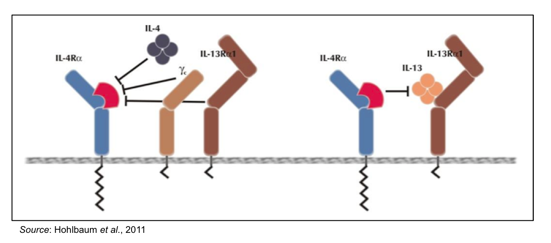
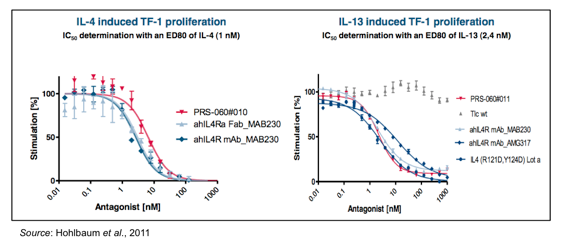
PRS-060 is an Anticalin® that has very high affinity for IL4Ra (Kd ~ 20 pM) and does not bind to the related cytokine receptors IL6R, IL18R, and IL23R. By targeting IL4Ra, PRS-060 inhibits binding of both IL-4 and IL-13, as depicted in the following graphic.
The inhibition of IL-4 and IL-13 binding by PRS-060 was shown in a series of preclinical experiments involving erythroleukemic (TF-1) cells that proliferate upon stimulation with a wide range of cytokines. The cells were preincubated for 30 min with PRS-060 or other IL4Ra antagonists prior to stimulation with IL-4 (left) or IL-13 (right). Cell proliferation was measured five days after treatment and graphed as a function of increasing amounts of IL4Ra antagonist. The results show that PRS-060 is able to inhibit both IL-4 and IL-13 dependent proliferation.
One of the advantages that Anticalins® have is their mode of delivery can be modified depending upon the therapeutic target. In the case of PRS-060, which is targeting IL4Ra expression in the lung, inhalation delivery would be optimal as it is likely to decrease the systemic side effects that could arise from a chronic, systemic Th2-targeting medication. Pieris has conducted inhalation studies with PRS-060 in mice and determined that systemic concentration of PRS-060 is minimal when dosed by inhalation. Since most other asthma medications are dosed by inhalation, the ability to dose PRS-060 by inhalation represents a more convenient dosing regimen than monoclonal antibody treatments, which must be administered by injection at a doctor’s office or other medical clinic.
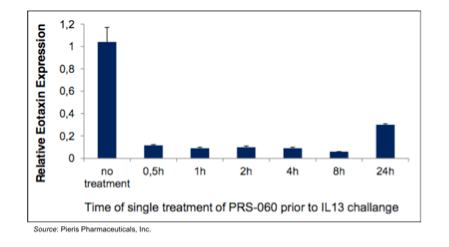
Efficacy of inhaled PRS-060 is shown in the following graphic, in which eotaxin expression (a marker of airway inflammation) was induced by administration of IL-13 to the lungs of mice after pre-treatment with inhaled PRS-060. The data shows that eotaxin expression is inhibited for up to 24 hours following a single inhaled dose of PRS-060.
Currently, PRS-060 is still in preclinical development with the final IND enabling studies being conducted in 2016 in preparation for a first-in-man study to be initiated in the first half of 2017. With well over 1 million potential patients worldwide, PRS-060 has blockbuster potential.
Update on Collaborations
On November 19, 2015, Pieris announced that collaborator Daiichi Sankyo Company, Ltd. dosed the first subject in a Phase 1 clinical study for the lead partnered Anticalin® program, which also triggered an undisclosed milestone payment. Pieris recently announced that the target of the partnered program is proprotein convertase subtilisin/kexin type 9 (PCSK9) and is being developed for dyslipidemia. Two monoclonal antibodies targeting PCSK9 have recently been approved by the FDA (alirocumab and evolocumab) while a third is currently in Phase 3 clinical trials (bococizumab). The compounds work by binding to the PCSK9 protein, thereby preventing it from binding to LDL receptors on the liver. The end result is additional LDL binding to those receptors, which leads to LDL clearance out of the bloodstream. The anti-PCSK9 antibodies are forecast to have peak revenues of $1 billion each.
As a reminder, Pieris entered into a research and technology licensing agreement with Daiichi Sankyo in 2011 whereby Pieris utilized the Anticalin® platform to discover novel drug candidates against two undisclosed targets chosen by Daiichi Sankyo. The two drug candidates have since been turned over to Daiichi Sankyo based upon the achievement of preclinical development milestones. Upon signing the collaboration agreement Pieris received $8.7 million and research funding with a total of approximately $242 million in potential milestone payments from the two programs. In addition, Pieris will receive mid- to mid-high single digit royalties on the sale of products originating from this agreement.
On November 30, 2015, Pieris announced a third milestone was achieved in the company’s R&D collaboration with Sanofi, which triggered an undisclosed payment to Pieris. The milestone payment is due to Sanofi’s decision to continue development of the tetra-specific Anticalin®-based program for infectious disease. As a reminder, Sanofi presented preclinical data on this program at the 2015 American Society of Microbiology Conference that included promising in vivo activity in a chronic Pseudomonas aeruginosa infection animal model along with desirable manufacturing and stability criteria. Pieris originally entered into a collaboration and licensing agreement with Sanofi in 2010. Upon signing the agreement, Pieris received an upfront payment of $4.2 million along with research funding with up to $31.5 million available upon the achievement of development milestones and up to $21.8 million available upon the achievement of commercialization milestones for the product. In addition, royalties of mid- to mid-high single digits are payable based upon the sale of products originating from this collaboration.
On December 8, 2015, Pieris announced it entered into a research collaboration and license agreement with Roche in cancer immunotherapy. At this point, the agreement only covers one target, but the potential exists for it to turn into a multi-program agreement. Pieris received an upfront payment of $6.4 million along with Roche fully funding the collaborative research phase. The deal could potentially be worth up to $400 million, with most of that money tied to development milestones, and does not include the potential for up to low double-digit royalties. This was an important milestone for the company, since working with an industry leader like Roche helps to further validate the Anticalin® platform while providing the opportunity to sign additional partnership deals and use the upfront payment to fund the company’s proprietary programs.
Conclusion and Recommendation
Pieris’ balance sheet is rock solid. As of September 30, 2015 the company had $32.3 million in cash and equivalents, which does not include the milestone payments from Daiichi and Sanofi or the upfront payment from Roche received in the fourth quarter of 2015, along with no debt. This should be sufficient to fund operations into 2017 and is a very important metric for the company given the current downturn in the biotechnology sector.
The Anticalin® platform is unrivaled at this moment in terms of both its flexibility and adaptability, and as the quote at the beginning of this report states, Pieris owns an entire class of drugs! With a near 100% success rate in identifying Anticalin’s® that bind to a target of choice, along with the ability to combine Anticalin’s® together in a virtually limitless combination, the full capability of the platform is only limited by the imagination of those using it. In addition, the company’s focus on IO is the right move, as real success with IO treatments will necessitate a multi-target approach, something for which the Anticalin® platform is particularly well-suited.
That the company is currently valued at only $60 million is baffling, since it is conceivable that Anticalin’s® could (and likely will) be produced for any number of multi-billion dollar indications. The fact that a number of leading biopharmaceutical companies have entered into collaboration with Pieris gives further validation to the platform, and the wide range of targets being exploited through the partnerships (PCSK9, P. aeruginosa, undisclosed immunotherapy target) underscores the flexibility of the platform to suit multiple therapeutic needs.
The recent negative sentiment in the biotechnology sector has indiscriminately affected every biotechnology company, which in the case of Pieris should be viewed by investors as an opportunity to pick up shares in one of the top small-cap biotechnology companies. We view the Anticalin® platform as a transformative technology that will lead to novel treatments in a variety of disease areas. Our price target is $8, and we are maintaining a ‘Buy’ rating on the shares.
READ THE LATEST FULL RESEARCH REPORT HERE
SUBSCRIBE TO ZACKS SMALL CAP RESEARCH to receive our articles and reports emailed directly to you each morning. Please visit our website for additional information on Zacks SCR and to view our disclaimer.