By David Bautz, PhD
OTC:PRTX
Business Update
PRTX-100
Protalex, Inc. (OTC:PRTX) is developing PRTX-100, a proprietary, highly purified form of Staphylococcus aureus protein A (SpA). SpA is a 42 kDa bacterial membrane protein composed of 5 nearly identical domains. Each of these domains has the ability to interfere with the activity of antibodies and B-cell receptors (BCRs). B-cell receptors are antibody-like proteins displayed on the surface of B-cells. The B-cell receptors found on the surface of each B-cell have the same antigen specificity as the antibodies it produces. SpA interferes with the protective immune response by binding to sites on the antibody or BCR other than the antigen binding sites antibodies normally use to bind pathogens. Protalex is currently developing PRTX-100 for the treatment of immune thrombocytopenia and rheumatoid arthritis.
PRTX-100 in Rheumatoid Arthritis
On April 25, 2016, Protalex announced preliminary findings from the PRTX-100-105 Study (NCT02330445). This study is a continuation study for former patients of the PRTX-100-104 Study that involves four weekly doses followed by five monthly doses of 6 μg/kg of PRTX-100 in combination with either methotrexate or leflunomide. The primary objective of the study is the safety and tolerability of a fixed dose of PRTX-100 administered over an extended period of time. Secondary objectives of the study are to evaluate clinical response to PRTX-100 treatment and what effect anti-PRTX-100 antibodies have on clinical activity.
The preliminary interim analysis indicated that for the eight of 11 trial participants who completed per protocol, PRTX-100 had an acceptable safety profile and RA disease activity was improved in a majority of patients at the end of the study compared to baseline. Importantly, there were no serious adverse events reported. One month after the final dose, the patients had a mean reduction in DAS28-CRP from 5.25 to 2.52. The DAS28 assessment is a composite score derived from the number of swollen joints, the number of tender joints, an assessment of general health, and a serum marker such as erythrocyte sedimentation rate (DAS28-ESR) or C-reactive protein (DAS28-CRP). The raw data from these assessments is combined to give a single score of disease activity using a mathematical formula. The cutoff values for qualitative assessment of patients according to DAS28 are as follows:
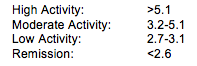
According to that scale, the eight patients that completed the 105 Study per protocol went from an average of “High Activity” to “Remission”! To put these data into perspective, the following table lists results from the AMPLE study, which compared abatacept (Orencia®) to adalimumab (Humira®) in RA patients naïve to treatment with biologic therapy (Weinblatt et al., 2013). The data showed that both adalimumab and abatacept resulted in a mean decrease of -2.3 for DAS28-CRP after six months of treatment, with both groups starting at an average DAS28-CRP of 5.5. Thus, PRTX-100 compares very favorably to both currently available biologics, each of which has a different mechanism of action.
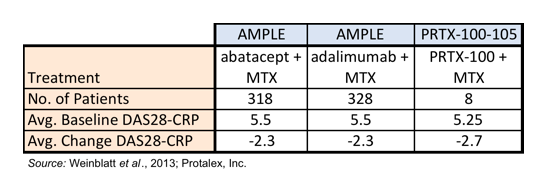
Protalex reported no serious adverse events in the 105 Study. In comparison, 10.1% of patients taking abatacept and 9.1% of patients taking adalimumab had serious adverse events in the AMPLE study. While hard to draw too many conclusions from a study of 8 patients, it appears that PRTX-100 may offer similar, if not better, efficacy than currently available RA treatments with a much better safety profile. If these results were to hold up in future clinical trials, PRTX-100 could become a blockbuster medication.
Awaiting next steps in RA
The results of the 105 Study agree with earlier clinical results suggesting that PRTX-100 is efficacious in RA patients with a better safety profile than currently available biological treatments. The company is continuing to work with outside consultants and various “Big Pharma” companies in order to obtain feedback on the design of a Phase 2 trial such that the results will be of interest to potential partners at pharmaceutical companies.
We feel like PRTX-100 is not far enough along in clinical development for a large pharmaceutical company to want to enter into a partnership yet, thus Protalex wants to be sure that whatever data is generated in the Phase 2 trial will be sufficient for a potential collaborator to decide whether or not PRTX-100 is worth pursuing further. We anticipate the company submitting the final clinical report for the 105 Study to the FDA within the next few months and finalizing a Phase 2 protocol before the end of 2016 such that a clinical trial can begin in 2017.
PRTX-100 in Immune Thrombocytopenia
Immune thrombocytopenia (ITP) is a bleeding disorder characterized by bruising and increased bleeding as a result of immune-mediated accelerated destruction of platelets and impaired production of platelets. ITP is an autoimmune-mediated condition in which the immune system attacks and destroys platelets, which are necessary for normal blood clotting. The disease can be brought on by bacterial or viral infections. The condition can be acute (short-term) or chronic (long-lasting) in nature, with women being two to three times as likely to develop chronic ITP as men. The bleeding can be found inside the body (internal bleeding), and underneath or from the skin (external bleeding).
The diagnosis of ITP is based upon a low platelet count, usually less than 100,000 per microliter of blood, in the absence of other possible causes of reduced platelet numbers such as an underlying illness or medication. A normal platelet count is considered to be between 150,000 and 450,000 per microliter of blood. ITP is recognized by the FDA as an orphan disease, which is defined as a condition that affects fewer than 200,000 people nationwide. The incidence for ITP is approximately 9.5 per 100,000 people in the U.S., representing approximately 30,000 cases.
Treatment of ITP depends upon the severity of symptoms and whether the patient is newly diagnosed or has a chronic condition. Adult patients who have significant bleeding are almost always treated, and while there is not necessarily an absolute platelet count threshold, bleeding accompanied with a platelet count < 50,000 per microliter of blood almost always warrants treatment. Current treatment options include glucocorticoids, intravenous immunoglobulin, and the thrombopoietic agents romiplostim (Nplate®) and eltrombopag (Promacta®).
PRTX for the Treatment of ITP
Four important lines of evidence support the use of PRTX-100 for the treatment of ITP:
- SpA is known to bind almost exclusively to human antibodies derived from the VH3 gene family (Graille et al., 2000)
- ITP autoantibodies are almost exclusively derived from rearrangements of a single Ig heavy-chain variable region gene (VH3-30) (Roark et al., 2002). In that study, 39 unique ITP autoantibody sequences were isolated from two ITP patients, with 6/6 sequences from patient A and 29/33 sequences from patient B being derived from VH3-30
- In a study involving SpA administration to mice, results showed a selective reduction in VH3 gene expression and this effect was long-lived, leading to an immunological “hole” in the B-cell repertoire where VH3-derived antibodies were significantly decreased (Silverman et al., 2000)
- Seventy-two ITP patients treated with the Prosorba® column (a medical device containing highly purified SpA covalently bound to a silica matrix, where plasma is passed over the column such that it can bind to and remove antibodies from the circulation) had an acute increase in platelet count to greater than 100,000 per microliter of blood in 18 patients and to 50,000 to 100,000 per microliter of blood in 15 patients (Snyder et al., 1992). The efficacy of the Prosorba® column in treating ITP is most likely predicated on the fact that up to 200 μg of SpA can leach from the column during immunoabsorption procedures (Roark et al., 2002). The SpA then likely binds to and deletes VH3 antibodies inside the patient, including those that are targeting platelets.
Those four lines of evidence lead us to believe that PRTX-100 is likely to be successful as a treatment for ITP, with a differentiated mechanism of action from currently available therapies.
Clinical Trials of PRTX-100 in ITP
Protalex is currently testing PRTX-100 in adults with chronic/persistent ITP in two clinical trials.
Study PRTX-100-202 (NCT02401061): This is an open label, dose escalation trial taking place in the U.S. that is expected to enroll up to 36 patients in as many as six dosing cohorts (1, 3, 6, 12, 18, and 24 μg/kg with 3-6 patients per dosing cohort). Inclusion criteria includes patients that are refractory to treatment with a thrombopoietic agent, are not receiving another ITP treatment and have a platelet count of <30,000 per microliter, or if on an approved treatment (corticosteroids or one of the thrombopoietic agents) having a platelet count of <50,000 per microliter. The primary endpoint for the study is platelet response, which for patients not receiving another ITP treatment is defined as platelet count >30,000 per microliter and at least a doubling of baseline platelet count. For patients receiving permitted treatments for ITP with a baseline platelet count of >30,000 per microliter and <50,000 per microliter, an increased platelet count >50,000 per microliter will be considered a platelet response. An independent safety monitoring committee (SMC) is monitoring the trial for adverse events following the dosing of each cohort before the next cohort can be enrolled. On February 29, 2016, the SMC gave a positive planned interim review of the safety data for the first cohort of patients.
Study PRTX-100-203 (NCT02566603): This is an open label, dose escalation trial that is taking place in France and is expected to enroll 30 adults who have received one prior ITP treatment in as many as five dosing cohorts. Similar to the 202 Study, the open-label 203 Study will dose patients with four, once-weekly doses of PRTX-100 (3, 6, 12, 18, and 24 μg/kg) and then follow them for up to a year. The primary outcome for the 203 Study is safety, with secondary outcomes including platelet response and concomitant ITP medication usage. On May 2, 2016, the company announced a positive interim data review by the independent safety monitoring committee following dosing of the first cohort of patients. Enrollment will now continue with the next cohort of patients set to receive 6 μg/kg of PRTX-100.
Financial Update
On April 12, 2016, Protalex, Inc. (PRTX) filed form 10-Q with financial results for the third quarter of fiscal year 2016 that ended February 29, 2016. As expected, the company did not report any revenues during the quarter. Net loss for the period ending Feb. 29, 2016 was $1.8 million and was comprised of $0.8 million in R&D expenses, $0.9 million in G&A expenses, and $0.1 million in D&A and interest expense. The net loss per share was $0.06 based on 28.8 million shares outstanding. Total cash burn for the quarter was $1.1 million.
The company is continuing its financing needs through a Credit Facility Agreement originally signed in November 2014 with Niobe Ventures, LLC, a limited liability company controlled by Arnold P. Kling, Protalex’s president and director. The agreement calls for a total of $7.5 million to be made available to the company. As of February 29, 2016, the outstanding principal balance totaled $6.1 million. For fiscal year 2016, the company has borrowed a total of $2.76 million. Subsequent to the end of the quarter, Protalex borrowed an additional $0.35 million on both March 4, 2016 and April 1, 2016. Each loan made to Protalex is represented by a senior secured promissory note with an interest rate of 3%. We remind investors that Niobe and management own approximately 80% of Protalex. As we’ve state previously, we have little concern about the ongoing financial needs of the company.
Conclusion and Recommendation
We continue to be enthusiastic about the potential for PRTX-100 in both RA and ITP. The results from the 105 Study give us increased confidence that PRTX-100 could go on to be a blockbuster medication. For RA, we estimate potential peak sales of PRTX-100 of greater than $1 billion, while for ITP we estimate peak sales of approximately $400 million. We believe the company has shown that PRTX-100 is safe, as it has now been tested in six clinical trials in RA patients and has also passed the first safety assessment in the 202 Study. Thus we do not anticipate any additional safety signals from the rest of the dosing cohorts in the ITP study.
While safety is certainly of interest in the 202 Study, the primary endpoint is platelet response, and we believe that we will receive some type of an indication as to the clinical effectiveness of PRTX-100 in ITP before the end of 2016. As a reminder, this trial is open label, so the patients can be tracked in real time and their results relayed to the company in an ongoing basis. It took approximately 3 months for the first cohort of patients in the 202 Study to be enrolled and dosed, and we would anticipate that future cohorts would take no longer than this or even a bit less time as new study sites are added. Thus, the 3 μg/kg cohort should be completed by the end of May and then will have approximately 7 months of follow-up by the end of 2016.
We view ITP as a meaningful opportunity for Protalex as Nplate® generated revenues in 2015 of $525 million Promacta® generated $500 million (EvalutePharma). PRTX-100 has already been granted Orphan Drug Designation by the FDA and EMA for the treatment of ITP, which both confers market exclusivity as well as making the compound more attractive to potential ‘Big Pharma’ partners.
The release of preliminary data from the ongoing Phase 1/2 clinical trials of PRTX-100 in ITP is a potential major catalyst for the stock in the second half of 2016. Based on our DCF model, we believe the shares are worth approximately $10 and currently represent a compelling opportunity for those with a higher risk tolerance.
READ THE FULL RESEARCH REPORT HERE
SUBSCRIBE TO ZACKS SMALL CAP RESEARCH to receive our articles and reports emailed directly to you each morning. Please visit our website for additional information on Zacks SCR and to view our disclaimer.