By David Bautz, PhD
OTC:PRTX
Financial Update
On January 7, 2016, Protalex, Inc. (OTC:PRTX) filed form 10-Q with financial results for the second quarter of fiscal year 2016 that ended November 30, 2015. The company did not report any revenues in the second quarter. Net loss for the quarter was approximately $2.2 million, or and was comprised of $1.1 million in R&D, $1.0 million of G&A, and $0.1 million in D&A and interest expense. The net loss per share was $0.08 based on 28.8 million shares outstanding. Total cash burn for the quarter was $1.0 million.
Subsequent to the end of the quarter, Protalex entered into a revised Credit Facility Agreement with Niobe Ventures, LLC, a limited liability company controlled by Arnold P. Kling, Protalex’s president and director. The revised agreement increased the funds available for the company under the 2014 Credit Facility Agreement to $7.5 million from $5 million. On both December 1, 2015 and January 4, 2016 the company borrowed $345,000. Each loan made to Protalex will be represented by a senior secured promissory note with an interest rate of 3%. We remind investors that Niobe and management own approximately 80% of the company. As we’ve stated previously, we have little concern about the ongoing financial needs of the company.
Clinical Trials of PRTX-100 in ITP Underway
On January 7, 2016, Protalex announced that the first patient has been dosed in the European Phase 1b study of PRTX-100 in adults with chronic immune thrombocytopenia (ITP). The company is also currently conducting a Phase 1/2 study of PRTX-100 in adults with chronic ITP in the U.S. PRTX-100 has orphan drug designation in both the U.S. and Europe for the treatment of ITP. Below we give a brief overview of ITP, PRTX-100, and the two studies currently underway.
Immune Thrombocytopenia
Immune thrombocytopenia (ITP) is a bleeding disorder characterized by bruising and increased bleeding as a result of immune-mediated accelerated destruction of platelets and impaired production of platelets. ITP is an autoimmune-mediated condition in which the body’s own immune system attacks and destroys platelets, which are necessary for normal blood clotting. The disease can be brought on by bacterial or viral infections. The condition can be acute (short-term) or chronic (long-lasting) in nature, with women being two to three times as likely to develop chronic ITP as men. The bleeding can be found inside the body (internal bleeding), and underneath or from the skin (external bleeding).
The diagnosis of ITP is based upon a low platelet count, usually less than 100,000 per microliter of blood, in the absence of other possible causes of reduced platelet numbers such as an underlying illness or medication. A normal platelet count is considered to be between 150,000 and 450,000 per microliter of blood. ITP is recognized by the FDA as an orphan disease, which is defined as a condition that affects fewer than 200,000 people nationwide. The incidence for ITP is approximately 9.5 per 100,000 people in the U.S., representing approximately 30,000 cases.
Treatment of ITP depends upon the severity of symptoms and whether the patient is newly diagnosed or has a chronic condition. Adult patients who have significant bleeding are almost always treated, and while there is not necessarily an absolute platelet count threshold, bleeding accompanied with a platelet count < 50,000 per microliter of blood almost always warrants treatment. Treatments for ITP are as follows:
Glucocorticoids: These agents work by suppressing the immune system. In urgent situations, infusions of dexamethasone or methylprednisolone may be used, while less severe cases can typically be treated with oral prednisone or prednisolone. As a patients platelet count increases the glucocorticoids are gradually tapered back to limit side effects of long-term glucocorticoid use, which include osteoporosis, cataracts, and diabetes. Relapse rates are high with glucocorticoid treatment, as only 20-40% of patients will have a durable remission (Stevens et al., 2006).
Intravenous Immunoglobulin: Another treatment option for urgent situations is the use of intravenous immunoglobulin (IVIg), which contains the pooled, polyvalent IgG antibodies extracted from over a thousand healthy donors. The mechanism of action for IVIg in autoimmune diseases is currently unknown, but the treatment is considered relatively safe although serious side effects have been reported, including anaphylaxis and venous thrombosis.
Thrombopoietic agents: These medications work to directly stimulate production of platelets; however, unlike other treatment options they do not appear to have an effect on platelet destruction. Two of these agents are currently available:
- Romiplostim (Nplate®): This is an Fc-peptide fusion protein that increases platelet production by binding to and activating the thrombopoietin (TPO) receptor. Clinical trials showed romiplostim to be effective in chronic ITP patients, particularly in those with relapsed disease who had previously had a splenectomy (Kuter et al., 2010). The FDA approved the compound in 2008. Amgen reported revenues of $469 million for Nplate® in 2014.
- Eltrombopag (Promacta®): This is an oral TPO receptor agonist that induces megakaryocyte proliferation and differentiation from bone marrow progenitor cells. Clinical trials showed eltrombopag decreased bleeding episodes and increased platelet count in a dose dependent manner (Bussel et al., 2007). The FDA approved the compound in 2008. GlaxoSmithKline reported revenues of approximately $340 million for Promacta® in 2014.
PRTX-100 for the Treatment of ITP
PRTX-100 is a proprietary, highly purified form of Staphylococcus aureus protein A (SpA). SpA is a 42 kDa bacterial membrane protein composed of 5 nearly identical domains. Each of these domains has the ability to interfere with the activity of antibodies and B-cell receptors (BCRs). B-cell receptors are antibody-like proteins displayed on the surface of B-cells. The B-cell receptors found on the surface of each B-cell have the same antigen specificity as the antibodies it produces. SpA interferes with the protective immune response by binding to sites on the antibody or BCR other than the antigen binding sites antibodies normally use to bind pathogens.
Four important lines of evidence support the use of PRTX-100 for the treatment of ITP:
- SpA is known to bind almost exclusively to human antibodies derived from the VH3 gene family (Graille et al., 2000)
- ITP autoantibodies are almost exclusively derived from rearrangements of a single Ig heavy-chain variable region gene (VH3-30) (Roark et al., 2002). In that study, 39 unique ITP autoantibody sequences were isolated from two ITP patients, with 6/6 sequences from patient A and 29/33 sequences from patient B being derived from VH3-30
- In a study involving SpA administration to mice, results showed a selective reduction in VH3 gene expression and this effect was long-lived, leading to an immunological “hole” in the B-cell repertoire where VH3-derived antibodies were significantly decreased (Silverman et al., 2000)
- Seventy-two ITP patients treated with the Prosorba® column (a medical device containing highly purified SpA covalently bound to a silica matrix, where plasma is passed over the column such that it can bind to and remove antibodies from the circulation) had an acute increase in platelet count to greater than 100,000 per microliter of blood in 18 patients and to 50,000 to 100,000 per microliter of blood in 15 patients (Snyder et al., 1992). The efficacy of the Prosorba® column in treating ITP is most likely predicated on the fact that up to 200 μg of SpA can leach from the column during immunoabsorption procedures (Roark et al., 2002). The SpA then likely binds to and deletes VH3 antibodies inside the patient, including those that are targeting platelets.
Those four lines of evidence lead us to believe that PRTX-100 is likely to be successful as a treatment for ITP, with a differentiated mechanism of action from currently available therapies.
Preclinical Data Supports the Use of PRTX-100 in ITP
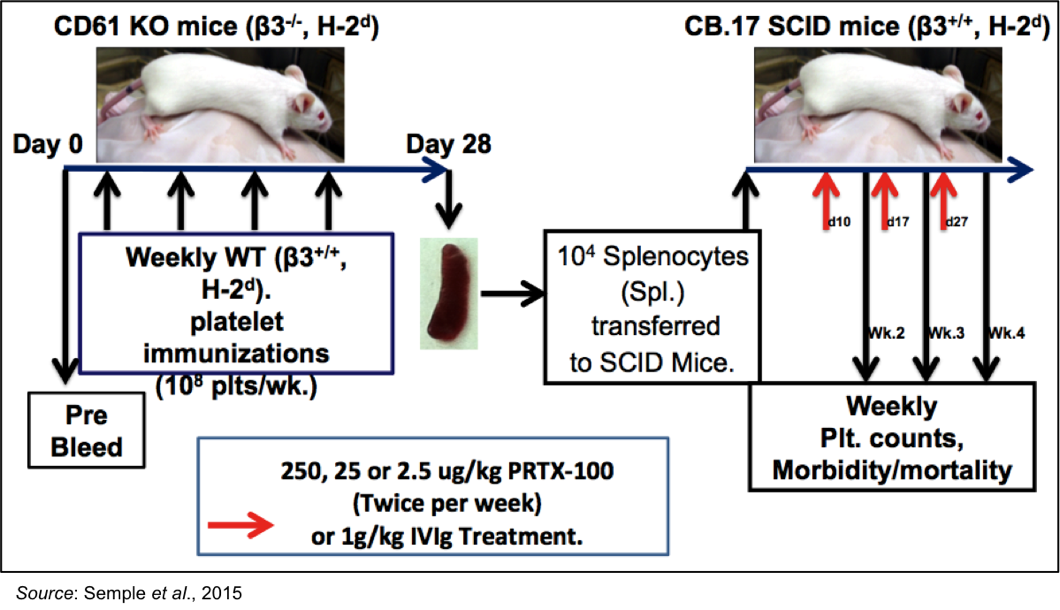
At the 2015 American Society of Hematology (ASH) meeting, data were presented that showed PRTX-100 was effective in treating ITP in an established murine model (Semple et al., 2015). The model involves the following (Chow et al., 2010):
- CD61 (platelet glycoprotein IIIa, a known target of the autoantibodies in ITP) knockout mice are immunized with platelets from wild-type mice. This results in an immune response to CD61 in the CD61 knockout mice.
- Splenocytes (which contain a mixture of B-cells, T-cells, dendritic cells, and macrophages) are isolated from the immunized CD61 knockout mice and transferred to severe combined immunodeficiency (SCID) mice, which are severely deficient in B- and T-lymphocytes.
- The SCID mice now harbor B- and T-lymphocytes that target CD61, resulting in the destruction of platelets and induction of ITP.
An outline of the experimental procedure is shown in the following figure:
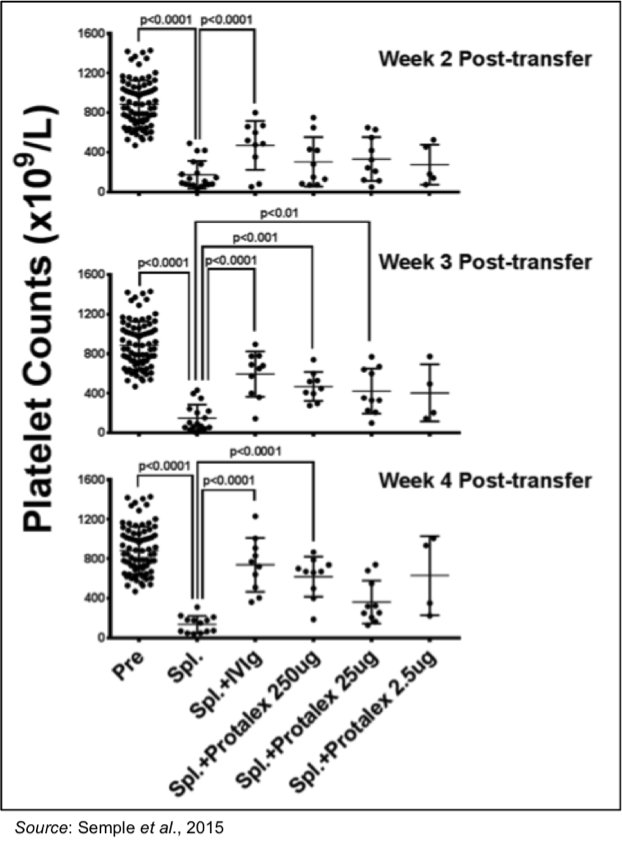
The following figure shows platelet counts in mice prior to receiving splenocytes, control mice not receiving treatment, and mice receiving treatment with either intravenous IVIg or PRTX-100 after two, three, and four weeks. The untreated mice that received splenocytes developed ITP, as shown by the significantly decreased level of platelets. Mice that received IVIg or PRTX-100 had platelet counts that increased to within normal levels within 1-2 weeks after treatment. PRTX-100 treatment was dose dependent, with the highest dose resulting in platelet levels that were very similar to mice treated with IVIg.
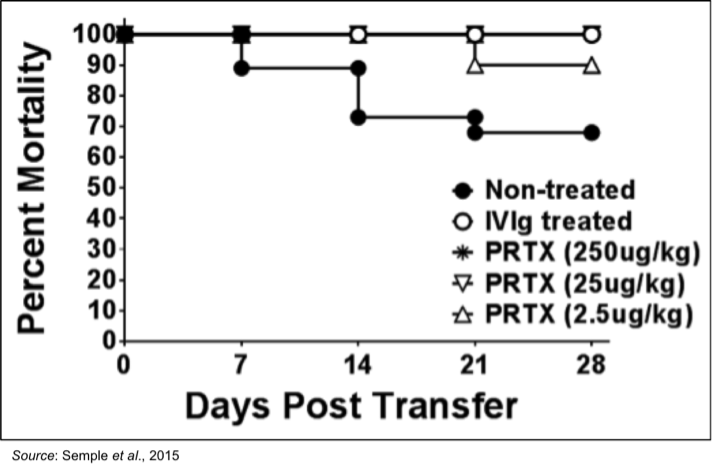
Lastly, the mortality rate for mice immunized with splenocytes and not treated was approximately 30%. No mice treated with either IVIg or the two higher doses of PRTX-100 died during the study, while 10% of the mice treated with the lowest dose of PRTX-100 died. There were no reports of any serious side effects for mice treated with PRTX-100.
Clinical Trials of PRTX-100 in ITP Underway
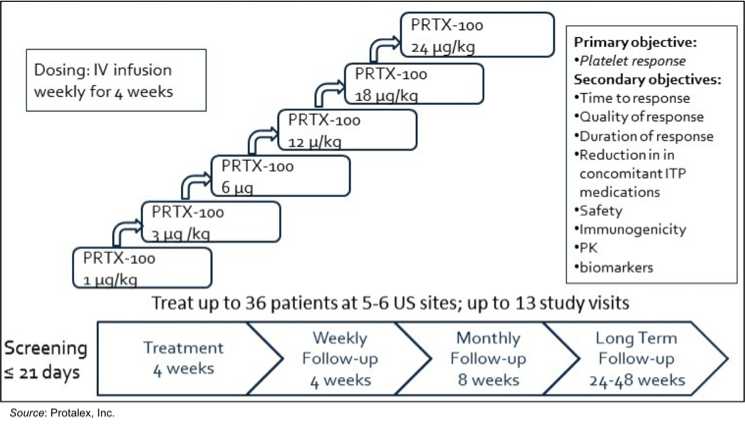
Protalex is currently testing PRTX-100 in adults with chronic/persistant ITP in two clinical trials. Since the studies are open-label, we expect topline results from both studies in the second half of 2016. Study PRTX-100-202 is an open-label, dose escalation trial taking place in the U.S. that will enroll up to 36 patients in as many as six dosing cohorts (1, 3, 6, 12, 18, and 24 μg/kg with 3-6 patients per dosing cohort) (NCT02401061). Patients will be dosed once-weekly for four weeks. A Data Safety Monitoring Board (DSMB) will review the safety data for each dosing cohort before the study is allowed to continue on to the next dosing cohort. Inclusion criteria includes patients that are refractory to treatment with a thrombopoietic agent, are not receiving another ITP treatment and have a platelet count of <30,000 per microliter, or if on an approved treatment (corticosteroids or one of the thrombopoietic agents) having a platelet count of <50,000 per microliter. The primary endpoint for the study is platelet response, which for patients not receiving another ITP treatment is defined as platelet count >30,000 per microliter and at least a doubling of baseline platelet count. For patients receiving permitted treatments for ITP with a baseline platelet count of >30,000 per microliter and <50,000 per microliter, an increased platelet count >50,000 per microliter will be considered a platelet response. The following figure gives an overview of the protocol for the 202 study.
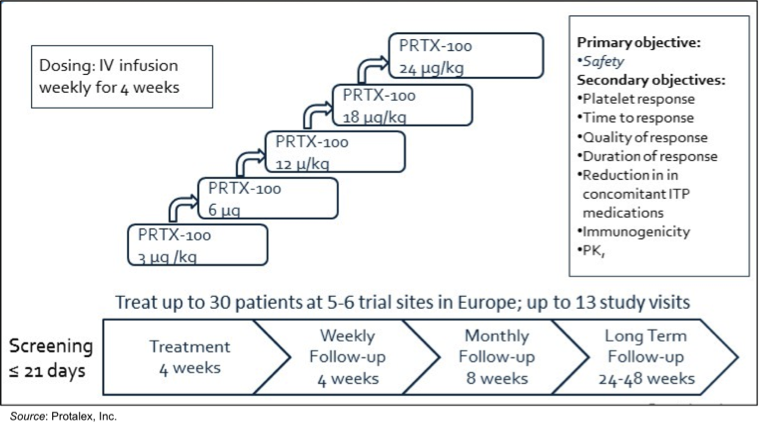
Study PRTX-100-203, which is taking place in France, is expected to enroll 30 adults who have received one prior ITP treatment in as many as five dosing cohorts (NCT02566603). Similar to the 202 Study, the open-label 203 Study will dose patients with four, once-weekly doses of PRTX-100 (3, 6, 12, 18, and 24 μg/kg) and then follow them for up to a year. The primary outcome for the 203 Study is safety, with secondary outcomes including platelet response and concomitant ITP medication usage. The following figure gives an overview of the protocol for the 203 Study.
PRTX-100 in Rheumatoid Arthritis
Protalex is currently conducting the PRTX-100-105 study (NCT02330445) in rheumatoid arthritis (RA) patients, which is a continuation of the -104 study. The company included 11 patients and treated them with 4 weekly doses followed by 5 monthly doses of 6 μg/kg PRTX-100, with the last patients set to conclude all their study visits in the first quarter of 2016. All of the patients participated in the -104 study, and the purpose of the -105 study is to evaluate the safety of 6 μg/kg PRTX-100 administered for an extended period of time, since it may be required for RA therapy. Secondary objectives of the study are to evaluate clinical response to PRTX-100 treatment and what effect anti-PRTX-100 antibodies have on clinical activity. We anticipate results from this study being available in mid-2016.
Awaiting next steps in RA
In April 2015, Protalex announced final cohort analysis from the Phase 1b trial. The final analysis confirmed the previously reported safety and tolerability of the drug. The analysis also suggests that weight-based dosing and monthly maintenance doses are an important aspect of the protocol and should be considered for future trials with PRTX-100, two ideas that have been incorporated into the -105 study. With respect to the relationship between certain biomarkers and response to PRTX-100, management is now going back and re-examining the data from the South African -103 study. In addition to working with outside consultants, the company will also speak to various “Big Pharma” companies in order to obtain feedback on the design of the Phase 2 trial such that the results will be of interest to potential partners at pharmaceutical companies.
We feel like PRTX-100 is not far enough along in clinical development for a large pharmaceutical company to want to enter into a partnership yet, thus Protalex wants to be sure that whatever data is generated in the Phase 2 trial will be sufficient for a large pharmaceutical company to decide whether or not PRTX-100 is worth pursuing further. We also believe the more data management has with respect to the biomarker activity of the drug, the more likely a big pharma partner will be interested in moving the drug forward because the probability of success goes up as the target population becomes more defined. We anticipate the company finalizing a Phase 2 protocol before the end of 2016.
Conclusion
We are maintaining a ‘Buy’ recommendation for shares in Protalex as the potential for PRTX-100 is quite large in both RA and ITP. We currently estimate potential peak sales of PRTX-100 in RA in excess of $1 billion, while for ITP we estimate potential peak sales of approximately $400 million. The company has shown PRTX-100 to be safe and well tolerated in RA patients, and there are initial signs of clinical activity. We look forward to learning more about the upcoming Phase 2 clinical trial later in 2016. For ITP, we believe that PRTX-100 has a reasonable probability of success based on the data discussed above involving SpA’s ability to selectively deplete autoantibodies and its success in preclinical animal models. PRTX-100 has already been granted Orphan Drug Designation by the FDA and EMA for the treatment of ITP, which both confers market exclusivity as well as making the compound more attractive to potential ‘Big Pharma’ partners.
Topline data from the ongoing Phase 1/2 clinical trials of PRTX-100 in ITP is a major catalyst for the stock in the second half of 2016. Based on our modeling, we believe the shares are worth approximately $10, and with the stock currently trading at approximately 50% of that value, we feel now is the time for investors to initiate or add to a position in the stock ahead of the ITP data release later in 2016.
READ THE LATEST FULL RESEARCH REPORT HERE
SUBSCRIBE TO ZACKS SMALL CAP RESEARCH to receive our articles and reports emailed directly to you each morning. Please visit our website for additional information on Zacks SCR and to view our disclaimer.