By: Nisha Hirani, M.D.
TSX:RVX.TO
OTC:RVXCF
Resverlogix Corp. (TSX:RVX.TO) (OTC:RVXCF) began recruiting and dosing participants in the Phase 3 BETonMACE trial of apabetalone (RVX-208) in high-risk CVD patients with diabetes in November 2015. We believe the trial will take approximately 3 years to complete, putting topline data in 2018.
The company also recently announced the commencement of an Orphan Disease Program to study apabetalone in complement mediated diseases, and plans to begin a Phase 2 proof-of-concept pilot study in a small group of patients with Paroxysmal Nocturnal Hemoglobinuria (PNH) in 2016.
At the current price, we view Resverlogix shares as undervalued, and as providing long-term upside potential. We have raised our price target to $4.00 per share, and we continue to rate the stock a ‘Buy’. We believe that the orphan disease program, as well as further exploration by the company into areas such as renal disease, could provide further upside to our valuation in the near future.
Financial Update
Resverlogix recently filed its Certification of Filings for the second quarter fiscal year 2016 ended October 31, 2015. The company reported no revenues in the quarter, and had a net loss of $3.8 million, or $0.04 per share.
R&D expenses for the second quarter fiscal year 2016 were $3.2 million vs. $0.8 million for the same time period in 2014. R&D expenditures in the quarter consisted of approximately $2.2 million of clinical costs (including $1.5 million related to the BETonMACE clinical trial, $0.5 million on biomarker studies, and $0.2 million for sample analysis, regulatory, consultants and insurance related costs), $0.2 million of chemistry costs (chemistry, manufacturing, and controls), $0.1 million of preclinical costs (research, pharmacology, toxicology, drug metabolism, and pharmacokinetics), and $0.5 million of R&D compensation and related costs associated with expansion of clinical staff in preparation for the BETonMACE.
G&A expenses for the second quarter fiscal year 2016 were $0.9 million vs. $1.1 million for the same time period in 2014. G&A expenses in the quarter reflect business development costs primarily related to the Hepalink license.
As of October 31, 2015, Resverlogix had approximately CAD $42.4 million in cash and cash equivalents. We believe that the cash position as of the end of October 2015 is enough to fund the activities related to Phase 3 BETonMACE trial. Although exact costs will be based on the total number of patients enrolled, we believe the program will cost at least $30 million and take about 3 years to complete. In our opinion, the cash raised from the Hepalink and Eastern Capital Limited should fully fund the Phase 3 BETonMACE trial.
Business Update
On November 11, 2015, Resverlogix Corp. (TSX: RVX) announced that the first patient was randomized and that dosing has commenced in its Phase 3 BETonMACE clinical trial with apabetalone (RVX-208) in high-risk patients with coronary artery disease and type 2 diabetes mellitus following the October 26, 2015 announcement regarding trial commencement. Dosing commenced two weeks after the opening of the first clinical trial sites. The trial is currently recruiting participants, and further details regarding BETonMACE can be found on ClinicalTrials.gov. We recently spoke with management and patient recruitment is progressing as planned, and we believe that Resverlogix has received initial approval from the regulatory authority and ethics committee in ten countries including Belgium, Hungary and Israel. We believe that additional investigative sites are being activated and proceeding as scheduled.
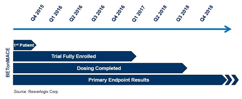
As a reminder, the primary outcome measure of the trial will assess the effect of apabetalone on time to first occurrence of Major Adverse Cardiovascular Events (MACE) in high-risk type 2 DM patients with CAD. In the primary outcome measure, MACE is narrowly defined as a single composite endpoint of cardiovascular death, or non-fatal myocardial infarction (MI), or stroke. All subjects will remain on a high-dose statin therapy (atorvastatin or rosuvastatin), with the experimental group receiving 200 mg/day of apabetalone in the form of 100 mg capsules twice daily. We believe that the company will perform an interim futility analysis, which will look at the chance of a positive result if existing trends for MACE continue, and will be formed when 50% of events are admitted in addition to an ongoing safety analysis by the Data Safety Monitoring Board (DSMB). We expect the trial to take about 3 years to complete. This puts the topline data in 2018, with the goal to file a new drug application (NDA) during the end of 2018 or early part of 2019. We believe the program will cost in the area of $30 million, but note that exact costs will depend on how many patients are ultimately enrolled since the trial is currently setup to be adaptive.
In other company news, on September 25, 2015, Resverlogix provided a Research and Development Update on apabetalone in New York City. The presentation included analyses of diabetes and chronic kidney disease (CKD) as they relate to cardiovascular disease by BETonMACE clinical steering members. We also learned more about some recent findings from ongoing mechanistic studies focused on cardiovascular risk pathways and apabetalone’s potential in reducing MACE, and have reviewed apabetalone and details from the event in our prior research report update.
Conclusion & Valuation Methodology
We would like to remind investors that Resverlogix’s lead product candidate, apabetalone (RVX-208), is the first selective BET bromodomain inhibitor in clinical trials for high-risk vascular disease. Apabetalone is targeting a very specific patient population with low HDL, type diabetes mellitus and chronic kidney disease with a high cardiovascular risk for increased MACE. Things are moving along with patient recruitment and trial site activation in Phase 3 BETonMACE.
According to internal analysis conducted by Resverlogix, there is a minimum high-risk market for apabetalone of 18.8 million patients in the top 7 global markets. We have adjusted our model to reflect apabetalone entering Phase 3 BETonMACE, and the first patient being dosed in the trial in November 2015. Management gave us some pretty good initial inputs for our valuation model and we have slightly ticked these up to 23% probability for high-risk CVD and 16% for diabetes mellitus, and 12% probability for chronic kidney disease for the U.S. We believe these are relatively conservative figures for projecting U.S. revenues, however, we have increased the probabilities for revenues outside of the U.S. to 40% for high-risk CVD and diabetes mellitus and 20% for chronic kidney disease, given the recent news that trial sites were initiated in Europe, and that the first patient should be dosed by year end. Management believes that the product will likely launch in 2021, with sales ramping up over the next several years. We are assuming peak sales in 2027. Management also gave us a 24% discount rate assumption, which we believe is a fair and conservative estimate.
We are modeling peak sales of $6.3 billion or approximately $5.7 billion, net of royalties. We have assumed gross sales of $1.5 billion from high-risk cardiovascular disease, $2.7 billion in diabetes mellitus, and $2.1 billion in chronic kidney disease. We also compared our projected peak sales figures to the existing market for at risk CVD patients, including approved drugs like Lipitor® ($13.7 billion peak in 2006), Crestor® ($6.6 billion peak in 2011, $5.5 billion in 2014), Lovaza® ($1.1 billion peak in 2013). We are also using several peak sales estimates we found for recently approved drugs such as Amgen’s and Regeneron/Sanofi’s PCSK9 inhibitors, evolocumab and alirocumab, respectively. We are also including CETP inhibitors, such as Merck’s Phase 3 candidate anacetrapib, on the list of comparable drugs to help us understand the peak sales potential for apabetalone. Wall Street consensus estimates, as well as independent analyst estimates from websites such as TheStreet.com, FierceBiotech, Benzinga, and Seeking-Alpha, for these drugs range between $3 billion to $10 billion. We believe apabetalone, although flying significantly below the radar of these other drugs, has similar peak sales potential, if Phase 3 BETonMACE data are positive.
We believe that strong patent position and pharmacoeconomics of apabetalone, combined with a management skill set surrounding CVD and diabetes and a novel approach to addressing the residual risk in high need CVD patients, allows for Resverlogix to be in an interesting position. The company secured access to approximately $37 million USD in new capital through licensing and stock purchase agreements with Hepalink and Eastern Capital, which we believe should fully fund the Phase 3 BETonMACE program. On the other hand, we still believe that there are certain challenges that Resverlogix will continue to face such as proving the long-term hepatic safety of apabetalone use, and significant operating losses that are building up year after year. Additionally, we are still not sure what type of cardiovascular clinical trials the FDA and EMA will require of apabetalone, and we are still uncertain regarding the outcome of Phase 3 BETonMACE.
We do want to point out that data from this trial will not likely be available until mid to late-2018, but we hope to see some data from the interim futility analysis which will look at the chance of a positive result if existing trends for MACE continue, and will be formed when 50% of events are admitted. The recently announced complement-mediated orphan disease program could also provide further upside to our valuation, however at this time it is too early to include in our model. Additionally, the proposed multimodal mechanism of action of Resverlogix that we have discussed in previous reports leads us to believe that Resverlogix may consider evaluating apabetalone as it relates to other conditions in more depth, such as real disease, which would also provide additional upside to our valuation. Currently, we believe the company is undervalued. We are re-iterating our ‘Buy’ rating and raising our price target to $4.00 per share given the potential upside to the Resverlogix story.
READ THE LATEST FULL RESEARCH REPORT HERE
SUBSCRIBE TO ZACKS SMALL CAP RESEARCH to receive our articles and reports emailed directly to you each morning. Please visit our website for additional information on Zacks SCR and to view our disclaimer.