By
John Vandermosten, CFA
TSX:RVX.V
Resverlogix Hosts KOLs for Presentations on Diabetes, CKD and Apabetalone Trials
On October 13, 2016 Resverlogix Corp. (TSX:RVX.TO)
held a research and development update for shareholders, investors and analysts in New York City. Several key opinion leaders (
KOLs) and Resverlogix management team members spoke at the event providing an update on the latest thoughts on diabetes, chronic kidney disease (
CKD) and how these co-morbidities impact cardiovascular disease. The discussion and focused on the company’s trials and progress for Resverlogix’s lead compound, apabetalone.
Several speakers headlined the event, including:
- Professor Kausik Ray, Imperial College of London
- Dr. Ewelina Kulikowski, SVP, R&D, Resverlogix
- Dr. Michael Sweeney, SVP, Clinical Development, Resverlogix
- Dr. Kamyar Kalantar-Zadeh, Irvine School of Medicine, UC
- Don McCaffrey, President & CEO, Resverlogix
Following an introduction by CEO Don McCaffrey, Professor Ray kicked off the presentation with a discussion on his research in diabetes. Prevalence of diabetes is increasing in the world and there is a vast trove of research showing a correlation among diabetes, vascular events and fatal cardiac events. Diabetes has become more common at younger and younger ages, and Professor Kausik cited research that shows the earlier the onset of diabetes, the greater number of life years lost. If the onset of diabetes is in a person’s 40s, then they can lose six or seven years of life compared to those without diabetes. If an individual has had myocardial infarction (MI) or stroke and has diabetes, this can reduce the number an individual’s life span by over 15 years for individuals in their 40s.
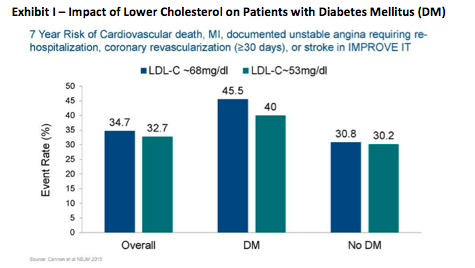
Professor Ray discussed the impact of cholesterol on individuals with diabetes and cited research that showed in excess of a five percentage point (45.5 – 40) improvement in event rate for diabetics if cholesterol was lowered.
He also highlighted blood characteristics when the body is suffering from inflammation. Prior to a heart attack, there is an increase in inflammatory activity. This inflammatory activity is associated with greater counts of adhesion molecules, which are linearly associated with an increase in cardiovascular events. Further, high glucose levels appear to exacerbate inflammation and reduce levels of good (HDL) cholesterol. Therefore, patients with acute coronary syndrome, diabetes mellitus and low HDL are at a higher risk of further coronary events.
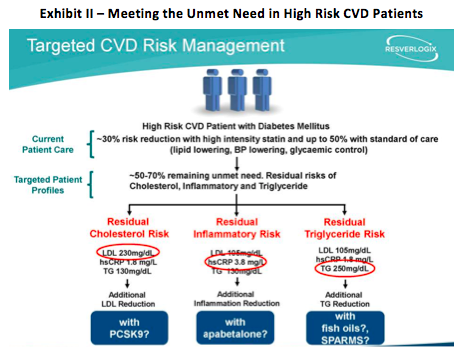
The current therapy for risk management for these factors is to prescribe a statin, blood pressure medication and glycemic control, which lowers the risk for a high risk individual by about 30%. However, for patients with high risks in cholesterol, inflammation, or triglycerides, additional therapy may be helpful. For inflammation in particular, Professor Ray concluded that apabetalone might be a potential candidate for reduction and inflammation.
Dr. Kulikowski was the next presenter, and provided background to epigenetics similar to what we have provided in our initiation on Reserverlogix. She reminded the audience that Resverlogix had found in their Phase II studies a substantial amount of evidence of apabetalone’s favorable impact on major cardiac events in high risk populations with diabetes and CKD.
Apabetalone affects many gene sets that reduce inflammation. In reviewing Resverlogix Phase 2 data from the three previous studies the company has conducted, statistical evidence indicated that apabetalone downregulated many pro-atherogenic gene sets and upregulated many anti-atherogenic gene sets. Cells were examined and dosed with apabetalone, where a dose dependent response was observed in several inflammatory mediators.
Dr. Kulikowski also reviewed the impact of apabetalone on the body’s acute phase response. Normally, when the liver detects a pathogen, it will signal the release of cytokines, resulting in inflammation. In the presence of apabetalone, several important inflammatory cytokines, including C-reactive protein (CRP), are substantially downregulated by apabetalone.
Dr. Kulikowski highlighted the importance of reducing inflammation, building on the presentation given by Professor Ray, and she pointed to evidence that apabetalone may be effective in this context. Dr. Kulikowski concluded her remarks by reminding the audience that apabetalone has an impact on multiple pathways and has multiple effects on cardiovascular disease which Resverlogix believes has an impact on major adverse cardiovascular events (MACE).
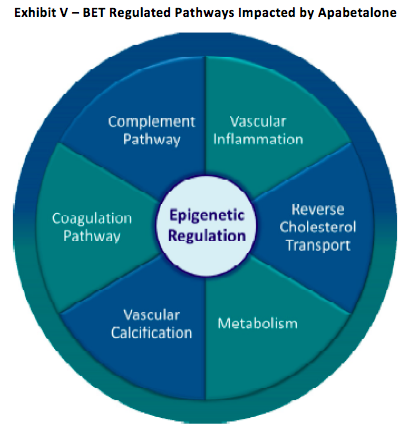
Dr. Sweeney reviewed Resverlogix’s Phase 2 trials and also updated the audience on the current status of the BETonMACE trial. He noted that apabetalone was shown in Phase 2 trials to reduce levels of vascular inflammation proteins, complement and coagulation in CVD patients, and has a good safety profile. In the BETonMACE trial, currently about 1/3 of patients have been enrolled and the study is targeting 125 events to drive the data analysis. Dr. Sweeney reviewed all of the detail of the trial, which we include in our initiation report. We expect to see the results of the trial in 2018.
Dr. Kalantar-Zadeh is a nephrologist and discussed chronic kidney disease (CKD) highlighting two important factors of CKD, namely that it is a progressive disease once it starts and that there is no cure. Nearly 30 million people have CKD in the United States with a cost of $83 billion in 2007.
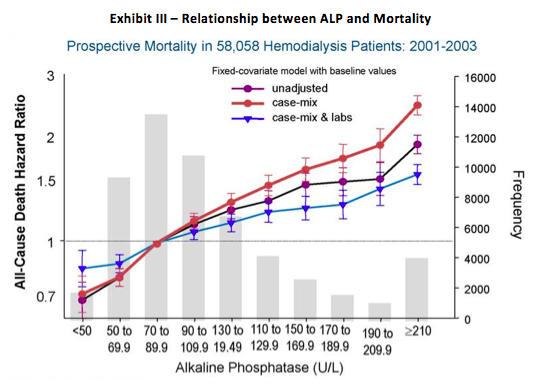
Dr. Kalantar also discussed the importance of alkaline phosphatase (ALP) as a biomarker. He elaborated on the link between ALP and increased mortality for individuals in the general population and with high risk conditions such as CKD and patients who have had MI.
We saw a summary of data from one of Dr. Kalantar’s studies that shows a linear relationship between ALP and mortality. The relationship indicated a higher prevalence of MI, stroke, congestive heart failure and diabetes with higher levels of ALP. High levels of ALP also lead to vascular calcification through the mechanism of ALP inhibiting pyrophosphate. Pyrophosphate is a potent inhibitor of medial vascular calcification, and in its absence, vascular calcification is promoted.
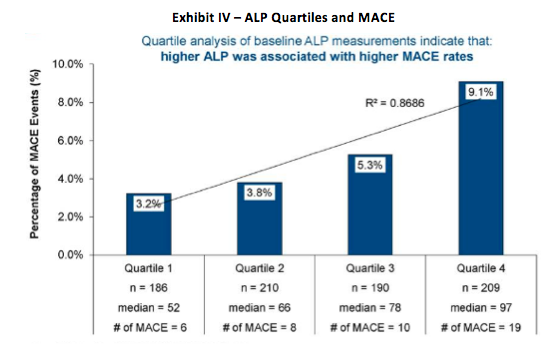
The presentation next examined the relationship between ALP and MACE, breaking down ALP levels into quartiles. As we move from the lowest quartile to the highest, we see a 6 percentage point increase in the number of MACE events. This implies that lowering ALP will play a role in reducing MACE. Citing evidence provided from Resverlogix SUSTAIN and ASSURE trials, Dr. Kalantar showed that apabetalone reduces ALP, which in turn suggests that apabetalone may be a valuable therapy in the efforts to reduce high risk CVD.
Don McCaffrey wrapped up the KOL presentation with a summary of the afternoon’s presentations, stressing the importance of emphasizing pharmacoeconomics when both designing trials and selecting pricing for a medicine. Don reminded the audience that based on preliminary evidence, apabetalone has a very attractive number needed to treat (NNT) of 22 compared to other approved compounds that range from 60 to 250. Due to this high level of efficacy and pricing, the drug also has a very favorable incremental cost-effectiveness ratio (ICER) score from $50 to $100 thousand to prevent one event This compares to other therapies that range in the millions of dollars to prevent an event.
Don also listed several new compounds that Resverlogix is developing, with research emphasizing the complement system, calciphylaxis, autoimmune disease, muscular dystrophy and pulmonary indications. The pipeline is also highlighting several Phase 2 and orphan indications that include dialysis, renal, PNH and Fabry’s Disease.
We found the R&D update and KOL presentation very helpful in providing further understanding to the investment community of the opportunity for apabetalone and the company’s epigenetic pipeline. Resverlogix has identified six different pathways where apabetalone has shown promise in improving MACE. The drug has also been shown to be more effective in high-risk populations where co-morbidities of diabetes and CKD exist. With a summary of studies that show a positive relationship between the impacts of apabetalone and many of the risk factors and markers associated with MACE, there is a wealth of preliminary evidence that is supportive of safety and efficacy for the drug as it progresses through Phase 3 trials and ultimately review by regulatory authorities.
SUBSCRIBE TO ZACKS SMALL CAP RESEARCH to receive our articles and reports emailed directly to you each morning. Please visit our website for additional information on Zacks SCR and to view our disclaimer.